


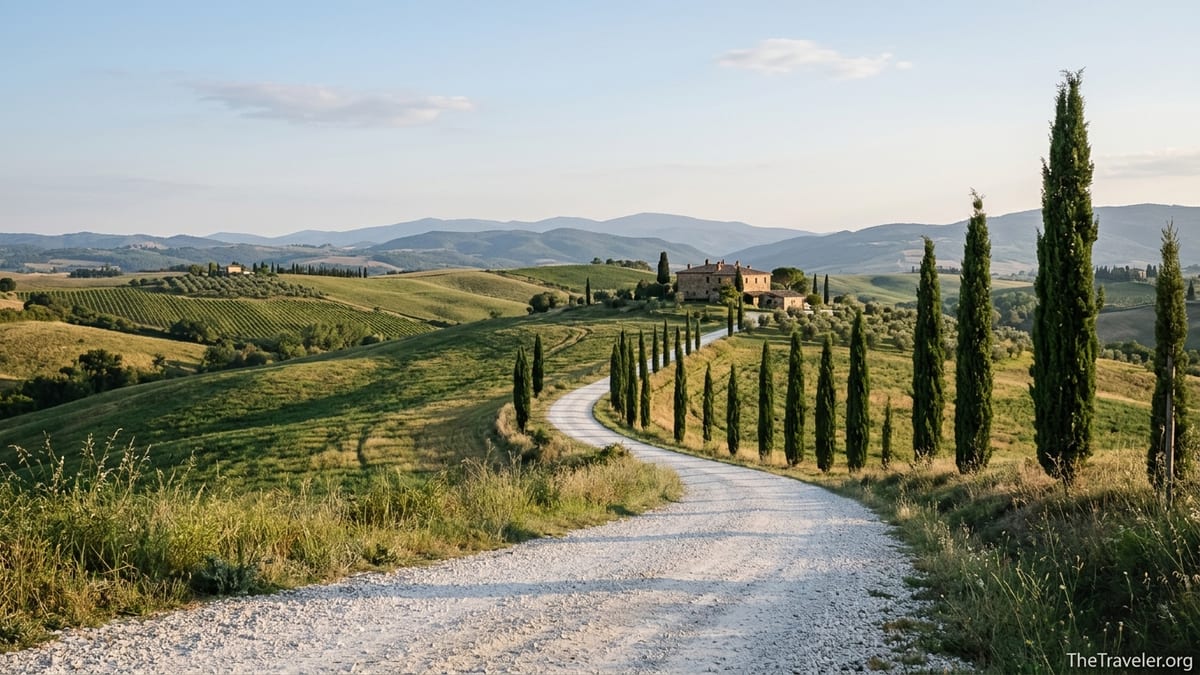
The fantasy of Tuscany is usually a single image: a pale gravel road rolling over soft hills, lined with cypress trees and stone farmhouses glowing in late-afternoon light. The reality on the ground is that without a bit of planning, it is surprisingly easy to miss those cinematic views and spend your precious days in tunnels, on busy highways, or circling for parking. This guide explains how to actually experience Tuscany’s most beautiful landscapes, with concrete routes, realistic timings, and specific stops so you make the most of every curve in the road.
Get the latest updates straight to your inbox!
Understanding the Tuscan Landscape Before You Plan
Tuscany is not one single postcard view but a patchwork of distinct landscape zones, each with its own character. The Chianti hills between Florence and Siena are green and wooded, with terraced vineyards and stone villages. South of Siena, the Crete Senesi open into clay ridges and lunar fields, while the Val d’Orcia glides into perfectly rounded hills topped with cypresses and farmhouses. Where you choose to drive or ride matters more than simply “going into the countryside.”
Most first-time visitors underestimate driving times and assume that they will “see the countryside” on the way from one big city to another. In practice, many major roads in Tuscany are fast but unremarkable, running in valleys or between sound barriers. If you simply let a navigation app choose the “fastest” route from Florence to Siena or from Siena to Montepulciano, you may arrive quickly but you will have skimmed past the landscapes you came to see. The key is to identify a few scenic corridors and plan your days around them, instead of treating them as incidental transfers.
Three areas in particular reward deliberate route planning: the Chiantigiana road (SR222) through Chianti, the clay hills of the Crete Senesi south of Siena, and the ridgeline roads and cypress-lined lanes of the Val d’Orcia, including the SP146 between Pienza and Montepulciano and the approach roads to La Foce and Monticchiello. These are the stretches where guidebooks and photographers return again and again.
Once you know that these corridors exist, it becomes easier to reverse-engineer your itinerary. Instead of asking “Can we squeeze in a quick drive through the countryside on the way from Florence to Rome?” you can ask a better question: “How do we structure a full day around the SR222 and an evening in Siena?” or “If we only have one countryside day, should we prioritize Val d’Orcia’s ridgeline views over longer distances?”
Choosing the Right Base to Maximize Scenic Time
Your base dictates how much of your day is spent in view-rich landscapes rather than on functional highways. For a first trip focused on iconic Tuscan views, three bases work particularly well: somewhere on the Chiantigiana between Florence and Siena, a farmhouse near Pienza or San Quirico d’Orcia in the Val d’Orcia, or a village on the edge of the Crete Senesi such as Asciano.
Staying along the Chiantigiana (SR222) gives you instant access to wave after wave of vineyard views. Towns like Greve in Chianti, Panzano in Chianti, Castellina in Chianti, and Radda in Chianti sit right on or just off this historic wine road, which runs roughly 80 kilometers between Florence and Siena through an almost unbroken ribbon of vines, olive groves, and cypress alleys. Many agriturismi advertise themselves as “5 minutes from SR222,” which in practice means you can roll out of the parking lot and be among classic wine-country scenery before your coffee cools.
For those who dream specifically of the soft, golden hills seen on countless calendars, the Val d’Orcia is the better base. Pienza, San Quirico d’Orcia, Monticchiello, and Bagno Vignoni all sit near roads that traverse the valleys from above rather than through them. A farmhouse between Pienza and San Quirico, for instance, allows you to hop on the SP146 and be among rolling wheat fields and lone cypress trees within minutes, rather than driving an hour just to reach the area.
If you want something a little rawer and less photographed, consider the Crete Senesi immediately south of Siena. Bases near Asciano or Arbia place you on or near roads like the SP438, which cross gray clay ridges and eroded gullies. The scenery is broader and more austere than in Chianti, with far fewer tour buses and a real sense of wide, open land. From here you can still make easy day trips into Siena and the Val d’Orcia while spending sunrise and sunset among the clay hills.
Driving the Chiantigiana: Florence to Siena the Scenic Way
The classic way to turn a simple transfer between Florence and Siena into a day of landscape immersion is to choose the Chiantigiana, known officially as the SR222. Instead of taking the faster Florence–Siena highway, you follow this twisting two-lane road for about 80 kilometers as it threads the heart of Chianti Classico wine country. It is a favorite with both drivers and motorcyclists because every few minutes the road opens onto another panorama of terraces, castles, and patchwork fields.
A realistic day might begin by picking up a rental car near Florence’s main station around 9:00 in the morning, then following signs out of the city toward Greve in Chianti. The stretch between Impruneta and Greve already feels rural, with forested hills giving way to their first vineyards. Greve itself makes a natural first stop: you can park near the main piazza, stroll under porticoes full of wine shops and delicatessens, and pick up picnic provisions. From there, continuing south, the road climbs toward Panzano, where a stop for an early lunch in the village center offers big-sky views over the vineyards on both sides of the valley.
After Panzano, the road to Castellina in Chianti becomes one of the most scenic segments. Here the vineyards sit in long ribbons along the slopes, separated by stands of oak and slender cypresses. Short, signed detours lead to wineries with marked tasting rooms and gravel drives. Many estates offer fixed-price tastings or light lunches that last 90 minutes to two hours, so it is wise to choose just one such stop if you want to reach Siena by late afternoon. Continuing south, the SR222 eventually approaches the Siena area, where you can either divert into town for an evening on the Piazza del Campo or curve eastward through the countryside if you prefer more rural light at sunset.
To really experience the Chiantigiana, it is important to accept that this is not a highway. Speed limits drop frequently near villages, local drivers know every curve, and parking at popular viewpoints is limited. Rather than trying to stop wherever a view appears, it is safer to target villages, wineries, and established lay-bys. The reward for this slower approach is that even when you are not stopping, you are still traveling through scenery, with each bend revealing a new composition of terraces, stone farmhouses, and cypress-topped ridges.
From Siena to the Crete Senesi and Val d’Orcia
South of Siena the landscape begins to shift from wooded hills to a more open, sculpted terrain. The Crete Senesi, an area of eroded clay hills and bare ridges immediately below the city, provides a dramatic transition from Chianti’s vineyards to the iconic curves of the Val d’Orcia further south. A popular route runs from Siena toward Asciano along a provincial road that climbs and drops across clay waves, offering long, uninterrupted views of farmhouses perched on solitary knolls.
From Asciano you can push further south or southeast toward the Val d’Orcia. Many travelers like to combine these zones in a single, long loop: Siena to Asciano for the clay ridges, then onward across backroads to rejoin larger roads near San Quirico d’Orcia or Pienza. By midafternoon, you may find yourself on the SP146, the scenic road that links Pienza with Montepulciano and delivers some of the most recognizable rolling-hill views anywhere in Italy. Here the landscape softens again, with wheat fields, hay bales in season, and cypress-lined farm drives cutting diagonally across slopes.
For a dedicated Val d’Orcia day, many visitors base themselves near Pienza and plan a roughly triangular route: Pienza to San Quirico, down toward Bagno Vignoni for hot springs and lunch, then across to Monticchiello before looping back to Pienza. Between these villages, numerous side roads peel off toward farmhouses or tiny hamlets, sometimes gravel, sometimes narrow tarmac. Some of the most photographed cypress avenues and lone farmhouses sit on such side roads, often clearly visible from the main road even if the drive itself is private. Respecting private property while enjoying the view from roadside pull-outs is essential to keeping these landscapes accessible.
If you are traveling in high season, it is worth starting very early or planning to be on the smaller roads late in the day. Around midday, the light can be flat and the roads busier with tour vans. Early morning or late afternoon, on the other hand, the clay and wheat fields pick up soft shadows that emphasize their contours, and you are more likely to have entire viewpoints to yourself.
Experiencing the Landscape Beyond the Car
Although driving opens up large swathes of Tuscany in a short time, some of the most memorable encounters with the landscape happen when you leave the vehicle altogether. Short walks, winery visits, and cycling segments allow you to slow down enough to notice small details: the texture of gravel underfoot, the smell of wild herbs on a farm track, the way cypress trunks catch side light in late afternoon.
In the Montepulciano area, for instance, the Nobile Trail is a signed path of roughly 18 kilometers that connects the hilltop town with the reclaimed plains below, crossing vineyards that produce Vino Nobile di Montepulciano. Even if you only walk a portion of this trail, starting from near the Church of Saint Agnes, you move through rows of vines and olive trees that you would otherwise only glimpse from a passing car. Time estimates for the full route on foot run to several hours, so many visitors choose to walk an hour or so down among the vineyards, then turn back before the steeper climbs.
In Chianti, combining a short walk or bike ride with a segment of the SR222 can turn a day of driving into a more varied experience. Some villages and wineries rent e-bikes by the half day, allowing you to pedal gently along backroads through vineyards while keeping hills manageable. You might, for example, leave your car in Greve, rent e-bikes to explore surrounding vineyard tracks for two or three hours, then reclaim the car in late afternoon for the final scenic stretch toward your lodging.
Even simple vineyard or olive-grove tours can deepen your sense of place. In many parts of Chianti and the Val d’Orcia, visits are structured around a guided walk through the vines or the cellar followed by a seated tasting. While the wine is often the headline, it is the short stroll up a gravel drive or the few minutes standing quietly between rows of vines that fixed the landscape in many travelers’ memories. Building one such stop into each countryside day ensures you are not just looking through glass but actually feeling the terrain under your shoes.
Practical Strategies So You Do Not Miss the Best Views
The most common reason travelers miss Tuscany’s trademark landscapes is not lack of time but overreliance on default navigation and overstuffed itineraries. A few simple, practical choices can make the difference between a day of forgettable driving and a day filled with postcard moments.
First, decide in advance which parts of each transfer will be “functional” and which will be “scenic.” For example, if you are traveling from Florence to a farmhouse near Pienza in a single day, you might choose to use the faster Florence–Siena highway only as far as the outskirts of Siena, then deliberately switch to smaller roads that cross the Crete Senesi and Val d’Orcia for the rest of the journey. Make a note of where you want to leave the main road, then adjust your navigation app to favor those intermediate villages rather than simply entering your final destination and following the suggested fastest route.
Second, build in buffer time so you are free to stop when a particularly beautiful view appears. On the Chiantigiana, for instance, a direct drive from Florence to Siena might take about two hours of continuous driving, but many visitors are happier spreading that over a full day with two or three substantial stops. That means starting no later than midmorning, planning a leisurely lunch in a village or winery, and expecting to roll into Siena closer to sunset than midafternoon.
Third, pay attention to the time of day and direction of travel. In summer, driving south through the Val d’Orcia in the late afternoon often puts the sun behind you, lighting up the hills ahead rather than glaring directly into your eyes. On overcast days, the softer light can actually make photographing the curves and textures easier by avoiding harsh contrast. Checking sunrise and sunset times shortly before your trip and roughly aligning your most scenic stretches with the hours when the sun is lower can significantly change the feel of the landscape in your photos and in your memory.
Finally, think about who is in the car. If everyone wants to look at the view, plan for occasional short walks from villages or roadside parking rather than attempting to photograph out the window at speed. In areas like the SR2 near the Val d’Orcia cypress viewpoints, there are designated parking areas with short, signed footpaths up to hilltops. Spending ten minutes here yields better views, and a safer experience, than any amount of leaning out of windows on curves.
The Takeaway
Experiencing Tuscany’s landscapes at their best is less about chasing secret spots and more about making deliberate choices: choosing scenic corridors like the SR222, the Crete Senesi roads, and the SP146, basing yourself in or near the countryside rather than commuting in from cities every day, and slowing down enough to notice what you are passing. The postcard images you have seen for years are, in most cases, taken from public roads and short walking paths that anyone can access with basic planning.
If you approach each day with one or two core scenic routes in mind, accept slower travel in exchange for richer views, and leave room for at least a short walk or vineyard visit away from the car, you will find that the Tuscan landscape reveals itself generously. Instead of looking back on your trip remembering tunnels and city traffic, you will recall specific curves in the road, the tilt of evening light on a particular farmhouse, and the scent of sun-warmed vines when you stepped out to look back at the hills. Those are the moments that make Tuscany feel exactly as beautiful as it does in your imagination.
FAQ
Q1. Do I need a car to experience Tuscany’s most scenic routes?
While you can see some countryside from buses or organized tours, having your own car gives you far more flexibility to follow roads like the SR222 and SP146, stop at viewpoints, and adjust your plans to the light and weather. Without a car, you will likely need to rely on day tours that include specific scenic stretches.
Q2. Is it difficult to drive the Chiantigiana (SR222) for a first-time visitor?
The SR222 is a paved, well-maintained two-lane road, but it is narrow and winding, with frequent curves and local traffic. Confident drivers who are comfortable with rural roads generally find it enjoyable, but nervous drivers may prefer to avoid peak hours, drive in daylight only, and allow extra time for frequent stops.
Q3. How many days should I spend in the Tuscan countryside to see the main landscapes?
With two full days you can sample both Chianti and either the Crete Senesi or Val d’Orcia. Three to four days allows a more relaxed pace, with time for walks, winery visits, and sunrise or sunset drives along your favorite routes.
Q4. Can I visit Chianti and Val d’Orcia as day trips from Florence?
You can reasonably visit Chianti as a day trip from Florence because the SR222 begins close to the city. Reaching the Val d’Orcia from Florence in a single day is possible but requires a long round trip, so most travelers prefer at least one night based closer to Pienza or Montepulciano to fully enjoy the scenery.
Q5. What is the best season for scenic drives in Tuscany?
Late spring and early autumn often combine pleasant temperatures with rich colors in the fields. Summer offers long days and golden light but can be hot and busier on the roads, while winter light can be beautiful on clear days but some rural services may be limited.
Q6. Are there tolls on the most scenic roads?
The classic scenic roads described here, such as the SR222 in Chianti, the provincial roads through the Crete Senesi, and the SP146 between Pienza and Montepulciano, are not toll roads. Tolls apply mainly on major autostrade and some faster highways that you might use for functional transfers.
Q7. Is it safe to stop for photos along Tuscan country roads?
It is safe if you use designated parking areas, village car parks, or clearly visible lay-bys off the roadway, and then walk back to viewpoints. Stopping on blind curves or narrow shoulders is dangerous and discouraged, especially on popular scenic routes frequented by local traffic and cyclists.
Q8. Can I explore these landscapes by bicycle instead of by car?
Yes, many visitors explore sections of Chianti and the Val d’Orcia by road bike or e-bike. However, the terrain is hilly and summer heat can be intense, so e-bikes, early starts, and careful route planning are recommended, especially for those not used to climbing.
Q9. Are navigation apps reliable on rural Tuscan roads?
Navigation apps are generally reliable for main and provincial roads, but they often default to the fastest route rather than the most scenic. Before departing, it is wise to manually set intermediate destinations such as Greve, Panzano, Asciano, Pienza, or San Quirico d’Orcia to ensure the app follows the scenic corridors you want.
Q10. Do I need to book winery visits along these routes in advance?
In high season many wineries along popular scenic routes require or strongly recommend advance reservations for tastings and lunches, especially at midday. Outside peak months, some tasting rooms accept walk-ins, but booking ahead ensures you can combine your preferred scenic drive with a relaxed, well-timed stop.