


Perched above the Aniene Valley just outside Rome, Tivoli rewards visitors with not one but two UNESCO World Heritage Sites: the theatrical Renaissance water gardens of Villa d’Este and the sprawling ruins of Hadrian’s Villa, or Villa Adriana. Both are remarkable, both are easy day trips from Rome, and both leave powerful impressions for very different reasons. If you only have one day, or even just a few hours, which Tivoli landmark is likely to stay with you long after you have flown home?
Get the latest updates straight to your inbox!
First Impressions: Gardens vs Empire
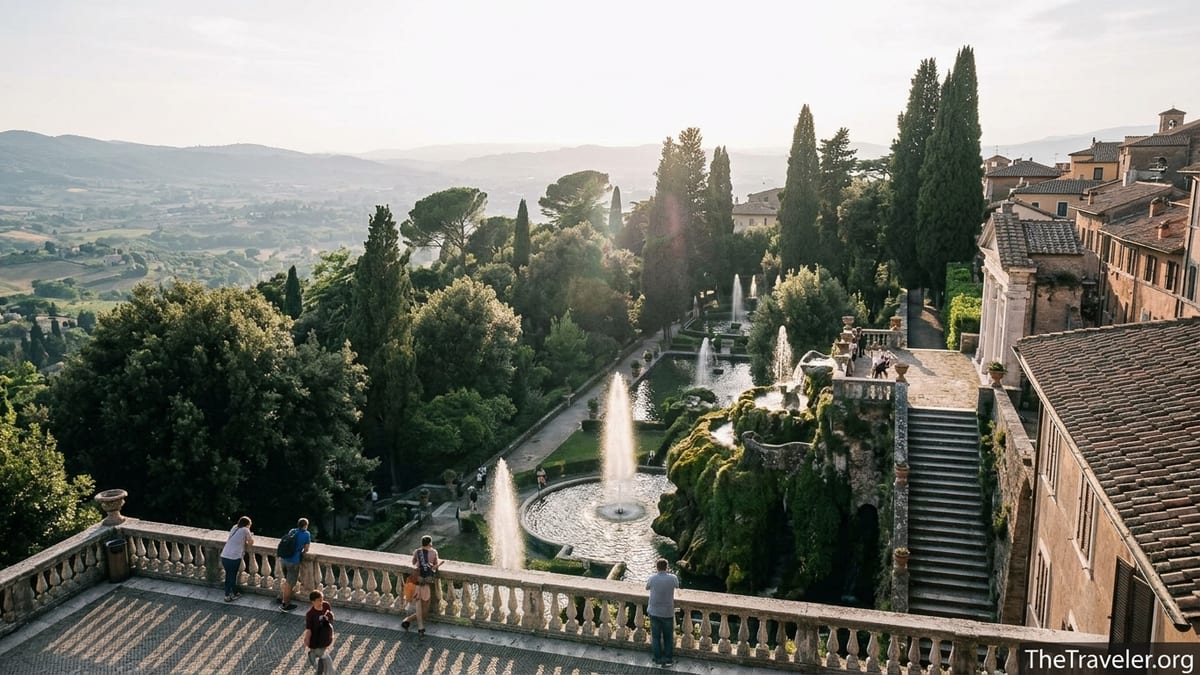
Your first encounter with each site could not feel more different. Villa d’Este announces itself in stages: you enter through a modest 16th century palace in the heart of Tivoli’s old town, then step out onto a terrace and suddenly the world drops away into terraces of cypress trees, stone balustrades and the shimmer of hundreds of fountains. The town’s church bells echo behind you while the sound of water rises from below. It feels theatrical and intimate at the same time, like walking onto the set of an opera just as the curtain lifts.
Hadrian’s Villa, by contrast, lies on the plain outside Tivoli, away from the medieval streets. When you arrive, usually after a short bus or taxi ride from town, the first impression is space. Low olive trees, fragments of walls, brick arches and distant hills frame what was once a vast imperial retreat built by Emperor Hadrian in the 2nd century. Instead of a single dramatic reveal, the site opens gradually as you follow dusty paths past baths, libraries, and long-buried halls. The emotion is less “wow” and more “this was an entire world of its own.”
Travelers who crave instant visual drama and lush scenery usually feel an immediate pull to Villa d’Este, especially when they step into the Avenue of the Hundred Fountains or see the towering Neptune Fountain. Visitors who are moved by ruins, big landscapes and the feeling of walking in the footsteps of emperors often find that Hadrian’s Villa quietly burrows deeper into memory as the day goes on.
For many, the decision about which leaves a bigger impression starts right here: spectacle and sensory overload at Villa d’Este, or slow-burn archaeological immersion at Villa Adriana.
History & Atmosphere: Renaissance Fantasy vs Imperial Dream
Understanding the stories behind each site helps explain why they feel so different. Villa d’Este was created in the mid-1500s for Cardinal Ippolito d’Este, a powerful Renaissance figure who transformed the hillside of Tivoli into an elaborate statement of status and taste. The villa and its gardens reflect the culture of their time: mythological statues, allegorical fountains and carefully orchestrated views designed to impress visiting dignitaries. Knowing this, the theatricality of the garden makes sense. You are walking through a carefully curated fantasy of power and pleasure.
Hadrian’s Villa is older by more than a millennium. Begun around 120 AD, it was the retreat of one of Rome’s most traveled emperors. Ancient sources and modern archaeology suggest that Hadrian tried to recreate his favorite places from across the empire in Tivoli, building versions of Egyptian sanctuaries, Greek gymnasia and shimmering pools. Standing by the Canopus, a long reflecting pool lined with columns and statues modeled on a canal in Egypt, you can imagine the emperor drifting here on a barge, far from the pressure of Rome. The site feels like a three-dimensional diary of his journeys and obsessions.
This difference in origin creates very different atmospheres on the ground. At Villa d’Este, the narrative is about artistic triumph, technological ingenuity and the Renaissance love affair with water. Interpretive panels often highlight how the gravity-fed hydraulic system still powers fountains without pumps. At Hadrian’s Villa, the narrative is about scale and complexity: archaeologists continue to piece together how the palace, baths, libraries and service quarters functioned as a miniature city. Many modern visitors describe the experience as “haunting,” especially if they wander into quieter zones in late afternoon when tour groups have thinned out.
If you are fascinated by art history and the Renaissance, Villa d’Este’s frescoed ceilings and carefully framed garden vistas may resonate more. If you are drawn to ancient history and archaeology, the broken columns and vast baths of Hadrian’s Villa carry a different emotional weight, even if you need more imagination to see them as they once were.
Visual Impact: Fountains, Ruins and the “Wow” Factor
On a purely visual level, Villa d’Este tends to deliver the larger immediate impact. Its statistics alone hint at why. Modern visitor guides commonly note that the garden holds hundreds of water features, from tiny spouts to monumental cascades, all fed by a gravity system that diverts water from the Aniene River. When you walk the Avenue of the Hundred Fountains, water runs from carved masks and bas-reliefs into long stone basins, and every few meters you turn to discover another viewpoint across the valley. On bright days, rainbow mist hangs in front of the Neptune Fountain, making it one of the most photographed spots near Rome.
By contrast, Hadrian’s Villa is a landscape of textures: brick, stone, rough grass and still pools. The Canopus, with its line of caryatid statues reflected in green water, is probably the site’s most visually striking single scene. Elsewhere, the beauty lies more in geometry and scale. The vaulted ceilings of the so-called Maritime Theatre, a circular island villa within a moat, hint at imperial luxury, while the Grand and Small Baths showcase complex brick domes and mosaics. You will not find lush flowerbeds here; instead you photograph arches, shadows and the play of light on ancient walls.
For many contemporary travelers, especially those influenced by social media, Villa d’Este’s fountains and manicured terraces feel more “Instagram-ready.” You see couples posing under stone balustrades, brides taking wedding portraits at golden hour, and amateur photographers lining up tripods for long exposures of waterfalls. At Hadrian’s Villa you are more likely to see small groups scattered far apart, each absorbed in their own exploration. The best photos here often focus on atmosphere: a lone column against a stormy sky, or evening sun catching the curve of a ruined wall.
If your idea of a memorable site is one jaw-dropping composition after another, Villa d’Este usually comes out ahead. If you are drawn to quieter, more meditative scenes and the abstract beauty of ruins, Hadrian’s Villa leaves its mark in a subtler way.
Practicalities: Time, Tickets and Getting Around
From central Rome, Tivoli is an easy day trip of roughly an hour by public transport in normal traffic, either by regional train to Tivoli town or by blue Cotral bus along Via Tiburtina. Many visitors staying near Termini or along Metro Line B take the metro to Ponte Mammolo and transfer to a Cotral bus bound for Tivoli, a route commonly recommended by locals because buses are frequent and inexpensive compared with regional trains. A one-way bus ticket typically costs only a few euros, while regional train fares from Roma Tiburtina to Tivoli are also modest but may involve longer walks on arrival.
Once in Tivoli, Villa d’Este is walkable from the historic center. You emerge from the bus or taxi onto streets lined with cafes and gelaterie, and within a few minutes you are at the entrance in Piazza Trento. Hadrian’s Villa is more complicated: it sits a few kilometers outside town, so you either catch a local bus, take a short taxi ride, or walk 20 to 30 minutes along suburban roads. Independent travelers often report allowing at least 1.5 hours each way from Rome to account for waiting times and connections, especially if relying on local buses rather than organized tours.
Ticket prices can change with seasonal exhibitions and national museum policies, but as of 2026 you can expect to pay roughly a mid-teens euro fee per adult for each villa, with reduced tariffs for EU residents under 26 and free or discounted entry for children and certain categories. Combined tickets that cover Villa d’Este, Hadrian’s Villa and sometimes the nearby Sanctuary of Hercules Victor are periodically available, offering good value if you plan to see more than one site in the same day. Many travelers now buy timed-entry tickets online through the state-approved ticketing platform in advance, especially in high season, to avoid queuing at peak hours.
In terms of time on site, Villa d’Este can be “seen” in around two hours, but garden lovers and photographers easily linger half a day. Hadrian’s Villa benefits from more time because of its size; the site can feel rushed in under two hours and is best appreciated with at least three, especially if you want to explore beyond the most famous pools and baths. If you are considering both in a single day by public transport, be realistic: between transfers, walking and time for lunch, many visitors find that 6 to 8 hours in total is comfortable but full.
Experiences on the Ground: Crowds, Seasons and Sensory Details
Crowd levels strongly influence which landmark feels more impressive. Villa d’Este, compact and centrally located, can feel busy, especially on weekends and during spring and early autumn when Rome receives many international visitors. The narrow garden paths sometimes funnel groups into bottlenecks near star attractions like the Oval Fountain or the Organ Fountain. At midday in June, the soundscape can be a mix of rushing water and multiple tour groups in different languages. If you visit early in the morning just after opening, or in the last hour before closing, the same spaces feel far more contemplative.
Hadrian’s Villa, by comparison, spreads visitors over a much larger area. Even on popular days, you might find yourself alone on a path with only cicadas and the crunch of gravel underfoot for company. Some travelers report that they can sit by the Maritime Theatre or in a shady corner of the gardens and hear almost nothing human for several minutes at a time. This sense of solitude is a big part of the site’s appeal, especially for those who have spent days in Rome’s swirling crowds.
Season also matters. In high summer, Villa d’Este’s shaded terraces and spray from its fountains can feel refreshing, though exposed steps still heat up underfoot. Spring brings fresh greenery and flowers in the garden beds, making the whole composition softer and more colorful. Winter visits can be atmospheric but may coincide with reduced water features during maintenance, so it is worth checking recent visitor reports before planning a December or January trip. Hadrian’s Villa in summer can be extremely hot and exposed, so a hat, sunscreen and water are essential. Many visitors find late afternoon in September or October ideal for long slanting light and more forgiving temperatures.
Practical extras differ, too. At Villa d’Este you are on the doorstep of Tivoli’s cafes, allowing for espresso breaks, gelato or long lunches in between garden strolls. At Hadrian’s Villa, facilities are more limited, typically a small cafe or vending area near the entrance and basic services inside. Pack water and a snack if you plan an extended exploration. Audioguides are commonly available at both sites for a modest additional fee, while guided day tours from Rome often bundle transport, priority entry and a licensed guide who accompanies you through both villas, a convenient choice for first-time visitors who prefer not to navigate public transport and timetables.
Which Leaves a Bigger Impression for Different Travelers?
In practice, the “winner” between Villa d’Este and Hadrian’s Villa depends heavily on your interests, energy level and travel style. For many first-time visitors to Italy who enjoy gardens, photography and a more leisurely day, Villa d’Este edges ahead. The experience is compact and layered: you wander through frescoed rooms, emerge to terraces with valley views, descend shaded staircases and discover new fountains at every turn. Couples often remember sharing a quiet bench above the fish ponds as a highlight of their trip, while families with children find that the constant movement of water keeps younger visitors engaged without long explanations.
For history enthusiasts, architects and those who enjoy connecting dots between sites in Rome, Hadrian’s Villa often has deeper resonance. You may have toured the Pantheon, walked Hadrian’s Wall in Britain on a previous trip, or studied Roman architecture in school. Standing in the Grand Baths at Villa Adriana, seeing the exposed brick, the remnants of marble cladding and the scale of the vaulted spaces, brings the power of the empire into tangible focus. Many travelers describe sitting by the Canopus and imagining the emperor looking at similar reflections nearly two thousand years ago as one of the most moving moments of their visit.
Travel fatigue can also play a role. If you have already spent several days in dense urban environments, from the Vatican Museums to the Colosseum, you might yearn for greenery and running water more than one more archaeological site. In that case, Villa d’Este’s romantic gardens may feel like a needed change of pace. On the other hand, if you have just toured Renaissance palaces and churches in Florence or Rome, you might be ready for the rougher textures and big skies of an open archaeological landscape like Hadrian’s Villa.
Solo travelers frequently report that they appreciate the meditative quality of Hadrian’s Villa, where they can wander off the main routes and sit undisturbed with a notebook or sketchbook. Groups of friends and multi-generational families tend to gravitate toward Villa d’Este for its central location, nearby dining options and straightforward logistics. If you are traveling with limited mobility, it is worth knowing that both sites have slopes and uneven ground, but Villa d’Este in particular involves many steps between terraces, which can be tiring in heat.
Designing Your Day: One Villa or Both?
For those with a full day in Tivoli, seeing both sites is not only possible but highly rewarding. Typical itineraries suggested by experienced travelers start with Hadrian’s Villa in the cool of the morning, when open spaces and limited shade are more comfortable. After three hours or so, you return to Tivoli town for lunch in one of the trattorie near Piazza Garibaldi, then spend the late afternoon and early evening at Villa d’Este when the light is soft over the fountains. Some evenings in peak season, special night openings allow you to see the gardens lit after dark, a particularly memorable way to end the day if available during your visit.
If time or energy limits you to one site, be honest about what you hope to feel. Choose Villa d’Este if your heart leaps at dramatic vistas, intimate corners, garden design and the theater of water. Imagine yourself standing at the top terrace, listening as the Organ Fountain periodically releases music powered solely by water pressure, a technical marvel conceived centuries ago. Imagine returning to Rome in the evening with your camera full of layered shots of fountains, balustrades and distant hills.
Choose Hadrian’s Villa if you crave a sense of scale and connection with the ancient world. Imagine walking alone along a gravel path and suddenly recognizing the footprint of a Roman villa you have only ever seen in textbooks. Imagine standing in the stadium-shaped pool and feeling how large-scale leisure and power shaped this landscape. Even though fewer intact structures remain compared to sites like the Colosseum, the sheer spread of Villa Adriana makes clear just how much space an emperor could command for his private retreat.
Travelers who return to Tivoli a second time often report that their appreciation deepens: a first visit to Villa d’Este may spark a later trip focused entirely on the archaeology of Hadrian’s Villa, or vice versa. In that sense, the question of which landmark leaves the bigger impression may change over your lifetime as your interests evolve.
The Takeaway
Ask a dozen travelers whether Villa d’Este or Hadrian’s Villa leaves a bigger impression and you will hear passionate arguments on both sides. The Renaissance jewel box of Villa d’Este, with its roaring fountains and stage-managed views, offers instant sensory satisfaction and extraordinary photographic possibilities. The sprawling ruins of Hadrian’s Villa ask for more time and imagination but repay that attention with a powerful, almost haunting sense of antiquity and scale.
If you have the flexibility, the most satisfying answer is not to choose at all. A full day divided between the quiet archaeology of the morning at Villa Adriana and the golden-hour glow of Villa d’Este’s fountains can become a highlight of a Rome trip, especially for those ready to step beyond the usual city-center circuit. If you must decide, let your own passions guide you: gardens or ruins, spectacle or solitude, Renaissance or Rome at its imperial height.
Whichever Tivoli landmark you choose, plan ahead for transport, allow more time than you think you need, and build in pauses simply to sit and absorb what you are seeing. The strongest impressions often come not in the first gasp at a famous fountain or ruin, but in the quiet moments that follow, when the stories of these places have time to sink in.
FAQ
Q1. Can I visit Villa d’Este and Hadrian’s Villa in one day from Rome?
Yes, many travelers comfortably visit both in one day. Plan on about an hour each way from Rome to Tivoli, three hours at Hadrian’s Villa, two to three hours at Villa d’Este, plus time for lunch and local transfers. Starting early and using a combination of metro and Cotral bus or booking a guided day tour makes the logistics easier.
Q2. Which is better if I only have half a day in Tivoli?
If you have only half a day, Villa d’Este is usually the better choice because it sits in Tivoli’s center and is more compact. You can experience the palace interiors and main garden terraces in two to three hours without additional local buses or taxis. Hadrian’s Villa is larger and farther out, so it feels more rushed on a very tight schedule.
Q3. Is one of the villas easier to reach by public transport?
Villa d’Este is easier because it is within walking distance of Tivoli’s main bus stops and a manageable stroll from the train station. Hadrian’s Villa lies a few kilometers away, so you need a local bus, taxi or a fairly long walk from town. Organized tours from Rome remove this complication by providing direct transport between the two sites.
Q4. Which site is better for children and families?
Families often find Villa d’Este more engaging for children, thanks to its dramatic fountains, terraces and frequent changes of scenery. Kids enjoy spotting different water features and climbing stairways. Hadrian’s Villa can also be rewarding, particularly for children who like stories of emperors and ruins, but distances are longer and shade is more limited, so breaks and sun protection are important.
Q5. Are there big differences in ticket cost between the two?
Ticket prices for both sites are in a similar range for adults, with common reductions for younger visitors, students from certain regions and other eligible categories. Occasional combined tickets cover both villas and sometimes an additional monument, offering better value if you intend to see multiple sites. Because prices and offers can change seasonally, it is wise to check current details just before your trip.
Q6. When is the best time of day to visit each villa?
Hadrian’s Villa is most comfortable in the morning or late afternoon, especially in warm months, because the site is open and can be hot at midday. Villa d’Este photographs beautifully in the late afternoon and early evening, when side light picks out textures in stone and water, and occasional extended evening openings in peak season add extra atmosphere. Early morning at Villa d’Este is also excellent if you prefer fewer people.
Q7. Which site offers a more peaceful experience?
Hadrian’s Villa generally feels more peaceful because of its size and location. Visitors are spread across a large area, and it is easy to find a quiet corner away from groups. Villa d’Este can be tranquil at opening or near closing, but its central position and smaller footprint mean it feels busier at peak times, especially along narrow paths near major fountains.
Q8. How physically demanding are the visits?
Both sites involve walking on uneven ground, but the challenges differ. Villa d’Este has many stairs and sloping paths between terraces, which can be demanding for knees and ankles. Hadrian’s Villa is relatively flat but expansive, so you may cover several kilometers without noticing. Comfortable shoes, water and, in summer, sun protection are essential in both places.
Q9. Which villa is better for photography?
Villa d’Este offers more immediate postcard views, with cascading fountains, sculpted hedges and framed vistas over the valley. It is ideal for wide shots and close-ups of water details. Hadrian’s Villa rewards a different eye: architectural compositions, play of light and shadow on ancient brickwork, and wide landscapes dotted with ruins. Serious photographers often appreciate visiting both for their complementary styles.
Q10. If I love ancient Rome, will Villa d’Este still be worth my time?
Yes. Even if your primary interest is ancient Rome, Villa d’Este offers insight into how later generations reinterpreted classical themes. The garden’s statues, mythological references and hydraulic engineering all reflect Renaissance fascination with antiquity. Many history-minded visitors enjoy tracing these connections, especially if they combine Villa d’Este with Hadrian’s Villa on the same trip.