


Seen in photos, Villa d’Este looks almost unreal: tier upon tier of stone balustrades, clipped hedges and cypress trees, and hundreds of fountains spilling down a hillside over the Roman countryside. In person, the effect is even more intoxicating, but only if you time your visit and plan your route so that the major fountains are running and the best viewpoints are not blocked by tour groups. This guide walks you step by step through how to experience Villa d’Este today without missing its hydraulic spectacles or its most memorable views.
Get the latest updates straight to your inbox!
Know Before You Go: Tickets, Hours and Timing the Light
Villa d’Este stands above the town of Tivoli, about 30 kilometers east of Rome, and operates on a schedule that can affect what you actually see when you arrive. As of 2026, the villa is generally open from 8:30 a.m. with last entry in early evening, later in summer and earlier in winter. Closing times and partial closures can change for conservation or events, so check the official Villae cultural authority information shortly before you go and avoid cutting it close to last entry. Most travelers find that 2 to 3 hours is the minimum to see both the palace interiors and the gardens without rushing.
Standard adult tickets are in the low to mid-twenties in euros, with reduced prices for EU residents aged 18 to 25 and free or symbolic-fee entry for under-18s. There is also a combined “Villae” pass that includes nearby Hadrian’s Villa, a good value if you are planning a full day in Tivoli. You can usually buy tickets on the spot at the ticket office on Piazza Trento, but in peak months like May, June and September it is prudent to reserve a timed entry slot online so you are not queuing in the sun while the morning light over the fountains slips away.
For the best atmosphere at the fountains themselves, consider starting your visit in the late afternoon rather than first thing in the morning, especially in summer. The slanting light after 4:00 p.m. brings out the textures of carved travertine and the fine spray around the cascades, and by the time you reach the lower terraces you may catch the warm glow of sunset over the Aniene valley. In high season, many bus tours leave Tivoli by late afternoon, so lingering until early evening can mean fewer crowds on the main viewpoints while the water is still running.
If you are day-tripping from Rome, allow at least an hour to reach Tivoli by regional train to Tivoli station plus a short local bus or 15 to 20 minute uphill walk, or budget more time if you are taking a Cotral bus from Ponte Mammolo. Many visitors opt for small-group tours that combine transport, skip-the-line entry and a guide at both Villa d’Este and Hadrian’s Villa; this can make timing easier if you are nervous about Italian bus schedules, but you will have less flexibility to linger at specific fountains.
The Best First Stop: Vialone Terrace and the Grand Loggia
Most visits begin inside the 16th century palace, with its painted ceilings and inlaid floors. Walk steadily but do not rush; the upstairs loggias and windows already hint at the gardens with glimpses of tree canopies and jets of water beyond the balustrades. The moment that really orients you, though, is when you exit the palace onto the broad Vialone terrace, a long stone platform that runs parallel to the facade.
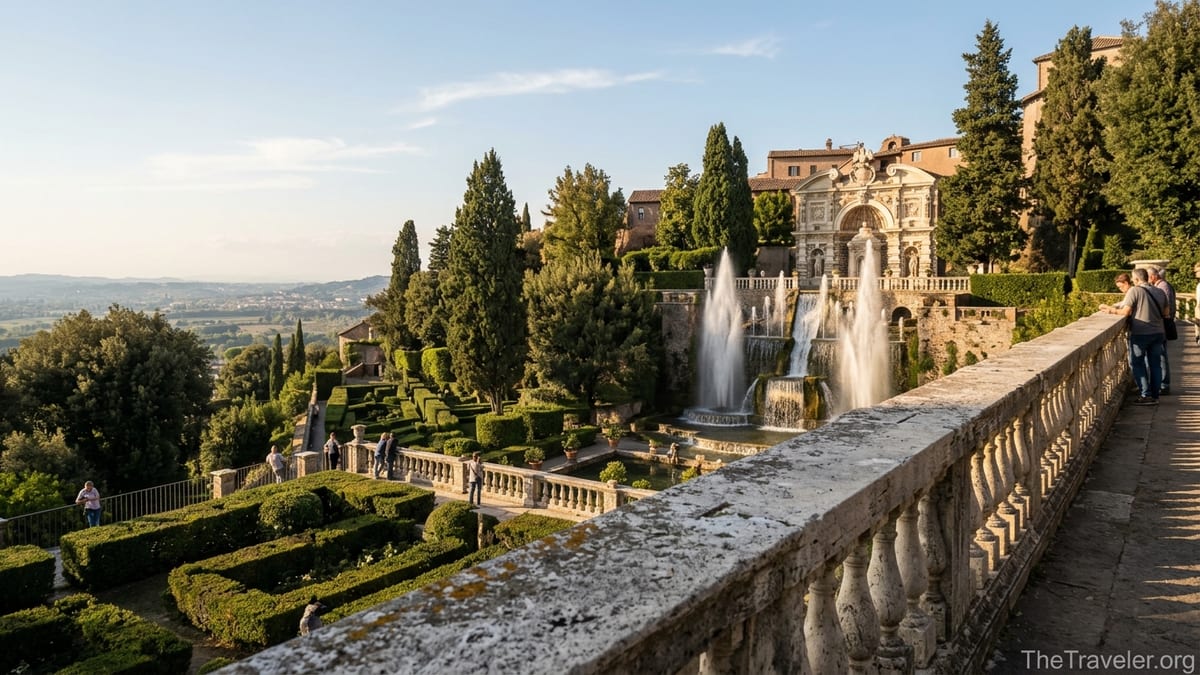
Here, near the Gran Loggia, you get your first commanding view down over the entire garden: the axial lines of staircases, the spine of the famous Hundred Fountains to one side, and the great vertical drop of the Neptune Fountain below. This is where many first-time visitors realize how steep the site actually is. Pause along the balustrade rather than drifting straight to the staircases. From the central section, you can frame the Organ Fountain directly in front of you, with its arch and niches rising above the cascades. From the ends of the terrace, particularly near the Fontana di Europa side, you can look back along the palace facade and capture wide-angle photographs that show the villa, terrace and gardens in a single shot.
If you are serious about not missing the best views, resist the temptation to descend immediately. Spend ten minutes walking the length of the terrace. Look for the points where the stone floor aligns with the axes of the fountains below; these are deliberate sightlines designed in the 16th century to create layered vistas. For example, standing slightly off-center near the Gran Loggia, you can see the water of the Neptune Fountain, the Organ Fountain structure above it, and beyond that the hazy plain stretching toward Rome. This layered composition is one of the archetypal Villa d’Este images that many people miss because they continue straight down the main staircase.
Travelers visiting in the shoulder seasons of March or November should be aware that light on the Vialone terrace can be quite flat at midday. In those months, consider visiting the palace in late morning but timing your pause on the terrace around 3:00 p.m., when the sun is lower and shadows emphasize the relief of the fountains below.
Timing the Organ Fountain and Neptune Fountain Shows
The heart of Villa d’Este’s hydraulic theater is the Fontana dell’Organo, or Organ Fountain, and the great cascades of the Neptune Fountain just below it. The Organ Fountain houses a 16th century water-powered organ whose pipes can still play short pieces thanks to a complex restoration completed in the early 2000s. Today the organ is not left running constantly; instead, it is activated at fixed times to protect the mechanism and create small daily events for visitors.
Current schedules can shift, but in recent seasons the Organ Fountain has typically played its musical program on a roughly two hour cycle, often starting mid to late morning. One common pattern has been performances around 10:30 a.m., 12:30 p.m., 2:30 p.m. and 4:30 p.m., with slight variations on weekends or in winter. This means that if you wander down with no plan, you can easily arrive two minutes after a performance and have nearly two hours to wait for the next, or miss it entirely if you leave early for a bus back to Rome.
A smart tactic is to check the day’s schedule at the ticket office or ask a staff member as soon as you enter. Then structure your route so that you are above or directly in front of the Organ Fountain ten minutes before one of its scheduled performances. Travelers who want a frontal view often stand on the broad terrace just above the Neptune Fountain, which gives a clear line to the organ pipes inside the stone arch. If you prefer to see how the sound and water interact in the space, you might descend to the level of the basin below and stand farther back, where the splashing of Neptune’s cascades mixes with the mechanical, almost ghostly music.
Neptune’s Fountain itself does not have timed “shows” in the sense of Las Vegas style choreography, but its large central jets are sometimes reduced or turned off for maintenance during low visitation periods or drought restrictions. On normal operating days the main vertical plume and fans of smaller spouts run continuously during opening hours. If you find the fountain barely trickling, check with a nearby guard to see whether it is a temporary maintenance pause or a longer conservation measure. When fully on, the spray can reach several meters high, catching sunlight in fine mist; this is especially photogenic in late afternoon from the terraces just above, when visitors sometimes capture rainbows in the mist with a basic smartphone camera.
Walking the Hundred Fountains Without Getting Stuck in Crowds
The Hundred Fountains, a long wall of stone spouts running parallel to the Vialone but one terrace lower, is one of the most famous walks in the garden. The name is poetic rather than literal; there are over 300 individual jets, arranged in three parallel rows emerging from circular masks, lilies and d’Este eagle emblems along a mossy wall. It is also one of the narrowest main routes in the garden, which makes timing vital if you want to enjoy it without shuffling shoulder to shoulder with tour groups.
Most group tours move in a clockwise loop that takes them from the palace down toward the Hundred Fountains, along its length, then down again toward the Fish Ponds and back up past Neptune and the Organ Fountain. If you have entered just behind a large group, let them descend first. Spend that time on the Vialone terrace or exploring a quieter corner such as the terraces near the Fountain of Tivoli (also called the Oval Fountain). Twenty minutes later, the bulk of the group will have cleared the Hundred Fountains, and you can walk it more peacefully.
When you do walk the Hundred Fountains, start at the end closest to the palace and head outward. Looking back occasionally gives you unexpected framed views: rows of water jets receding into the distance with the villa rising above. Because the path is level, this is a good area for travelers with limited mobility or for families with small children, and in summer its canopy of trees offers welcome shade. In July and August, parents often let kids run a hand along the cool spray from the lowest jets while adults linger, looking through openings in the hedges to the lower terraces and the cypress-ringed Rotonda dei Cipressi beyond.
If you visit in cooler months, be aware that some minor jets along the Hundred Fountains may be temporarily off for maintenance or because of freezing risk. The main effect of the wall is usually preserved, but the density of jets can vary. Early morning can be particularly atmospheric here: the combination of stone, moss and low volumes of water gives a soft, almost musical background to your walk, and you are more likely to have unobstructed views for photographs.
Unmissable Viewpoints: From the Oval Fountain to the Rotonda dei Cipressi
Beyond the headline fountains, Villa d’Este is full of quieter viewpoints that many rushed visitors never notice. One of the most rewarding is at the Fontana di Tivoli, also known as the Oval Fountain, a large semicircular basin with water spilling from rockwork into a pool surrounded by statues. Approach it first from above, descending from the palace via the main staircases and following signs. From the upper terrace, you can look down into the bowl of the fountain framed by trees, with the town of Tivoli visible through a gap in the foliage. This is a classic Renaissance “borrowed view,” blending the engineered garden and the real landscape beyond.
Walk around the Oval Fountain slowly and notice how the view shifts: at one point you align the curving lip of the basin with the distant hills, at another you see the spray layered against the cypresses on the opposite side of the garden. If the Organ Fountain performance is scheduled for later, this is an excellent place to spend the waiting time. In late afternoon, the light here can be golden and flattering for portraits, and because most people stop only briefly, you can usually find a quiet corner to sit on the low stone walls.
Another almost meditative viewpoint is the Rotonda dei Cipressi, the Rotunda of the Cypresses. This circular clearing ringed by four towering cypress trees and low fountains in travertine basins is tucked slightly away from the noisiest cascades. To reach it, walk past the Neptune Fountain level and follow the path as it curves. The sudden symmetry and verticality of the cypresses create a strong sense of enclosure. Stand near the center of the circle and look back toward the palace: between trunks and foliage, you will catch glimpses of terraces and balustrades stacked above. Travelers often describe this spot as where the villa feels most contemplative, a counterpoint to the roar of water elsewhere.
Do not neglect the views outward from the very edges of the garden either. Near some of the lower terraces and from certain side paths you can look through the perimeter balustrades toward the Aniene valley and, on a clear day, all the way to the outskirts of Rome. In late spring, when the hills are still green and the air relatively clear, these outward-looking viewpoints remind you that Villa d’Este was conceived not as a closed world but as a theatrical stage overlooking a real countryside.
Practical Route Planning: How To See Everything Without Backtracking
A good route through Villa d’Este balances the steepness of the hillside, the timing of the Organ Fountain, and your own energy level. One widely recommended pattern is to move from top to bottom once, then work your way back up along a different line, rather than zigzagging. After exiting into the gardens from the palace, spend time on the Vialone terrace as described, then descend by one of the main staircases toward the Hundred Fountains level.
Walk the Hundred Fountains from the palace side outward, then drop down toward the lower Fish Ponds and the area beneath Neptune’s cascades. From here, you can loop across the bottom of the garden and explore side paths that bring you to quieter fountains and shaded benches. Once you are ready to climb again, take a route that leads you up toward the basin in front of the Neptune Fountain and the terrace facing the Organ Fountain, timing your arrival for one of the organ performances. After the show, continue upward via staircases that return you near the Oval Fountain and eventually to the Vialone terrace and palace exit.
Visitors with limited mobility or traveling with very young children might prefer a modified route that minimizes steep climbs. One option is to explore the palace and Vialone terrace, then take the most direct staircase down to the level of the Hundred Fountains and the Organ Fountain terrace, skipping some of the lowest terraces. Benches along the Hundred Fountains and near the Oval Fountain offer places to rest. The garden’s paths are mostly paved or cobbled, but some slopes are quite pronounced; comfortable shoes with good grip are essential, particularly on hot days when worn stone can become slippery with fine dust.
In high summer, consider reversing the usual timing. Arrive right at opening time, around 8:30 a.m., when the air is cooler and crowds are lower. Head directly into the garden and down to the lower terraces, leaving the palace interiors for later, when the sun is stronger and the cooler rooms feel more inviting. By late morning, when temperatures rise and tour groups become thicker on the main paths, you will already have enjoyed the fountains with relative peace and can retreat indoors or to a shaded cafe in Tivoli for a break.
Seasonal and Conservation Factors That Affect the Fountains
Unlike many modern attractions, Villa d’Este’s waterworks depend on a historic hydraulic system that still draws from local water sources. In periods of drought or when the Aniene river basin is under stress, authorities sometimes reduce water flow or temporarily turn off less critical fountains to conserve resources. This means that what you see in May after a rainy spring may be quite different from August in a hot, dry year.
Before your trip, it is worth checking recent traveler reports or local news for any mentions of water restrictions affecting Tivoli’s gardens. When reductions happen, they often prioritize keeping major features like the Neptune Fountain and Organ Fountain functioning, while smaller jets or decorative basins may be dry or run at reduced pressure. Inside the garden, staff sometimes post notices about temporary shutdowns for cleaning or maintenance. If you arrive at a favorite fountain and find it silent, ask a guard or attendant politely; they can often tell you whether it will resume later that day.
Winter brings its own variables. While the villa is open year-round except for certain holidays or maintenance closures, very cold spells can lead to brief shutdowns of some jets to prevent ice damage. On the other hand, winter also offers unique visual rewards: low sun, mist rising from the warmer water, and far fewer visitors. Photographers who do not mind gray skies often prize January and February visits for the moody atmosphere and uncluttered compositions, even if they accept that not every minor fountain will be running at full force.
Throughout the year, remember that Villa d’Este is both a monument and a living hydraulic system under constant conservation. You may see workers cleaning basins, adjusting valves or inspecting stonework. Rather than treating this as an intrusion, consider it part of the behind-the-scenes reality that allows a 16th century water theater to keep functioning in the 21st century. Watching how quickly a basin clears as drains are opened or how a jet changes shape when a valve is adjusted can give you fresh appreciation for the engineering that lies beneath the romance.
The Takeaway
Experiencing Villa d’Este without missing its fountains and best viewpoints comes down to a few key choices: when you visit, how you move through the garden, and how attentive you are to the rhythms of the water. Aim for morning or late afternoon light, but always anchor your route around the Organ Fountain’s performance times. Spend unhurried moments on the Vialone terrace, at the Oval Fountain and in the Rotonda dei Cipressi, not just at the obvious showpieces. Accept that some details may be off for conservation reasons, and focus on the ensemble effect that made this hillside garden a model for generations of European landscape design.
If you build in time for detours, pauses and simply listening to the rush and trickle around you, Villa d’Este reveals itself as more than a checklist of famous fountains. It becomes a lived experience of water, stone and light, shifting with the hour and the season. Plan thoughtfully, travel flexibly, and you will leave Tivoli not just with photographs of its great cascades, but with a sense of having walked inside one of the Renaissance’s most extraordinary works of art.
FAQ
Q1. How long do I need to visit Villa d’Este without feeling rushed?
Most visitors need at least 2 to 3 hours to see the palace interiors, walk the main terraces, and experience the major fountains at a relaxed pace.
Q2. What is the best time of day to see the fountains at their most beautiful?
Late afternoon offers especially flattering light on the stone and water, but early morning is best if you want fewer crowds in high summer.
Q3. How often does the Organ Fountain play, and how can I avoid missing it?
The Organ Fountain generally plays on a roughly two hour schedule, often starting around mid to late morning. Check the exact times at the ticket office when you arrive and plan to be near it ten minutes before a performance.
Q4. Are all the fountains always running, or can some be turned off?
Most major fountains run during opening hours, but smaller jets or basins may be reduced or turned off during droughts, cold snaps or maintenance work.
Q5. Is Villa d’Este suitable for travelers with limited mobility?
The site is on a steep hillside with many stairs, but some terraces such as the Hundred Fountains and the Vialone are relatively level. Those with mobility issues may prefer to focus on these areas and avoid the lowest levels.
Q6. Can I visit Villa d’Este and Hadrian’s Villa on the same day?
Yes, many travelers combine them using a joint ticket or guided tour, but it makes for a full day. Plan several hours at each site and factor in transport time between them.
Q7. Do I need to book tickets for Villa d’Este in advance?
Advance booking is not always mandatory, but in peak seasons reserving a timed entry online can save you from queueing and help you time your visit around the Organ Fountain schedule.
Q8. What should I wear and bring to be comfortable in the gardens?
Wear comfortable shoes with good grip, as paths and stairs can be steep and uneven. In warm months bring a hat, sunscreen and water, since shade is not continuous.
Q9. Is photography allowed at the fountains and inside the villa?
Photography is generally allowed for personal use, but avoid flash inside the palace and respect any signs restricting tripods or professional equipment in certain areas.
Q10. What happens if it rains on the day of my visit?
Villa d’Este remains atmospheric in light rain, and the fountains still run. Bring a compact umbrella or waterproof jacket and take advantage of quieter paths and reflections in wet stone.