


On a coastline lined with glamorous names, Villefranche-sur-Mer manages to feel quietly extraordinary. Tucked between Nice and Saint-Jean-Cap-Ferrat, this compact harbor town combines the deep-blue drama of one of the Mediterranean’s finest natural bays with the scale of a lived-in village. For travelers deciding where to base themselves along the French Riviera, understanding what makes Villefranche different from its neighbors is the key to planning the right kind of trip.
Get the latest updates straight to your inbox!
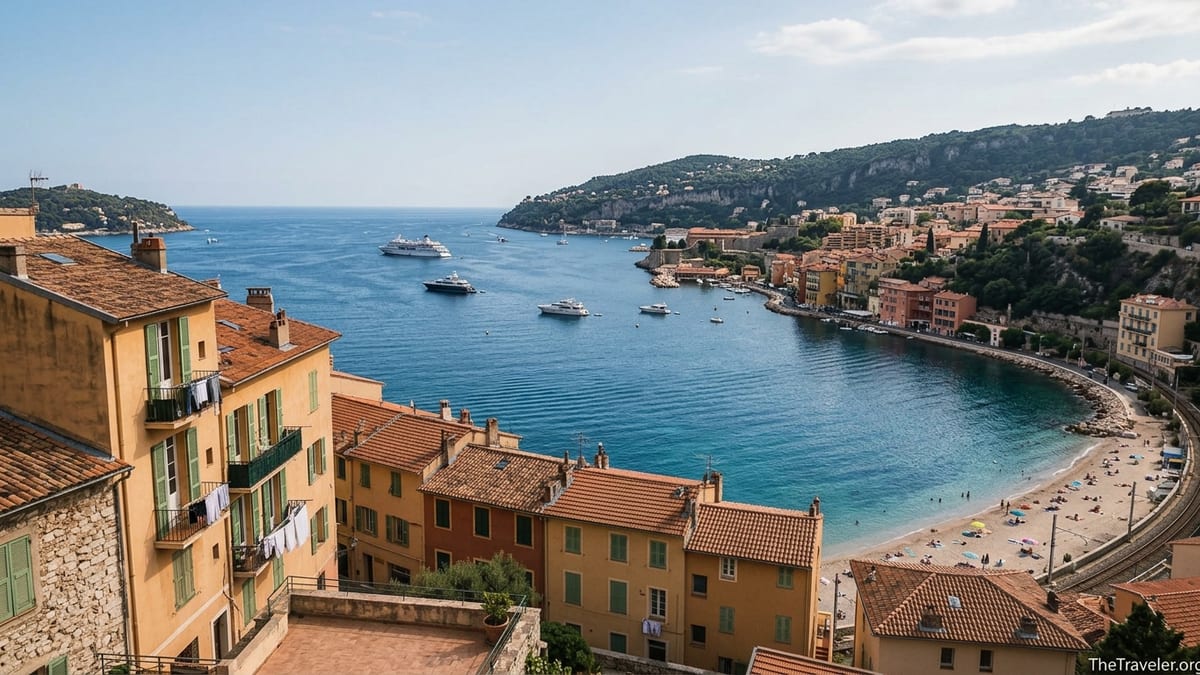
A Natural Amphitheater Above One of the Riviera’s Deepest Bays
Many Riviera towns are beautiful, but Villefranche-sur-Mer has a geography that is unusually spectacular. The colorful old town climbs steeply from a sweeping, horseshoe-shaped bay, creating an amphitheater of ochre and terracotta facades that seem to tumble straight into the sea. This bay is one of the deepest natural harbors in the Mediterranean, which is why even large cruise ships often anchor here rather than in neighboring Nice. From the waterfront promenade or the terrace of a simple café, you can watch tenders shuttling passengers back and forth and superyachts pivoting slowly in the calm water, all framed by the forested headland of Cap Ferrat.
The practical effect for visitors is that the views in Villefranche feel unusually immersive. In flatter towns like Antibes or Menton, sea and city lie side by side. In Villefranche, you are almost always looking down at the bay from some angle, whether you are walking down stone steps from Rue du Poilu to the harbor or pausing on a balcony rail at a modest guesthouse. A basic sea-view room in a mid-range hotel or rental apartment here might cost less than in Saint-Jean-Cap-Ferrat, yet the spectacle is similar: cruise ships at anchor, small fishing boats bobbing in the foreground, and the train sliding in and out of the tunnel carved into the cliff.
The depth of the bay also shapes the town’s maritime life. Traditional fishing boats still sit alongside sleek sailing yachts in the small Port de la Santé, while the larger Port de la Darse, tucked around the headland, is focused on yachting and marine research. Divers use the bay as a training ground because depths plunge sharply close to shore. For travelers, that means you can take a paddleboard lesson in water so clear that you see the seabed just a few meters from a drop into deep blue, a contrast you will not find on the broader, shallower strands of Cannes or Juan-les-Pins.
An Old Town That Feels Genuinely Lived In
Villefranche’s old town is compact, but it does not feel like a stage set. Unlike sections of Nice’s Vieux Nice or parts of Saint-Paul-de-Vence where souvenir shops dominate, many of the ground-floor spaces here are still used as homes, simple cafés, and neighborhood services. Walk along Rue du Poilu, the main street that runs parallel to the harbor, and you will pass a butcher, a small grocery, a wine shop with boxes stacked in the doorway, and a café-restaurant where locals linger over coffee long after breakfast hours. Menus are often bilingual, but this is very much a place where you might hear children leaving school or neighbors chatting across balconies.
The architecture carries layers of history without being heavily curated. Laundry hangs across narrow alleys, potted geraniums sit on worn stone steps, and paint peels slightly on the shutters in a way that looks charming rather than neglected. Travelers who find some Riviera resorts too polished or fashion-focused often appreciate this softer kind of authenticity. You can spend an afternoon simply wandering the maze of lanes between Rue du Poilu and the waterfront, turning down any passage that catches your eye. Within a few minutes, you are likely to find yourself in a small square with a fountain, or under a vaulted archway that frames a perfect slice of sea.
There are serious historic sights here too, but they are woven naturally into daily life. The 18th-century Saint-Michel Church, painted a warm pastel hue, anchors one side of the old town; step inside between services and you might find a handful of locals lighting candles rather than a stream of tour groups. Higher on the slope, the 16th-century Citadel of Saint-Elme houses the town hall and several small museums. Admission is often free or modestly priced, making it easy to combine a cultural stop with a late-afternoon stroll along the citadel ramparts overlooking the bay.
Atmosphere Over Flash: A Calmer Alternative to Nice and Monaco
Compared with Nice, Cannes, or Monaco, Villefranche-sur-Mer feels notably slower and more residential. This is not the Riviera of red carpets and luxury boutiques lining a grand promenade. Instead, evenings tend to center on the waterfront, where a handful of restaurants set tables just meters from the water’s edge. You might pay moderate Riviera prices for a main course, but the ambience is less about being seen and more about watching ferries glide in front of the lights of Cap Ferrat, or listening to the clink of rigging against masts in the small harbor.
Travelers who base themselves in Villefranche often do so precisely because they want close access to big-name destinations without having to sleep in them. A 10-minute train ride west takes you into Nice, with its art museums, Old Town markets, and tram network. Head east and in under 20 minutes you can reach Monaco for the day. Yet when you return to Villefranche in the evening, the streets are quiet enough that you can hear the wash of the tide along the promenade. For many visitors, that contrast is the town’s greatest luxury.
The nightlife scene reflects this more relaxed character. Do not expect late-closing clubs or rooftop cocktail bars with guest DJs. Instead, you will find wine bars pouring local rosé, a couple of spots where live music pops up on summer weekends, and restaurants that stay open late enough to linger over dessert but rarely feel frantic. For families, this translates into an easygoing atmosphere where children can play on the beach or promenade after dinner while adults finish their coffee within sight.
A Rare Stretch of Sand in a Region of Pebbles
One of the most practical ways Villefranche stands out from other Riviera towns is its main beach. Plage des Marinières, curving along the bay just below the train tracks, is a long arc of sand and fine shingle. Compared with the round pebbles of much of Nice’s shoreline, this makes getting in and out of the water more comfortable, especially for families or anyone with mobility issues. In summer, locals from Nice will often hop on the regional train and step off directly at Villefranche’s small station specifically to spend the day here rather than on their own city’s rockier beaches.
The beach is largely public, with a well-marked zone where you can spread a towel for free. There are also seasonal private sections where, for a typical Riviera day rate, you can rent a sun lounger and parasol, often with bar and snack service brought directly to your chair. Travelers comparing costs with neighboring towns may find that sunbed rentals here can be slightly lower than on central Nice’s prime beachfront or the most prestigious private strands in Cannes, while the scenery is just as appealing: train emerging from tunnels in the cliff, colorful houses rising behind the curve of the bay, and yachts at anchor in the distance.
Facilities are straightforward but adequate. There are public showers, a few snack kiosks selling ice cream and sandwiches, and water sports operators renting paddleboards or kayaks by the hour. Parents appreciate that the water stays relatively shallow for several meters from the shore before deepening. Swimmers who like longer distances can follow the line of the bay, using the moored buoys and anchored boats as informal markers. Even in high season, the feel is more like a local beach that has become popular than a heavily managed resort strip. That simplicity contrasts with the more formal, club-like atmosphere you may find in Saint-Jean-Cap-Ferrat’s exclusive beach clubs or along Cannes’ Croisette.
Hidden Passages, Art, and Festivals Rooted in the Town
Beyond its postcard harbor and beach, Villefranche-sur-Mer has small, distinctive experiences that most Riviera towns simply cannot match. The most famous is Rue Obscure, a covered medieval street that runs for about 130 meters beneath the houses along the old ramparts. Dating back to the 13th century, this vaulted passage once served as a defensive corridor and shelter for animals and goods. Today, walking along its cool, dimly lit length feels like stepping centuries back in time. In contrast, Nice’s old town lanes are atmospheric but open to the sky; few have the same enclosed, almost secret character as this preserved corridor.
Art is present in subtle, site-specific ways. In the nearby Saint-Pierre Chapel at the waterfront, the poet and artist Jean Cocteau created an intimate cycle of murals in the 1950s, transforming the once utilitarian fishermen’s chapel into a dreamlike space dedicated to the life of Saint Peter and local seafarers. Unlike the major museums in Nice or Antibes, the chapel is small enough that you can take it in quietly in 20 or 30 minutes, often without crowds. Admission is typically just a few euros, and many visitors combine it with a stroll along the quay and a coffee at one of the simple harbor bars.
Villefranche also has its own traditions that help distinguish it from neighboring towns. One of the best known is the “combat naval fleuri,” a flower-bedecked water parade usually held in winter, when local boats are decorated with blossoms and greenery and take part in a gentle mock battle on the bay. Compared with the internationally famous Carnival in Nice or the high-profile events in Monaco, this is a smaller, more community-focused celebration. Visitors who happen to be in town often find themselves watching alongside residents on the quay rather than behind barriers in a dense crowd.
Easy Access Without Losing a Village Scale
From a logistics standpoint, Villefranche-sur-Mer is one of the more convenient bases on the Riviera while still feeling like a true village. The regional coastal train line connects Villefranche’s little station directly with Nice in one direction and Monaco, Menton, and the Italian border in the other. Trains typically run several times an hour in high season, and the journey to Nice-Ville main station takes only around 10 minutes. That means you can skip hiring a car if you are comfortable with public transport, a significant advantage over hilltop villages where buses are infrequent and parking is limited.
The walk from the station to the old town and beach is short and scenic. Within a few minutes, you descend from the tracks to the promenade along Plage des Marinières, passing under the railway line via simple tunnels. For travelers hauling luggage, this is considerably easier than the uphill climbs required in perched villages like Èze, where you may need to transfer from train to bus and then tackle a steep path. Taxis and ride-hailing services can reach most accommodation in Villefranche, but many visitors find they rarely need them once installed.
At the same time, the town has resisted large-scale development. There are no high-rise hotels looming over the waterfront and very few big-brand properties. Most options are small hotels, guesthouses, or rental apartments tucked into historic buildings. This keeps the skyline low and preserves views across the bay. Dining is similar: independent restaurants and family-run spots dominate, with menus focused on seafood, Provençal recipes, and Italian influences rather than international chains. For travelers looking to feel embedded in a specific place instead of a generic resort, this gentle, small-scale infrastructure is a major draw.
How Villefranche Compares With Other Riviera Favorites
Choosing between Villefranche-sur-Mer and other Riviera towns often comes down to priorities. If you want extensive shopping, big museums, and nightlife that runs into the early hours, central Nice or Cannes will suit better. Nice offers a grand promenade, large squares, and a grid of streets filled with boutiques and bars, while Cannes has a more overtly glamorous atmosphere around its film festival palace and designer storefronts. Villefranche, by contrast, offers a handful of small shops, one main grocery store, and evenings centered on the harbor and old town rather than on broad boulevards.
Compared with Monaco, Villefranche is less about spectacle and more about scenery. Monaco’s casino, skyscraper skyline, and marina packed with some of the Mediterranean’s largest yachts create a sense of high-density luxury. Many travelers enjoy a day there but prefer to sleep somewhere quieter and less expensive. Staying in Villefranche allows you to visit Monaco easily by train while returning to a human-scale setting where you can walk most places in under 15 minutes and order a glass of local wine at a casual café without a dress code.
When weighed against smaller coastal neighbors, Villefranche hits a middle ground. Saint-Jean-Cap-Ferrat, just across the bay, is more private and residential, with spectacular coastal walks and high-end villas but fewer everyday amenities and less of a historic urban core. Beaulieu-sur-Mer feels slightly more formal and grand, with belle époque buildings and a broader main street but lacks Villefranche’s dramatic natural bay. Menton at the Italian border has beautiful pastel facades and gardens, yet its wide, open seafront feels less enclosed than Villefranche’s amphitheater-like harbor. Travelers who want a place that feels both intimate and visually dramatic often find Villefranche strikes the right balance.
The Takeaway
In a region full of celebrated seaside names, Villefranche-sur-Mer stands out not for high-profile events or luxury branding, but for its combination of natural drama and village intimacy. The deep, sheltered bay, the rare sand-and-shingle beach, and the way the old town seems to cascade toward the water give the town an instantly memorable silhouette that many larger resorts would envy. Yet its streets remain scaled to daily life, with laundry lines, local cafés, and schoolchildren weaving through the alleys.
For travelers, the appeal lies in that contrast. You can step onto a train and be in Nice’s museums or Monaco’s casino district in minutes, then return the same evening to dine beside a working harbor where fishing boats bob next to sleek tenders. You can spend the day stretched out on Plage des Marinières or exploring the cool shadows of Rue Obscure, knowing that nearly everything in town is within walking distance. When you are choosing between Riviera bases, ask yourself whether you want to vacation in a resort or in a village with a world-class view. If it is the latter, Villefranche-sur-Mer belongs near the top of your list.
FAQ
Q1. Is Villefranche-sur-Mer a good base for exploring the French Riviera without a car?
Yes. Villefranche has its own train station on the main coastal line, with regular services to Nice, Antibes, Cannes, Monaco, Menton, and the Italian border. Many visitors find they can comfortably explore the region using trains, local buses, and walking paths without renting a car.
Q2. How does the beach in Villefranche compare to the beaches in Nice?
Plage des Marinières in Villefranche is a mix of sand and fine shingle, which most people find softer underfoot than the large pebbles that dominate Nice’s city beaches. The bay is also more sheltered, so the water is often calm and clear, making it popular with families and casual swimmers.
Q3. Is Villefranche-sur-Mer very expensive compared with other Riviera towns?
Prices in Villefranche reflect its Riviera location, but in general accommodation and dining can be slightly less expensive than in the most prestigious areas of Nice, Cannes, or Saint-Jean-Cap-Ferrat. You will still pay coastal France prices, but simple cafés, bakeries, and self-catering apartments help keep costs manageable.
Q4. What makes Villefranche’s old town different from others on the Riviera?
Villefranche’s old town is small and steep, with lanes that feel genuinely residential rather than dominated by tourist shops. Features like the covered medieval Rue Obscure, the hillside Saint-Michel Church, and the integrated citadel complex give it a distinctive character, while the presence of everyday services and local residents keeps the atmosphere grounded.
Q5. Are there things to do in Villefranche if the weather is not good for the beach?
Yes. You can visit the Citadel and its small museums, explore Saint-Michel Church or the Saint-Pierre Chapel with its Jean Cocteau murals, linger in cafés along Rue du Poilu, or take a short train ride to museums and galleries in Nice. The covered Rue Obscure is also atmospheric in wet weather.
Q6. How crowded does Villefranche-sur-Mer get in summer?
In peak summer, cruise ship calls and day-trippers from Nice can make the harbor and beach busy, especially during the day. Even then, the scale remains smaller than in major resorts, and early mornings or evenings are usually quieter. Outside July and August, the town often feels pleasantly lively rather than crowded.
Q7. Can you swim in the bay when cruise ships are anchored there?
Yes. Swimming is generally concentrated along Plage des Marinières and designated nearshore areas, while large ships anchor farther out in the deep part of the bay. Small boats and tenders operate in marked zones, and swimmers typically stay near the beach where the water is shallow and separated from boat traffic.
Q8. Is Villefranche-sur-Mer suitable for travelers with limited mobility?
The seafront promenade and parts of Plage des Marinières are relatively flat and accessible, and some restaurants are located right at waterfront level. However, the old town is built on a steep slope with many steps and uneven pavements. Travelers with limited mobility may wish to choose accommodation close to the harbor or beach to minimize uphill walking.
Q9. How many days should I plan to stay in Villefranche-sur-Mer?
Many travelers find that two to three full days is enough to explore Villefranche itself and enjoy the beach. Staying four to five nights allows time for relaxed day trips to Nice, Monaco, Cap Ferrat, or Antibes while still returning each evening to the village atmosphere.
Q10. Is Villefranche-sur-Mer more suitable for couples, families, or solo travelers?
Villefranche works well for all three. Couples appreciate the romantic harbor views and quiet evenings, families enjoy the sheltered beach and manageable size, and solo travelers benefit from easy public transport connections and a friendly, small-town feel that is less overwhelming than larger cities on the Riviera.