


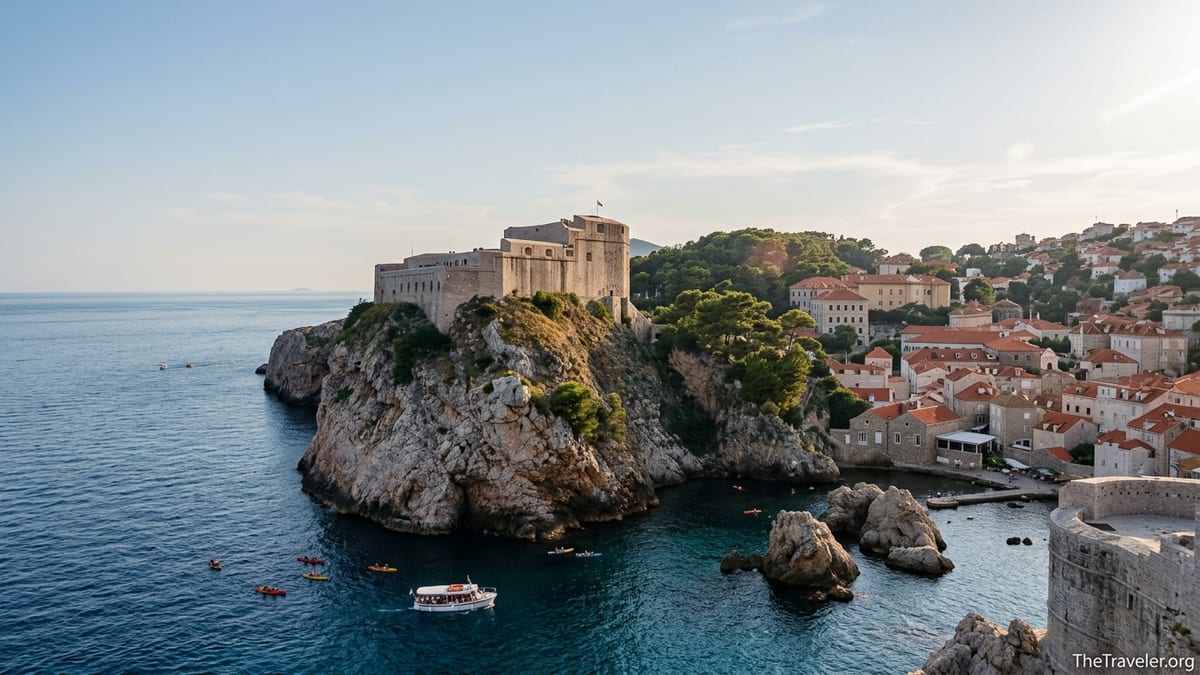
Approaching Dubrovnik’s Old Town from Pile Gate, it is almost impossible to miss the stone giant that guards the city from a rocky headland to the west. Fort Lovrijenac, sometimes called “Dubrovnik’s Gibraltar,” rises directly from a 37-metre sea cliff, its angular walls and red-tiled roofs seemingly carved from the rock itself. For centuries it has stood apart from, yet fiercely protective of, Dubrovnik’s famous city walls. Today, it is not only a symbol of military ingenuity and stubborn independence, but also a stage for Shakespeare, a star of screen fantasy, and one of the most compelling vantage points on the Adriatic coast.
Get the latest updates straight to your inbox!
A Fortress Born From a Struggle for Independence
Fort Lovrijenac’s story begins with a threat. In the 11th century, the powerful Republic of Venice reportedly planned to construct its own fortress on the very rock where Lovrijenac now stands, hoping to dominate Dubrovnik’s harbour and exert control over the rising maritime city. According to local tradition, news of the Venetian project spurred the people of Dubrovnik to act with remarkable speed. Working day and night, they built and fortified their own stronghold before Venetian ships could arrive with building materials. Whether every detail of the legend is precise or not, the symbolism is clear: Lovrijenac was conceived as a declaration that Dubrovnik would defend itself on its own terms.
The resulting fortress, dedicated to St Lawrence, developed into a key outpost of the Republic of Ragusa, the independent city-state that thrived on trade and diplomacy from the Middle Ages into the early modern era. While Dubrovnik’s famous walls wrap tightly around the Old Town, Lovrijenac was positioned deliberately outside the western ramparts. Its placement meant that any invading fleet trying to approach the city from the sea would face crossfire from both the fortress and the walls, a deadly stone-and-cannon pincer that contributed to Dubrovnik’s reputation for being almost untouchable.
This independent attitude is immortalised above the fort’s entrance in a Latin inscription that visitors still pass under today: “Non bene pro toto libertas venditur auro.” Translated, it reads, “Freedom is not to be sold for all the gold in the world.” For a small maritime republic surrounded by larger powers, this motto was more than ornament. It signalled that Lovrijenac was not simply a garrison but a physical statement of civic values, rooted in the belief that Dubrovnik’s liberty was priceless.
By the 15th and 16th centuries, when cannons eclipsed catapults and the Ottoman and Venetian empires vied for influence on the Adriatic, Lovrijenac became one of Dubrovnik’s principal coastal bastions. Travelers today can still see the thickening of the walls that took place during this era, particularly on the seaward side where artillery would have been concentrated to repel enemy ships.
An Engineering Feat on a Sheer Sea Cliff
Even before you walk through its gate, Fort Lovrijenac impresses with its improbable location. The fortress crowns a massive rock that juts into the Adriatic, 37 metres above sea level, with sheer cliffs falling directly into the water. Reaching it involves a short but steep stair climb from the Pile area, passing through pine trees and low Mediterranean scrub before the stone walls loom overhead. The ascent, which takes around five to ten minutes for most visitors, underlines just how challenging building here must have been for medieval engineers.
Architecturally, Lovrijenac differs from the rounded towers and more continuous lines of Dubrovnik’s city walls. It is triangular in plan, adjusting to the irregular outline of the rock. From the landward side, the walls rise high and relatively thin, reflecting the fact that any attack on this side would already have to fight past the main city walls. On the seaward flank, by contrast, the walls are significantly thicker, sometimes quoted as being up to 12 metres at their broadest. This uneven distribution of stone saved material while still offering formidable protection in the direction where cannon fire from ships was most likely.
Inside, the fortress is arranged across several terraces and vaulted chambers that step down toward the sea. Today, visitors find a large open courtyard where guns once stood facing the channel between Lovrijenac and the Old Town. These days, the cannons are mostly decorative, but it is easy to visualise how they could have swept the approaches to Dubrovnik’s harbour. From the upper terrace, you can peer over the parapets and see kayakers and small tour boats passing beneath, tracing the same waters that would once have carried galleys and merchant ships.
Modern safety standards mean that access points, railings and internal pathways are maintained by the city, but the stonework retains a rough, authentic feel. There are relatively few explanatory panels, so walking through Lovrijenac can feel like exploring a semi-ruin rather than a polished museum. Solid walking shoes are advisable, as some surfaces are uneven and can grow slick in wet weather. For many visitors, this tactile quality, combined with the panoramic views, is precisely what makes the fortress so memorable.
Guardian of Dubrovnik: From Ragusa to the 1990s War
For centuries, Fort Lovrijenac served as a critical piece of Dubrovnik’s layered defenses. Positioned to control the western sea approach and the small bay of Kolorina below, it worked in tandem with Fort Bokar and the main city walls. Merchant captains arriving from Venice, Naples or the Levant would have sailed past its guns before anchoring in the harbour. Historical records indicate that the Republic of Ragusa periodically upgraded Lovrijenac’s artillery and structure, maintaining it as a ready deterrent even during long stretches of peace.
The fortress also played a role in internal politics. Because of Dubrovnik’s tradition of wary independence, the authorities were always careful that no single commander could entrench himself in such a powerful position. One oft-repeated detail is that the fort’s garrison commander was appointed for terms of only a single year, and the city kept a close watch on the number of cannons and men stationed there. In this way, Lovrijenac symbolised both strength and the republic’s suspicion of unchecked power.
In the late 20th century, during the Croatian War of Independence, the wider Dubrovnik area endured a devastating siege from late 1991 into 1992. While the fiercest shelling targeted the Old Town’s tiled roofs and streets, Lovrijenac forms part of the same historic ensemble that came under threat. Local veterans’ accounts and contemporary reporting describe how every defensible height and structure around the city gained renewed military importance at that time. Walking through the fort today, you may see small plaques and memorials in Dubrovnik that commemorate this period, reminding visitors that the city’s fortifications were not just medieval relics but part of a still-living story of defense.
The fact that Dubrovnik survived the siege and was painstakingly restored has only deepened the symbolic power of Lovrijenac. To stand on its ramparts and look across to the pale stone and red roofs of the Old Town is to see a city that has endured both distant imperial ambitions and very recent conflict, yet remains focused on trade, tourism and cultural life rather than war.
A Stage for Shakespeare and Summer Nights
One of the most distinctive aspects of Fort Lovrijenac is that it is not only a historical monument but also an active cultural venue. The fortress doubles as an open-air theatre, particularly during the Dubrovnik Summer Festival, which typically runs from mid-July to mid-August. During this period, its courtyard and terraces become an atmospheric setting for dramas and concerts, most famously productions of Shakespeare’s “Hamlet.”
Watching Hamlet performed within the stone walls of Lovrijenac, with night air from the Adriatic drifting through the battlements, is a very different experience from a traditional indoor theatre. The audience sits on temporary stands or simple chairs in the central courtyard, with the fortress itself serving as the backdrop. Lighting is subtle, designed to preserve the dark sky and highlight the textures of ancient stone rather than overwhelm them with colour. Performances usually begin after sunset, and the play’s themes of power, betrayal and moral struggle feel sharpened by the setting, where real commanders and councils once debated the security of the republic.
For travelers, the practicalities of such a performance are relatively straightforward. Tickets can usually be booked in advance through local cultural outlets or the festival’s official sales points in the Old Town. Prices tend to be comparable to mid-range theatre tickets in other European cities, and performances often sell out, particularly on weekends. Arriving early is wise, not only to secure a good seat but also to enjoy the twilight views over the city and sea before the show begins.
Even outside festival season, smaller events sometimes take place within the fortress, from classical music recitals to local cultural ceremonies. These are sporadic rather than daily occurrences, but for visitors who are flexible with dates, stumbling upon a concert in this setting can be a highlight of a stay in Dubrovnik.
From Coastal Stronghold to Screen Legend
In the last decade, Fort Lovrijenac has gained a second, more global form of fame through film and television. For fans of fantasy television, it is instantly recognisable as a key stand-in for the Red Keep in the series “Game of Thrones.” Production crews used both the exterior and interior of the fortress for multiple scenes, including royal ceremonies, courtly intrigues and tense conversations on stone terraces overlooking the sea.
Walking through the fort today, it is easy to match real spaces to their on-screen counterparts. The main courtyard, once a battery for cannons, became the setting for a tournament sequence watched by the fictional nobility. One of the upper balconies, with its view across the channel to the Old Town, appears in scenes where characters survey the bay and city. Unlike heavily modified film sets, Lovrijenac required relatively little digital alteration. Its weathered masonry, narrow stairways and raw cliff-top position provided production designers with almost everything they needed straight from reality.
Local tour operators have embraced this connection. Numerous walking tours, some focused purely on “Game of Thrones” and others blending fantasy with history, include Lovrijenac as a key stop. A typical themed tour might cost roughly the same as a mid-priced restaurant meal in Dubrovnik and last around two to three hours, combining a visit to the Old Town with time at the fortress. Guides often carry stills from the show or tablets to help guests match frames to real-life views, explaining where green-screen effects started and where the authentic stone ends.
Importantly, Lovrijenac’s identity has not been reduced to a backdrop for fiction. While some visitors arrive primarily because of its television fame, most leave talking just as much about the views, the motto over the gate, and the sense of standing on a centuries-old lookout that long predates modern pop culture. In this way, the fortress serves as a bridge between the global imagination and the very specific local history of Dubrovnik.
The Best Views in Dubrovnik: What Visitors Experience Today
For many travelers, Fort Lovrijenac is above all about the vantage point it offers over Dubrovnik and the Adriatic. From its highest terrace, the Old Town appears almost like a living model: terracotta roofs tumbling toward the sea, church domes rising above narrow streets, and the loop of the city walls encircling it all. Looking east, you can trace the walls as they climb to the Minčeta Tower and curve down toward the harbour, while to the south the broad blue of the Adriatic stretches away toward the horizon.
To the north and west, the landscape changes character. Here the view takes in rocky headlands, pine forests and the open sea dotted with kayaks, small sightseeing boats and, in season, larger cruise ships anchored offshore. Late afternoon and early evening are particularly popular times to visit, when the sun drops behind the Elaphiti Islands and casts a warm, slanting light across the city. Photographers often favour these hours for capturing detailed shots of roof tiles, stone textures and the contrast between deep blue water and pale walls.
Reaching the fortress involves purchasing an entry ticket. As of recent seasons, individual admission is commonly bundled with tickets for Dubrovnik’s city walls, so visitors who pay to walk the ramparts can usually enter Lovrijenac on the same ticket within a limited time frame, often 24 hours. This combined approach tends to offer better value than paying separately, and it encourages travelers to see the fortress and the walls as two halves of a single defensive system. Arriving earlier in the day, before the highest heat and largest cruise ship crowds, can make the stair climb more comfortable.
Inside, there are few modern amenities. You will not find cafés or souvenir shops within the walls, only the occasional vendor or guide at the entrance. Restrooms are limited, and shade can be scarce on the upper levels in the middle of the day. Sensible shoes, a bottle of water and adequate sun protection make the visit more pleasant, particularly in July and August when temperatures can be high. These small inconveniences are a reasonable trade-off for the fort’s relatively uncommercialised atmosphere and the opportunity to roam its platforms and corridors freely.
Planning Your Visit: Practical Tips and Realistic Expectations
Most visitors reach Fort Lovrijenac by walking from the Pile Gate area, which is one of the main gateways into Dubrovnik’s Old Town. From the small square and bus stop outside the gate, you follow the road downhill to the left, then climb a long flight of stone steps that cuts up through greenery to the fort’s entrance. The approach is well signposted, and the entire walk from Pile usually takes around ten minutes for those in average health, a little longer if you pause on the way up.
Opening hours can vary by season, with longer days in late spring and summer and more limited access in winter. In the busy months, typical visiting windows start in the morning and run into the early evening, often aligning roughly with the hours for the city walls. Tickets for the combined city walls and Lovrijenac entry are widely sold at official booths near Pile and Ploče Gates and through authorised online platforms ahead of time. Prices change periodically and may differ for adults, students and children, so it is worth checking current figures shortly before you travel rather than relying on outdated guidebooks.
To make the most of a visit, many travelers pair Lovrijenac with a full circuit of the city walls. One common pattern is to start with the fort in the later afternoon, when its west-facing views catch the softer light, then enter the walls just before the last admission of the day and walk the loop as the sun sets. Another option is to visit Lovrijenac early in the morning when temperatures are cooler and crowds smaller, then join a guided walking tour of the Old Town afterward. In peak season, arriving right as the fort opens can offer a rare moment of peace before cruise excursions build up.
Travelers with limited mobility should be aware that the staircase to the fortress is long and fairly steep, and there is no elevator. Within the fort, staircases and uneven stone surfaces add further challenges. Those who can manage the climb, however, often find it one of the most rewarding efforts of their time in Dubrovnik. Families with children typically appreciate the sense of exploration, though close supervision is advisable near ramparts and high walls despite safety railings in key areas.
The Takeaway
Fort Lovrijenac occupies a unique place in Dubrovnik’s landscape and identity. It is physically separate from the Old Town yet visually inseparable from the classic postcard view of the city, poised dramatically above the sea on its own rocky pedestal. Its motto proclaims a dedication to freedom that has resonated from the days of the Ragusan Republic through the conflicts of the 20th century, and its angular walls still convey the determination of a small city that refused to surrender its independence.
At the same time, Lovrijenac is not locked in the past. It functions as an open-air theatre, a major film and television location, and a favourite lookout for visitors seeking the best perspectives on Dubrovnik and the Adriatic. Whether you are drawn by history, by the allure of fictional capitals and royal courts, or simply by the promise of sea views and stone underfoot, a visit to this fortress adds a layer of depth to any stay in the city. Standing on its ramparts, with the wind off the water and the Old Town spread below, it is easy to understand why Fort Lovrijenac has become one of Dubrovnik’s most enduring and iconic symbols.
FAQ
Q1. Where is Fort Lovrijenac located in relation to Dubrovnik’s Old Town?
Fort Lovrijenac sits on a rocky headland immediately west of Dubrovnik’s Old Town, facing the city across a narrow inlet near Pile Gate.
Q2. How do I get to Fort Lovrijenac, and how long is the walk?
Most visitors walk from Pile Gate, following the road downhill toward the small bay and then climbing a long flight of stone steps. The walk usually takes around 10 minutes.
Q3. Is entry to Fort Lovrijenac included with the Dubrovnik city walls ticket?
In recent seasons, admission to Fort Lovrijenac has generally been bundled with tickets for Dubrovnik’s city walls, allowing entry to both within a limited time period. It is best to confirm this when purchasing tickets.
Q4. How much time should I plan for a visit to Fort Lovrijenac?
Most travelers spend between 45 minutes and 1.5 hours in the fortress, depending on how long they linger over the views, photography and exploration of interior spaces.
Q5. Are there facilities such as cafés or restrooms inside Fort Lovrijenac?
Facilities inside the fortress are minimal. There are no permanent cafés or shops within the walls, and restroom options are limited, so it is wise to plan accordingly before climbing up.
Q6. Is Fort Lovrijenac suitable for visitors with limited mobility?
The approach involves a substantial flight of stairs, and the interior includes additional steps and uneven stone surfaces. Unfortunately, it is not well suited to visitors who cannot manage stair climbs.
Q7. What is the best time of day to visit Fort Lovrijenac?
Late afternoon and early evening are especially popular, when the sun casts warm light over the Old Town and the Adriatic. Early morning can also be pleasant, with fewer crowds and cooler temperatures.
Q8. Can I attend performances or events at Fort Lovrijenac?
Yes. During the Dubrovnik Summer Festival and occasionally at other times, the fortress hosts theatre and music performances, including well-known productions of Shakespeare’s “Hamlet.” Tickets are usually sold in advance in the Old Town.
Q9. Why is Fort Lovrijenac often associated with Game of Thrones?
The fortress served as a primary filming location for the Red Keep in the television series “Game of Thrones,” appearing in several scenes set in the royal stronghold of the fictional capital.
Q10. Do I need a guided tour to appreciate Fort Lovrijenac?
A guided tour can add context about the fortress’s history and its role in film and television, but it is not essential. Many visitors explore independently, reading up on its background before or after their visit.