


When I first booked a room in Fuorigrotta, I thought I was trading charm for convenience. This western suburb of Naples, wedged between the sea and the volcanic landscapes of the Campi Flegrei, is best known for its football stadium and huge exhibition center. It sounded functional rather than fascinating. What surprised me most on arrival was how local it felt: a dense, lived-in neighborhood where match days and mega-events are only brief interruptions in an otherwise ordinary Neapolitan life.
Get the latest updates straight to your inbox!
First Impressions: A Stadium District That Isn’t a Stage Set
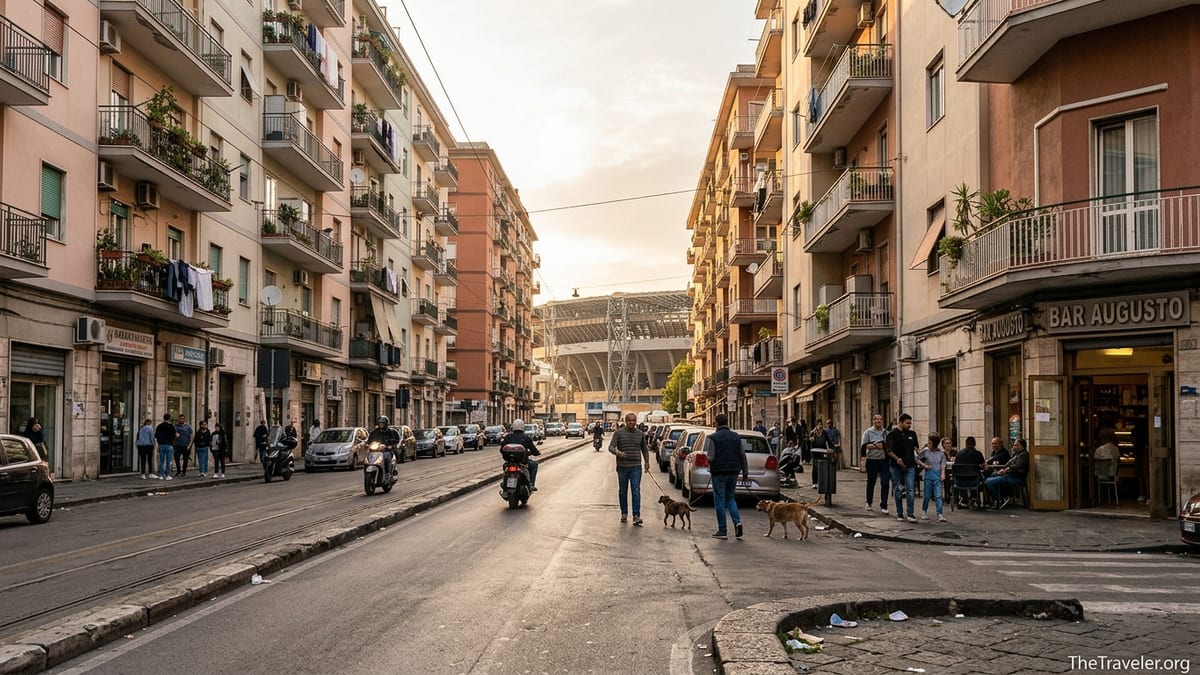
Most people come to Fuorigrotta with a single image in mind: the Stadio Diego Armando Maradona rising above the apartment blocks. On match days you feel the energy several streets away, with vendors setting up stalls selling blue Napoli scarves and panini around Piazzale Tecchio. Yet visit on a Monday morning and the scene is completely different. Children walk to school past the same gates that host Champions League nights, pensioners chat on benches under the pine trees on Viale Augusto, and the smell of espresso from corner bars drifts over the tram tracks.
What struck me is how little of Fuorigrotta is obviously aimed at visitors. Around the Campi Flegrei train station you find kebab shops, a dry cleaner, a household-goods store advertising plastic buckets and clothes racks, and a florist doing brisk trade in simple bouquets. The cafés that ring the roundabout serve tiny glasses of strong coffee across sticky counters for 1 to 1.30 euros, the same prices you find in working areas of the city rather than the waterfront promenades. No one is waving menus in English. Most people at the counter are regulars, greeted by name.
Even the streets you may have heard of, like Via Giulio Cesare and Viale Augusto, feel more like local high streets than thoroughfares to a major tourist site. Under the apartment blocks with their laundry-draped balconies sit neighborhood businesses: a stationery shop stacked with school notebooks, a fruttivendolo with crates of late-summer figs, a bar advertising cornetti filled with pistachio cream, and a betting shop where men in Napoli tracksuits watch daytime sports. You do not feel as if the area was polished up to impress you; you feel as if you have walked into someone’s everyday routine.
A Fascist-Era Plan, Lived In By Today’s Naples
Fuorigrotta’s local feeling is partly the result of its relatively recent urban history. Until the early twentieth century it was a rural district on the road toward Bagnoli. The big change came in the 1930s, when Fascist planners carved out new boulevards and built the vast Mostra d’Oltremare fairgrounds as a showcase for Italy’s colonial ambitions. Streets like Viale Augusto and Via Cintia were laid out with symmetrical facades and wide central medians planted with palms, giving the quarter its classically ordered look.
Walk those same boulevards today and the official history feels far away. On Viale Augusto, mothers park strollers in front of bakeries, scooters roar past the original rationalist facades, and a supermarket occupies what was once a bank on a prominent corner. Near the Mostra gates, university students from the nearby engineering and science faculties at the University of Naples Federico II gather at bar counters, comparing lecture notes over cheap cappuccinos. A neighborhood originally intended as a monumental entrance to a regime’s exhibition has become a practical residential area threaded with tram lines, bus routes and train stations.
That mix of monumental geometry and everyday improvisation creates odd but endearing corners. You might pass a stern white post-office building from the 1930s, all straight lines and stone, only to spot a tiny altar to the Virgin Mary set into a wall across the street, surrounded by plastic flowers and football stickers. A side lane intended as a service road to the fairgrounds now hosts a dance school, a boxing gym, and a copy shop that prints flyers for local events. The grand plan still shapes the map, but the content belongs to the people who live here now.
The Green Heart: Mostra d’Oltremare as a Neighborhood Park
On paper, the Mostra d’Oltremare is one of Italy’s major exhibition centers, a complex of pavilions, fountains and open-air spaces spread over more than seventy hectares. In practice, on many days it doubles as Fuorigrotta’s back garden. When there are no large trade fairs or conferences, local families buy low-cost admission or use resident passes to wander the internal avenues, push strollers past ornamental ponds, or sit in the shade of tall pines by the Fontana dell’Esedra’s arc of jets.
One of my strongest impressions of Fuorigrotta’s local character came on a quiet Sunday inside the Mostra. While a small home-improvement fair occupied one hall, much of the grounds felt like any city park. Children cycled along wide paths, teenagers practised TikTok dances in front of a faded modernist facade, and an elderly couple reading newspapers shared a bench overlooking the long reflecting pool. A youth football training session took over one of the grassy clearings. The architectural details were recognizably rationalist, but the usage was entirely informal and contemporary.
The Mostra grounds also host neighborhood-friendly events that rarely appear on international tourist radars. In summer there might be an open-air cinema program in the evenings, when locals bring folding chairs and packets of crisps. At other times there are craft markets, regional food festivals, or small concerts in the Teatro Mediterraneo. For travelers, this means you can experience a big-name venue not as a grand attraction but as a place where Neapolitans actually spend their free time, mingling with dog walkers and joggers instead of tour groups.
Daily Rhythms: Markets, Bakeries and University Life
The more time you spend in Fuorigrotta, the more its daily rhythms reveal themselves. Early mornings are ruled by the street markets. Around Via Metastasio and side streets off Via Giulio Cesare, stalls set up selling fruit, vegetables, cheap clothing and household items. Prices are rarely marked, but you hear cry sellers advertising two kilos of tomatoes or peaches for a few euros. Locals fill shopping trolleys for the week ahead, stopping to gossip under awnings while scooters thread politely between piles of watermelon.
Food anchors the neighborhood in other ways. On a typical corner you might find a forno advertising fresh pane cafone, traditional loaves with crackling crusts, for around 3 euros, next to a rosticceria selling slices of margherita pizza and arancini for pocket change. In the afternoons, schoolchildren crowd pastry counters for sfogliatelle and graffe dusted with sugar. Around the stadium, snack bars serve massive takeaway panini stuffed with salsiccia and friarielli, the local bitter greens. For visitors staying in an apartment, picking up ingredients from these places offers a tangible taste of ordinary Neapolitan life that is hard to find in more tourist-heavy districts.
Another key presence in Fuorigrotta is the university. Several STEM faculties of the University of Naples Federico II and other institutions have campuses here, particularly along Via Claudio and Via Nuova Agnano. This academic presence keeps cafés busy with students tapping on laptops, creates demand for low-budget trattorie offering fixed-price lunch menus, and ensures the area feels lively well into the evening. It is common to see groups of students heading to the cinema near Piazzale Tecchio or grabbing aperitivo in simple bars that put out a plate of taralli with every drink.
Getting Around: A Local Hub With Excellent Connections
Another surprise for many travelers is how well connected Fuorigrotta is, despite its suburban label. The Campi Flegrei railway station sits right in the heart of the quarter, with regional trains linking to the main Napoli Centrale station in about fifteen minutes. Metro Line 2 runs through the area, and Line 6, when fully operational, is designed to connect the seafront to Fuorigrotta with stations near the Mostra. The Cumana and Circumflegrea suburban rail lines add further options toward the Campi Flegrei coastline and beyond.
Practically, this means you can base yourself in a very local neighborhood and still reach the historic center relatively quickly. Morning commuters hop between metro and bus around Piazzale Tecchio, creating a rush-hour buzz that feels more like a transportation hub than a quiet suburb. Buses fan out to Posillipo hill, Bagnoli’s waterfront, and Soccavo, offering scenic rides past views of the Gulf of Naples. Tickets are the same integrated urban fares used across Naples, so you can move from a cappuccino in a Fuorigrotta bar to a sfogliatella near Spaccanapoli on a single €1.50 ride if you time your connections.
From a traveler’s point of view, those connections matter because they let you experience Fuorigrotta’s local flavor without sacrificing access to Naples’s headline sights. You can walk five minutes from an unpretentious guesthouse near Via Consalvo to catch a train to Pompeii, or head to the Cumana line for a short hop to the volcanic fields of Pozzuoli. In the evening you can be back in time to join locals at a pizzeria or watch the stadium lights turn on, rather than staying in the historic center with its sometimes overwhelming tourist focus.
Contrasts at Night: Match Days and Quiet Evenings
Fuorigrotta’s dual identity is most obvious after dark. On big match nights, everything revolves around the Stadio Diego Armando Maradona. Hours before kick-off, hawkers wheel in carts laden with grilled sausages and peppers, and unofficial stands materialize on side streets selling knock-off jerseys. Bars around Piazzale Tecchio overflow with fans in blue shirts, singing club songs and debating line-ups. Traffic snarls, police vans line key junctions, and the entire area hums with anticipation.
Yet on nights without matches or major concerts the atmosphere flips. The same streets feel surprisingly low-key. Viale Augusto becomes an evening passeggiata route where couples stroll past shuttered clothing shops, licking gelato from local parlors. Groups of teenagers gather on benches playing music from portable speakers. Families with young children linger around the small rides and game stalls of nearby Edenlandia, the vintage amusement park on the edge of the quarter, while the roar of the stadium is replaced by the soft rumble of trains pulling into Campi Flegrei station.
Safety-wise, Fuorigrotta feels like an ordinary working district of a big southern Italian city: lively, occasionally chaotic, but not especially menacing. As a visitor you stand out less here than in the historic center packed with visitors and tour groups. People are used to seeing students, out-of-town football fans and attendees of trade fairs, so a traveler with a small suitcase or a camera does not attract undue attention. As always in Naples, staying aware of your surroundings and avoiding deserted alleys late at night is sensible, but most of the action in Fuorigrotta happens along well-lit main roads and busy transport hubs.
How to Experience Fuorigrotta Like a Local
To get a feel for Fuorigrotta’s local side, it helps to structure a day around ordinary routines rather than big-ticket attractions. Start with a stand-up espresso and cornetto at a bar on Viale Augusto or Via Giulio Cesare, watching the morning school run. From there, wander the side streets to explore the market stalls, picking up seasonal fruit or a packet of fresh taralli. If you are staying in a rental apartment, duck into a neighborhood supermarket to see what locals actually buy: jars of friarielli, inexpensive house wine, and generous tubs of fresh ricotta in the dairy section.
Late morning is a good time to walk into the Mostra d’Oltremare, if open, and treat it as a park. Look out for joggers on the long straight avenues and office workers eating panini on steps during their lunch break. In the afternoon, consider taking the Cumana train from Fuorigrotta or nearby stations like Mostra to explore the seafront of Bagnoli or the archaeological sites around Pozzuoli, then return in time for an early evening aperitivo in one of the bars near Piazzale Tecchio.
Food is an easy way to plug into the neighborhood. Pizzerias around Fuorigrotta often offer both sit-down meals and takeaway slices at modest prices, catering to students and stadium-goers. You might pay around 6 to 8 euros for a classic margherita, a little less than in heavily touristed areas. For dessert, stop at a pasticceria that has trays of babà soaked in rum and glass cases piled with sfogliatelle. You will probably find yourself surrounded by families picking up sweets for Sunday lunch rather than influencers seeking the latest Instagram shot.
The Takeaway
Fuorigrotta challenged my assumptions about what a suburban sports and exhibition district would feel like. Instead of a sterile zone that springs to life only when a game or fair is on, I found an area deeply rooted in Neapolitan daily life. The rationalist avenues and monumental gateways are just the backdrop to scenes that repeat every day: kids dragging schoolbags, nonni comparing vegetable prices, students cramming for exams over cheap espresso, commuters lining train platforms before dawn.
For travelers willing to look beyond the postcard views of the bay and the tight lanes of the historic center, Fuorigrotta offers a different perspective on Naples. It is a place where you can stay in a modest guesthouse, shop at markets, share park benches with locals inside a vast 1930s fairground, and still be minutes away from Baroque churches and archaeological treasures by train. What surprised me most was not any single sight, but the realization that here, in the shadow of a famous stadium, Naples lives very much for itself.
FAQ
Q1. Is Fuorigrotta a good base in Naples for first-time visitors?
Yes, if you prefer a local, residential atmosphere over being in the middle of the historic center. Transport links are good, but you will not have major sights on your doorstep.
Q2. How long does it take to reach central Naples from Fuorigrotta?
Using the regional trains or Metro Line 2 from Campi Flegrei station, you can usually reach the main station area or historic center in about 15 to 25 minutes.
Q3. What is the atmosphere like on match days near the Stadio Diego Armando Maradona?
On match days the streets around the stadium are very lively, with crowds, street food stalls and loud chants. It is energetic and busy but generally festive rather than hostile.
Q4. Is Fuorigrotta safe to walk around at night?
Fuorigrotta feels like a typical working neighborhood. Main streets and areas around stations stay busy into the evening, though basic urban precautions are still advisable.
Q5. Are there interesting things to do in Fuorigrotta besides football?
Yes. You can explore the Mostra d’Oltremare grounds, visit Edenlandia amusement park, go to the cinema, enjoy local pizzerias, and use the area as a base for trips to the Campi Flegrei.
Q6. What kind of accommodation can I expect to find in Fuorigrotta?
Accommodation tends to be simple hotels, B&Bs and apartment rentals rather than luxury properties. Many places cater to students, conference visitors and football fans.
Q7. Is Fuorigrotta convenient for visiting Pompeii and other archaeological sites?
You can reach Naples’s main train hubs from Fuorigrotta and connect to services for Pompeii and other sites. It adds a short extra leg compared with staying near the central station.
Q8. Are restaurants and cafés in Fuorigrotta tourist-friendly?
Most places are aimed at locals, but staff are used to visitors for matches and fairs. Menus may be in Italian only, yet a few key words and some pointing usually work fine.
Q9. What is the price level for food and drinks in Fuorigrotta?
Prices are often a little lower than in the historic center. Expect roughly 1 to 1.50 euros for an espresso and around 6 to 8 euros for a standard margherita pizza.
Q10. When is the best time of year to experience Fuorigrotta’s local life?
Spring and autumn are ideal, when the weather is pleasant and there are regular events at the Mostra d’Oltremare and the stadium, but daily routines still dominate the neighborhood.