


Airport lounge access is one of those perks that sounds luxurious on paper but can feel very different once you are actually standing in a crowded terminal at 6 a.m. with a delayed flight. For United flyers, the United Club Infinite Card is marketed as the all-in lounge solution, bundling a full United Club membership into a single ultra-premium credit card. After comparing its benefits with day passes, annual lounge memberships, Priority Pass networks and even United’s own Polaris Lounges, a much more nuanced picture emerges of what this card is really like in day-to-day travel.
Get the latest updates straight to your inbox!
What the United Club Infinite Card Actually Includes
The United Club Infinite Card is Chase and United’s top-tier co-branded credit card. As of 2026 it carries a $695 annual fee and is positioned as a premium product with heavy emphasis on lounge access for frequent United travelers. The headline feature is that the card comes with a United Club membership for the primary cardholder, which is effectively the same membership you could otherwise buy directly from United, now rebranded under “The New United Club Card” language on Chase’s site.
In practice, that membership gets you access to United Club lounges whenever you are flying United or another Star Alliance airline on the same day. The membership shows inside your United app under Passes and Subscriptions, so you do not need to carry a separate physical membership card. At check-in desk level, agents see you as a full United Club member rather than simply as a premium credit card holder, which matters when they are enforcing rules on guests or access at partner lounges.
The membership that comes with the Infinite Card is typically the “individual” level, which covers the primary cardholder. Frequent flyers who hold Star Alliance Gold status, like United Premier Gold or higher, or those who hit a specified annual spend threshold on the card, may be upgraded to an “All Access” style membership, which expands the ability to bring guests and use more partner lounges. For many travelers, the key benefit is simple: walk into any open United Club on your itinerary, show your same-day boarding pass and you are in, without thinking about per-visit fees.
Beyond lounges, the Infinite Card layers on two free checked bags on United-operated flights for the cardholder and a companion on the same reservation, Premier Access priority services at the airport, elevated earning on United spending, and the ability to earn Premier qualifying points through spend. These are relevant, but for most travelers considering this card the single biggest question is whether the lounge access itself justifies the fee compared with cheaper or more flexible options.
How United Club Access Works in the Real World
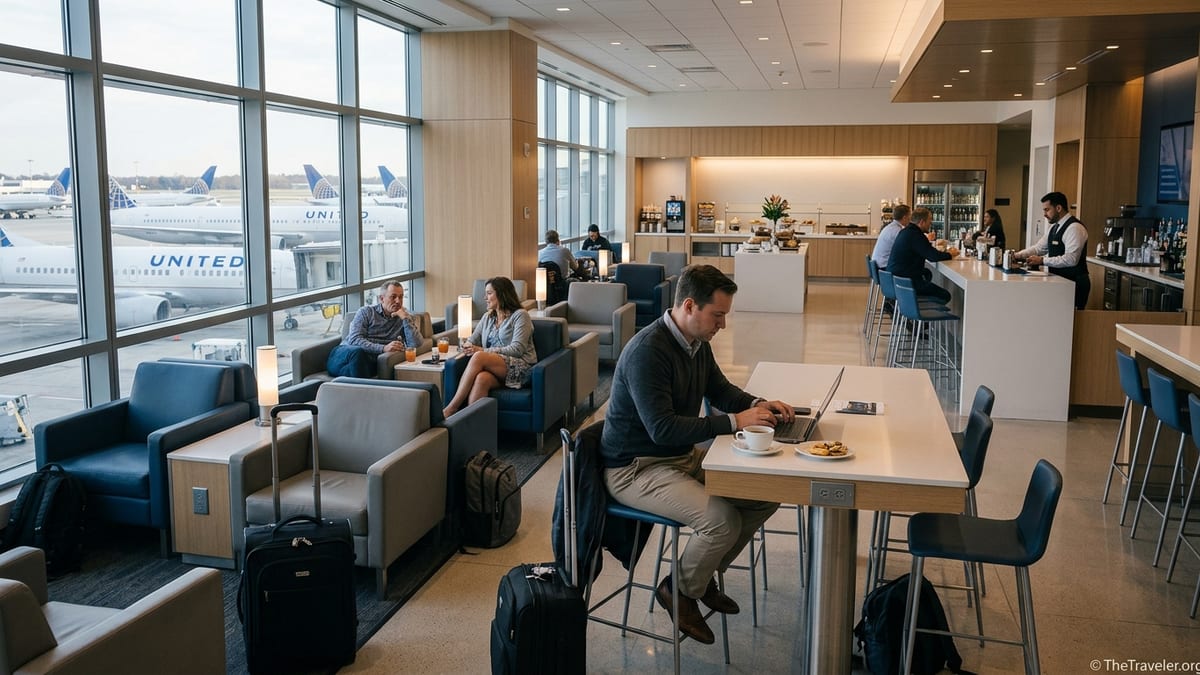
Understanding how the card feels in practice starts with how United Clubs operate in 2026. United’s lounge network has grown to more than 45 United Club locations across major hubs such as Denver, Chicago O’Hare, Houston Intercontinental, Newark, San Francisco and Washington Dulles, plus busy non-hub airports like Austin and San Diego. A typical United Club offers comfortable seating, power outlets, self-serve buffets with snacks and light meals, a staffed bar with complimentary beer and wine, and upgraded cocktails for purchase.
Access rules are relatively straightforward day to day. With the Infinite Card’s built-in membership, you can use United Clubs at your departure, connecting or arrival airports, as long as you have a same-day boarding pass on United or a Star Alliance carrier. In practice, that means you might stop into the lounge at Denver before a 7 a.m. flight, duck into the club again during a two-hour layover in Houston, and even grab a quick drink at the Newark club after landing, all on the same itinerary with no extra fees.
Partner and Star Alliance lounge access is where real-world experiences start to diverge. Cardholders report that in some overseas airports, particularly in Europe and South America, the United Club membership encoded through the Infinite Card is recognized at Star Alliance-branded lounges or partner carrier lounges, while at other locations staff may insist on seeing a physical United Club membership card or may default to Star Alliance status rules. The most consistent experience is at United-branded clubs in United hubs, where the Infinite Card membership is clearly understood by staff and the United app display is enough to be scanned at the door.
There are also hidden benefits that do not appear on glossy marketing copy. Many regular United flyers value the dedicated customer service desks inside United Clubs, staffed by experienced agents who can rebook missed connections, reroute baggage or handle complex same-day changes much faster than packed gate podiums. On bad-weather days at hubs like Chicago or Newark, having a quiet desk inside the club can easily save you an hour in line and sometimes makes the difference between getting home that night or sleeping in an airport hotel.
Comparing Lounge Access to Day Passes, Memberships and Priority Pass
A key question for any traveler is how the Infinite Card compares to simply paying per visit or purchasing a standalone membership. As of early 2026, a one-time United Club day pass costs about 59 dollars per person when purchased through United’s app or at the lounge door. Some airports see slightly higher or lower prices, but most travelers encounter a range from roughly 59 to the high 60s for a single visit. That means that if you expect to visit a United Club more than around ten times a year, the raw math can quickly start to favor the Infinite Card over paying cash per visit.
Standalone annual United Club memberships vary in price by elite status, but are generally in the mid-hundreds of dollars. Flyers without United elite status can easily see pricing around or above the Infinite Card’s 695 dollar annual fee for a new membership purchased directly from United, though Premier members may receive discounted rates. Because the Infinite Card’s fee is in the same ballpark, cardholders essentially trade a direct lounge membership for a credit card that bundles in the membership plus a suite of additional perks and the opportunity to offset some of that fee with United travel credits and card rewards.
Compared with Priority Pass, which is bundled with many premium cards like the Chase Sapphire Reserve or The Platinum Card from American Express, the Infinite Card is narrower but deeper. Priority Pass gives access to a patchwork of independent lounges, cafes and sometimes minute suites worldwide, but it generally does not include United Clubs in the United States. A traveler flying Denver to Newark on United with a Priority Pass card may find there is no Priority Pass lounge accessible in Terminal B or C, but an Infinite Card holder can reliably walk into the nearest United Club, grab coffee, work at a desk and use fast Wi-Fi.
In real terms, the choice often comes down to your pattern of travel. A business traveler flying United or Star Alliance 40 to 50 times a year, often through United hubs like Houston, O’Hare or San Francisco, will likely get far more consistent value out of the Infinite Card than from a primarily Priority Pass-based strategy. On the other hand, a leisure traveler who flies multiple airlines and spends more time at international non-Star Alliance hubs might find Priority Pass or competing premium cards more flexible.
United Club vs Polaris Lounge: What You Do Not Get
One of the most common misconceptions about the United Club Infinite Card is that it somehow unlocks United’s Polaris Lounges. It does not. United Polaris Lounges are a different tier of space entirely, reserved for eligible long-haul international business class passengers on United and select Star Alliance partners. There are only a handful of Polaris locations, such as Chicago O’Hare, Newark, San Francisco, Houston, Los Angeles, Washington Dulles and a newer lounge at Denver, and they offer amenities like restaurant-style dining, a-la-carte menus, barista coffee, shower suites and quiet daybeds.
Access to these Polaris Lounges is tied strictly to the ticket you are flying, not the card in your wallet. Even a full United Club membership does not open the door unless you also hold an eligible Polaris or partner business class boarding pass on a same-day international itinerary. That means an Infinite Card holder flying economy from Newark to London will be directed to the standard United Club in Terminal C, not to the nearby Polaris Lounge, regardless of how high their annual fee is.
For many travelers, this distinction only becomes clear in the moment. Imagine a traveler with the Infinite Card connecting through Chicago O’Hare on a trip from New York to San Francisco, seeing signage for the renovated Polaris Lounge near the international gates. Despite the branding and the obvious premium feel, they will be turned away at the Polaris entrance and guided to one of the several United Clubs in Terminal C, which offer solid but less extravagant food and amenities. Understanding this difference ahead of time prevents disappointment and helps set realistic expectations about what the card can and cannot do.
What you are really buying with the Infinite Card is reliable access to the broader United Club network, not a shortcut into United’s top-shelf international lounges. For most domestic and short-haul international flyers, that is still a meaningful comfort upgrade, but it is not the same as having guaranteed access to Polaris-level dining, showers and dedicated quiet zones.
What a Typical Lounge Day Looks Like With the Card
To see how the Infinite Card plays out in daily travel, consider a frequent business flyer based in Denver with a typical work week itinerary: Monday morning Denver to Houston, connecting onward to Orlando; Wednesday night Orlando back to Houston; and Friday evening Houston home to Denver. With the Infinite Card’s United Club membership, this traveler could visit the Denver club before departure, stop into the newer United Club near the C gates at Houston during the connection, and then repeat the pattern on the way back, easily logging four or five lounge visits in a single work week.
Each stop might include a light breakfast or afternoon snack, coffee, a glass of wine before an evening flight and an hour of quiet time at a desk with reliable Wi-Fi. Over the course of a year, a traveler repeating this rhythm twice a month might use United Clubs more than 80 times. If that same traveler bought day passes at 59 dollars each, they would spend well over 4,000 dollars annually just on lounge visits, far surpassing the card’s fee even before considering the value of checked bags, priority services and miles earned on flights.
By contrast, picture a leisure traveler who flies United from Chicago to Phoenix twice a year to visit family and takes one international trip to Cancun. With the Infinite Card, they could stop in at the United Club near their departure gates at O’Hare and Phoenix for each leg, enjoying quieter seating and snacks instead of crowded gate areas. However, that adds up to maybe 8 to 10 lounge visits per year. At current day-pass pricing, they could replicate much of the lounge experience with ad hoc passes for around 500 to 600 dollars annually, which may not justify locking in a 695 dollar yearly card fee unless they also highly value the card’s baggage and priority perks.
Real-world user feedback often highlights crowding as a variable factor. At peak times, such as Sunday afternoons at hubs like Newark or Monday mornings in San Francisco, clubs can feel busy, with limited seats and lines for espresso machines or bars. At off-peak times, like mid-morning on a Tuesday at Denver or mid-afternoon in Houston, lounges may feel far more spacious and relaxed. The Infinite Card does not guarantee a seat, but it does give you access to any open club on your route, making it easier to walk a few gates to find a quieter location if your first choice is packed.
Who Really Gets Value From the United Club Infinite Card
When you compare the Infinite Card’s lounge benefits against alternatives, certain traveler profiles emerge as clear winners. High-frequency United flyers who consistently route through United hubs are at the top of that list. Think of consultants, sales reps and tech workers who fly United or other Star Alliance carriers two or three times a month, often on itineraries with connections. For them, consistent access to United Clubs at departure, during layovers and on arrival can turn otherwise lost time into productive work blocks, meals and short decompression breaks.
United loyalists who already spend heavily on the airline also see outsized value. Someone who books multiple long-haul flights in premium cabins or spends tens of thousands of dollars annually on United tickets can take advantage of the card’s elevated earning rates on United purchases and the ability to earn Premier qualifying points through everyday spending. Combined with the fact that United Club memberships purchased directly from the airline can cost a similar amount to the card’s fee, bundling everything into the Infinite Card can make financial sense, especially if they can also use the card’s credits and protections.
On the other hand, travelers who mostly fly non-Star Alliance carriers or who rarely pass through airports with United Clubs may find the lounge benefit underwhelming. A frequent Delta flyer who holds the Infinite Card solely to access a handful of United Clubs per year on occasional trips is almost certainly overpaying compared with a more airline-agnostic product that comes with Priority Pass and broader transfer partners. Likewise, casual travelers who take one or two trips a year might be better served by paying for day passes on those specific journeys rather than carrying a heavy-fee card whose headline perk they rarely use.
Families should think carefully about guesting policies. The Infinite Card’s bundled membership typically allows the cardholder to bring one adult guest or a spouse and children under a certain age, though details can vary and are subject to United’s lounge rules at the time. For a family of four traveling together from Newark to Orlando once or twice a year, relying on the card’s guest allowance might work well at quieter times, but on peak holidays, clubs could restrict access or enforce capacity caps more strictly. In those cases, cardholders sometimes report being asked to wait before all family members can be admitted.
The Takeaway
After comparing the United Club Infinite Card’s lounge benefits against day passes, standalone memberships, competing premium cards and United’s own Polaris Lounges, the card emerges as a powerful but very specific tool. It delivers strong value for travelers who spend a lot of time flying United or Star Alliance through airports with United Clubs, turning noisy gate areas into a network of reliable rest stops and workspaces. For those flyers, the ability to walk into a club in Denver, Houston, Newark or Chicago several times each month can more than justify the annual fee.
At the same time, the card is not a magic key that opens every premium lounge with a United logo. It does not grant access to Polaris Lounges, and it offers limited benefits in airports without United Clubs or partner lounges that honor United Club membership. Travelers who favor other airlines, rely on a mix of global routes or simply do not fly that often may find more flexible value in cards anchored around Priority Pass or bank-operated travel credits instead.
Thinking about the Infinite Card purely as “lounge access” also undersells the broader package. Free checked bags, priority airport services, enhanced earning on United tickets and the ability to earn progress toward elite status all add incremental value. Ultimately, the card works best for a traveler who is already deeply tied into United’s ecosystem and who sees the lounges not as a rare treat, but as part of a weekly commuting rhythm through major hubs.
If that describes you, the Infinite Card’s lounge benefit can transform your United journeys from a series of crowded concourses into a familiar network of comfortable stops across the country. If not, you may be better off buying the occasional day pass and putting the rest of your annual fee budget toward a card that matches the way you actually travel.
FAQ
Q1. Does the United Club Infinite Card get me into United Polaris Lounges?
No. The card includes a United Club membership, which only grants access to standard United Clubs. Polaris Lounges are reserved for eligible international business class passengers and are not opened by any credit card on its own.
Q2. How many times can I visit United Clubs each year with the Infinite Card?
There is no published limit on how many times you can visit as long as you have a valid same-day boarding pass on United or a Star Alliance carrier and the lounge is open. Many frequent flyers use clubs multiple times per week without issues.
Q3. Can I bring guests into United Clubs with my Infinite Card membership?
Usually you can bring one adult guest or a spouse and dependent children under a set age, but exact rules are determined by United’s lounge policy at the time of travel. Capacity controls may limit guests during very busy periods.
Q4. Will my United Club Infinite Card get me into Star Alliance partner lounges overseas?
Often yes, but not always. In many international airports, United Club membership is accepted at Star Alliance-branded or partner lounges when you are flying a Star Alliance airline. However, some lounges apply stricter local rules or prioritize elite status, so experiences can vary.
Q5. Is the Infinite Card worth it if I only fly a few times per year?
Probably not. If you take only one or two round trips annually, buying United Club day passes for those specific trips will usually cost less than the card’s annual fee, unless you also heavily value its baggage and priority benefits.
Q6. How does the Infinite Card compare with cards that offer Priority Pass?
The Infinite Card is better for regular United flyers because it provides consistent access to United Clubs, which are generally not part of Priority Pass. Priority Pass cards, on the other hand, are more flexible if you fly multiple airlines and spend time in airports without United lounges.
Q7. Do I need to show the physical credit card to enter a United Club?
Typically no. Your United Club membership from the Infinite Card appears in your United app under Passes and Subscriptions, and lounge agents can scan your boarding pass and confirm access. Carrying the card is useful but not usually required for entry.
Q8. Does the Infinite Card cover my family’s checked bags or just mine?
The card’s baggage benefit usually covers the primary cardholder and one companion traveling on the same reservation when flying United-operated flights. This can significantly reduce or eliminate checked bag fees for couples or small families.
Q9. Will holding the Infinite Card help me earn United elite status faster?
Yes, to a degree. The card offers the ability to earn Premier qualifying points from everyday spending up to a set annual cap, and also includes a small annual PQP bonus. These can complement, but not replace, status earned through flying.
Q10. What happens to my lounge access if I cancel the United Club Infinite Card?
If you cancel the card, your bundled United Club membership ends. Lounge access will stop as of the membership expiration date linked to your card, and you will need either a new membership, eligible elite status or another form of access to continue using United Clubs.