


Princeton’s ivy-draped campus is what draws many visitors, but the town itself offers far more than collegiate nostalgia. Step beyond the university gates and you will find a walkable community layered with Revolutionary War history, a serious arts and theater scene, peaceful canal paths, and a compact downtown packed with independent shops and ambitious restaurants. Whether you are in town for a day trip from New York or Philadelphia or planning a relaxed weekend, Princeton rewards anyone willing to look past the orange and black.
Get the latest updates straight to your inbox!
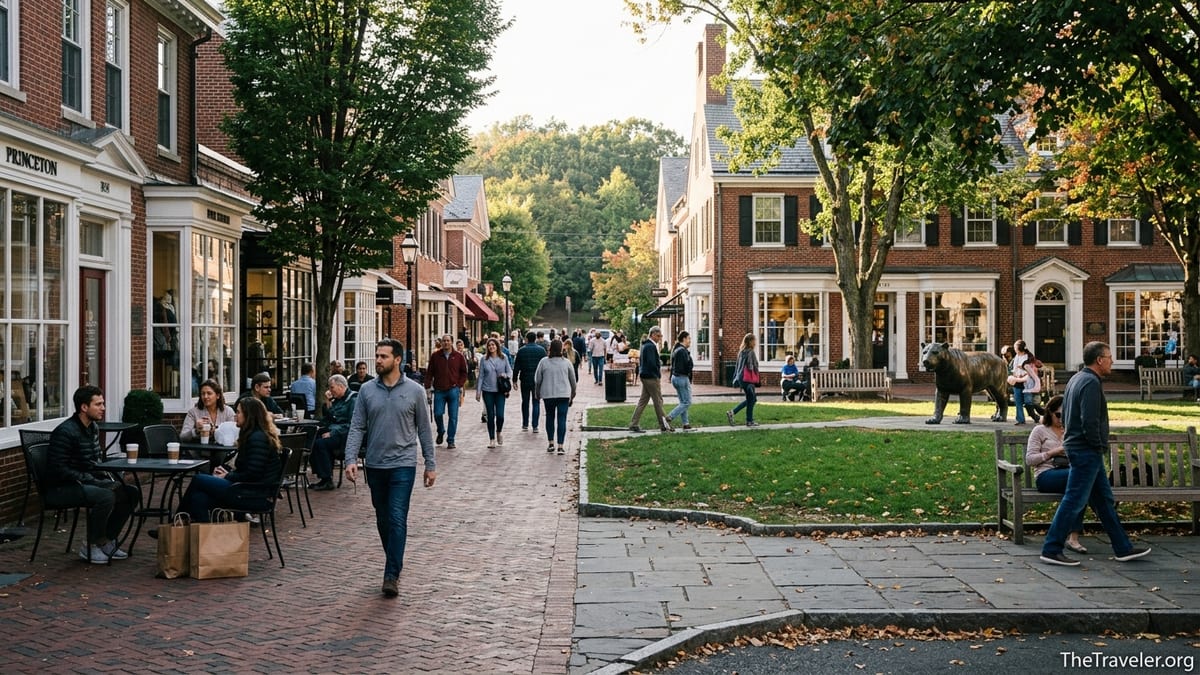
Stroll Historic Streets and Linger in Palmer Square
Downtown Princeton is small enough to explore on foot, but dense with character. Start on Nassau Street, the main commercial strip that runs along the northern edge of campus, and let yourself wander into the side streets that fan out from it. The architecture shifts from brick storefronts to clapboard houses and early twentieth century apartment buildings within a few blocks, reflecting the town’s long history as both a college village and a commuter hub for New York and Philadelphia. Tree-lined streets and pocket parks make it a pleasant place to explore at a leisurely pace rather than racing from one attraction to the next.
Palmer Square is the heart of this compact center and feels a little like a village green ringed by shops and cafes. Built in the late 1930s in a Colonial Revival style, it wraps around a small central lawn and a bronze tiger statue, with the historic Nassau Inn anchoring one side. Here you will find a mix of national brands and independent spots: a beloved ice cream shop where lines form most evenings in warm weather, a long-running record store just off the square, and several boutiques that range from outdoor gear to high-end fashion. Prices are on par with an upscale suburb; expect to pay city-level prices for a sit-down lunch or a glass of wine, and slightly more than you might in a typical New Jersey town for coffee or dessert.
Palmer Square is also one of the best places in Princeton to simply sit and people-watch. Grab a coffee from a local roaster on Witherspoon Street, or an artisanal scoop from the ice cream shop on the square, and find a bench or low wall facing the lawn. On sunny weekends you are likely to see street musicians performing, kids running around the grass, and a steady stream of students, faculty, and visitors drifting between campus and town. In the winter, a seasonal ice-skating rink sometimes appears on the square, while spring and fall often bring outdoor art displays or small festivals to the surrounding streets.
If you are driving, downtown parking can be tight during peak dining hours or big campus events, but it is manageable with a little planning. Multi-level garages near Spring Street and Palmer Square typically charge an hourly rate that is lower than big-city garages, and meters on side streets offer short-term options if you are just dropping in for a meal or a quick browse. Once you park, you do not need your car again until you leave town; nearly everything in this part of Princeton is within a ten-minute walk.
Step Inside Morven Museum & Garden
Just a short walk from Palmer Square along Stockton Street sits Morven Museum & Garden, a stately 18th century mansion that once served as the New Jersey governor’s residence. Today it operates as a small museum dedicated to state and local history, with galleries inside the house and several acres of landscaped grounds outside. The mansion’s interiors are furnished to reflect different eras of its long life, from its beginnings as a private home to its years as an official residence, giving a layered sense of how elite life in Princeton evolved over time.
Morven is open to the public from Wednesday through Sunday, generally from late morning to mid afternoon, and standard adult admission is typically in the mid-teens in US dollars, with discounts for seniors, students, and children. Tickets normally include access to both the galleries and the grounds. Guided tours, when offered, add context to the decorative arts and political history on display, but independent visitors can also move through at their own pace and make use of printed guides or short interpretive panels in each room.
The gardens are a highlight even if you are not a devoted museum-goer. A formal walled garden, seasonal flower beds, and quiet lawns shaded by mature trees create a peaceful contrast to the busier streets downtown. In spring and early summer, the beds are full of color and bees, while in autumn the trees frame the old house in rich reds and golds. Because the garden is open daily from dawn to dusk, you can time a visit to catch morning light or a late-afternoon stroll even on days when the museum itself is closed. It makes for a good picnic spot if you grab sandwiches from a Nassau Street deli and want a quieter place to eat.
Morven frequently hosts temporary exhibitions and evening events that go beyond traditional house museum fare. These can range from shows on New Jersey’s role in national politics to displays focused on local artisans or photography. Seasonal programs might include outdoor concerts on the lawn, holiday house tours, or family days with hands-on activities. It is worth checking what is on when you are planning a trip, especially if you are traveling with children or looking for something to do in the early evening that does not revolve around bar-hopping.
Walk a Revolutionary War Battlefield
Princeton’s Revolutionary War history is easy to overlook if you spend all your time on campus, but just a short drive from downtown lies Princeton Battlefield State Park. This expanse of open fields and woodlot marks the site of the Battle of Princeton, fought on January 3, 1777, when George Washington’s Continental Army confronted British forces in a key campaign following the victory at Trenton. Today the park preserves several hundred acres of the battlefield, with interpretive signs that explain the movements of troops and the significance of the engagement in turning momentum toward the American side.
The landscape is surprisingly tranquil considering its violent past. A broad meadow, known as the Maxwell Field, stretches out from the parking area, bordered by trees that provide shade in summer and color in fall. Short trails lead visitors past monuments and historic structures such as the Clarke House, a farmhouse that served as a field hospital during the battle. Although the interior of the house is not always open, the exterior and surrounding grounds are accessible, and simple panels provide historical background even when buildings are closed.
Admission to Princeton Battlefield State Park is currently free, which makes it an easy low-cost addition to any visit. There are basic amenities such as parking and restrooms, but services are limited compared with larger state parks, so bring your own water and snacks. The park is open during daylight hours, and it rarely feels crowded outside of special events or reenactments. Many locals use the open fields for casual walks and jogging, so it has the relaxed feel of a neighborhood park layered onto its national historical significance.
A visit here pairs well with a stop at the Princeton Battle Monument near the intersection of Nassau Street and Stockton Street back in town. The monument, a massive stone sculpture dedicated in the early twentieth century, commemorates Washington’s leadership in the campaign and visually anchors the western end of Nassau Street. Taken together, the monument and the battlefield help frame Princeton not only as a college town, but also as a place where the revolutionary story of the United States played out in real time.
Bike, Run, or Paddle Along the Delaware and Raritan Canal
One of Princeton’s greatest assets for outdoor lovers is the Delaware and Raritan Canal State Park, a long, linear park that follows a nineteenth century canal and its towpath through central New Jersey. In the Princeton area, the towpath runs alongside Lake Carnegie, creating a corridor of water, trees, and wildlife that feels far removed from the nearby highway network. A flat, graded trail along the canal is popular for walking, jogging, and cycling, and it connects to other local parks and residential neighborhoods, making it possible to design anything from a short afternoon stroll to a full-day bike ride.
Access points near Princeton include trailheads at Alexander Road, Washington Road, and Harrison Street, all just a few minutes’ drive or a moderate walk from downtown. At each crossing you will usually find a small parking area or pull-off where you can leave a car, though these can fill up on the first warm weekends of spring. The surface in this section is generally hard-packed dirt or fine gravel, which is suitable for most hybrid or gravel bikes as well as sturdy city bikes; skinny racing tires can handle it, but you will feel every bump. Because the path is shared, expect to encounter anglers, families with strollers, and runners, and plan to ride or walk with a bit of patience.
If you are not traveling with a bike, ask at your hotel or a local shop about rentals; availability can vary, but weekend visitors often find basic bikes for a half-day or full-day fee that is comparable to urban bike rental prices. A popular route for visitors is to start near Alexander Road and head east along the canal, with Lake Carnegie glinting through the trees on one side and the canal on the other. You can ride for several miles without crossing busy streets, listening to birds and the distant clack of oars from university rowing teams practicing on the lake.
On hot days, being near the water is a relief even if you are not getting in it. Limited paddling access is available along parts of the canal, and in-season you may see people in kayaks or canoes moving at a leisurely pace under stone bridges. Even without equipment, simply walking a mile or two along the towpath is enough to experience the wildlife corridor that the canal has become. Herons, turtles, and the occasional fox or deer are all possible sightings, especially early in the morning or near dusk. Pack insect repellent in summer, wear sturdy shoes that you are not afraid to get dusty, and bring water because there are few services directly along the trail.
Immerse Yourself in Princeton’s Arts and Theater Scene
For a town of roughly thirty thousand residents, Princeton has an unusually rich arts scene, much of it accessible to visitors. While the university’s own galleries and performance spaces are a major part of that picture, there are also independent institutions and venues that give the town a cultural life beyond the campus calendar. If you enjoy live theater, for instance, it is worth planning an evening around a performance at McCarter Theatre Center, a Tony Award winning regional theater that presents a mix of new plays, classics, and touring productions.
McCarter has two primary performance spaces: a larger proscenium theater and a more intimate black-box style space that often hosts experimental or smaller-scale works. The season typically runs from fall through late spring, with some summer programming as well. Ticket prices vary widely depending on the production and seating, but visitors can usually find weeknight tickets in the lower price tiers if they book early, while weekend prime seats command prices closer to those of major city theaters. In addition to plays, McCarter’s schedule often includes concerts, dance performances, author talks, and family-oriented events, making it a flexible option if you are not a traditional theater fan.
In town, the Arts Council of Princeton operates out of a building on Witherspoon Street and runs exhibitions, classes, and community events. Its galleries usually offer free admission and showcase work by regional artists in a variety of media, from painting and ceramics to photography and mixed media installations. Stopping by can be a good way to connect with the local creative community, especially if you are visiting during one of the town’s art walks or festivals, when outdoor performances and pop-up installations spill into nearby streets and plazas.
Cinema lovers should not overlook the Princeton Garden Theatre, an independent movie house just off Nassau Street that programs a mix of first-run films, documentaries, and repertory screenings. On any given week you might see a mainstream release sharing the marquee with a foreign-language drama or a classic Hollywood film. Tickets are generally a bit cheaper than big multiplexes in the region, and the atmosphere feels more like a neighborhood cinema than a corporate chain. For a low-key night out, pair an early evening showing with a simple dinner on Witherspoon Street or Palmer Square.
Eat and Drink Your Way Around Town
Princeton’s dining scene is more varied than you might expect for a town its size, thanks in part to a steady flow of students, faculty, and commuters who keep demand high for everything from budget-friendly falafel to white-tablecloth tasting menus. Much of the action is concentrated along Nassau Street, Witherspoon Street, and around Palmer Square, where you can easily browse menus in windows before committing. Prices reflect Princeton’s affluence: a casual sit-down lunch often lands in the 15 to 25 dollar range per person before tax and tip, while dinner at popular mid-range restaurants can run 30 to 40 dollars per person without drinks.
For a quick lunch, options range from ramen and noodle shops to burrito counters and salad bars. A long-standing pancake house on Nassau Street is popular for hearty breakfasts and brunch, while small delis and bakeries turn out sandwiches you can take to nearby Hinds Plaza or the lawn at Morven. Coffee culture is strong here too. Several independent cafes in the downtown core cater to laptop workers and small meetups, each with a distinct personality: one might have mismatched furniture and students cramming for exams, another minimalist decor and a quiet, date-friendly vibe.
Dessert and snack stops are almost a subculture of their own in Princeton. An artisanal ice cream and sorbet shop on Palmer Square is widely considered a must-visit, drawing devotees for inventive flavors that change with the seasons, while a classic scoop shop just off the square offers a more traditional lineup that appeals to kids and nostalgic adults. There are also patisseries, frozen yogurt spots, and a handful of candy and chocolate stores within a few blocks of one another, so sweet-toothed travelers can design their own dessert crawl without ever moving their car.
In the evening, bars and restaurants around Witherspoon Street and Palmer Square fill with both locals and visitors. Wine bars pour by-the-glass lists that showcase European and American producers, and some offer small plates menus that can function as a light dinner. There are also a couple of cozy pubs and taprooms pouring regional craft beers alongside standard lagers. While Princeton is not a late-night party town, you will find lively patios and barrooms until around midnight on weekends, particularly when the university is in session. If you prefer a quieter night, consider an early dinner followed by a canal-side walk or a performance at McCarter.
Explore Neighborhood Parks, Plazas, and Family-Friendly Spots
Beyond the marquee attractions and the canal, Princeton has a network of smaller parks and plazas that add to its livability and appeal for visitors, especially those traveling with children. Hinds Plaza, adjacent to the public library just off Witherspoon Street, functions as a kind of urban living room. Tables and chairs spill out from nearby cafes, and families often stop here to let kids run around between errands or after picking up books. Free public events such as outdoor concerts and film screenings occasionally take place here in warmer months.
For more traditional playgrounds and open fields, neighborhood parks around Princeton offer swings, climbing structures, and sports fields that are open to the public when not reserved. These spaces can be particularly useful for breaking up a day of more adult-oriented sightseeing. Pack a simple picnic from a grocery store or market in town and let younger travelers burn off energy while adults relax under mature shade trees that have helped earn Princeton recognition as a long-standing Tree City USA community.
Families might also enjoy browsing toy stores and bookshops downtown. Independent bookstores near Nassau Street carry a deep selection of children’s titles as well as local interest books about New Jersey history and nature, while a colorful toy shop just north of Palmer Square stocks puzzles, games, and educational toys that are more interesting than generic big-box offerings. These small-scale stops rarely require a dedicated trip on their own, but woven into a broader day in the center they give younger visitors something to look forward to between meals and museum visits.
If you have access to a car and want to expand your radius beyond Princeton proper, consider a side trip to Grounds For Sculpture in nearby Hamilton, a large outdoor sculpture park and botanical garden about a twenty-minute drive away. The combination of large-scale contemporary art and landscaped grounds offers a very different feel from the brick and stone of downtown Princeton, and many pieces are interactive or visually playful enough to keep kids engaged. Tickets for Grounds For Sculpture are timed and usually cost in the mid- to high-twenties for adults, with reduced rates for children and seniors, so it is worth reserving ahead on busy weekends.
The Takeaway
Princeton may be internationally known for its university, but the town around the campus more than holds its own as a destination. Within a compact, walkable area you can trace the arc of American history from Revolutionary battlefields to gubernatorial mansions, immerse yourself in live theater and independent film, and step straight from brick-lined streets into a green ribbon of canal-side trail. The mix of historic preservation and contemporary culture gives the place a depth that rewards more than a rushed campus tour.
For visitors, that means options. You can design a day that balances indoor and outdoor time, quiet gardens and crowded cafes, kid-friendly parks and grown-up evenings at the theater. Prices tend to reflect Princeton’s status as an affluent community, but with free or low-cost highlights like the canal, the battlefield, local parks, and many art spaces, it is possible to experience the best of the town without overspending. Plan your visit with a rough outline, keep an eye on local events and opening hours, and leave space for serendipity when a side street, sunny bench, or unexpected gallery draws you in.
FAQ
Q1. How many days do I need in Princeton if I want to see more than just the university?
One full day is enough for a taste of downtown, the canal towpath, and a museum, but a weekend stay lets you add the battlefield, Morven, and an evening show without rushing.
Q2. Is it easy to get around Princeton without a car?
Yes. The downtown area, campus edge, and many attractions are walkable from each other, and local buses and ride-hailing apps can cover short trips to places like the battlefield or canal trailheads.
Q3. When is the best time of year to visit Princeton beyond campus tours?
Spring and fall are especially appealing, with comfortable temperatures, colorful foliage or blossoms, and busy arts calendars. Summer is quieter but pleasant, while winters can be cold and occasionally snowy.
Q4. Are there free things to do in Princeton besides walking around campus?
Yes. Highlights include strolling Palmer Square, accessing portions of the Delaware and Raritan Canal towpath, visiting local parks, viewing downtown public art, and exploring the Princeton Battle Monument and Battlefield State Park.
Q5. Can I visit Princeton as a day trip from New York City or Philadelphia?
Absolutely. Direct trains connect both cities to Princeton Junction, with a short shuttle or taxi ride into town. Many visitors arrive mid-morning, spend the day exploring downtown and nearby sites, and return in the evening.
Q6. Is Princeton family-friendly for travelers with children?
Very. Children enjoy the open spaces of the battlefield, canal paths, playgrounds, ice cream shops, toy stores, and occasional hands-on programs at museums and the arts council.
Q7. What should I budget for food in Princeton?
Expect coffee or snacks to be similar to big-city prices, casual lunches in the 15 to 25 dollar range per person, and sit-down dinners from about 30 dollars per person before drinks, tax, and tip.
Q8. Do I need to book tickets in advance for attractions like Morven or McCarter Theatre?
For Morven, same-day admission is often available, though special events can fill quickly. For McCarter, booking ahead is strongly recommended, especially for weekend performances or popular shows.
Q9. Is the Delaware and Raritan Canal towpath suitable for all fitness levels?
Yes, the path around Princeton is flat and unpaved but well graded. It suits gentle walks and relaxed bike rides, though you should wear appropriate footwear and watch for roots or uneven surfaces.
Q10. Where should I stay if I want to experience more than the campus?
Staying in or near downtown Princeton places you within walking distance of Palmer Square, restaurants, cultural venues, and public transit, making it easy to experience the town as well as the university.