


From a distance, Princeton, New Jersey can look like a one-note destination defined entirely by its Ivy League campus. For many travelers debating a day trip from New York or Philadelphia, the question is simple: is Princeton worth visiting, or is it really just a college town with some pretty stone buildings? The answer depends on what you like to do when you travel and how much time you have. Princeton is compact, walkable, and quietly upscale, with a mix of academic energy, American Revolutionary history, serious arts institutions, and surprisingly good food and green space. It is not a big-city thrill ride, but for the right traveler it can be a memorable, very manageable escape.
Get the latest updates straight to your inbox!
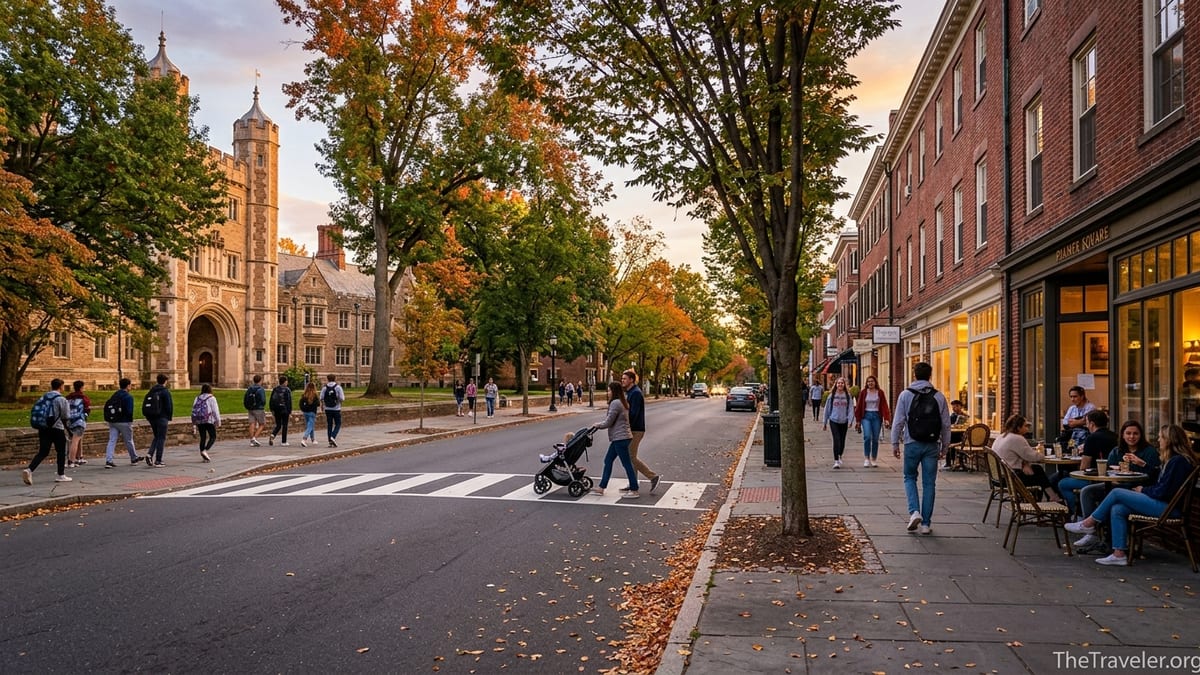
First Impressions: What Princeton Actually Feels Like
Arriving in Princeton, the first surprise is usually the scale. The downtown area around Nassau Street and Palmer Square is compact enough to cross on foot in a few minutes, yet it is framed by collegiate Gothic towers, redbrick townhouses, and leafy residential streets that feel more like a small European university city than suburban New Jersey. Step off the short “Dinky” train from Princeton Junction or a Suburban Transit bus from New York and you are immediately in the middle of shops, cafes, and the university gates rather than a remote park-and-ride.
The mood is calm rather than buzzy. On a weekday you will see students moving between classes, faculty walking dogs, and local residents running errands. On sunny weekends, visitors spill out of ice cream shops into Palmer Square, and young families push strollers along the edge of campus. It is a place built for walking, lingering, and looking up at details on stone archways and historic houses, not for nightlife hopping or major-event spectacle.
That quieter energy is part of the charm. For travelers used to the intensity of Manhattan, a day in Princeton can feel like downshifting: wandering through quads, browsing a serious independent bookstore, then sitting in a cafe on Witherspoon Street watching the world go by. If your idea of a successful trip is measured in museums visited and miles walked rather than clubs or rooftop bars, Princeton starts to make sense very quickly.
On the other hand, travelers looking for late-night entertainment or a packed checklist of blockbuster attractions may find the town limited after a single day. The key is setting expectations: Princeton is best approached as a refined small-town and campus experience with excellent side trips, not as a full-scale urban destination.
Getting There: How Easy Is Princeton as a Day Trip?
Accessibility is one of Princeton’s strongest arguments in its favor. From New York Penn Station, regular New Jersey Transit trains along the Northeast Corridor reach Princeton Junction in roughly 60 to 80 minutes in normal conditions. At Princeton Junction, the tiny Princeton Branch shuttle known as the Dinky connects you to campus in about five minutes. Typical combined fares run in the neighborhood of twenty dollars each way for a standard adult ticket if you buy at the station or via the NJ Transit app, which is competitive with suburban commuter journeys in the region.
If you prefer the bus, Suburban Transit and other operators run coaches from Manhattan’s Port Authority Bus Terminal to downtown Princeton, generally taking around 90 minutes depending on traffic. Advance fares can start well under twenty dollars one way for off-peak departures, though last-minute or peak-hour tickets tend to be higher. Buses conveniently stop near Palmer Square, putting you within a two- or three-minute walk of the center of town.
From Newark Liberty International Airport, travelers can take an NJ Transit train from the airport rail station to Princeton Junction and then transfer to the Dinky. The train portion usually takes a bit under an hour, with combined tickets often priced in the mid-twenty-dollar range one way. A rideshare or taxi directly from the airport to Princeton can cost roughly one hundred dollars or more, depending on traffic and the time of day, so public transit is usually the better value unless you are traveling as a group with heavy luggage or arriving very late at night.
Drivers coming from Philadelphia can expect about an hour on the road in light traffic, following I-95 and local routes. Parking in town is a mix of metered street spaces along Witherspoon and Nassau Streets and municipal garages near Spring Street and Palmer Square. Rates are comparable to other prosperous small towns in the Northeast, with hourly fees rather than steep downtown-city-style charges. For a day trip, you can reasonably park once and explore almost everything on foot.
Beyond the Classroom: Campus Architecture, Art, and History
Even if you have no interest in admissions or academia, Princeton University itself is the main reason to come, and its campus delivers more than just lecture halls. The core of campus is a carefully maintained landscape of collegiate Gothic courtyards, modern glass-and-steel buildings, and sweeping lawns. Walking from Nassau Hall, the 18th-century stone building that once briefly served as the capital of the United States, to newer structures by star architects gives you a compact architecture tour without needing a car.
For art lovers, the recently reopened Princeton University Art Museum is a standout. Admission is free, and the collection ranges from classical Mediterranean works and Asian ceramics to modern painting and photography. For a visitor from New York or Philadelphia, the museum feels on par with a serious city institution, but with fewer crowds and shorter lines. It is easy to spend one to two hours here between other activities and still feel you have seen the highlights.
History-minded travelers can layer in stops like the Princeton University Chapel, an impressive early-20th-century Gothic Revival building that resembles a small European cathedral inside, with soaring stained glass and intricate stonework. Across town, Morven Museum & Garden occupies a former New Jersey governor’s mansion and an earlier home tied to a signer of the Declaration of Independence; it offers rotating exhibitions and well-kept formal gardens that work nicely as a late-morning or mid-afternoon stop.
Short, structured tours help make sense of what you are seeing. The university’s Orange Key student guides offer scheduled walking tours most days, which are free and focus on campus history, traditions, and architecture rather than sales pitches. Even for travelers with no intention of applying, tagging along on one of these tours can orient you to the layout and anecdotes you would miss strolling on your own.
Small City, Big Culture: Museums, Festivals, and Performance
For a town of roughly thirty thousand residents, Princeton supports a disproportionate amount of culture. In addition to the university art museum, you have the McCarter Theatre Center on the edge of campus, a respected regional theater that stages a mix of new plays, classics, concerts, and dance. A traveler passing through on a weekend can often catch a Saturday evening performance that compares reasonably well with off-Broadway productions in New York, but in a smaller, more intimate setting.
Music fans may find their visit coincides with the Princeton Festival, a summer program that has recently anchored many of its opera and orchestral performances at an open-air pavilion on the grounds of Morven Museum & Garden. On these nights, visitors pack picnic blankets and low chairs onto the lawn and buy prepared picnic boxes or snacks from local vendors set up along the perimeter. The effect is something between a European summer music festival and a neighborhood park concert, framed by historic trees and mansion walls.
The town also has a robust calendar of community events centered on Palmer Square and the nearby Arts Council of Princeton. Seasonal highlights include outdoor concert series, Porchfest performances on residential porches, holiday tree lightings, and pop-up markets featuring local artisans. For visitors, these events can turn an ordinary Saturday into something more atmospheric, with live music spilling into the streets and families gathering under string lights.
Of course, much of the cultural life is small-scale and everyday: a poetry reading at Labyrinth Books on Nassau Street, a low-key jazz set at a local bar, or an author talk at the Princeton Public Library. Travelers who enjoy slipping into the local cultural rhythm rather than chasing only headline attractions will find plenty of opportunities to do so, especially on weekends and during the academic year.
Eating Your Way Through Town: Cafes, Ice Cream, and Date-Night Dinners
Food is one of the clearest ways Princeton steps beyond the stereotype of a basic college town. Around Palmer Square and down Witherspoon Street, you will find a concentration of restaurants and cafes that serve both budget-conscious students and the town’s more affluent residents. A basic lunch of a sandwich and coffee can cost around fifteen to twenty dollars at popular spots near campus, which is comparable to other upscale New Jersey downtowns and less than many Manhattan equivalents.
For casual daytime eating, places like Hoagie Haven on Nassau Street have cult followings among students and alumni for overstuffed sandwiches priced in the low-teens. Independent coffee shops and bakeries cluster along Witherspoon Street, where you can grab a latte and pastry for under ten dollars and linger at a sidewalk table. In summer, The Bent Spoon on Palmer Square draws long lines for artisanal ice cream, including inventive seasonal flavors and dairy-free options; a cup or cone will typically run in the five- to eight-dollar range depending on size and toppings.
On the other end of the spectrum, Princeton does refined dining that feels closer to New York than to a typical suburb. The Peacock Inn, a boutique hotel restaurant off Nassau Street, offers multicourse menus and a polished bar scene suitable for anniversaries or business dinners, with entrees that often sit in the thirty-to-forty-dollar range. Just beyond town, places like Eno Terra in nearby Kingston provide farm-to-table Italian-influenced cooking, drawing on local produce and wineries for a countryside-meets-city feel.
In the midrange, long-running favorites in Palmer Square such as Winberie’s offer approachable American pub fare and burgers for about twenty dollars per main course, ideal for mixed groups that include children or less adventurous eaters. Newer entries such as a Korean-American eatery on Nassau Street signal that Princeton’s dining scene keeps evolving, serving bibimbap bowls and fried chicken alongside burgers and brunch dishes. For a small town, the variety is impressive, especially if you treat food and coffee breaks as key parts of your visit.
Green Escapes: Walking, Biking, and Nature Close to Town
Where Princeton really distinguishes itself from many college towns is in how quickly you can leave the built environment behind. Just beyond the downtown grid, a network of parks, preserves, and canal paths opens up low-key outdoor adventures that work for all fitness levels. Ten minutes by car, or a slightly longer bike ride, brings you to the Delaware and Raritan Canal State Park, with a towpath that runs for dozens of miles along a tree-lined waterway. The path is flat, making it ideal for casual cycling or long walks; several local outfitters and seasonal rentals in the region can supply bikes if you do not bring your own.
Closer in, the Institute Woods and adjacent Princeton Battlefield State Park offer leafy trails and meadows tied to Revolutionary War history. Travelers can park in small lots near Clarke House or along local roads and follow well-marked paths through quiet forest and fields, often spotting deer and birds. On a crisp autumn afternoon, this combination of foliage, history markers, and distant campus spires can feel far removed from the dense Northeast Corridor, yet it is only a short drive or rideshare from the university gates.
Families may prefer places like Marquand Park, a compact arboretum-style green space with large specimen trees, walking paths, and a playground, or Herrontown Woods on the town’s eastern edge, where shorter loops wind past boulders and wetlands. In good weather, you can easily combine a morning campus tour with an afternoon hike, returning to downtown in time for ice cream and an early dinner.
For many visitors, these outdoor options are what tip Princeton into “worth the trip” territory. If you simply walked campus and Nassau Street, you might feel you had done the town in half a day. Add a two-hour canal bike ride or a woodland walk, and suddenly you have a full, satisfying day that mixes culture, history, and nature without complicated logistics.
Who Will Love Princeton, and Who Might Be Underwhelmed?
Because Princeton is small and polished, it does not suit every traveler equally. It is an excellent fit for visitors who value atmosphere, architecture, and walkability over sheer volume of attractions. Solo travelers and couples often appreciate its safe, compact core, where it is easy to wander without specific plans, ducking into bookstores, galleries, and cafes as you go. Parents visiting college-aged children will find plenty of comfortable hotels and restaurants that support relaxed, conversational meals rather than loud scenes.
History and art enthusiasts can build rich itineraries around the university art museum, Morven, Princeton Battlefield, and tours of Nassau Hall and the Chapel. Nature lovers have the canal, Institute Woods, and nearby orchards and farms for tasting rooms and seasonal events. For travelers who measure a trip by the number of memorable meals, Princeton’s dining scene is deep enough to support a long weekend without repeating restaurants, especially if you include nearby towns like Kingston or Hopewell.
On the other hand, visitors primarily seeking nightlife, big-brand shopping outlets, or constant high-energy entertainment might feel they have exhausted Princeton quickly. There are bars and student hangouts, of course, but no dense district of music venues or late-night clubs. Retail runs more toward independent shops and a few upscale national brands rather than giant malls or discount outlets. Younger travelers on tight budgets may also find that the overall price level for food and lodging reflects the town’s affluence.
Time frame matters too. A well-planned day trip from New York or Philadelphia can feel perfectly complete: morning train, campus tour, art museum, lunch, a walk on the canal, then ice cream and an early-evening return. Stretching the same plan into a full week without a car or side excursions, however, might lead to boredom. If you are considering a longer stay, think of Princeton as a hub from which to explore other central New Jersey sights such as Grounds for Sculpture in Hamilton or historic sites along the Delaware River, rather than as a stand-alone resort-style destination.
The Takeaway
So is Princeton worth visiting, or is it just a college town with nice buildings? For travelers who prize walkable charm, layered history, serious arts institutions, and easy access to green space, Princeton more than justifies a day or weekend. Its combination of Gothic towers, free world-class art, Revolutionary-era landmarks, and strong independent food and cafe culture sets it apart from many suburban communities along the Northeast Corridor.
At the same time, expectations should be calibrated. Princeton is not trying to be a 24-hour entertainment capital, and its downtown can feel quiet once the dinner rush subsides. If you come looking for big-city nightlife or a never-ending list of marquee attractions, you may conclude after a short visit that you have “done” Princeton and are ready to move on. But if you treat it as a carefully scaled, intellectually alive small city where you can slow down, walk everywhere, and still eat and drink very well, it becomes a destination that punches above its weight.
Ultimately, Princeton is best seen not as “just a college town” but as a university-centered cultural village. Whether you visit on a crisp October day when the campus is blazing with foliage, a summer evening during an outdoor concert at Morven, or a quiet winter weekend of museum-going and cafe-hopping, you will find enough substance to fill your time. For many travelers in the northeastern United States, that makes Princeton not only worth a visit, but worth planning into a broader itinerary again.
FAQ
Q1. Is Princeton worth visiting if I am not interested in colleges or admissions?
Yes. Even if you are not thinking about school, Princeton offers a free art museum, historic sites like Morven and Princeton Battlefield, strong dining, and easy access to scenic walking and biking along the Delaware and Raritan Canal. You can comfortably fill a day or weekend without stepping inside an admissions office.
Q2. How long do I really need to see Princeton properly?
Most travelers find that one full day is enough for a satisfying first visit: a campus walk, the art museum, lunch downtown, and a canal or woods walk. A weekend stay allows you to add a performance at McCarter Theatre, more leisurely meals, and side trips to nearby parks or farms.
Q3. Is Princeton a good day trip from New York City?
Yes. Regular NJ Transit trains and buses connect Manhattan to Princeton in roughly 60 to 90 minutes in typical conditions. Because the Dinky or bus drops you close to the center of town, you do not need a car once you arrive, making it a very manageable day trip for visitors based in New York.
Q4. Is Princeton expensive compared with other small towns?
Princeton is relatively pricey for dining and lodging due to its affluence and university ties. Expect cafe lunches in the fifteen- to twenty-dollar range and midrange dinner entrees around twenty to thirty dollars. However, major attractions such as the university art museum and many outdoor spaces are free, which balances costs for budget-conscious travelers.
Q5. What is the best time of year to visit Princeton?
Spring and fall are particularly appealing, with mild temperatures and colorful campus landscaping. October and early November bring foliage and busy campus life, while April and May offer flowering trees and outdoor events. Summer can be quieter but often features festivals and concerts, while winter is calmer and better for museum visits and cozy cafe time.
Q6. Is there enough to do in Princeton for children and families?
Yes. Families can enjoy the art museum’s family-friendly programs, playtime in Marquand Park, easy walks on the canal towpath, and picnics at Princeton Battlefield. Ice cream stops in Palmer Square, visits to the public library, and open lawn spaces on campus give kids room to explore between more structured activities.
Q7. Do I need a car to enjoy Princeton?
Not necessarily. The downtown, campus, art museum, and many restaurants are all within easy walking distance of the train station and bus stops. A car becomes more useful if you want to explore farther-flung preserves, farms, or attractions like Grounds for Sculpture or neighboring small towns, but a car-free day trip works well for most visitors.
Q8. Is Princeton safe for solo travelers, including at night?
Princeton has a reputation for being generally safe, especially in the core areas around campus and downtown where there is regular foot traffic and university security presence. As in any town, basic precautions apply at night, but solo travelers commonly walk between restaurants, hotels, and the train or Dinky station without issues.
Q9. Can I visit Princeton on a tight budget?
Yes, with some planning. You can arrive by NJ Transit rather than rideshare, visit free attractions like the art museum and parks, and choose casual eateries, sandwich shops, and bakeries over higher-end restaurants. Sharing accommodation or staying in a nearby town with lower hotel rates can also keep overall costs down.
Q10. Is Princeton mainly for older visitors, or will younger travelers enjoy it too?
Younger travelers who enjoy culture, architecture, and low-key nightlife often appreciate Princeton’s mix of student energy and small-town charm. While it lacks big-club scenes, it offers lively cafes, bars, readings, and performances. Those who want EDM clubs or large concert venues every night may be underwhelmed, but travelers who like conversation and atmosphere tend to enjoy it.