


If you are based in the New York or Philadelphia area and looking for a quick New Jersey escape, Princeton and New Brunswick often rise to the top of the list. Both are on the busy Northeast Corridor rail line, both are true college towns, and both offer plenty to fill a day without needing a car. Yet the experience you will have in each place is very different. Choosing the right one can mean the difference between a relaxed, leafy afternoon among historic buildings and a high‑energy day of big‑venue shows, multicultural food, and late trains back to the city.
Get the latest updates straight to your inbox!
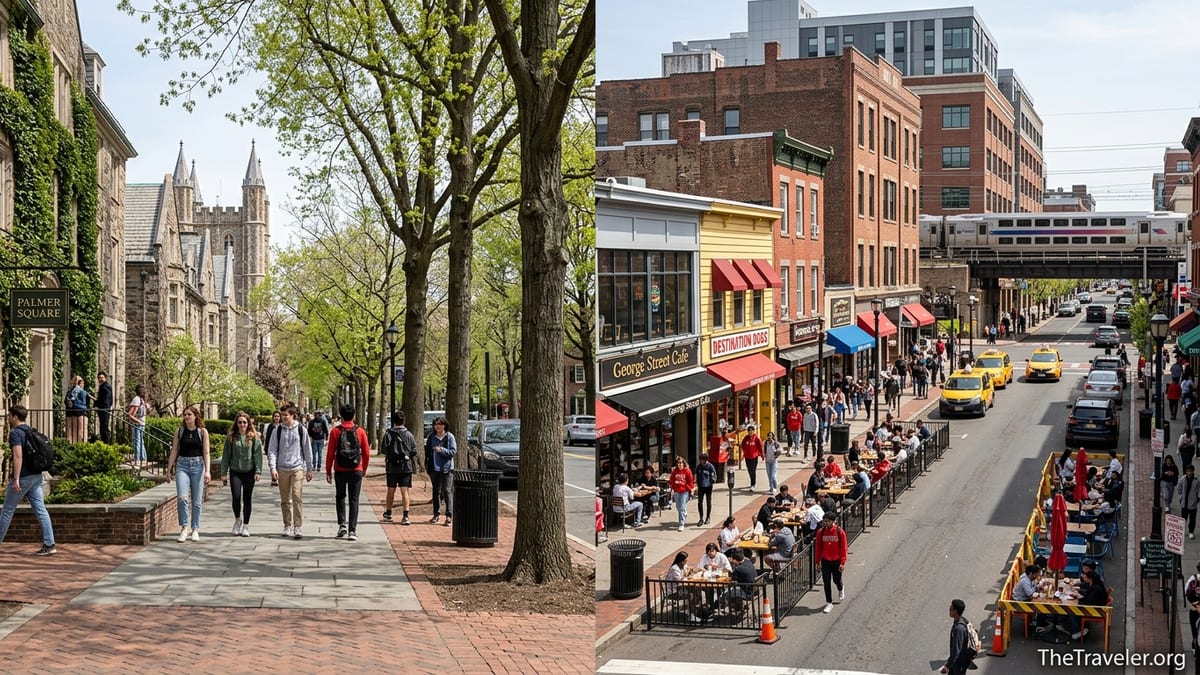
Princeton vs New Brunswick at a Glance
Princeton and New Brunswick sit roughly 15 miles apart in central New Jersey, but they feel like different worlds. Princeton is a compact, polished town centered on ivy‑covered Princeton University and a walkable downtown of brick sidewalks, independent shops, and galleries. New Brunswick is larger and grittier, anchored by Rutgers University, major hospitals, corporate offices, and a busy restaurant and entertainment scene that stays lively well into the night.
In practical terms, Princeton is ideal if you want a slower‑paced day of strolling historic streets, browsing bookstores, touring museums, and walking along a canal or lake. Travelers often describe it as a small European university town transported to New Jersey, with landmarks like Nassau Hall, Gothic campus quads, and shaded residential streets radiating from Nassau Street. New Brunswick, by contrast, feels more urban and energetic, with high‑rise student housing, several distinct restaurant corridors, and big performing arts venues clustered near the train station and across the river.
Access also plays a role. New Brunswick sits directly on the main New Jersey Transit Northeast Corridor line, so trains from New York Penn Station can arrive in about 45 to 60 minutes depending on the schedule, with roughly hourly service on weekends. Princeton requires an easy transfer at Princeton Junction to the short "Dinky" shuttle train into town, adding around 10 minutes of travel time, but many visitors find the payoff in atmosphere and scenery well worth that extra step.
Getting There: Transit, Driving, and Ease of Access
For car‑free day trippers, both towns are straightforward. From New York Penn Station, you can board any New Jersey Transit Northeast Corridor train that stops in New Brunswick and ride directly to the downtown station. On weekends and off‑peak hours, you can generally count on trains running at least once an hour, with the ride usually under an hour depending on stops. From Philadelphia, you can reach both towns by transferring at Trenton, though Princeton requires the extra connection on the Dinky shuttle from Princeton Junction.
Reaching Princeton involves one more step but little added complexity. You ride a Northeast Corridor train to Princeton Junction, then transfer to the Dinky, a small local train that takes around five minutes to reach Princeton Station, located at the edge of the university campus. Timetables are often coordinated so you are not waiting long. Many visitors buy a through ticket from New York to Princeton so they do not need to think about fares during the transfer.
If you are driving, both are close to major roads. Princeton is a short detour from US Route 1 via Washington Road or Harrison Street, with parking garages near Palmer Square and on Spring Street. On fair‑weather weekends you may pay typical small‑city garage rates and should budget extra time to find a spot near the heart of town. New Brunswick is just off Route 18 and near the New Jersey Turnpike and Garden State Parkway connections, with several garages around George Street and the train station. Drivers often appreciate that New Brunswick’s garages are large and built for commuters, making it easier to find space during off‑peak daytime hours.
Cost wise, a same‑day off‑peak roundtrip train ticket from New York to either town on New Jersey Transit typically sits in the moderate range compared with commuting from closer suburbs. Check the latest fares before you go, as prices are adjusted periodically. If you are traveling as a family or small group, it can be worth comparing the total rail cost with off‑peak tolls, gas, and parking to decide which mode feels more comfortable.
Atmosphere: Leafy College Green or Urban Energy
Atmosphere is where Princeton and New Brunswick truly diverge. Princeton offers instant charm. Step off the Dinky and you are immediately among collegiate stone archways, shaded courtyards, and manicured lawns. Walk a few minutes to Nassau Street and you will find independent coffee shops, boutiques, galleries, and the historic Nassau Inn fronting Palmer Square. The town feels carefully preserved, from the brick sidewalks to the historic homes that line Library Place and Mercer Street.
New Brunswick greets you with a more urban, workaday vibe. The train station opens onto a mix of mid‑rise and high‑rise buildings, Rutgers student housing, and the broad sweep of George Street and Albany Street. There are still leafy pockets, especially as you walk toward the riverfront or through the Rutgers College Avenue campus, but you are never far from traffic, buses, and the buzz of a regional employment hub. If you like a city feel without going all the way into Manhattan, New Brunswick fits that brief better than Princeton.
Demographically, both are diverse college towns, but their personalities differ. Princeton leans toward affluent and quietly international, with visiting scholars, conference guests, and day trippers mingling in the cafes. You will hear multiple languages along Nassau Street, yet the overall pace remains unhurried. New Brunswick feels more overtly student‑driven and blue‑collar at the same time, with Rutgers undergraduates sharing sidewalks with hospital workers in scrubs and office employees on quick lunch breaks.
Your personal travel style should guide your choice. If you crave cobblestone character and relaxed window‑shopping, Princeton is more likely to satisfy. If you want somewhere that still has energy after 9 p.m., with casual bars, comedy nights, and late‑night food, New Brunswick has a clear edge.
What to Do in Princeton: History, Art, and Nature
Princeton rewards unstructured wandering. A common day trip pattern is to arrive midmorning, walk up University Place to Nassau Street, then dip into the Princeton University campus. Visitors often start at Nassau Hall, the 18th‑century stone building that once served briefly as the seat of the Continental Congress, before circling through campus quads like McCosh Walk and the front of Firestone Library. Many university buildings are closed to the public, but the grounds themselves are open to visitors during the day.
Art lovers gravitate to the Princeton University Art Museum, which is currently in the midst of a multi‑year rebuilding project. While the main building is under construction, the museum is presenting its collections in temporary downtown spaces and outdoor public art around town. Combined with installations from the Arts Council of Princeton, it creates a kind of open‑air gallery experience that you can explore between coffee stops and bookstore visits.
For history beyond campus, the Princeton Battlefield State Park lies just a short drive or bike ride from downtown and offers open fields, a historic house museum, and interpretive signs about the 1777 Revolutionary War battle. Closer in, you can walk the Albert E. Hinds Memorial Walking Tour through the Witherspoon‑Jackson neighborhood to learn about African American life in Princeton, guided by plaques and audio materials. These kinds of experiences are particularly rewarding if you prefer low‑key, educational days over high‑octane entertainment.
Nature is never far away in Princeton. The D&R Canal towpath runs just outside town, offering miles of flat walking and cycling along the water. Lake Carnegie, created for Princeton’s rowing program, becomes a quiet destination for joggers and walkers, especially in spring and fall when foliage reflects off the water. On a summer day trip, it is realistic to spend the morning in museums and historic sites, then picnic by the canal or lake before returning to town for an early dinner and train home.
What to Do in New Brunswick: Food, Culture, and Nightlife
New Brunswick’s strengths lie in culture and dining. Start a day trip with a stroll through the College Avenue campus of Rutgers University, which combines older red‑brick academic buildings with newer facilities and student centers. From there, you can walk to the Zimmerli Art Museum, which often features rotating exhibits in a manageable size for a one‑hour visit, or explore the riverfront walkway along the Raritan when the weather cooperates.
Food is a major draw. Within a 10 to 15 minute walk of the train station you can find everything from casual taquerias and halal grills to Korean barbecues and higher‑end New American restaurants. Spots around George Street, Albany Street, and Easton Avenue form a loose grid of choices. It is common to see groups of Rutgers students sharing large plates at budget‑friendly spots early in the evening, while business travelers and theatergoers head to polished places serving seasonal menus and cocktails.
For performing arts, few New Jersey towns can match New Brunswick’s lineup. The State Theatre New Jersey regularly hosts national touring Broadway productions, concerts, and comedians. Nearby, New Brunswick Performing Arts Center presents regional theater, dance, and classical music. On any given weekend, you might pair an early dinner with a stand‑up show, musical, or symphony concert, then walk a few blocks back to the station for a late train toward New York or Trenton.
New Brunswick also has a more robust bar and nightlife scene than Princeton. Along Easton Avenue you will find student‑friendly pubs and sports bars, while George Street and surrounding blocks cater to a slightly older crowd. If your ideal day trip includes lingering over drinks after a show and catching a close‑to‑midnight train back to the city, New Brunswick is the more practical choice, as evening service on the Northeast Corridor through town stays frequent later into the night than the Dinky shuttle to Princeton.
Food, Coffee, and Budget Considerations
Both towns offer good eating, but the feel and price points differ. Princeton tends toward polished cafes, bakeries, and restaurants that appeal to visitors, alumni, and families. Around Nassau Street and Palmer Square you will find espresso bars, small patisseries, and sit‑down spots serving everything from Italian pastas to contemporary American dishes. Brunches and dinners in the immediate downtown area can lean expensive compared with student‑focused places in New Brunswick, though you can still find more casual options for sandwiches, pizza, and ice cream.
New Brunswick’s dining scene leans more eclectic and budget friendly, thanks to its large student population. It is easy to assemble a wallet‑conscious day built around a breakfast sandwich near the station, a generous bowl or platter for lunch on Easton Avenue, and shared small plates at a casual spot before a show. At the same time, there are enough upscale restaurants that you can plan a special‑occasion evening without leaving downtown. For many travelers, the ability to mix low‑cost daytime bites with a more refined pre‑theater dinner is a key selling point.
Coffee culture also diverges. Princeton has a cluster of independent coffee shops where you can linger with a laptop or a paperback from the nearby independent bookstore. These spots tend to attract a blend of students, professors, and day trippers. New Brunswick offers a mix of chain coffee outlets and smaller cafes, but the spaces can feel more transient and commuter oriented, especially near the station. If whiling away an afternoon in a quiet, bookish cafe is part of your ideal day, Princeton is better suited to that slow rhythm.
Overall, you will likely spend slightly more per person in Princeton if you focus on its central cafes and restaurants, both because of the town’s affluence and the concentration of visitor‑oriented businesses. New Brunswick can be gentler on the budget, especially if you gravitate to student‑priced spots a few blocks off the main theater district.
Seasonality, Events, and Who Each Town Fits Best
Season matters in both places. Princeton is especially lovely in spring and fall, when flowering trees and vivid foliage frame the stone campus and residential streets. Many visitors time their trips for April and May or October and early November to capture that atmosphere. Summer brings quieter sidewalks when university activity slows, which some travelers enjoy, but you may find fewer campus events. Winter days can still be pleasant if you focus on indoor museums, cafes, and short walks between them.
New Brunswick’s appeal is more consistent year‑round because so much of its draw is indoors. Theater seasons, concert calendars, and dining scenes run in all weather. Rutgers’ academic calendar shapes the feel: during the semester, weekends are lively and at times boisterous, while winter break and parts of summer can feel slightly calmer. If your primary goal is to see a show at one of the major venues, you can plan a trip around specific productions, then fill the rest of the day with food and short walks.
For travelers with children, Princeton’s walkable core, historic sites, and access to open space make it an easy recommendation. Families can let kids run around campus lawns, explore the battlefield, or walk along the canal in between ice cream stops and bookstore visits. New Brunswick can work for families too, especially if you are attending a matinee show or visiting a student at Rutgers, but its strengths skew more toward adult travelers who enjoy dining out and nightlife.
Solo travelers and couples might choose based on mood. For a contemplative day of photography, sketching, or reading on campus benches, Princeton is hard to beat. For a social day meeting friends for brunch, wandering a museum, then heading to a concert and drinks, New Brunswick’s density of venues makes logistics easy. Both are safe by the standards of mid‑sized American cities, though standard urban precautions apply, especially late at night near transit hubs.
The Takeaway
Choosing between Princeton and New Brunswick for a New Jersey day trip is less about which town is objectively better and more about which one matches your travel style. Princeton offers a concentrated dose of collegiate architecture, history, and greenery, best suited to travelers who enjoy slow walks, quiet cafes, and time outdoors along canals and lakes. The extra transfer on the Dinky is a small trade‑off for the sense of stepping into a self‑contained, postcard‑ready town.
New Brunswick, by contrast, is an excellent choice if you want an easy rail ride, a wide range of affordable global food, and serious performing arts in venues that attract national touring acts. It feels more like a miniature city than a classic college town, with buses, hospitals, and office towers folded into the student landscape. Evening trains back toward New York and Trenton make it a practical hub for late shows and dinners.
If you have time, the two are close enough that you can experience both on separate weekends. Start with Princeton when you want a breathing space from big‑city intensity, then head to New Brunswick when you are craving a compact cultural district with nightlife. Either way, you will discover that some of New Jersey’s most rewarding day trips lie not on the shore, but along the same set of rails running quietly through the center of the state.
FAQ
Q1. Which town is easier to reach by train from New York City?
New Brunswick is slightly easier because most Northeast Corridor trains from New York Penn Station stop there directly, while Princeton requires a transfer at Princeton Junction to the short Dinky shuttle.
Q2. If I only have one day, which destination is better for a relaxed, scenic walk?
Princeton is better for a relaxed day, thanks to its compact historic downtown, walkable university campus, nearby canal towpath, and access to Lake Carnegie and Princeton Battlefield.
Q3. Which is better for nightlife and late trains back to the city?
New Brunswick is stronger for nightlife, with more bars and late‑opening restaurants near the station and frequent evening trains on the Northeast Corridor line.
Q4. Is Princeton or New Brunswick more budget friendly for food and drinks?
New Brunswick generally offers more budget‑friendly options, with many student‑priced eateries and casual spots, while central Princeton’s cafes and restaurants lean slightly more upscale.
Q5. Can I visit either town without a car?
Yes. Both are practical without a car. New Brunswick’s core attractions cluster around the train station, and Princeton’s campus and downtown are an easy walk from the Dinky station.
Q6. Which town is better for visiting with kids?
Princeton is usually better for families, offering open lawns on campus, a nearby battlefield park, canal paths, and a calm downtown where it is easy to take breaks.
Q7. Where will I find more museums and performing arts?
Both have museums, but New Brunswick is stronger for performing arts, with major venues like the State Theatre and New Brunswick Performing Arts Center hosting frequent shows.
Q8. How far in advance should I check train schedules and fares?
It is wise to check schedules and fares a few days before your trip and again on the morning of travel, since rail timetables and pricing can change periodically.
Q9. Is it realistic to see both towns in a single day?
It is technically possible by using the Northeast Corridor and local connections, but most travelers will enjoy each town more by dedicating a separate day trip to each.
Q10. Which town should I choose if I want a day that feels very different from Manhattan?
Princeton will feel more distinct from Manhattan, with its small‑town scale, historic campus, and access to nature, while New Brunswick retains more of a compact city feel.