


Hong Kong International Airport (HKIA) is one of Asia’s busiest hubs, handling tens of millions of passengers a year. The experience is generally efficient and well organized, but the procedures for security, immigration, and customs can still surprise first-time visitors. This guide walks you, step by step, through what to expect in 2026, with concrete examples so you can plan ahead and move through the airport with confidence.
Get the latest updates straight to your inbox!
Before You Fly: Documents, Visas and Timing
Well before you reach Hong Kong International Airport, it helps to know what paperwork and timing you will need. Most visitors flying in from North America, Europe, Australia, New Zealand and many Asian countries either do not require a visa in advance or can travel visa-free for a limited stay, often between 7 and 90 days depending on nationality. Always check the Hong Kong Immigration Department’s latest list for your passport, since conditions can change with little notice.
As of 2026, Hong Kong has removed the old paper arrival card for most visitors. Airlines now transmit your details electronically, so on landing you typically go straight from the gate to immigration without filling out forms. This makes arrivals faster, but it also means you must ensure your airline booking details match your passport exactly, including middle names, or you risk delays if the data does not sync correctly.
On the outbound side, most airlines at HKIA close check-in counters around 60 minutes before departure for regional flights and 60 to 75 minutes for long-haul services, with boarding often starting 30 to 40 minutes before departure. To comfortably clear security and exit immigration, allow at least two hours for regional flights and three hours for long haul, especially during peak periods such as Friday evenings and major Chinese holidays.
Practical example: if you are on a 10:30 p.m. flight from Hong Kong to London, aim to be at the check-in area in Terminal 1 by around 7:30 p.m. This gives you time for possible queues at airline counters, security, and automated or manual immigration, plus a short walk or people-mover ride to your gate.
Security Screening: Liquids, Laptops and Cabin Bags
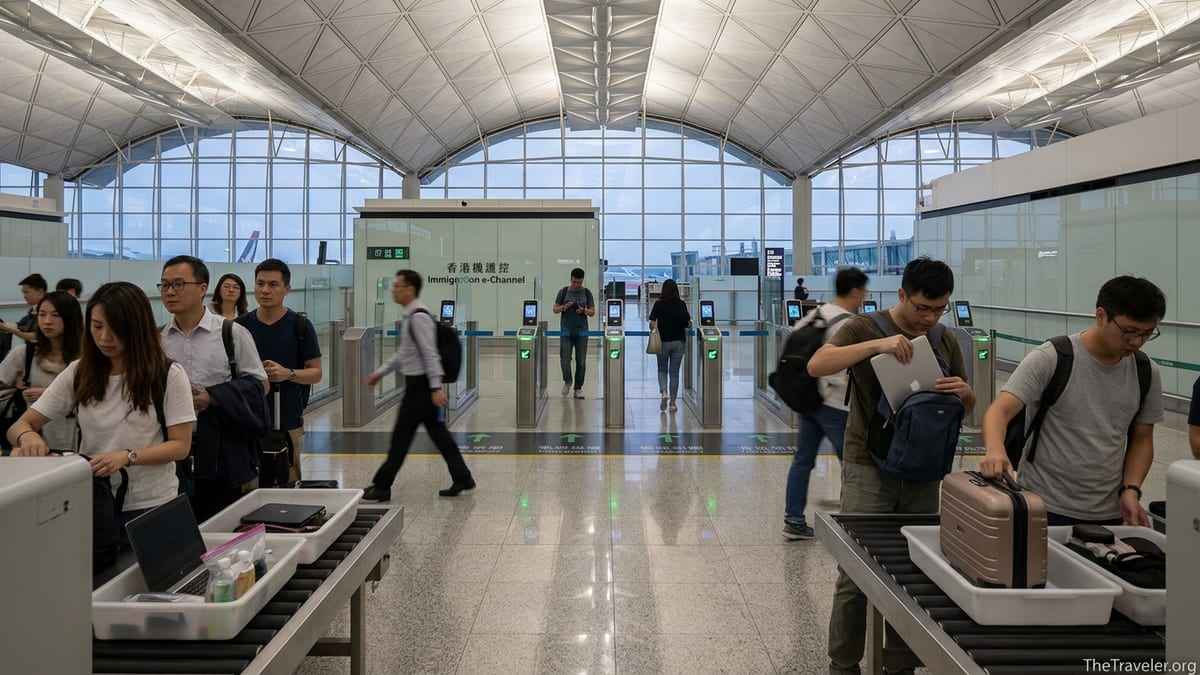
Security at Hong Kong International Airport follows the familiar pattern used at many major airports. After you check in and drop your luggage, you will pass through security before immigration. You place your cabin bags on the conveyor belt, walk through a metal detector or body scanner, and collect your belongings on the other side. Electronic and metal items in your hand baggage or on your person must usually go into a tray for separate screening, including laptops, tablets, cameras, belts with large buckles, and loose coins.
Liquid rules follow the standard international guideline for most passengers. Each container must typically hold no more than 100 milliliters, and all liquids, aerosols and gels should fit comfortably in a single transparent, resealable bag of around 1 liter. In practice this means you can bring a small 50 ml perfume, a 75 ml travel-sized sunscreen, and a 30 ml contact lens solution, but not a full 250 ml shampoo bottle from home in your carry-on. Larger liquids should be checked in. Security staff at HKIA are used to explaining the rules gently, but if you arrive with a large bottle of water from outside the secure zone, expect to drink it or discard it before passing through.
The airport operates baggage measuring gauges in the check-in and security areas. The recommended maximum size for cabin baggage is about 56 x 36 x 23 cm, which aligns with what many airlines serving Hong Kong already use. If you arrive with a bulky hiking backpack that sticks far above your shoulders or a hard-shell suitcase that looks oversized, ground staff may ask you to place it in the metal frame. If it does not fit, they can insist you check it in, which might involve extra fees if you booked hand baggage only.
Security staff in Hong Kong are generally efficient rather than chatty. During evening bank times, such as when multiple long-haul flights to Europe and North America depart, queues can build but tend to move steadily. For example, when a wave of flights to London, Frankfurt and Vancouver depart around midnight, security may take 15 to 25 minutes. On weekday mid-mornings outside holiday periods, you might clear in under 10 minutes. If you are traveling with young children, you can usually keep small items like soft toys with them, but strollers are scanned separately, so be prepared to fold them quickly.
Departure Immigration: Regular Counters, e-Channels and Smart Departure
After security, you walk directly to Hong Kong’s departure immigration area. Here you either join a queue for a staffed counter or, if eligible, use one of the automated e-Channels. At a manual counter, the immigration officer will scan your passport, check your boarding pass, and may ask simple questions such as how long you are staying at your destination or whether you live in Hong Kong. For most travelers this interaction lasts less than a minute.
Automated e-Channels are one of HKIA’s biggest time savers. Hong Kong residents with a smart identity card typically use them by default, but in recent years the government has expanded eligibility for frequent visitors too. In 2026, visitors who hold certain travel documents and have entered Hong Kong through HKIA at least twice in the past 24 months can usually enroll in the frequent visitor e-Channel program at dedicated counters in the arrival hall. On future trips, they can then use the e-Channels for quicker entry and exit instead of lining up at regular desks.
For departures, using the e-Channel is straightforward: you insert or scan your travel document at the first gate, step into the booth, place your fingers on a scanner or look at a facial recognition camera depending on the lane type, and then wait a few seconds until the second gate opens. A small paper slip confirming your departure may print; keep this with your travel documents until you leave the airport in case an airline agent requests proof of exit during a connection.
Hong Kong also offers “Smart Departure” lanes that use biometrics captured at check-in or from a prior enrollment instead of fingerprints. This service is mainly for eligible Hong Kong residents, but as the system evolves it is being integrated with newer e-Channels to speed up processing. In practice, this means that during a busy evening, a Hong Kong ID holder might pass through departure immigration in under two minutes, while a non-enrolled visitor at a regular counter might wait 10 to 20 minutes in line before reaching an officer.
Arrival Flow: From Gate to Baggage Claim
When your aircraft arrives at HKIA, you typically disembark into a modern, well-signposted concourse. Passengers on wide-body aircraft often board the airport’s automated people mover, a short driverless train that shuttles you from the far gates back toward the main terminal building. On eastbound services, everyone must disembark at the East Hall and proceed to immigration, baggage claim and customs. Signs for “Arrivals,” “Baggage Claim,” and “Transfer” are plentiful and bilingual, in Chinese and English.
At immigration, the hall is divided into different sections: Hong Kong residents, visitors, and automated e-Channels. Residents with smart ID cards and enrolled frequent visitors scan their documents and biometric data to clear through automated gates. Everyone else heads to the regular visitor lines, which are staffed by officers behind glass counters. Since arrival cards are no longer required for most travelers, your passport and possibly your boarding pass are usually the only documents needed.
Queue times vary by time of day. In the late evening, when several long-haul flights from Europe, North America and the Middle East arrive within a short window, lines at the visitor counters can stretch across the hall, but they generally move in an orderly fashion. Travelers arriving on a mid-afternoon regional flight from Bangkok or Tokyo might find immigration nearly empty and be through in 5 to 10 minutes. Families traveling with small children and elderly passengers are sometimes directed to shorter lines or special channels by staff on duty.
After immigration, you descend by escalator or elevator into the baggage claim area, where large overhead screens display carousel numbers for each flight. Baggage handling at HKIA is generally efficient. On an inbound flight from Singapore, for example, checked bags often begin appearing within 15 to 25 minutes after actual arrival. If you are connecting onward on a separate ticket, it is important to allow enough time for potential delays in baggage delivery and the walk from the gate to immigration, which can take 10 to 15 minutes at distant stands.
Customs at HKIA: Green and Red Channels Explained
Once you have collected your baggage, you walk toward customs. Hong Kong is known as a free port with no general import tariffs, but there are strict rules on a few categories of dutiable goods such as tobacco, alcohol, certain fuels and methyl alcohol. Just before exiting into the public arrivals hall, you must choose between the Green Channel, which indicates you have nothing to declare, and the Red Channel, where you declare dutiable or restricted items.
Dutiable allowances for incoming passengers are limited. For example, passengers aged 18 or over are typically allowed to bring about 1 liter of spirits with an alcohol content above 30 percent, and only a small quantity of tobacco products, such as fewer than 20 cigarettes or an equivalent weight of cigars or loose tobacco. If you are bringing back multiple bottles of whisky from duty free abroad or several cartons of cigarettes, you should expect to declare them and pay duty. Customs officers can impose penalties if you attempt to pass undeclared dutiable goods through the Green Channel and are selected for inspection.
Customs also enforces rules on large cash movements and controlled goods. If you are carrying the equivalent of roughly HKD 120,000 or more in cash or bearer negotiable instruments, you are generally required to make a declaration on arrival. Controlled goods include items such as firearms, ammunition, certain types of knives, and some communications equipment, all of which may require prior import permits. Sensitive products like certain pharmaceuticals, endangered wildlife products, or high-powered laser pointers may be seized if you do not have proper documentation.
In practice, most leisure visitors simply walk through the Green Channel. Spot checks do occur, and you may be asked to put your suitcase through an X-ray or open it for inspection. A typical example: a traveler returning from Europe carrying two large bottles of liquor and several cartons of cigarettes in a checked suitcase is directed by a customs officer to the Red Channel. There, an officer explains the duty-free allowances, calculates the duty owed on the excess liquor and tobacco, and issues a receipt once payment is made. The process is usually businesslike, but officers have the power to confiscate goods and prosecute if they suspect deliberate smuggling.
Prohibited and Sensitive Items: What Not to Carry
Many items that are commonplace elsewhere are strictly controlled in Hong Kong, and this can affect both security screening and customs inspection. One high-profile example is electronic cigarettes and heated tobacco devices. Hong Kong has banned the import of most vaping products, even for personal use. That means a traveler arriving from Europe with a vape kit in carry-on or checked baggage risks confiscation and potential penalties if customs discovers it. People who transit through Hong Kong without entering the territory are generally subject to airline and origin/destination rules instead, but if you clear security or customs in Hong Kong, local law applies.
Other items to avoid include realistic replica firearms, pepper spray, high-capacity magazines, and certain types of knives or batons. While a small pocket knife in checked luggage might pass unnoticed in many countries, travelers have reported closer scrutiny in Hong Kong if security staff detect blades or martial arts weapons. It is safer to leave such items at home or purchase them within the region where they are legally allowed.
Medicines warrant particular care. Common prescription drugs for blood pressure, diabetes or asthma are usually fine for personal use if they are in original packaging and quantities that match the length of your stay. However, some strong painkillers, stimulants and sedatives can fall under Hong Kong’s dangerous drugs regulations. If you travel with anything stronger than basic over-the-counter medications, carry a doctor’s letter and prescription, and keep the tablets in their original pharmacy box rather than mixed in unmarked pill organizers.
Finally, be mindful of food items. Hong Kong is less restrictive than some neighboring destinations when it comes to bringing in packaged snacks, coffee or tea for personal use. Sealed chocolates, vacuum-packed coffee beans, and commercially canned goods are rarely an issue for personal consumption. Fresh fruits, meats or dairy products, on the other hand, may face restrictions or attract more attention during customs inspections, especially if you are arriving from regions with known agricultural disease outbreaks.
Connecting, Transiting and Special Situations
Hong Kong International Airport is a major hub, so many passengers connect through HKIA without formally entering Hong Kong. If you are on a through ticket and your bags are checked to your final destination, you typically remain airside and follow “Transfer” signs after disembarking. In this case, you usually do not pass through Hong Kong immigration or customs at all, though you must go through a security screening checkpoint before entering the departures area for your next flight.
Your experience as a transfer passenger depends on the connection. A traveler flying from Sydney to London via Hong Kong on a single ticket with the same airline alliance will usually emerge into a dedicated transfer corridor, clear a quick security check, and walk directly to their new gate, all within 45 to 60 minutes. Another traveler on separate tickets who must collect baggage and re-check with a different airline will have to clear full arrival immigration and customs, retrieve bags, and then go upstairs to the public check-in halls to start the departure process again. For such “self-transfer” arrangements, planning a buffer of at least four to five hours is wise.
HKIA also has special channels for passengers with reduced mobility, elderly travelers, and families with infants. Airline staff can arrange wheelchair assistance that begins at the aircraft door and continues through immigration and customs to the arrivals hall or connecting flight. Dedicated courtesy channels for security and immigration are signposted in the departure and arrival halls and are staffed to reduce waiting times for those who need extra support.
Occasionally, immigration officers may refer passengers to a secondary inspection area for additional questions. This can happen if your passport has extensive travel to certain regions, if there is a discrepancy in your documentation, or if you are entering on a work or study visa that requires in-depth checks. A typical scenario might involve a new foreign employee whose company-sponsored visa has just been issued and needs to be activated. The officer may ask about your employer, job title and accommodation, then stamp or electronically record your permission to land. These interviews are usually straightforward but can extend your time at immigration by 15 to 45 minutes.
The Takeaway
Navigating security, immigration and customs at Hong Kong International Airport is generally a smooth experience if you understand the basic rules and arrive prepared. Allow enough time before your flight, keep your cabin liquids within the usual 100 milliliter limits, and double-check that your carry-on bag meets the size guidelines. If you are a frequent visitor, consider enrolling for the automated e-Channel service to reduce your time in line on future trips.
On arrival, the elimination of paper arrival cards and the widespread use of e-Channels have made entry more efficient, but peak periods can still bring queues at the visitor counters. Collect your bags promptly, choose the correct customs channel, and be honest about any dutiable or controlled goods you are carrying. Remember that items like vaping devices, large quantities of alcohol or tobacco, and certain medications can cause complications if you do not understand the local rules.
Ultimately, HKIA combines the scale of a global mega-hub with an emphasis on orderly procedures and clear signage. With realistic expectations and a bit of advance planning, most travelers find that they can move from aircraft door to city center or from check-in to boarding gate with minimal hassle, leaving more of their energy for the city’s food, skyline and neighborhoods beyond the terminal.
FAQ
Q1. How early should I arrive at Hong Kong International Airport before my flight?
For regional flights within Asia, arriving about two hours before departure is usually sufficient. For long-haul flights to Europe, North America or Australia, plan on three hours, especially in the evening peak when security and immigration queues can be longer.
Q2. Do I still need to fill out an arrival card for Hong Kong?
Most visitors arriving by air no longer need to fill out a paper arrival card. Airlines submit your information electronically in advance, so you typically go straight from the gate to immigration with just your passport and, if requested, your boarding pass.
Q3. What are the liquid rules at security in Hong Kong?
Hong Kong generally follows the standard rule that liquids, aerosols and gels in cabin baggage must be in containers of 100 milliliters or less and fit inside a clear, resealable bag of about one liter total capacity. Anything larger should go in checked luggage or be discarded before screening.
Q4. Can I use the e-Channel as a visitor to Hong Kong?
Yes, certain frequent visitors can enroll for the automated e-Channel service. Typically you must hold an eligible travel document and have entered Hong Kong via HKIA at least a set number of times in the previous 24 months. Once enrolled at a designated office in the arrivals hall, you can use e-Channels for faster entry and exit on later trips.
Q5. How strict is Hong Kong about duty-free allowances for alcohol and cigarettes?
Hong Kong’s duty-free allowances for alcohol and tobacco are relatively limited. Adults can usually bring in only about 1 liter of strong spirits and a small quantity of cigarettes or other tobacco products duty-free. Carrying more than this without declaring it at customs can lead to duty charges, confiscation or penalties.
Q6. Is it legal to bring e-cigarettes or vapes into Hong Kong?
Hong Kong has strict controls on e-cigarettes and heated tobacco products, and importing most types is prohibited even for personal use. If customs finds such items in your baggage, they can be confiscated and you may face penalties, so it is safest not to bring them.
Q7. What happens if customs selects me for inspection?
If you are stopped at the Green Channel, officers may X-ray your bags or ask you to open them. They will examine any dutiable, restricted or suspicious items and can charge duty, seize prohibited goods, or in serious cases begin legal proceedings. Most inspections are brief and routine if you have nothing problematic.
Q8. Do I go through immigration and customs when transiting through Hong Kong?
If you are on a through ticket and staying airside between flights, you usually do not pass through Hong Kong immigration or customs. You follow “Transfer” signs, clear a security checkpoint, and go directly to your connecting gate. If you must collect baggage and re-check with another airline, you will go through full arrival and departure procedures.
Q9. Are there special lanes for families or passengers needing assistance?
Yes, Hong Kong International Airport has courtesy channels at security and immigration for passengers with reduced mobility, elderly travelers and families with infants. Airlines can arrange wheelchair assistance that covers the route from aircraft door through immigration and customs to the arrivals hall or next departure gate.
Q10. Can I bring my prescription medications into Hong Kong?
Most common prescription medicines for personal use are allowed, particularly if kept in their original packaging and in quantities that match the duration of your stay. However, some strong painkillers, sedatives and stimulants are more tightly controlled. Carry a doctor’s letter and prescription if you travel with such medications, and check in advance if they are classified as controlled drugs in Hong Kong.