


Hawksbill Mountain may only require a couple of miles of hiking, but it is still a true high-country experience. As the highest peak in Shenandoah National Park at just over 4,050 feet, it catches colder winds, thicker fog and harsher storms than the valleys below. That same elevation also delivers sweeping views of the Shenandoah Valley, the Blue Ridge and the Virginia Piedmont. Hiking it in March feels very different to hiking it in July or November. Understanding those seasonal shifts is the key to a safe, rewarding day on the mountain.
Get the latest updates straight to your inbox!
Hawksbill Mountain Basics: Trails, Access and Elevation
Hawksbill sits in the Central District of Shenandoah National Park, roughly midway along Skyline Drive. The summit rises to about 4,051 feet, making it the park’s highest point. Most hikers reach it from trailheads just off Skyline Drive: the Lower Hawksbill Trail from Hawksbill Gap parking around mile 45.5, or the Upper Hawksbill Trail from a lot near mile 46.5. Both routes are short, but they climb quickly, and first-time visitors sometimes underestimate how “high mountain” the conditions can feel, even in late spring or early fall.
The National Park Service describes the Lower Hawksbill out-and-back as a moderate 1.7-mile round trip with roughly 700 to 800 feet of elevation gain, while longer loop options that combine Lower Hawksbill, Salamander and Upper Hawksbill trails come in around 2.7 to 3 miles with about 850 feet of climbing. Those numbers sound small on paper, but they translate to sustained uphill walking from the very first steps. Many day-trippers who pull off Skyline Drive in sneakers and jeans discover quickly that a “short hike” here is still a workout.
Access to Hawksbill depends on Skyline Drive, the only public road through the park. When the road is fully open you can drive from any of the four main entrances to the Hawksbill trailheads in about 45 minutes to an hour. In winter, however, the park frequently closes sections or the entire length of Skyline Drive after snow, ice or wind events. In those cases, the trailheads for Hawksbill may technically be open, but reaching them from the valley would require a long approach on foot that most day hikers will not attempt.
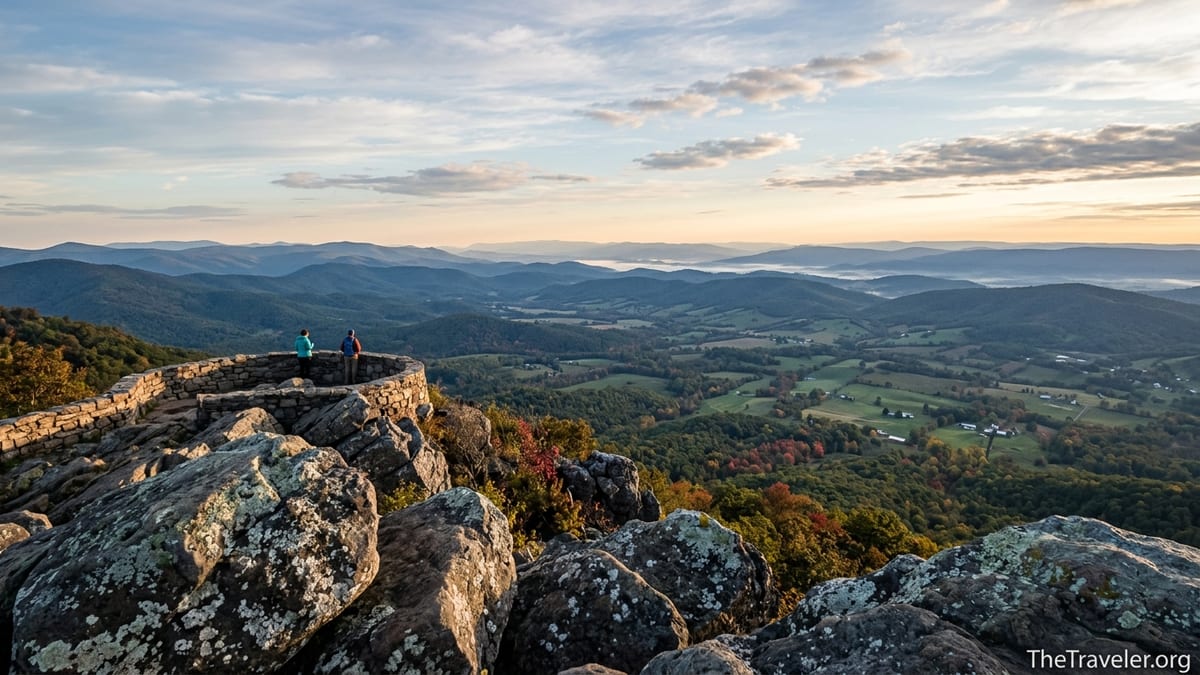
From the summit, a stone viewing platform and adjacent rock outcrops give you broad views west over the Shenandoah Valley and Massanutten Mountain, and east over foothills rolling toward the Virginia Piedmont. On a clear day in October, for example, you might see patchwork colors from farm fields far below, strings of traffic glinting along US 33 or US 211, and the blue silhouettes of far ridges fading into haze.
Seasonal Weather Patterns on Hawksbill’s High Ridge
Although Hawksbill is only a few thousand feet above nearby towns like Luray or Elkton, the weather difference is noticeable. In general, temperatures on the summit can run roughly 5 to 10 degrees Fahrenheit cooler than in the valley, and wind speeds can be significantly higher. In summer that can feel like a pleasant escape from August heat and humidity. In early spring or late fall it can make the difference between a comfortable hike and a miserable, hypothermic one.
Spring in Shenandoah typically lags urban centers by several weeks. Hikers driving up from Washington, DC, in late March are often surprised to find bare trees and lingering pockets of snow above 3,000 feet. Trail reports from March and early April frequently mention muddy sections and occasional ice in shaded, north-facing switchbacks. On Hawksbill’s steeper slopes, that can translate into unexpectedly slick footing, especially in the morning before the sun has warmed the trail.
Summer brings long daylight hours, rising humidity and more thunderstorms. Afternoon storms often build quickly along the Blue Ridge, rolling over Hawksbill with gusty winds, heavy rain and occasional hail. Lightning is a real concern on exposed summits. On a typical July weekend, hikers who started up under blue skies at 10 a.m. may be racing back down by 2 p.m. as thunderheads build along the western horizon. Heat can also be an issue at lower elevations, particularly on the drive in and out, even though the summit itself feels cooler.
Autumn is generally considered the best season for Hawksbill. September through early November often brings crisp air, stable high-pressure systems and outstanding visibility. The park’s fall color season usually peaks in mid to late October, but it varies year to year. In those weeks temperatures at the summit can swing widely, from frosty mornings in the 30s Fahrenheit to sunny afternoons in the 60s. Later in November, cold fronts become more frequent, and flurries on the summit are not unusual even while the valleys remain snow-free.
Winter Realities: Snow, Ice and Skyline Drive Closures
Winter on Hawksbill is beautiful but serious. From roughly December through March, Shenandoah National Park experiences regular snow and freezing rain events. Skyline Drive often closes for days at a time when conditions create black ice, downed trees or drifting snow. The park publicizes closures and phased reopenings, but visitors who show up without checking current conditions sometimes find gates locked miles from their planned trailhead.
Even when Skyline Drive is open, the trails around Hawksbill can be icy. Sections of Lower and Upper Hawksbill climb through shaded forest and hold packed snow long after a storm. Local hikers commonly recommend traction devices such as microspikes in mid-winter, even on sunny days with above-freezing temperatures in nearby towns. For example, after a January snowstorm, it is common to see hikers step out of their cars in the Hawksbill Gap lot to discover the trailhead itself is a solid sheet of compacted snow polished by boots.
Daylight is another constraint. In December, sunset along Skyline Drive can be shortly after 5 p.m., and the sun drops behind westward ridges even earlier from the perspective of the trail. A late-afternoon start that would be fine in June can leave you walking out in the dark in winter. Carrying a reliable headlamp, even for a short outing, is considered standard practice by local hikers from December through early March.
Winter also amplifies exposure to wind. Hawksbill’s summit is open, and in January or February windchill values can dip well below freezing. A hiker who leaves the car in a light fleece because the trailhead temperature feels mild can become dangerously cold after 20 minutes in the summit wind, especially if they are sweaty from the climb. Many experienced visitors treat Hawksbill as a true winter mountain objective in this season, packing insulated layers, waterproof gloves and an emergency blanket even though the hike is only a few miles long.
Spring and Summer: Wildflowers, Heat and Thunderstorms
By late April and May, Hawksbill’s slopes begin to green up, and wildflowers emerge along the trail. Trillium, violets and mountain laurel are common, and higher up you hike through a mix of hardwoods and pockets of red spruce and balsam fir that feel more like New England than Virginia. Streams along the drive into the park often run high from snowmelt and spring rains, so expect damp, sometimes muddy trail sections, especially on loop routes that dip into small hollows.
Spring temperatures can change quickly. On a typical May day, you might start in a light jacket at 45 degrees at 9 a.m., strip down to a T-shirt during the climb as temperatures approach the upper 60s, then put on a wind shell at the summit. By late May and June, humidity climbs, and lower-elevation trailheads can feel hot and sticky by midday. Starting your hike early, around 8 or 9 a.m., minimizes both heat and crowds, and often rewards you with quieter summit time and clearer views before haze builds in the afternoon.
Summer heightens the risk of afternoon thunderstorms. Some of the most dramatic views from Hawksbill occur just before or after a storm when clouds race past the summit, but that drama comes with risk. Sound travels far in the mountains, so if you hear thunder, you should treat it as nearby. There is no shelter at the very top; the Byrds Nest shelter sits slightly below the summit, but it is designed as a day-use structure, not a lightning-safe building. Smart hikers check the day’s hourly forecast for Luray or the park’s central district, time their hike to finish the summit by early afternoon, and turn around at the first rumble of thunder.
Summer also brings insects. Mosquitoes are not typically overwhelming on Hawksbill itself, but gnats and flies can be annoying on still days, and ticks are a persistent concern in mid-Atlantic forests. Long, lightweight pants and high socks do more than sunscreen in this environment, and many local hikers use insect repellent treated with permethrin on clothing for added protection.
Fall Color, Crowds and Shorter Days
Autumn is peak season for Hawksbill, both in terms of scenery and visitor numbers. By late September, cool nights bring the first hints of color to dogwoods and sumacs along Skyline Drive. In early to mid-October, maples, oaks and hickories shift from green to gold and red, and on sunny weekends the central district fills early with leaf-peepers. On some Saturdays you can expect to see the Hawksbill Gap and Upper Hawksbill lots close to full by mid-morning, with cars circling for spaces.
For many travelers, this is the ideal time to hike Hawksbill. Views are often crystal clear, with ridges stacked in sharp relief and the Shenandoah Valley glowing in soft autumn light. Temperatures are typically comfortable for hiking, ranging from cool mornings to mild afternoons, and biting insects are less active. It is no surprise that photographers with tripods line the summit platform at sunrise and sunset in October. If you want similar light without the crowds, consider weekdays or very early starts.
However, fall also brings shorter days and fast-changing weather. Cold fronts can sweep through with strong winds, and a blue-sky morning in late October can turn into a chilly, gusty afternoon. Once the leaves have dropped, the forest offers less shelter from wind, and the summit can feel notably colder than the trail below. Planning layers becomes important. Many experienced hikers carry a compact synthetic puffy jacket or insulated vest in their pack from late September onward, even if the forecast high is comfortable.
Parking and traffic are practical issues in fall. Skyline Drive can back up at entrance stations on peak color weekends, and the drive from entrances like Thornton Gap to Hawksbill can take longer than mapping apps suggest. Building in an extra 30 to 45 minutes of buffer time is wise if you have a specific goal like catching sunrise or sunset on the summit. Some visitors overnight in nearby towns such as Luray or Elkton to cut down on morning drive times and to be closer if a favorable weather window appears during a short trip.
Logistics: Fees, Access, Parking and Timing
Shenandoah National Park charges an entrance fee that is typically valid for seven consecutive days per vehicle. In recent years, that fee has been around the upper twenties to low thirties in US dollars for a private car, with separate rates for motorcycles and per-person entry for cyclists or pedestrians. Prices can change periodically, so it is wise to confirm current fees before you go. Holders of federal interagency passes such as America the Beautiful, Senior, or Military passes usually have their entrance covered, though campground or special use fees are still separate.
Entrance stations accept major credit and debit cards, and the park has been moving progressively toward cashless fee collection. Travelers who are used to paying cash at small state parks sometimes arrive at Shenandoah with only bills and coins, then discover card payment is expected. Planning to pay by card or purchasing a digital pass in advance avoids surprises. The cost can be good value if you intend to explore multiple overlooks and trails over several days, not just Hawksbill.
Parking for Hawksbill is straightforward when Skyline Drive is open and crowds are moderate. The Hawksbill Gap lot (mile 45.5) serves the Lower Hawksbill Trail, while the Upper Hawksbill lot (around mile 46.5) serves the Upper Hawksbill Trail and loop options that incorporate Salamander Trail. Both are paved, signed lots just off the road. There is no separate parking fee beyond the park entrance fee. On busy weekends, especially during fall color, lots can fill by mid-morning. In that case, rangers may encourage you to continue driving and return later rather than waiting idling in the lot.
Timing your hike around traffic and weather pays off. Many visitors from the Washington metropolitan area leave after breakfast and arrive at Hawksbill late morning, creating a crowd surge between roughly 10 a.m. and 2 p.m. Starting earlier, say 8:30 or 9 a.m. from the trailhead, often means a quieter trail on the ascent and more room at the summit. Evening hikes can also be rewarding in summer, but you must factor in the drive back to your lodging and the risk of afternoon storms.
Gear and Safety: How “Short” Still Demands Respect
A frequent mistake on Hawksbill is underestimating the mountain because the distance is short. Visitors sometimes hop out of cars in sandals, without water, assuming a quick stroll. While experienced hikers may move quickly, the combination of steep grade, variable weather and rocky footing means you should treat Hawksbill like any serious backcountry outing, just compressed into a few hours.
Footwear with solid traction makes a tangible difference. Trail running shoes or light hiking boots with grippy soles handle the rocky, sometimes rooty path better than smooth-soled sneakers. In wet spring conditions or after summer storms, sections of trail can be slick, and in winter compact snow and ice are common. Local outdoor stores in gateway towns like Luray sell affordable strap-on traction devices that fit over regular boots; many winter visitors pick these up on their way to the park when they see snow lingering on the ridge tops.
Carrying water and snacks is essential in every season. Even in cool weather, the steady climb can be surprisingly taxing for people not used to elevation gain. A single reusable bottle of around 0.5 to 1 liter may be enough for a fit adult on a spring or fall day, but in summer heat most hikers carry at least 1 to 1.5 liters per person. There is no potable water at the trailheads, so you need to fill containers before entering the park or at developed areas like Big Meadows if you are already inside.
Basic safety items pay dividends if something goes wrong. A compact first-aid kit, map or downloaded offline trail map, headlamp, and a lightweight extra layer add little weight but can make a big difference if an ankle injury or sudden weather change slows your group. Cell coverage on Hawksbill is irregular. In spots you may pick up a signal from towers along the Shenandoah Valley, but you should not assume you can rely on your phone for navigation or emergency calls. Before you go, it helps to let someone know your planned route and expected return time, especially outside peak season.
Choosing a Route and Season Based on Your Experience
Hawksbill offers enough variation in distance and conditions that you can tailor a visit to your comfort level. For newer hikers or those traveling with children, late spring to early fall on a clear day is usually the best bet. The Lower Hawksbill out-and-back is a straightforward, steep but short introduction to mountain hiking. Families from cities like Richmond or Baltimore often tackle this route on a long weekend, pairing it with easier stops at overlooks or flat nature trails elsewhere in the park.
More experienced hikers may prefer the loop that combines Lower Hawksbill, Salamander, and Upper Hawksbill trails, providing slightly more distance and variety underfoot. This circuit gives a fuller sense of the ridge, passes through different forest types, and offers shifting views as you move around the mountain. Trail runners sometimes use this loop for a quick but intense workout early in the morning before day-trippers arrive.
Winter ascents, while rewarding, are better suited to hikers with some cold-weather experience who are comfortable using traction devices and navigating in potentially low-visibility conditions. The reward is a quieter summit, often with stark, crystal-clear views of snow-dusted ridges and a nearly empty skyline. Local hiking clubs and outing groups sometimes schedule winter Hawksbill hikes for members who want to experience the mountain in a more serious, alpine mood, but participants are expected to bring proper gear.
Ultimately, the “best” season for you depends on your tolerance for crowds, your comfort with variable weather, and what you want from the experience. A first-time visitor who dreams of lush greenery and mild temperatures might aim for late May or early June. Someone chasing fiery foliage and crisp air may choose mid-October and accept crowds as part of the experience. A solitude-seeker with mountaineering layers in their closet may actually favor a bright weekday in January when Skyline Drive has just reopened after a storm and the ridge is quiet.
The Takeaway
Hawksbill Mountain rewards preparation. Its short, steep trails give quick access to big-mountain views, but the summit’s elevation and exposure bring weather and safety considerations that change dramatically with the seasons. Winter demands respect for snow, ice and limited daylight. Spring and summer bring mud, heat and thunderstorms. Fall offers spectacular foliage but tests your patience with crowds and fast-changing conditions.
If you understand those seasonal patterns, plan around Skyline Drive access, carry appropriate gear, and choose a route that fits your experience, Hawksbill becomes far more than a quick roadside detour. It turns into a compact lesson in Blue Ridge mountain weather, geology and ecology, and one of the most memorable half-day hikes in Shenandoah. Whether you stand on its stone platform in a February wind or under an October sky glowing with color, you will leave with a deeper respect for how a few thousand feet of elevation can reshape an entire day outdoors.
FAQ
Q1. How long does it take to hike Hawksbill Mountain?
Most hikers complete the shorter out-and-back routes in 60 to 90 minutes of walking time, not counting breaks. If you take the longer loop options, stop for photos and enjoy the summit, plan on 2 to 3 hours total from car to car.
Q2. Which trail is better, Lower Hawksbill or Upper Hawksbill?
Lower Hawksbill from Hawksbill Gap is steeper but shorter and is often recommended for first-time visitors who want a direct climb and quick reward. Upper Hawksbill is slightly longer and more gradual, and it fits well into loop hikes that include Salamander Trail. Both reach the same summit and viewing platform.
Q3. Do I need special gear to hike Hawksbill in winter?
In winter, basic traction devices such as microspikes or similar products are strongly recommended, along with waterproof footwear, warm layers, a hat, gloves and a headlamp. Even though the distance is short, icy sections and cold wind at the summit can make conditions feel much more serious than the mileage suggests.
Q4. Is Hawksbill suitable for kids and beginners?
Yes, many families successfully hike Hawksbill, especially from late spring through early fall on dry days. However, the trail is steep and can feel strenuous to beginners. Start early, take frequent breaks, bring plenty of water and snacks, and avoid winter or stormy conditions if you are new to mountain hiking.
Q5. Are dogs allowed on the Hawksbill trails?
Leashed dogs are generally allowed on most Hawksbill routes, but they must be on a leash no longer than six feet and under control at all times. Because the trail is steep and can be rocky, think about your dog’s fitness and paw protection, especially in hot summer weather or on icy winter days.
Q6. How early should I arrive to find parking in peak fall season?
On peak fall color weekends, it is wise to aim for the Hawksbill trailhead parking areas by 9 a.m. or earlier. After that, lots may fill quickly, particularly on sunny Saturdays, and you may need to adjust your plans or wait for vehicles to leave.
Q7. What is the best time of day to hike Hawksbill?
Morning and late afternoon are generally the most pleasant times. Morning hikes often offer cooler temperatures, fewer crowds and clearer views. Late afternoon can bring warm light and dramatic skies, but you must watch sunset times closely and carry a headlamp to avoid descending in total darkness.
Q8. Can I hike Hawksbill if Skyline Drive is closed?
Practically speaking, no, most visitors cannot. When Skyline Drive is closed, reaching Hawksbill from the valley would require long approach hikes on fire roads or boundary trails that are not obvious or convenient for casual visitors. For nearly all travelers, a closed Skyline Drive effectively means postponing the hike until the road reopens.
Q9. Is there cell phone coverage on Hawksbill Mountain?
Coverage is inconsistent. Some carriers pick up a signal at the summit or along exposed sections of trail, often from towers in the Shenandoah Valley, while other spots have no service at all. You should not rely on your phone for navigation or emergencies; instead, carry a map or offline GPS map and let someone know your plans in advance.
Q10. Do I need a permit or reservation to hike Hawksbill?
At present, you do not need a special day-use permit or reservation to hike Hawksbill beyond the standard park entrance fee. Unlike some heavily impacted areas in other parks that require advance permits, Hawksbill remains accessible on a first-come, first-served basis, though parking can be limited at busy times.