


Ask a half-dozen Shenandoah regulars where to find the park’s single best view and you may get a few different answers. Old Rag is the most famous scramble, Stony Man is beloved for its easy access, and Skyline Drive strings together 75 scenic overlooks. But if you are looking for the most complete, horizon-to-horizon panorama in Shenandoah National Park, the conversation almost always lands on one place: Hawksbill Mountain.
Get the latest updates straight to your inbox!
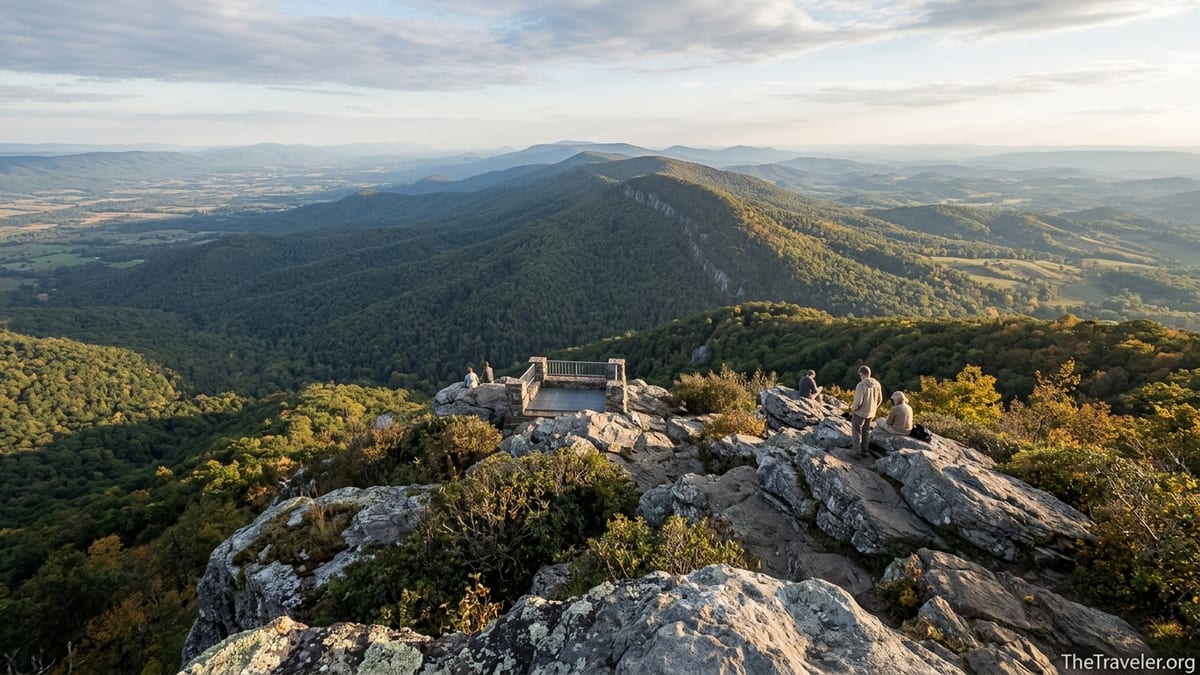
Shenandoah’s Highest Peak, Perfectly Positioned
Hawksbill Mountain earns instant credibility for one simple fact: at just over 4,050 feet, it is the highest summit in Shenandoah National Park. That extra elevation may not sound dramatic on paper, but when you are standing on the rocky outcrop or the small viewing platform at the top, it translates into a noticeably broader sweep of landscape compared with lower overlooks. On a clear day, you can trace the subtle layers of the Blue Ridge crest, the deep trench of the Shenandoah Valley to the west, and the gentle roll of the Virginia Piedmont to the east.
Its location amplifies that height advantage. The mountain sits near the center of the park’s North District and rises steeply above Timber Hollow on its north face, where the terrain drops around 2,500 feet to the valley floor. That creates one of the largest single elevation changes in the park and opens a vast viewing window that most roadside overlooks cannot match. When you look north from Hawksbill, you are not just seeing trees and a close ridge; you are looking straight down a long Appalachian corridor punctuated by the Massanutten range and the far ridges beyond.
Because Hawksbill is free-standing enough along the crest, its summit is not crowded by competing peaks. Many Skyline Drive overlooks, though scenic, look across to similar-height ridges at relatively close range, which can shorten the perceived depth of the view. At Hawksbill, that depth is multiplied; the eye can travel from the lichen-speckled rock at your feet, across the patterned farm fields of the Valley, all the way to the hazy blue ridges that mark the distant Alleghenies.
This combination of maximum park elevation and open positioning is what gives Hawksbill a genuine “top of Shenandoah” feel. Travelers who have already driven the length of Skyline Drive often comment that the summit perspective finally stitches together everything they have been seeing in fragments from pullouts and picnic areas along the way.
Why the View Feels Bigger Than Other Classic Summits
Shenandoah has several marquee viewpoints, so it is fair to ask why Hawksbill’s panorama stands apart. Take Stony Man as an example. At about 4,011 feet, it is just shy of Hawksbill in elevation and famous for its dramatic west-facing cliffs above the Page Valley. The view from Stony Man is unquestionably impressive, but it is strongly oriented in one direction. You get a fantastic, wide-angle look at the Valley and the Massanutten range, yet you do not see as much of the Piedmont side or the full spine of the Blue Ridge without moving around and peering through trees.
By contrast, Hawksbill’s summit area invites you to pivot through almost the full compass. From the stone platform built by the Civilian Conservation Corps, you can scan the Shenandoah Valley and Massanutten to the west, then swing around to spot the knobby silhouette of Old Rag to the south, and continue turning to take in the rolling Piedmont to the east. It feels less like standing at the edge of a balcony and more like occupying the center of a giant amphitheater of hills.
Old Rag offers another useful comparison. Its rocky, hands-on scramble and exposed granite domes make it one of the most iconic hikes in the Mid-Atlantic. However, Old Rag sits slightly off the main Blue Ridge crest and much of its best scenery comes from looking inward over its own summit domes and the rugged Shenandoah backcountry. The views are thrilling, but they are not as all-encompassing. Hikers who tackle Old Rag on one day and Hawksbill on the next often remark that Hawksbill gives them a better overall sense of the park’s shape, its valleys, and surrounding countryside.
Even many beloved Skyline Drive overlooks, such as Thorofare Mountain or Spitler Knoll, offer primarily one-sided views. You pull off the road, look out from the west wall of the ridge, and see a single valley. Beautiful, yes, but still only half the story. Hawksbill, perched above that deep drop into Timber Hollow yet close to the crest’s pivot point, delivers a near 360-degree sweep that captures both flanks of the ridge in one visit.
Three Approaches, One Unforgettable Summit
Part of what makes Hawksbill so rewarding is that its world-class view is accessible by more than one type of hiker. The shortest and steepest option is the Lower Hawksbill Trail from Hawksbill Gap, around milepost 45.5 on Skyline Drive. This route is roughly 1.7 to 1.9 miles round trip with about 650 to 700 feet of elevation gain. For a reasonably fit hiker, it often takes 40 to 60 minutes to climb, and you will feel that ascent in your calves. Families frequently tackle it by taking plenty of breaks at switchbacks and using trekking poles for stability on the steeper sections.
If you prefer a more gradual climb, the Upper Hawksbill Trail from the higher parking lot a couple of miles north along Skyline Drive offers a gentler grade. The round-trip distance is similar, but the climb is spread out and the path passes through a mixed hardwood forest that feels especially atmospheric on misty summer mornings. You will still gain several hundred feet, yet the wider forest road–style tread in places makes it comfortable for hikers who may not be used to rocky Appalachian trails.
There is also a popular loop that combines both the Lower Hawksbill and Upper Hawksbill routes into a moderate 2.7 to 2.9 mile circuit. Hikers often park at Hawksbill Gap, climb the steeper Lower Hawksbill first to reach the summit quickly, then descend on the more relaxed Upper Hawksbill for a kinder finish. This loop gives you a variety of forest scenery along with the summit’s open rock and is a good choice for travelers who want to spend two to three hours on the mountain without committing to an all-day trek.
Whichever route you choose, the summit experience is the same: you emerge from the trees onto a rocky, wind-swept crest where stone, sky, and distant ridges dominate the scene. There is a small viewing platform, informal rock perches where hikers spread out with snacks or cameras, and usually a light breeze that feels like nature’s own air-conditioning after the climb. It is a textbook example of effort meeting reward.
Light, Seasons, and the Magic of Timing Your Visit
The technical height and layout of Hawksbill tell only part of the story. The summit’s reputation for delivering Shenandoah’s best panoramic view is also tied to its changing light and seasonal character. Sunrise and sunset are prime times. At dawn, the Piedmont side to the east often glows first, with soft pink bands of light and low fog settling in the folds of the hills. Photographers who arrive in time to catch civil twilight often set up on the eastern edge of the outcrop, using wide-angle lenses in the 16 to 24 millimeter range to capture both the textured rock in the foreground and the pastel sky beyond.
As the sun rises higher, the Shenandoah Valley side to the west begins to sharpen. Individual farm fields, the sinuous line of the Shenandoah River, and the long ridge of Massanutten come into focus. On clear fall days, usually from late September through October, the patchwork of reds and golds in the hardwood forests emphasizes just how far the view extends. Hikers standing at the summit around mid-morning in autumn often comment that it feels like looking down on a living topographic map, with every ridge and hollow clearly outlined by color.
Sunset offers a different mood. With the sun slipping down behind the Alleghenies beyond the Shenandoah Valley, the western view becomes a layered silhouette of ridges fading into deeper shades of blue and purple. Evening visitors frequently linger to watch the last light catch on the lichen and low shrubs near the viewing platform, then make their way down by headlamp along the Lower Hawksbill Trail. In summer, when afternoon thunderstorms are common, a clearing sky at golden hour can create dramatic beams of light radiating across the valley.
Seasonally, Hawksbill is attractive nearly year-round. Spring brings fresh green leaf-out and blooming wildflowers such as trillium along the forested trails. In summer, the summit can be refreshingly cooler than the lowlands, especially on breezy days. Autumn is arguably the most spectacular season for far-reaching clarity and color. Winter visits, while requiring more preparation, can reward hikers with remarkably crisp air, long-range views, and rime ice patterns on the rocks that make the summit feel almost alpine.
A Summit Built for Savoring, Not Just Snapping a Photo
Many roadside overlooks in Shenandoah encourage quick, five-minute stops: park the car, take a few photos, and drive on. Hawksbill, even with its relatively short access trails, invites you to linger. The summit area has room for dozens of hikers to spread out along the rocks without feeling crowded. On busy weekends in October you will certainly share the space, but there are usually quieter corners if you walk a short distance past the viewing platform.
Travelers often turn the hike into a leisurely half-day outing. A common pattern for visitors staying at nearby lodgings, such as Skyland Resort to the north or Big Meadows Lodge to the south, is to tackle Hawksbill in the morning, return to their room or campsite for lunch and a rest, then head back out to a different, shorter overlook drive in the afternoon. Because the round-trip hike can be completed in two to three hours at an easy pace, it fits neatly between other park activities like visiting the Byrd Visitor Center, exploring the Big Meadows area, or stopping at wayside stores for a casual meal.
The summit lends itself to quiet rituals: couples sharing a thermos of coffee at sunrise, families spreading out a small picnic on the flatter rocks, or solo hikers lying back with their pack as a pillow to watch hawks and vultures circle on afternoon thermals. Birdwatchers sometimes bring compact binoculars to scan for raptors migrating along the ridge in fall. On particularly clear days, locals familiar with the region like to point out specific landmarks in the distance, such as the town of Luray or the silhouette of Old Rag’s granite knobs to the south.
This capacity to host both brief visits and unhurried contemplation is part of what makes Hawksbill feel more like a destination than a quick photo stop. You are not just collecting another overlook; you are spending time at the literal high point of the park, with the freedom to experience it as hurriedly or as deeply as you choose.
Practical Tips to Experience the Best of Hawksbill
Because Hawksbill is one of the most popular hikes in Shenandoah, timing and simple preparation make a big difference. On busy weekends, especially in October leaf season and on clear Saturdays in May and June, the parking areas at Hawksbill Gap and the Upper Hawksbill trailhead can fill by mid-morning. Travelers driving down from Washington, D.C., or up from Charlottesville often aim to arrive at Skyline Drive gates around 8 a.m. so they can be on the trail before crowds peak. Arriving early also increases your chances of catching softer light and less haze.
The hike itself is short but can feel demanding if you are not used to elevation gain. Lightweight hiking shoes or trail runners with good tread are more comfortable than casual sneakers on the steeper Lower Hawksbill route, which includes rocky and rooty sections. Many visitors pack a small daypack with at least one liter of water per person, a light snack, and a wind layer; even in summer, the summit can feel breezy and cooler than the parking areas. In shoulder seasons, a beanie and gloves make sunrise and sunset visits far more comfortable.
Weather can change quickly along the Blue Ridge. Low clouds sometimes roll in and obscure views entirely, especially in midsummer when humidity is high. Travelers with flexible itineraries often keep an eye on the sky as they drive Skyline Drive, choosing to hike Hawksbill when distant ridges are clearly visible from lower overlooks. If the horizon looks washed out or fog is clinging to the crest, it may be worth shifting your plans, visiting waterfalls such as Dark Hollow Falls or Rose River during the cloudy period and saving Hawksbill for a clearer window.
Traffic and entrance fees are additional logistics to consider. During peak seasons, there can be lines at the most popular Skyline Drive entrance stations in the late morning. Purchasing a park pass ahead of time or using an annual America the Beautiful pass at the gate helps speed the process. Many visitors pair a Hawksbill hike with a picnic or stop at a nearby wayside, turning the day into a relaxed loop that alternates between trail time and scenic driving.
How Hawksbill Fits Into a Broader Shenandoah Itinerary
Hawksbill’s central location along Skyline Drive makes it easy to weave into a multi-day Shenandoah itinerary. Travelers staying at Skyland or in the central campgrounds at Big Meadows often use the hike as a keystone activity, planning one day around Hawksbill and shorter waterfall hikes, then devoting another day to the North District or to more challenging routes like Old Rag. Because the window for peak fall color can vary by elevation and year, some visitors plan flexible two- or three-day trips where they can choose the clearest day for Hawksbill while still having other options if the weather turns.
For road trippers tackling Skyline Drive end to end, Hawksbill is a natural midpoint highlight. Starting from the Front Royal entrance, you can stop at overlooks in the North District, have lunch at one of the waysides or picnic areas, then arrive at Hawksbill in the mid-afternoon for a summit hike. Travelers driving up from the south entrance near Rockfish Gap can do the reverse, using a morning Hawksbill hike as their first marquee stop before continuing north.
Even international visitors on tight schedules often carve out time for Hawksbill. Tour companies and small-group outfitters that base in Washington, D.C., sometimes advertise day trips that include a hike to Shenandoah’s highest point, paired with brief stops at viewpoints and visitor centers. For many of these travelers, Hawksbill becomes their single vivid mental image of the Blue Ridge: a rocky, windswept summit above a green and gold valley, framed by multiple mountain ranges fading into the distance.
Because the hike is relatively short yet delivers such a commanding perspective, it appeals to a wide spectrum of visitors. A trail runner can dash up and down in under an hour, while a family with young kids or grandparents can make it a slow, exploratory adventure with frequent breaks and still reach the same destination. That universality helps cement Hawksbill’s status as the best all-around panoramic viewpoint in the park.
The Takeaway
Shenandoah National Park is rich in vistas, from quiet pullouts along Skyline Drive to rugged summits that require hours of rock scrambling. Yet Hawksbill Mountain occupies a unique sweet spot: the park’s highest point, set in a location that opens views in nearly every direction, accessible via trails that most reasonably prepared visitors can manage in a half-day. Its panorama does not just impress; it orients you, revealing how the Blue Ridge, Shenandoah Valley, Massanutten, and distant Alleghenies all fit together.
Whether you are crafting a weekend escape from Washington, D.C., piecing together a family road trip through Virginia, or visiting the Blue Ridge for the first time from overseas, Hawksbill deserves a place near the top of your list. Time it for a clear morning or golden-hour evening, bring a bit of patience for the climb and a layer for the breeze, and give yourself permission to linger at the summit. When you look back on your Shenandoah visit, it is likely that the view from Hawksbill will be the one that stays with you the longest.
FAQ
Q1. How difficult is the hike to Hawksbill Mountain’s summit?
The hike is considered short to moderate. The steepest option, the Lower Hawksbill Trail, gains roughly 650 to 700 feet of elevation in under a mile, which can feel strenuous if you are not used to hills. The Upper Hawksbill route spreads the climb out more gently. Most reasonably fit visitors, including families with children, can complete the round trip in 1.5 to 3 hours with breaks.
Q2. Which trail should I choose: Lower Hawksbill, Upper Hawksbill, or the loop?
Choose Lower Hawksbill if you prefer a shorter but steeper climb and want to reach the summit quickly. Choose Upper Hawksbill if you favor a more gradual grade and a wider, forested path. The 2.7 to 2.9 mile loop combining both is ideal if you have a bit more time and want variety, climbing the steeper side and descending the gentler route.
Q3. When is the best time of day for panoramic views from Hawksbill?
Clear mornings and late afternoons usually offer the best combination of light and visibility. Sunrise highlights the Piedmont to the east with pastel colors and low fog, while late afternoon and sunset create layered silhouettes over the Shenandoah Valley to the west. Midday can still be beautiful but may have more haze, especially in summer.
Q4. What is the best season to hike Hawksbill Mountain?
Hawksbill is rewarding in all seasons, but many hikers favor autumn for its combination of crisp air, long-range visibility, and colorful foliage. Spring brings wildflowers and fresh green leaves, summer offers cooler temperatures at elevation compared with the lowlands, and winter, for well-prepared hikers, can provide exceptionally clear, far-reaching views.
Q5. Do I need special gear to hike Hawksbill?
You do not need technical gear, but basic hiking essentials make the experience safer and more comfortable. Sturdy shoes or trail runners with good grip, at least one liter of water per person, a light snack, and a wind or rain layer are recommended. In cooler months, a hat and gloves are useful on the breezy summit, and a small headlamp is smart if there is any chance you will descend near dusk.
Q6. How crowded does Hawksbill get, and how can I avoid peak crowds?
Hawksbill is one of Shenandoah’s most popular hikes, especially on weekends from late spring through fall and during peak leaf season in October. Parking lots can fill by late morning. To avoid crowds, aim for early starts, weekday visits, or less popular times such as cool, clear days outside of holiday weekends. Arriving at Skyline Drive gates around 8 a.m. often gives you a quieter summit experience.
Q7. Is Hawksbill suitable for young children or older adults?
Yes, with realistic pacing and preparation. Many families hike Hawksbill with school-age children, taking frequent breaks on the steeper Lower Hawksbill Trail or choosing the gentler Upper Hawksbill route. Older adults with reasonable mobility often do well on the more gradual trail, using trekking poles for support. The key is allowing enough time and not rushing the ascent.
Q8. Can I see other well-known landmarks from Hawksbill’s summit?
On clear days, you can often spot the long ridge of Massanutten Mountain, the Shenandoah Valley floor dotted with fields and small towns, and the distinctive profile of Old Rag to the south. To the east, the rolling hills of the Virginia Piedmont stretch toward the horizon. The broad, nearly 360-degree view from Hawksbill makes it easier to visualize how these landscapes relate to each other.
Q9. Is Hawksbill a good choice if I only have one day in Shenandoah?
Yes. Because the hike can be completed in a half-day or less yet delivers the park’s highest and one of its widest views, Hawksbill is an excellent anchor for a short visit. Many travelers with just one day in Shenandoah pair a Hawksbill hike with a scenic drive along part of Skyline Drive and a stop at a visitor center or picnic area.
Q10. Why is Hawksbill often described as having the best panoramic view in Shenandoah?
Hawksbill combines several advantages that few other spots share: it is the park’s highest summit, it sits in a position that opens views in nearly every direction, its trails are short enough for many visitors to hike in a half-day, and the summit area encourages lingering rather than quick photo stops. Together, these factors create a panoramic experience that many travelers find more complete and memorable than any single overlook or other summit in the park.