


Far from the crowds around the Colosseum and the Trevi Fountain, the Papal Basilica of Saint Paul Outside the Walls feels like another world. Known in Italian as Basilica di San Paolo fuori le Mura, it is one of Rome’s four major papal basilicas and stands over the tomb of the Apostle Paul. For many travelers it is a surprise: vast, luminous and almost uncrowded compared with Saint Peter’s, yet just as steeped in history and symbolic importance for the Catholic Church.
Get the latest updates straight to your inbox!
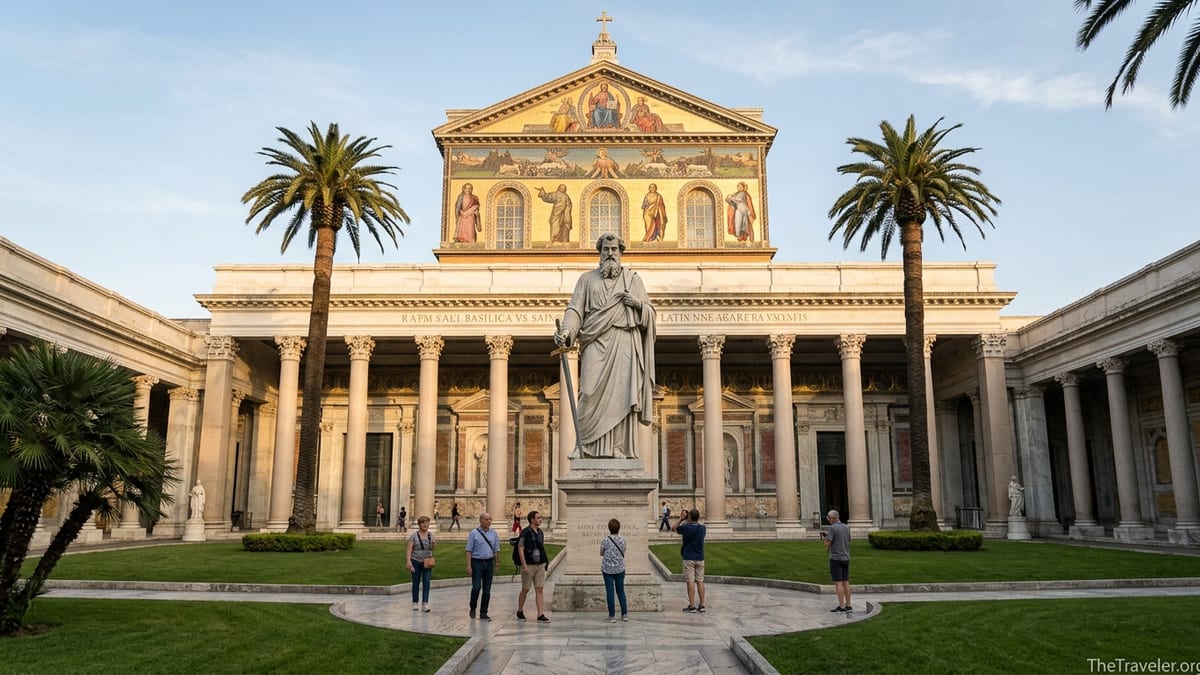
What Is Basilica San Paolo Outside the Walls?
Basilica San Paolo fuori le Mura is a monumental church in Rome built over what is venerated as the burial place of Saint Paul the Apostle. It belongs to a very small and exclusive group: the four "major" or papal basilicas of Rome, alongside Saint Peter’s, Saint John Lateran and Saint Mary Major. In Church hierarchy, these are the highest-ranking churches in the Catholic world, each with a Holy Door, a papal altar and a special role during Jubilee Years. For visitors, that status translates into exceptional art, architecture and centuries of layered history inside a single complex.
The basilica sits along the ancient Via Ostiense, just beyond the line of the old Aurelian Walls, which explains its name "Outside the Walls." When Paul was executed in Rome in the first century, Christians marked his grave here. By the 4th century, Emperor Constantine ordered a church on the site, making this one of the earliest monumental Christian sanctuaries in the city. Although the present structure mostly dates from a 19th century reconstruction after a devastating fire in 1823, it faithfully follows the early basilica’s plan, preserving the sense of vast, orderly space that defined the first great churches of Rome.
Today, San Paolo functions both as a working Benedictine abbey church and a key pilgrimage destination. On many days you will see groups of local Roman schoolchildren learning about the Apostle Paul, pilgrims queuing quietly to venerate the tomb and casual visitors wandering the silent cloister with guidebooks in hand. It is a place where daily parish life, monastic prayer and international tourism intersect in a surprisingly calm atmosphere.
Why It Is One of Rome’s Major Papal Basilicas
The term "major basilica" is not simply about size or beauty; it is a precise rank granted by the pope. There are only four such churches in the world, all in Rome, and San Paolo is one of them. Each major basilica enjoys a direct relationship with the Holy See and has a papal archpriest appointed by the pope. They also have a Holy Door, normally sealed, which is opened during Jubilee Years so pilgrims can pass through as part of a special itinerary of prayer and reconciliation.
In civil terms, San Paolo also enjoys a unique status. Although physically within the city of Rome and the Italian state, the basilica and its immediate grounds are considered extraterritorial property of the Holy See, similar to an embassy. This special arrangement was formalized in the Lateran Treaties of 1929 and subsequent agreements, and in practice it means that visitors are, symbolically at least, stepping onto Vatican soil when they cross the threshold.
For travelers curious about Catholic tradition, San Paolo’s rank is visible in practical ways. During Holy Years, such as the 2025 Jubilee, the basilica becomes one of the central destinations for organized pilgrim groups who move between the four papal basilicas, often carrying banners and singing as they arrive. Inside, the presence of the papal altar, reserved for the pope or his delegate, and the line of portraits of all the popes emphasize the basilica’s close identification with the universal Church rather than just the local diocese of Rome.
At the same time, San Paolo is the least visited of the four papal basilicas, largely because it lies a short metro ride from the historic center rather than in the heart of the old city. That relative remoteness is an advantage for many travelers. Where Saint Peter’s may require long security lines and shoulder to shoulder crowds, visitors often report walking straight into San Paolo on a weekday afternoon, with ample space to linger in front of mosaics or sit quietly beneath the forest of marble columns.
A Brief History: From Paul’s Tomb to 19th Century Reconstruction
The story of Basilica San Paolo begins with a grave. After Paul’s martyrdom in Rome, probably under Emperor Nero, early Christians marked his burial place with a simple monument along the Ostian Way. By the time of Constantine in the early 300s, devotion to the apostle had grown strong enough that the emperor commissioned a basilica over the site, similar to the church he ordered over Saint Peter’s tomb on the Vatican Hill.
Over the centuries the original Constantinian basilica was enlarged and embellished. By the 5th century it was one of the grandest buildings in Rome, with a five aisle plan, massive colonnades and a rich cycle of mosaics. Pilgrims from across Europe walked here as part of the classic Seven Church route of Rome, stopping to pray at Paul’s tomb before continuing to Saint Peter’s and the other great sanctuaries. Medieval travelers’ accounts frequently mention the basilica’s size and solemnity, distinguishing it from the more crowded urban churches within the city walls.
The turning point came in 1823, when a night time fire, reportedly started by workers repairing the roof, raged out of control and almost completely destroyed the ancient structure. The disaster shocked Europe. Donations flowed in from Catholic and non Catholic countries alike, and even the Russian tsar contributed funds for reconstruction. Over the following decades, architects and artisans rebuilt the church as closely as possible to its previous form, reusing surviving columns and decorative elements and commissioning new mosaics in a style that echoed the originals.
When you walk into San Paolo today, you enter that 19th century reconstruction, completed around 1840. The vast nave, glittering triumphal arch mosaic of Christ and the apostles, and the coffered ceiling are all products of this era. Yet beneath the high altar the archaeologically investigated tomb of Saint Paul remains, connecting the modern visitor directly with the earliest Christian community that gathered here almost 1,700 years ago.
Architecture and Art: What You Will Actually See Inside
Stepping through the main doors of Basilica San Paolo, most travelers have the same first reaction: surprise at the scale and clarity of the interior. The nave stretches for around 130 meters, framed by four parallel rows of granite columns that create a rhythm of light and shadow. Golden mosaics shimmer on the triumphal arch and apse, depicting Christ, Peter, Paul and a host of saints. Even on busy days, the scale of the space swallows noise so the atmosphere remains hushed.
One of the most distinctive features is the band of papal portraits that runs around the upper walls of the nave and transept. These circular mosaics, each about the size of a dinner plate, depict every pope in chronological order from Saint Peter up to the current pontiff. Travelers often find themselves scanning the sequence to locate familiar modern popes like John Paul II or Francis. The tradition is that when a pope dies and a new one is elected, the latest portrait is added; gaps once visible during an interregnum are later filled.
Closer to the sanctuary, you will find the confessio, a sunken area in front of the papal altar that allows a view of Paul’s tomb below. A marble slab marked "Paulo Apostolo Mart" covers the sarcophagus associated since antiquity with the apostle. There is usually a quiet line of people waiting to descend the steps, pause in silence, and then move on. Even non religious visitors often describe this as a moving moment, partly because the space is relatively free of tourist chatter compared with other sites.
Off to one side, usually accessed through a modest doorway, lies the cloister. This 13th century courtyard, with its twisted columns, inlaid marble and citrus trees, feels like a different world from the grand basilica. There is typically a small entrance fee to the cloister and the adjoining lapidary museum, where fragments of ancient inscriptions and sculpture are displayed. Many travelers consider the cloister the highlight of their visit, and it is a fine place to sit for a few minutes in the shade, listening to the distant murmur of visitors inside the church.
Spiritual Significance and Pilgrim Traditions
For pilgrims, Basilica San Paolo is above all the place where the apostle to the nations is honored. Paul’s letters form a large part of the New Testament, and his missionary journeys shaped early Christianity. Standing at his tomb connects believers with that foundational history. On the Feast of the Conversion of Saint Paul in January, for example, the basilica hosts ecumenical celebrations that draw Catholic, Orthodox and Protestant representatives, reflecting Paul’s role as a bridge figure across Christian traditions.
San Paolo is also one of the classic Seven Pilgrim Churches of Rome, a route that has existed since at least the time of Saint Philip Neri in the 16th century. Modern visitors sometimes recreate this pilgrimage on foot or by public transport, moving from church to church over the course of a long day or weekend. Local tour companies advertise guided "Seven Churches" experiences that include San Paolo, especially in the lead-up to Holy Years when interest in traditional devotions rises.
During Jubilee Years the basilica’s Holy Door becomes a focus of attention. Groups arrive by coach from different countries, singing hymns as they assemble in the large forecourt decorated with a monumental statue of Saint Paul. Passing through the Holy Door is, for many, the climax of a long saved for trip. Practicalities reflect this: extra confessionals staffed by multilingual priests, extended opening hours and volunteers helping organize queues. Even if you are simply a cultural traveler, visiting during such a period offers a vivid glimpse into how living faith animates the historic building.
Daily monastic life continues in the background. The Benedictine community attached to the basilica maintains regular times of prayer, and visitors can often hear Gregorian chant echoing faintly during certain hours. It is worth checking on arrival whether a Mass or service is under way, particularly if you plan to explore the confessio area, since access may be restricted during liturgies.
Planning Your Visit: Location, Access and Practical Tips
Reaching Basilica San Paolo is straightforward. The church stands in the Ostiense district, south of the historic center. Most visitors take Metro Line B to the station "Basilica San Paolo"; from there it is a short level walk of about five minutes to the main entrance. This ease of access surprises some travelers who assume "Outside the Walls" implies a remote location. In reality, from central stops like Colosseo or Termini you can be at the basilica in roughly 15 to 20 minutes on a direct metro ride.
Entry to the basilica itself is typically free, though there may be a small charge for the cloister and museum area. Because this is an active place of worship, there are security and bag checks at the entrance, but lines are usually minimal compared with Saint Peter’s. Mid morning and late afternoon on weekdays tend to be the quietest times; on Sunday mornings, Masses attract larger congregations and parts of the church may be set aside for worshippers.
Visitors should observe the standard modest dress code enforced in Rome’s major churches. Shoulders and knees should be covered, which in practical terms means bringing a light scarf or shawl if you are wearing a sleeveless top, and avoiding very short shorts. During Rome’s hot summers, many travelers carry a packable linen shirt or lightweight trousers specifically for church visits, slipping them on over beachwear before entering sites like San Paolo or Saint Peter’s.
Photography is generally permitted for personal use, without flash, but staff may ask visitors to refrain during services. Tripods are rarely allowed without prior permission. For a better experience, consider turning off your camera for a few minutes to absorb the space, especially in the nave and cloister. Then take focused photos of key elements such as the papal portrait frieze, the apse mosaic and the cloister’s carved capitals.
How Basilica San Paolo Compares to the Other Papal Basilicas
Travelers who visit all four papal basilicas often describe San Paolo as the most contemplative. Saint Peter’s impresses with its baroque grandeur and global crowds, Saint John Lateran with its status as the cathedral of Rome and row of massive apostle statues, and Saint Mary Major with its gilded ceiling and early Christian mosaics. By contrast, San Paolo’s wide, orderly nave and simple rhythm of columns create a calmer visual effect, closer in spirit to the early Christian basilica type.
If you are short on time in Rome, you might be tempted to focus only on Saint Peter’s and perhaps one other church. Yet many seasoned visitors suggest pairing Saint Peter’s with San Paolo precisely because the experience is so different. At Saint Peter’s, you may spend much of your visit navigating queues for security, the dome climb or the papal tombs, and standing in dense crowds near the Pietà. At San Paolo, you can often move freely from the atrium with its large modern mosaic of Christ, through the nave and up to the confessio without feeling rushed.
Another difference is the surrounding neighborhood. Saint Peter’s is embedded in the dense, tourist oriented Borgo district, while Saint John Lateran overlooks major traffic arteries and Santa Maria Maggiore sits near Termini station. San Paolo, by contrast, opens onto a relatively spacious piazza, with a mix of residential blocks, university buildings and local cafes. After your visit you can walk ten minutes toward the Tiber to find quieter trattorias where office workers and students eat lunch, at prices often lower than those around more famous monuments.
For travelers interested in architecture, San Paolo is also an instructive place to understand how early Christian basilicas worked. The clear basilican plan, with its longitudinal axis and five aisles, contrasts with the more heavily modified interiors of the other papal basilicas, which underwent extensive baroque and later renovations. If you are visiting multiple churches, consider bringing a simple floor plan from a guidebook or app to compare layouts as you go.
The Takeaway
Basilica San Paolo fuori le Mura combines deep historical roots, high ecclesiastical status and a surprisingly tranquil visitor experience. It is one of only four major papal basilicas in the world, built over the tomb of the Apostle Paul and linked closely with key Catholic traditions such as Jubilee Years and the classic Seven Church pilgrimage. Its vast, luminous interior, papal portrait frieze and serene cloister offer a powerful contrast to the more crowded sites in central Rome.
From a practical perspective, San Paolo is easy to reach by metro, free to enter, and rarely overwhelmed by tourists. That makes it an excellent choice for travelers who want to experience Rome’s spiritual and artistic heritage without spending their day in queues. Whether you come as a pilgrim or simply as a curious guest, the basilica invites you to slow down, look carefully at its art and architecture, and reflect on the long story that has unfolded here from the earliest centuries of Christianity to the present.
FAQ
Q1. What exactly is Basilica San Paolo and why is it important?
It is the Papal Basilica of Saint Paul Outside the Walls, one of four major papal basilicas in Rome, built over the tomb venerated as that of the Apostle Paul. Its rank, connection to the papacy and role in pilgrimages and Jubilee Years make it one of the most important churches in the Catholic world.
Q2. Where is Basilica San Paolo located and how do I get there?
The basilica is in the Ostiense district of Rome, along the ancient Via Ostiense, just beyond the old city walls. Most visitors take Metro Line B to the "Basilica San Paolo" stop and walk a few minutes to the main entrance, making it an easy side trip from central areas like Termini or the Colosseum.
Q3. Is there an entrance fee to visit Basilica San Paolo?
Entry to the main basilica is generally free, as it is a place of worship. There is usually a modest charge for access to the cloister and small museum, which helps support the maintenance of the complex. Exact amounts can change, so it is wise to check current information once in Rome.
Q4. What should I wear when visiting Basilica San Paolo?
Visitors are expected to follow the standard dress code common to major Roman churches: shoulders and knees covered for both men and women, and no beachwear or very revealing clothing. Many travelers carry a light scarf or packable shirt to slip on before entering, especially in summer.
Q5. How long should I plan for a visit, and what are the must see areas?
Most travelers find that 60 to 90 minutes is enough for an unhurried visit. Key areas include the vast nave with its line of papal portraits, the confessio over Saint Paul’s tomb, the golden apse and triumphal arch mosaics, and the 13th century cloister with its twisted columns and quiet garden atmosphere.
Q6. Can I attend Mass or a religious service at Basilica San Paolo?
Yes. Regular Masses are celebrated at the basilica, and the attached Benedictine community maintains daily prayer. Schedules vary by day and season, and are typically posted at the entrance. If you attend, remember that during services certain areas such as the confessio may be reserved for worshippers.
Q7. How does Basilica San Paolo differ from Saint Peter’s Basilica?
Saint Peter’s is larger overall and sees far more visitors, with long security lines and heavy crowds around famous artworks. Basilica San Paolo is also monumental but usually much quieter, with a clearer early Christian style interior, a more contemplative atmosphere and easier access to features like the papal portrait frieze and cloister.
Q8. Is photography allowed inside the basilica?
Non flash photography for personal use is generally allowed in the basilica, though staff may restrict it during Masses or special ceremonies. Tripods and professional equipment typically require prior permission. It is courteous to avoid photographing people at prayer and to keep noise to a minimum.
Q9. Is Basilica San Paolo suitable for children and less mobile travelers?
Yes. The basilica’s flat floors, wide aisles and level entrance make it relatively accessible for strollers and wheelchairs, and the nearby metro stop reduces walking distances. Children often enjoy spotting familiar saint names among the papal portraits and exploring the cloister, though supervision is important to preserve the quiet atmosphere.
Q10. Why is it called “Outside the Walls” and does that affect my visit?
The name "fuori le Mura" or "Outside the Walls" refers to its position beyond the ancient Aurelian Walls that once enclosed Rome. Historically that marked it as a suburban pilgrimage site, but today it simply means a short metro ride from the center. For modern visitors, the location mostly brings benefits: fewer crowds, a calmer setting and a glimpse of everyday Roman neighborhoods beyond the historic core.