


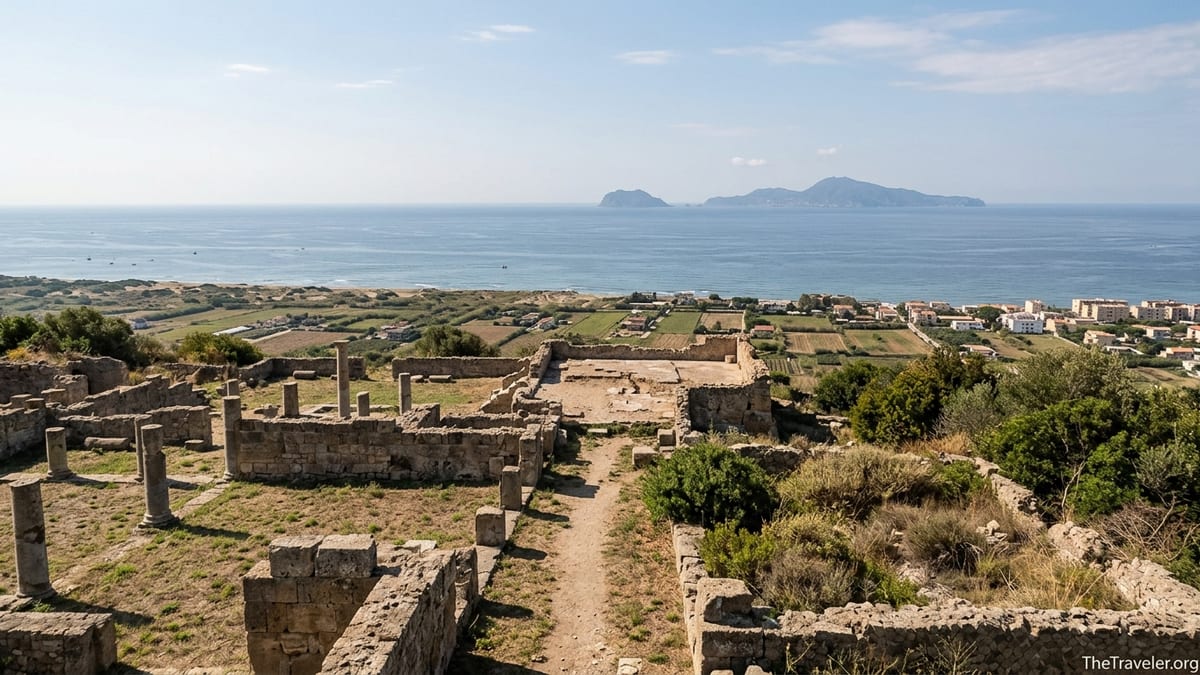
Cuma, the ancient Greek city of Cumae on the edge of the Campi Flegrei west of Naples, is one of southern Italy’s most atmospheric archaeological sites. Perched above the Tyrrhenian Sea with sweeping views toward Ischia and Procida, it combines myth, history, and raw volcanic landscape in a compact area that is easy to visit on a day trip. For a first-time visitor, though, Cuma can feel remote, under-signposted, and a bit confusing without preparation. Here is what you should know before you go, with practical examples from how to get there and ticket prices to what to pack and how to move around safely.
Get the latest updates straight to your inbox!
Understanding Where Cuma Is and Why It Matters
Cuma sits in the Campi Flegrei, or Phlegraean Fields, a volcanic area just west of Naples that also includes Pozzuoli, Baia, Bacoli and the crater lakes Averno and Fusaro. Administratively, the archaeological park of Cuma belongs to the Parco Archeologico dei Campi Flegrei, a network of sites spread around the bay. In practice this means your visit to Cuma can easily be combined with places like the Castello Aragonese in Baia, the submerged Roman ruins of Baia, or the amphitheater in Pozzuoli on the same day if you plan your timing.
Historically, Cuma is important far beyond its modest size. Founded by Greek settlers from Euboea around the 8th century BC, it was the first Greek colony on the Italian mainland and a key bridge between Greek and Roman cultures. The famous Sibyl of Cumae, the legendary prophetess described by Virgil, was said to have lived here. When you walk through the rock-cut corridor known as the Antro della Sibilla and stand on the acropolis among the remains of the temples of Apollo and Jupiter, you are quite literally walking through the layers of Greek, Roman, and medieval history that shaped the region.
For travelers deciding between Cuma and better-known sites like Pompeii or Herculaneum, it helps to think of Cuma as a quieter, wilder counterpoint. It is smaller and more focused, with fewer reconstructed houses and frescoes, but with dramatic coastal views and fewer crowds. On a weekday in shoulder season you may share the site with a handful of school groups and local families, compared with the coachloads you find in Pompeii. If you have two or more days in the Naples area, Cuma is an excellent addition rather than a replacement.
Getting to Cuma from Naples and Beyond
Reaching Cuma requires a bit more effort than visiting central Naples sights, but it is quite manageable if you understand the options in advance. Most independent travelers come from Naples using a combination of train and bus. The usual route is to take the Cumana suburban railway from Naples (for example from Montesanto station) toward Torregaveta and get off at Licola. From Licola station, local EAV buses or regional buses toward Bacoli and Cuma can drop you near the park entrance, which sits along the coastal road between Licola and Bacoli. Schedules vary, so many visitors check timetables the day before and allow extra time for connections.
If you are short on time or prefer simplicity, a taxi or private transfer from central Naples is common. As a rough guide, a pre-booked car for up to three passengers from central Naples to the Parco Archeologico di Cuma often runs in the range of 70 to 100 euros one way, depending on the company and time of day. Some drivers will agree a half-day rate, for example 160 to 200 euros for four to five hours including waiting time and onward stops in Baia or Pozzuoli, which can be good value if you are two or three people sharing costs.
Another increasingly popular option is joining a small-group excursion focused on the Campi Flegrei. These typically depart from Naples, include transport, an authorized guide, and entry to at least two sites such as Cuma and the Serapeum in Pozzuoli, and last six to eight hours. Prices in 2026 commonly fall somewhere between 80 and 130 euros per person, depending on group size and inclusions. This kind of tour is particularly useful if you are interested in the volcanic geology as well as the archaeology, since guides often link what you see at Cuma to the wider caldera.
If you are driving a rental car, Cuma is straightforward to reach but Italian road conditions and local driving style may be stressful for some visitors. The site lies a short detour from the tangenziale (ring road) around Naples, following signs for Pozzuoli, Bacoli and then Cuma. There is surface parking outside the archaeological park; on weekends in high season it can fill up, so arriving at opening time is wise. Remember that many Italian cities, including Naples, have restricted-traffic zones, so check where you are allowed to drive and park before leaving your hotel.
Tickets, Opening Hours and How Long to Stay
Cuma is managed as part of the Parco Archeologico dei Campi Flegrei, and ticketing can change, so it is worth checking the official park information shortly before you travel. As of mid-2026, entry to individual Campi Flegrei sites such as Cuma is generally in the range of a modest single-digit euro fee for adults, with reduced and free categories for EU residents under certain ages and for specific groups. There is also a combined Campi Flegrei ticket and regional passes such as the Campania ArteCard that can include Cuma along with other sites and public transport for a set number of days, which can make sense if you plan to visit multiple archaeological areas.
Opening hours typically follow a pattern similar to other archaeological parks in the region: opening in the morning and closing before sunset, with the last admission at least an hour before closing time. In winter, this may mean a shorter visiting window in the afternoon. On certain dates, parts of the site, such as the Antro della Sibilla, may close temporarily for maintenance or safety checks, while the acropolis remains open. Before committing to a specific day trip, it is worth verifying whether there are any extraordinary closures or strikes affecting Campi Flegrei sites, especially if you are visiting outside peak season.
Most first-time visitors spend between two and three hours inside the park. This allows enough time to walk up through the Antro della Sibilla, reach the terrace with the remains of the Temple of Apollo and the Temple of Jupiter, take in the sea views, and explore parts of the lower city and necropolis. If you are deeply interested in archaeology and stop to read every panel, you may spend closer to four hours. When planning your day, factor in the travel time from and back to Naples. For example, a visitor staying near Piazza Bellini who leaves at 9:00 in the morning by Cumana and bus might reasonably expect to be back in central Naples between 15:00 and 17:00 depending on connections and how long they linger on site.
Guided tours of Cuma can extend the visit slightly but provide useful context. Some local guide cooperatives based in the Campi Flegrei offer two-hour walks through the park with an archaeologist or licensed guide, often for around 20 to 30 euros per person in small groups, excluding the entry ticket. Even without a guide, consider downloading or printing a map of the acropolis, as on-site signage can be patchy and paths sometimes branch without clear direction arrows.
What to See on Site: From the Sibyl’s Cave to the Acropolis Views
The core of a first visit to Cuma focuses on three main elements: the Antro della Sibilla, the acropolis at the top of the hill, and the remains of the lower city and necropolis. The visit usually begins by entering the long, trapezoidal tunnel cut into the tuff rock, known as the Antro della Sibilla. Whether or not this was actually the chamber of the Sibyl, walking down the dimly lit corridor with lateral openings and cross-passages is an evocative introduction to Cuma’s mythical reputation. Some travelers bring a small torch or use their phone light to better appreciate the rock walls, though there is basic lighting in place.
From there, paths climb through Mediterranean scrub and pines to the acropolis. At the top, you will find the remains of the Temple of Apollo and Temple of Jupiter, both heavily altered over centuries but still impressive for their position and surviving walls. On clear days, the views stretch over the Tyrrhenian coast, the flat coastal plain around Licola, and across to the islands of Ischia and Procida. Many visitors choose to sit on the low walls or benches here for a simple picnic of local bread, cheese, and fruit picked up earlier in Naples or Pozzuoli, as there is limited food available directly at the site.
The lower part of the archaeological area preserves sectors of the Roman city and necropolis, with tombs, stretches of road, and foundations. While these remains may appear less spectacular than Pompeii’s frescoed villas, they are important for understanding Cuma as a lived-in city over many centuries. Descriptive signs in Italian and often in English outline the main phases of occupation, from the early Greek fortifications to the late antique and medieval castrum that once occupied the acropolis. Some travelers pair their visit with a stop at the Museo Archeologico dei Campi Flegrei in the Castello Aragonese at Baia to see artifacts found at Cuma, such as statues and inscriptions, providing another layer of context.
If you have access to a car or a full-day tour, you can extend the experience by visiting nearby volcanic landscapes that are closely linked to Cuma. For example, Lago d’Averno, a crater lake just a short drive away, was once thought by the Romans to be an entrance to the underworld and is mentioned in the same literary traditions as the Sibyl. A short walk around the lake’s path offers views of volcanic cliffs, vineyards, and small fishing platforms, and makes the mythological landscape tangible after seeing the archaeological remains on the acropolis.
Safety, Volcanic Activity and Weather Considerations
Cuma lies within the Campi Flegrei caldera, a volcanic area that has experienced cycles of ground uplift and subsidence known as bradisism, along with swarms of small earthquakes. Italian authorities and scientific institutions closely monitor this activity, and in recent years there has been public discussion about the long-term evolution of the caldera. For visitors, the key point is that if conditions were considered unsafe for tourism, sites like Cuma, the Solfatara area, and other attractions in the Campi Flegrei would be closed and civil protection measures would be visible and widely reported in Italian media.
When planning a trip, it is reasonable to stay informed in a general way about the situation, much as you might check for flood advisories in Venice or wildfire conditions in Mediterranean islands. However, you do not need to follow every scientific paper or online debate. In practical terms, if Cuma and other Campi Flegrei sites are open, public transport and local life are functioning normally, and your hotel in Naples or Pozzuoli does not flag particular restrictions, it is considered acceptable to visit. If you are particularly concerned, you can ask your accommodation or a local guide how recent volcanic activity has impacted the area, and they can relate this to their day-to-day experience.
Beyond geology, standard travel safety precautions apply. The archaeological park itself is generally calm and family-friendly, but paths can be uneven, especially on the acropolis. Wear closed-toe shoes with good grip rather than flimsy sandals, and be prepared for some climbing. In wet weather, the stone steps and exposed rock can be slippery, so take your time on descents. Outside the site, the coastal road has traffic and relatively narrow verges, so be cautious if walking between bus stops and the entrance, especially with children.
Weather is an important factor in how enjoyable your visit will be. Summers around Naples can be very hot and humid, with temperatures in July and August often reaching the low to mid 30s Celsius in the early afternoon. On the exposed acropolis, there is limited shade. Many locals time their visit to start right at opening time, enjoying the ascent to the temples in the relative cool of the morning, and then descending before the heat peaks. In shoulder seasons like April, May, late September and October, temperatures are milder and visibility is often excellent, making these months particularly pleasant for exploring Cuma and the wider Campi Flegrei.
Practical Tips: What to Bring, Eat and Wear
Cuma does not feel like a heavily commercialized tourist attraction, which is part of its charm but also means amenities are limited compared with major sites like Pompeii. Before leaving Naples or Pozzuoli, it is sensible to stock up on water and snacks. A typical approach is to stop at a neighborhood bar for a cappuccino and cornetto, then pick up a large bottle of water and some fruit from a small grocery or market stall for a few euros. In hot months, consider carrying at least 1.5 liters of water per person, especially if you plan to spend several hours on the acropolis paths.
Clothing should balance comfort, modesty, and sun protection. Lightweight, breathable trousers or shorts, a T-shirt, and a hat with a brim work well in summer. The coastal breeze can be strong on the acropolis, so a light layer is useful outside of high summer, even when the sun is bright. Comfortable walking shoes or hiking sandals with sturdy soles will make it easier to navigate loose stones and uneven steps. If you are visiting outside peak season, pack a small folding umbrella or light rain jacket; showers can move in quickly from the sea.
There is usually at least basic restroom provision at or near the entrance, but do not count on extensive visitor centers or multiple cafes. Many travelers plan lunch either in the town of Bacoli or Pozzuoli after visiting the site. For example, you might leave Cuma around 13:00 and take a short bus or taxi ride to the waterfront in Pozzuoli, where trattorias serve dishes like spaghetti alle vongole, fried seafood, or simple pizza, often in the range of 10 to 15 euros for a main course. If you are on a tighter budget, bakeries and take-away pizza al taglio offer substantial slices and filled focaccia for just a few euros, which you can eat on a bench overlooking the harbor.
As with any archaeological site, it is respectful to avoid climbing on fragile walls or leaving litter. Cuma is still an active research area, with ongoing excavations and conservation projects; you may see cordoned-off sections or archaeologists at work. Following marked paths and instructions from staff helps protect both the site and your own safety. Bringing a small bag for your rubbish, including fruit peels and paper, ensures you can dispose of it properly once you are back in town.
Combining Cuma with Other Campi Flegrei Highlights
One of the rewards of making the effort to reach Cuma is that it opens the door to a broader exploration of the Campi Flegrei, a region that many visitors to Naples overlook. A popular full-day itinerary starts with Cuma in the morning, moves on to the panoramic viewpoints over Lago d’Averno or Lago Fusaro at midday, and finishes with an afternoon visit to the archaeological and volcanic sites around Pozzuoli and Baia. This creates a narrative arc from the mythic Greek colony through Roman imperial leisure culture to modern seaside life.
For instance, after leaving Cuma you could head to the Castello Aragonese in Baia, which houses the Museo Archeologico dei Campi Flegrei. From its terraces you can see across the bay to the zones you have just visited, and inside you will find sculptures, reliefs, and everyday objects discovered at Cuma and neighboring sites. Alternatively, you might book a glass-bottom boat tour or snorkeling excursion over the submerged ruins of Baia, where sunken mosaics and columns give a concrete sense of how volcanic subsidence has changed the coastline over time.
Back in Pozzuoli, the Macellum, often referred to as the Temple of Serapis, is a particularly clear illustration of bradisism. The marble columns of the ancient marketplace are pitted by marine organisms at a height that shows how the ground level has risen and fallen relative to the sea over centuries. Seeing these physical traces can make the abstract concept of a restless caldera more immediate and may deepen your understanding of what you saw at Cuma’s clifftop acropolis.
If you are staying several nights in the area, you might dedicate one day to Cuma and the coast and another to inland volcanic features. Guided walks over ancient craters, visits to fumarolic fields where steam vents from the ground, and wine tastings in vineyards planted on volcanic soils are all available in the wider Campi Flegrei. These experiences help place Cuma not just as an isolated ruin, but as part of a living landscape where geology, agriculture, and urban life continue to interact.
The Takeaway
Visiting Cuma for the first time is less about ticking off a list of monuments and more about entering a layered landscape where myth, archaeology, and volcanic terrain overlap. Its relative remoteness compared with central Naples is both a logistical challenge and a reward: with some planning around transport, opening hours, and basic supplies, you are likely to find quieter paths, broader horizons, and more space to let your imagination roam than at the region’s busiest sites.
The essentials are straightforward. Give yourself at least half a day door to door from Naples, wear sturdy shoes and sun protection, carry water and a simple snack, and check the most recent information on tickets and access. Consider whether you would benefit from a guided tour, especially if you want in-depth historical or geological context, and think about pairing Cuma with a stop in Baia or Pozzuoli to see artifacts and volcanic features that complete the picture.
Most of all, approach Cuma with a sense of curiosity rather than a fixed checklist. Allow time to linger in the Antro della Sibilla, pause on the acropolis and look out toward the islands, and notice small details like inscriptions, plant life, and the changing light on the tuff cliffs. For many travelers who make the journey, Cuma becomes a quiet highlight of their time in Campania, a place that feels both ancient and surprisingly alive.
FAQ
Q1. Is Cuma safe to visit given the volcanic activity in the Campi Flegrei?
Cuma lies within a monitored volcanic area, but if the archaeological park is open and local life is functioning normally, authorities consider it safe for visitors. As with any destination affected by natural hazards, it is sensible to stay generally informed and follow any instructions from local officials or your accommodation.
Q2. How long should I plan for a first visit to Cuma?
Most first-time visitors spend around two to three hours inside the archaeological park, plus travel time to and from Naples or Pozzuoli. If you want to explore more slowly or combine Cuma with nearby sites such as Baia or Pozzuoli, plan for a full-day outing.
Q3. Can I visit Cuma using public transport from central Naples?
Yes, it is possible using the Cumana suburban train from Naples to Licola and then a local bus or taxi to the site entrance, though connections and schedules require some planning. If you prefer a simpler option, you can book a guided excursion that includes transport or arrange a private transfer.
Q4. Are there guided tours available at the Cuma archaeological park?
There are often local guides and tour companies offering scheduled or private visits to Cuma, sometimes combined with other Campi Flegrei sites. Booking in advance, especially in peak season or if you want an English-speaking archaeologist or specialist guide, is recommended for the best experience.
Q5. What kind of shoes and clothing should I wear at Cuma?
Wear comfortable closed-toe shoes or sturdy sandals with good grip, as paths on the acropolis and around the ruins can be uneven. Light, breathable clothing, a hat, and sun protection are essential in warm months, while a light jacket or sweater is useful outside of summer when the coastal breeze can be cool.
Q6. Is Cuma suitable for children and less experienced travelers?
Cuma can be rewarding for families and first-time visitors to Italy, provided you are prepared for some uphill walking and uneven terrain. Bringing snacks, water, and sun protection helps keep children comfortable, and allowing extra time for breaks makes the experience more relaxed for everyone.
Q7. Are there restaurants or cafes inside or right next to the site?
Facilities at Cuma are limited compared with major sites, and you should not rely on finding a full-service restaurant at the entrance. Many visitors bring a small picnic and then head afterward to nearby towns such as Bacoli or Pozzuoli, where you can choose from waterfront trattorias, pizzerias, and bars.
Q8. Does Cuma offer good views or photography opportunities?
Yes, the acropolis of Cuma provides wide views over the Tyrrhenian coast, the surrounding flatlands, and on clear days the islands of Ischia and Procida. The combination of ruins, sea, and volcanic landscape makes it a rewarding place for landscape and detail photography, especially in early morning or late afternoon light.
Q9. Can I combine a visit to Cuma with Pompeii or Herculaneum in one day?
It is technically possible but not recommended for most travelers, as each site deserves several hours and they are in different directions from Naples. A more comfortable plan is to pair Cuma with other Campi Flegrei locations on one day and dedicate a separate day to Pompeii or Herculaneum.
Q10. Do I need to book tickets for Cuma in advance?
Ticketing policies can change, but in many cases you can simply buy your ticket on arrival, especially outside peak holiday periods. For peace of mind in busy months or if you are using a regional pass, check current information on the official channels shortly before your visit and follow any instructions about advance booking or time slots.