


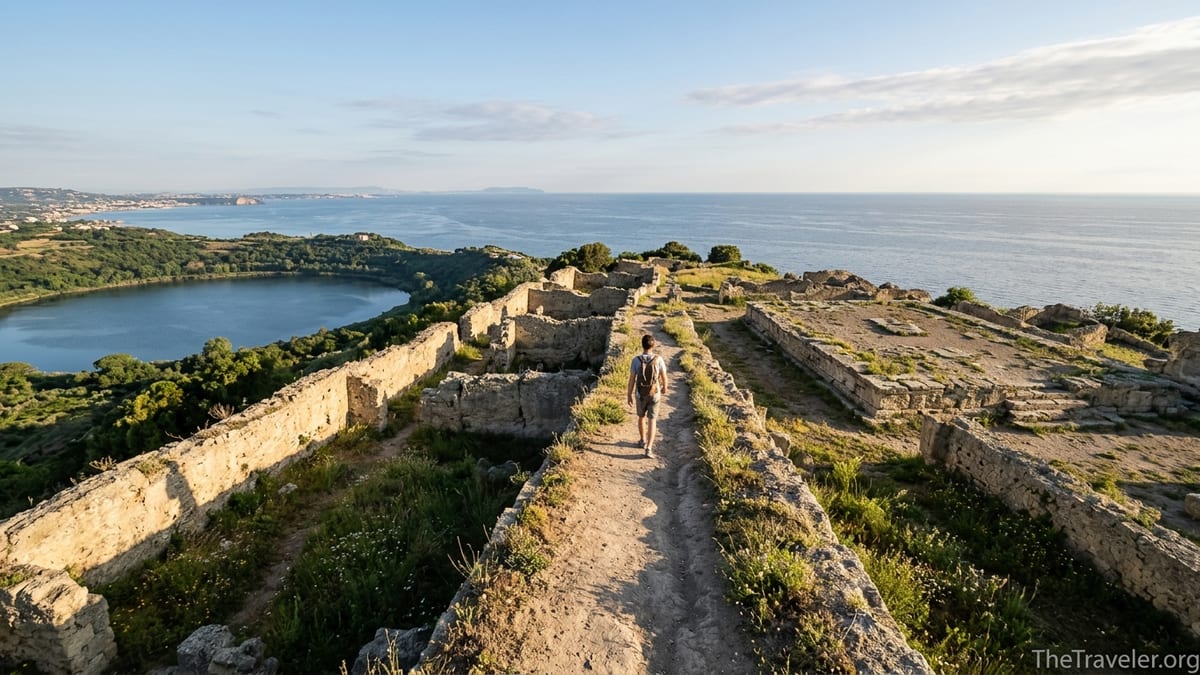
On paper, ancient Campania is a swirl of names and dates: Magna Graecia, the Cumaean Sibyl, Roman villas, the restless volcanoes of the Campi Flegrei. It was only when I walked up through the wind-carved tufa of Cuma’s acropolis, shoes dusty with volcanic ash and the Tyrrhenian Sea glittering below, that those abstractions turned into somewhere unmistakably real. Cuma is not as famous as Pompeii or Herculaneum, but it may be the single most evocative place to understand how Greek myth, Roman power and the raw geology of southern Italy shaped everyday life.
Get the latest updates straight to your inbox!
Arriving in the Quiet Shadow of the Campi Flegrei
The approach to Cuma is disarmingly ordinary. From central Naples, commuters crowd the Cumana and Circumflegrea suburban rail lines toward Pozzuoli and Torregaveta, and buses fan out from there toward the low coastal plain. By the time you step off near the Scavi di Cuma stop and walk the final stretch along the roadside, the city has fallen away behind you. Ahead lies a low, scrub-covered ridge of volcanic tufa and, beyond it, a glint of sea. Somewhere up there was the first Greek colony on the Italian mainland, founded in the 8th century BC, long before Rome mattered to anyone.
The entrance to the archaeological park is modest: a ticket booth, a car park where local families unload picnic bags, and a simple gate. As of mid-2026, the Parco Archeologico dei Campi Flegrei sells a three-day combined ticket that covers Cuma, the Flavian Amphitheater in Pozzuoli, the archaeological zone and museum at Baia. The cost is low enough that it rivals a mid-range pizza in Naples, which makes it one of the better cultural values in Italy and encourages you to see Cuma not as a standalone ruin but as part of a wider volcanic landscape of ports, villas and temples.
On my visit, the woman at the ticket window circled the key areas on a printed map: the acropolis with the cave of the Sibyl and the sanctuary terraces, the lower city with its forum and baths, and paths out to viewpoints over the Campi Flegrei coast. There were no crowds pressing behind me, no cruise-ship queues, just a couple of hikers adjusting backpacks. That quiet was the first signal that Cuma would feel different from the marquee sites along the Bay of Naples.
From the gate, a stony path climbs gently upward between banks of wildflowers and low maquis. The soundscape shifts from distant traffic to cicadas and the crunch of pumice underfoot. To the right, between stands of pine, the glimmer of Lake Averno appears, the ancient entrance to the underworld in Virgil’s Aeneid. The mythology is literally in your peripheral vision as you start to walk.
Climbing the Acropolis: A Greek City Above a Volcanic Sea
The upper city at Cuma is really a layered acropolis, its tufa terraces stacked above the shoreline like a series of fortresses. The Greeks chose this headland for its defensible position and its control of sea routes; the Romans later fortified it further, and Byzantine troops reused its walls during the Gothic Wars. As you climb, you are effectively walking through successive defensive lines built across a thousand years.
The main path zigzags between cut rock walls, some still bearing the tool marks of ancient quarrymen. In places, you can see where blocks have been removed for later construction, leaving negative impressions in the soft yellow stone. These scars, more than any museum label, make it clear that Cuma was once a living building site rather than a perfectly frozen ruin. I passed a school group whose teacher pointed out the same chisel patterns the children had learned about at the Archaeological Museum back in Naples; here, they could run their hands across them.
Higher up, the city opens out into terraces. On the western side, the remains of the so-called Temple of Jupiter occupy the summit, built over an earlier Greek sanctuary. Today its rectangular footprint is traced by low walls and fragments of column drums. From here you have one of the definitive views in Campania: the blue arc of the Tyrrhenian, the curve of the coastline toward Gaeta, and, inland, the pockmarked fields and cones of the Campi Flegrei caldera. It is a sweeping, almost cinematic panorama, but what makes it compelling is the sense that the ancient inhabitants saw almost exactly this same view when they negotiated trade, watched for enemies or read signs from the gods in the clouds over the sea.
Turn inland and another terrace holds the remains of a sanctuary to Apollo. The Cumaean Sibyl, the prophetess who would later guide Aeneas to the underworld in Roman literature, was associated with this space. Standing there, with only a few scattered column bases and a later Byzantine tower to orient you, the famous stories become less like myth and more like local memory. The idea that pilgrims once climbed this same ridge to ask questions of an oracle suddenly feels perfectly plausible.
Stepping into the Sibyl’s Cave
Just below the summit, a broad tunnel cuts straight into the tufa. This is the so-called Cave of the Cumaean Sibyl. Contrary to the romantic Victorian idea of a cramped grotto, the entrance is monumental: a long, trapezoidal corridor more than a hundred meters in length, hewn directly from the volcanic rock. Current research suggests it served as a military or defensive passage connected to the acropolis walls, later overlaid with the Sibyl legend, but its atmosphere is undeniably oracular.
Inside, the light drops dramatically. Narrow side openings create alternating bars of brightness and shadow across the floor, like a series of stage spotlights. On a hot summer day, the temperature falls noticeably, and sound becomes muffled. Guides sometimes pause here and ask you to imagine an ancient visitor, having made an offering at Apollo’s temple above, being led into the dim, echoing tunnel to await the Sibyl’s voice. Whether or not that exact ritual happened, the physical space makes the literary accounts feel like they could have.
Near the midpoint of the passage, a side door leads to a small chamber traditionally identified as the Sibyl’s room. It is unadorned and functional, more bunker than chapel, which only sharpens its power. In the low light, the rough tufa walls absorb the last glints from outside, and you can easily picture a priestess or an official standing silhouetted in the doorway, mediating questions and answers on behalf of Apollo. As one Italian visitor remarked to me on the way out, “It is easier to believe in prophecy when the room looks like this.”
Back outside, blinking in the sunlight, the cave’s entrance regains its military feel. From the path, you can see how it fits into a broader system of cut rock, terraces and walls that would have allowed defenders to move rapidly along the ridge while staying partly concealed. Cuma’s genius, it becomes clear, was to fuse a sacred landscape with strategic engineering, using the same geology that made the area so unstable to carve out both fortifications and sanctuaries.
From Myth to Municipality: The Lower City
Leaving the acropolis eventually brings you down toward the remains of the lower city, where Cuma shifts from the world of oracles and temples to something more municipal. Here you find the outlines of the forum, market buildings, workshops and stretches of paved road, all built over earlier Greek layers. In one corner, basalt paving stones still bear the ruts of cart wheels, and weeds thrust up between them alongside shards of roof tile and pottery.
One of the most instructive structures is a set of Roman baths. Although only the foundations and some low walls remain, you can trace the standard sequence of rooms: the frigidarium for cold immersion, the tepidarium for warm air, and the caldarium where underfloor heating channels once carried hot air from a furnace. Standing in the shell of the caldarium, looking down at the ground where the hypocaust pillars would have stood, you grasp that even a “frontier” city in Magna Graecia had the full infrastructure of Roman leisure and hygiene. Cuma was hardly an outpost. It was plugged into the thermal culture that still defines modern Campania’s spas at places like Baia and Ischia.
In the forum area, fragments of inscriptions turn the anonymous ruins into a place of named individuals. Marble blocks preserve partial dedications from local magistrates who funded building works or games. While many of the finest pieces have been moved to the Archaeological Museum in Naples or the museum at the Castello di Baia, enough remain on site to give you a sense of Cuma as a community of citizens and freedmen, not just a backdrop for mythological episodes. A broken Latin inscription mentioning public funds feels oddly contemporary when you realize you are walking through what was once a town hall square.
Beyond the forum, paths lead toward residential zones where excavations have uncovered houses with mosaic fragments and fresco traces. Most are modest by the standards of Pompeii’s showpiece villas. For a modern traveler, that is precisely their value. You are seeing the scale of ordinary homes, the sort of two-storey structures that might today correspond to apartments in the outer districts of Naples or Pozzuoli, rather than palatial seaside retreats. Rooflines are gone, but door thresholds and room proportions still articulate how families would have moved between kitchen, courtyard and sleeping areas.
Walking Cuma in the Context of Ancient Campania
What sets Cuma apart is how it forces you to think horizontally across Campania rather than vertically through time. From almost any viewpoint on the acropolis, you can orient yourself toward other key sites. Look east and you can imagine the line of road and sea that links Cuma to Puteoli, the bustling Roman port beneath modern Pozzuoli. Turn slightly and you align with Baia, where emperors built sprawling villas along the volcanic bay, parts of which now lie underwater. Further south are the directions of Herculaneum, Pompeii and the cone of Vesuvius, dominating the horizon on clear days.
In practice, many travelers still visit these places as isolated day trips: one day to Pompeii, another to climb Vesuvius, perhaps an afternoon at the Flavian Amphitheater. Cuma subtly reorders that pattern. Because it is quieter and more contemplative, walking here encourages you to imagine movements instead: ships sailing from the Greek harbor, grain and wine moving inland, information and styles diffusing along the coast. When you later stand in the chaotic streets of Naples or in the orderly grid of Pompeii, the memory of Cuma’s ridge makes it easier to picture a genuinely interconnected Campania rather than a set of famous ruins separated by tour buses.
The park’s own ticketing structure reinforces that network. With a single combined pass, you can visit Cuma in the morning, then take a local train and bus to Baia in the afternoon to see the museum and, if conditions allow, arrange a glass-bottom boat or snorkeling trip over the submerged Roman streets. Another day, the same pass gets you into the Flavian Amphitheater in Pozzuoli, where you can walk through the subterranean corridors that once held gladiators and animals. Using Cuma as your starting point, those later sites feel like natural extensions of the same story.
There is also the geological continuity. The Campi Flegrei are an active volcanic system, and the ground you walk on at Cuma is part of the same restless caldera that bubbles at Solfatara and tilts the harbor at Pozzuoli through a process known as bradyseism. Guides sometimes point out that what preserved Pompeii under Vesuvius’s ash was a single catastrophic event, while the landscape around Cuma bears the marks of repeated smaller upheavals over a much longer period. When you see the warped pavements and repaired walls in the lower city, they are part of this slow-motion instability.
Practical Ways to Experience Cuma Like a Local
Despite its deep history, visiting Cuma is logistically straightforward. Most travelers base themselves in Naples, where a dense web of trains and buses connects to the western suburbs. One common route is to take metro Line 2 or a regional train to Montesanto, transfer to the Cumana or Circumflegrea line toward Torregaveta, then get off at a station where local buses or taxis continue to the archaeological park. Travel times vary with connections, so it is wise to leave Naples by mid-morning if you want to explore at a relaxed pace.
For those uncomfortable with Italian public transport quirks or traveling with young children, pre-arranged transfers and small-group tours can be a sensible alternative. Local operators specializing in the Campi Flegrei offer half-day excursions that combine Cuma with stops at viewpoints over Lake Averno or short tastings at nearby vineyards that grow Falanghina and Piedirosso grapes in volcanic soils. These packages typically cost only slightly more than the sum of taxi fares and tickets if you were to organize everything independently, and they add the benefit of a guide versed in both archaeology and modern local life.
On site, facilities are simple. There is usually a kiosk or vending machines near the entrance, but serious refreshments are better found in the nearby towns of Licola, Arco Felice or Pozzuoli. Many visitors bring water, a light picnic and sun protection, then plan a late lunch at a family-run trattoria back down on the coast. Ordering a plate of spaghetti alle vongole or fried anchovies within sight of the same sea that fed ancient Cuma is one of those quietly satisfying travel experiences that links past and present more effectively than any exhibition panel.
Time your walk carefully. In high summer, midday heat on the exposed acropolis can be intense, with limited shade beyond scattered pines. A morning or late-afternoon visit not only offers softer light for photography but also more comfortable temperatures. In shoulder seasons like April, May, September and October, the site is at its best: wildflowers, clear air and a level of visitor traffic low enough that you may have whole terraces to yourself for several minutes at a time. Sensible shoes are essential, as paths can be uneven, and a light jacket is useful even in warm weather, given how cool the Sibyl’s tunnel can feel.
The Takeaway
Cuma will not overwhelm you with frescoed dining rooms or streets frozen mid-evacuation. It does something subtler and, arguably, more valuable for anyone interested in ancient Campania. Walking its paths, you feel the continuity between Greek sailors seeking a safe harbor, Roman citizens building bathhouses and forums, medieval soldiers refortifying the acropolis and modern residents waiting at bus stops under the same volcanic ridge.
If Pompeii offers a snapshot of disaster, Cuma offers a lived-in panorama of survival and adaptation. The combination of modest crowds, far-reaching views and tangible connections to myth make it a place where history shifts from textbook to territory. By the time you descend from the acropolis and look back up from the roadside, the hill no longer reads as a ruin. It looks like a familiar neighborhood that simply happens to have been inhabited for nearly three millennia.
For travelers willing to go slightly off the most trodden path, a half-day at Cuma can reframe an entire trip to southern Italy. After you have traced the Sibyl’s tunnel, looked out over Lake Averno and stood in the shell of the Temple of Jupiter, every later encounter with the words “Magna Graecia” or “Campi Flegrei” carries the memory of volcanic dust on your shoes and salt on the air. Ancient Campania, once abstract, becomes a tangible place that you have climbed, breathed and walked through in person.
FAQ
Q1. Where exactly is Cuma and how far is it from Naples?
Cuma is in the Campi Flegrei area within the municipality of Pozzuoli, northwest of Naples. By public transport, it typically takes about 60 to 90 minutes from central Naples, depending on connections.
Q2. How much time should I plan for a visit to the Cuma Archaeological Park?
Most visitors spend between two and four hours at the site, enough to walk the acropolis, visit the Sibyl’s cave and explore parts of the lower city without rushing.
Q3. Is Cuma suitable for children and less experienced travelers?
Yes, provided everyone is comfortable with some uphill walking on uneven paths. The site is less crowded and more relaxed than Pompeii, which many families find easier to manage.
Q4. Do I need a guided tour, or can I visit Cuma independently?
You can visit independently with the help of on-site panels and a simple map, but a guided tour, especially one covering multiple Campi Flegrei sites, adds valuable context that connects Cuma to the wider region.
Q5. What should I wear and bring for a day at Cuma?
Wear sturdy walking shoes, bring water, sun protection and a light layer for the cooler tunnels. In warmer months, a hat and sunglasses are strongly recommended.
Q6. Are there food and restroom facilities inside the park?
Restrooms are usually available near the entrance, but food options are limited to basic snacks or vending machines. Many visitors bring a small picnic and eat a full meal later in nearby coastal towns.
Q7. Can I combine Cuma with other nearby archaeological sites in one day?
Yes. Many travelers pair Cuma with the Flavian Amphitheater in Pozzuoli or the archaeological area and museum at Baia, using a combined ticket and local transport or a small-group tour.
Q8. How crowded does Cuma get compared with Pompeii or Herculaneum?
Cuma is generally much quieter than the better-known sites. Even in peak season, you are likely to find areas of the acropolis and lower city with only a handful of other visitors.
Q9. Is Cuma accessible for visitors with limited mobility?
Some lower sections near the entrance are relatively level, but the main highlights, including the acropolis and the Sibyl’s cave, involve slopes, uneven ground and steps, so access can be challenging.
Q10. When is the best time of year and day to visit Cuma?
Spring and autumn offer the most pleasant conditions, with milder temperatures and fewer crowds. Within each day, mornings and late afternoons are best for cooler air and softer light.