


Most travelers reach Cuma with a single image in mind: the long, shadowy passage of the Cumaean Sibyl, cut into volcanic rock above the Tyrrhenian Sea. They walk through the tunnel, snap a photo at the viewpoint, then hurry back to their bus for the next stop in the Phlegraean Fields. Yet the archaeological park of Cuma quietly rewards those who slow down. In its worn stone blocks, half-buried stairways and overlooked corners are traces of Greek sailors, Roman generals, Byzantine soldiers and medieval pilgrims that almost everyone else misses.
Get the latest updates straight to your inbox!
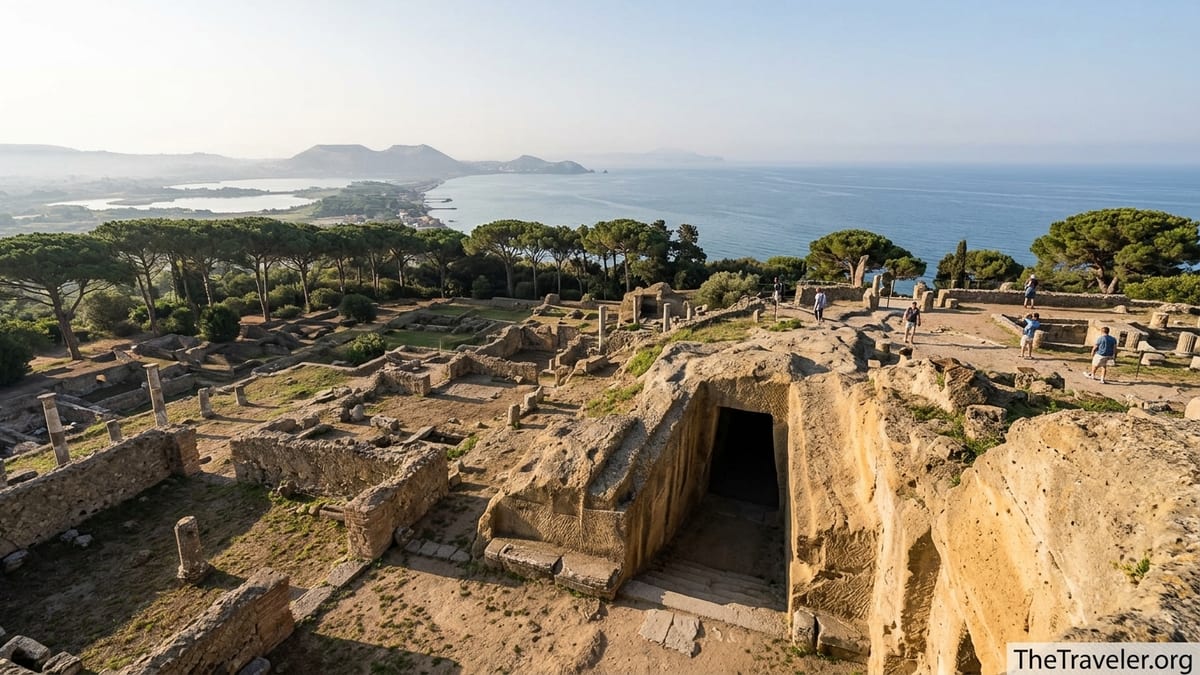
Reading the Landscape Before You Enter
If you arrive at Cuma by car or taxi from Naples, the first surprise hides in plain sight, long before the ticket office. As you drive the last stretch from the Cuma exit of the Naples ring road, low, tree-covered hills rise on your left, flat agricultural land opens on your right and, suddenly, a rocky spur appears ahead. It looks unremarkable at first glance, but this headland is why Cuma exists. Greek settlers from Euboea chose this spot around the 8th century BC because the tuff promontory offered a natural acropolis above the sea and lagoons, a defensive perch in a landscape that was otherwise marshy and hard to control.
Most visitors stride straight into the park without thinking about that geography. Take a moment in the parking area to look back toward the flat land and imagine it as it once was: a patchwork of brackish ponds and channels rather than farmland, with the Silva Gallinaria forest and malarial wetlands isolating Cuma from its neighbors. Even today, on humid mornings in spring and autumn, a faint mist can hang over the fields and reed beds, giving a hint of the marshy fringe that shaped the city’s history and eventually contributed to its decline as disease and silt choked the lower town.
Walk from the parking lot to the entrance slowly and you will also notice small modern shrines and religious posters on fences and walls. Many travelers ignore them as visual clutter, yet they echo a continuity of sacred landscape. This stretch of road runs between the archaeological park and the Lago di Licola and Lago d’Averno area, where ancient writers located the entrances to the underworld and the groves of Hecate. The habit of marking roads here with crosses, Madonnas and devout slogans is the latest layer over a route that has been lined with sacred markers in one form or another for more than two thousand years.
Inside the gate, before you climb toward the acropolis, pause by the first explanatory panels and look at the rocky slopes. You can often spot rectangular cuts in the tuff that are not part of any standing building. These are the ghost outlines of quarried blocks, proof that the hill itself was the quarry that fed Cuma’s walls, temples and houses. It is an early lesson in how the ancients treated the landscape as a living resource rather than a neutral backdrop.
The Sibyl’s Passage: Geometry, Light and Sound
The Antro della Sibilla is the star attraction of Cuma, yet even here most people overlook the details that make the place so uncanny. As you step into the passage, look closely at its cross-section. Instead of a simple rectangle, the corridor tapers slightly, forming a long, trapezoidal space that narrows in both width and height as you advance. The floor is roughly flat, but the walls lean inward, and the ceiling slopes gently down. That geometry plays with your perception: the eye reads the far end as more distant and mysterious than it actually is, and the mind fills the dimness with significance.
About halfway along, on the seaward side, a series of lateral chambers opens off the main passage. Guides often describe one as the Sibyl’s seat, but visitors tend to treat it as a photo stop and move on. Step into one of these niches and fall silent for a few seconds. The sound changes. Your voice and footsteps take on a brief echo, and you can hear the difference between the muffled main corridor and the livelier side chamber. Acoustic studies carried out by researchers from Campanian universities note that the proportions of the space subtly amplify a speaking voice without producing a confusing echo. Even if this specific identification is debated among archaeologists, the lived experience of standing here and hearing the change in sound helps you understand why ancient people associated this place with a powerful voice from beyond.
Light is another hidden feature most people sense without consciously noticing. If you enter when the sun is fairly high, slim shafts of light slice across the floor from the openings cut toward the sea side of the gallery. Because the rock is volcanic tuff with a slightly warm tone, that light reflects softly upward, giving a faint glow to the lower walls while the ceiling remains in shadow. Walk slowly from one end of the tunnel to the other and watch how the pattern of light shifts with each window. It is remarkably easy to imagine a priestess stepping from darkness into one of those pale beams to deliver an oracle, her form half-lit, her face unreadable.
At the far end, many people look only at the fenced-off inner chamber, trying to frame it in their phone cameras. Turn around instead and look back toward the entrance. From this angle the long trapezoid of the tunnel becomes a kind of stone funnel, drawing the much brighter rectangle of daylit doorway into sharp focus. It is an inversion of the usual underworld imagery: rather than descending into darkness, you are standing at the mythic threshold looking outward toward life. That simple reversal is easy to miss, but it reveals how ancient visitors might have felt when they left the Sibyl’s presence, stepping back toward the uncertainties of the world with words of prophecy echoing in their ears.
Forgotten Tunnels and Defensive Tricks on the Acropolis
Beyond the Sibyl’s passage, paths climb toward the upper acropolis where the temples of Apollo and Jupiter once stood. Many visitors follow only the main stairs and the shortest route to the panoramic viewpoints. If you have time, detour whenever you see a side path leading into the rock. Some of these short, dim corridors belong to the so-called Crypta Romana, a network of tunnels cut through the hill to link different plateaus and, later, to move troops and supplies unseen.
In some stretches you can still spot chisel marks on the tuff, running in regular, shallow grooves like the grain of wood. These marks often go unnoticed, yet they are tangible traces of the labor that carved these galleries in the late Republican or early Imperial period. If you compare older, rougher cuts near corners with smoother ones along the main walls, you can sense the different phases of work and repair that transformed the acropolis from a Greek sanctuary into a heavily fortified Roman and Byzantine stronghold.
Another overlooked detail lies in the bends and kinks of the tunnels themselves. The galleries rarely run straight for long. They twist and dogleg, sometimes forcing you to slow down or turn your shoulders. That awkwardness is intentional. In an emergency, such bends would have broken the line of sight for archers or slingers, limited the advance of enemy troops and helped defenders create choke points. To feel this in your body, imagine trying to run in formation through these passages wearing armor or carrying a shield. A path that feels mildly inconvenient to a modern visitor would have been a serious tactical feature in antiquity.
When you emerge from these galleries onto the open terraces, do not rush directly to the obvious viewpoints. Look at the edges of the plateau where the rock drops away. In places you will find shallow, straight channels cut into the tuff, sometimes ending abruptly at nothing. These may be the remains of water management systems or defensive ditches that once held palisades. Today they are often choked with soil and small plants, but their presence hints at a complex infrastructure that supported life atop this windy spur.
Temples, Thresholds and Recycled Stone
The upper acropolis of Cuma is famous for the temple of Apollo, where Roman legend places the meeting between Aeneas and the Sibyl. Most photos focus on the broad platform and the surviving walls, but the real stories lie in the thresholds and loose blocks scattered around. As you approach what remains of the temple, look down at the sill stones at doorways and at the first steps up to the platform. Many of these are heavily worn in the center, with smoother, shallower wear toward the edges, a classic pattern created by thousands of feet over centuries. Put your own foot there for a moment and you are literally stepping where worshippers in Greek, Roman and even early Christian times once walked.
Around the Apollo and Jupiter areas you will also find blocks with carved moldings, column fragments and bits of cornice lying as if randomly along paths and terraces. These are not simply debris. They are fragments that were pulled from one building to reinforce a later wall, then perhaps pulled again in the Middle Ages to strengthen a tower, then discarded when those defenses collapsed or were quarried for local farmhouses. Look for pieces where one face has fine, regular carving and another side is roughly chipped. That contrast is the fingerprint of reuse. It tells the story of a city that reinvented its own stone again and again as its needs, rulers and religions changed.
One subtle but important cue is the way the orientation of the sacred spaces shifts across the acropolis. The original Greek layout favored alignments toward rising suns or specific points on the horizon, while later Roman and Christian interventions respected, altered or ignored those orientations. Without a compass it can be hard to track, but you can sense it simply by watching where the light falls. On clear mornings, parts of the Apollo terrace catch sharp sunlight while nearby areas remain in shade, suggesting differing axial lines. Spend a few minutes just watching the way shadows slide across the paving and you begin to see the acropolis not as a static ruin but as a stage where centuries of builders negotiated with the sun, wind and topography.
Near some of the standing walls you may notice small crosses or initials scratched into the stone at eye level, usually faint and easy to miss. These are later graffiti, left by pilgrims, soldiers or local visitors over centuries. While conservation staff today discourages any new marks, the surviving older ones form a quiet palimpsest of devotion and presence that sits uncomfortably, but revealingly, beside the grand narratives of emperors and generals.
Traces of Everyday Life in the Lower Town
Many tours concentrate on the acropolis and Sibyl’s cave, mentioning the remains of the lower town only in passing. If the site is fully open during your visit, follow the paths that lead away from the hill toward the flatter areas where domestic quarters once stood. Here the ruins are often less photogenic, but the small details carry a different kind of fascination. In some house foundations you can spot basalt or reused brick set into the tuff to form door thresholds, suggesting an attempt to make high-traffic areas more durable under constant wear.
Look closely at wall stubs and you may see thin ribs of red brick alternating with thicker courses of stone. This sort of mixed masonry is a hallmark of later Roman and late antique building everywhere around the Bay of Naples, but at Cuma it speaks to centuries when the city was no longer a glittering frontier colony yet still very much alive. Builders used whatever materials came to hand, including fragments scavenged from older monumental structures. For a modern traveler, recognizing such patterns makes wandering the lower town feel less like walking through anonymous ruins and more like reading a record of adaptation and improvisation.
In some seasons, especially in late winter and early spring, wildflowers and grasses colonize the gaps between stones. Purple thistles, yellow daisies and small blue blossoms push up along the old street lines. It is tempting to dismiss this as just pretty scenery, but it also quietly demonstrates the resilience of the native Mediterranean scrub that reclaimed Cuma after its abandonment. For centuries, the same kind of vegetation contributed to the “desolate” and “melancholic” impressions recorded by early modern visitors who came here when the area was sparsely populated and the ruins half-buried in greenery.
Occasionally you will see modern interventions in the lower town that are easy to overlook: discreet drainage channels, low fences and newly consolidated walls. These works are part of the ongoing effort by the Phlegraean Fields Archaeological Park to stabilize the site after heavy rains and to make additional areas safely accessible. Keeping an eye out for these small, contemporary details gives you a more honest sense of Cuma as a living archaeological project rather than a frozen relic.
Viewpoints, Volcanoes and the Underworld
One of the reasons so many visitors rush through Cuma is that they are focused on ticking off several Phlegraean sites in a single day. Yet some of the most revealing details here demand that you simply stand still and look out. From the top terraces near the remains of the temple of Jupiter, the view sweeps over dunes, pine woods, coastal lakes and, beyond them, the sea and the low cone of Procida. It is a beautiful scene, but if you turn slowly you will start to notice the subtle craters and irregular ridges that ring the horizon. These are the remnants of the Phlegraean Fields volcanic system, including the basins that hold Lake Avernus and other flooded craters.
Ancient authors described Lake Avernus, just inland from Cuma, as a place where birds fell from the sky because of fumes from the underworld. Standing on the acropolis on a still, warm day, you can understand how such stories arose. The air can feel heavy, and heat hazes shimmer over the low ground. Occasional whiffs of sulfur drift on the breeze from active fumaroles at nearby Solfatara and other vents you cannot see from here. Those small sensory impressions, easy to dismiss amid the click of phone cameras, help you grasp what it meant for people in antiquity to live in a landscape where the earth itself seemed restless and alive.
Another overlooked aspect of the view is the coastline. From Cuma’s height you can trace the long arc of beach that runs toward modern Pozzuoli and, beyond that, the industrial sprawl of Naples. Somewhere along that line lay ancient harbors and landing places now partly buried or eroded. Thinking about how the shoreline has shifted over time adds depth to the experience. Where you now see a straight, regulated beach dotted with umbrellas and beach clubs, Greek sailors once navigated sandbars and inlets, and Roman merchants watched for ships heavy with grain and wine. When planning your visit, it is worth allowing time simply to sit on one of the stone blocks at the edge of the terrace and let your eyes wander over this changing frontier between land and sea.
On clear winter afternoons, when the sun sits low over the water, long shadows stretch from every remaining wall and block on the acropolis. The relief of the tuff stones stands out more sharply then than in harsh midday light. If your schedule allows, visiting in the cooler months or staying late enough in the day to see this transformation can reveal textures and alignments that are invisible at noon. It is a quiet reminder that ruins, like living cities, look different hour by hour and season by season.
Practical Ways to Notice More at Cuma
Seeing these hidden details does not require specialist training, only a shift in tempo and a bit of preparation. One simple strategy is to avoid packing Cuma into the margins of a day dominated by Pompeii or Naples. Instead, treat the Phlegraean Fields as a stand-alone excursion and plan to spend several unhurried hours at Cuma itself, ideally in spring or autumn when the heat is gentler and coach tours a little thinner. A combined ticket for the Phlegraean sites typically allows you to visit Cuma alongside the archaeological park of Baiae, the Flavian amphitheater of Pozzuoli and the museum at the castle of Baia within a three-day window, so you can spread your visits rather than rushing them all in one go.
On the ground, small choices make a big difference. Bring a simple notebook or use your phone’s notes app not just for photos but for observations: textures you notice, changes in sound between spaces, fragments of carving that catch your eye. When you walk the Sibyl’s tunnel, consider doing one pass without taking any pictures, giving your senses time to adjust to the light and acoustics. Then, on the way back, you can photograph details that now stand out: the angles of the ceiling, the precise size of side chambers, the line of sunlight on the floor.
Comfortable shoes with good grip are more important here than at some other sites in the region. Paths on the acropolis can be uneven, with loose gravel, and some of the rock-cut steps in the tunnels are worn smooth. A refillable water bottle and a hat are also wise, especially if you plan to linger on the upper terraces where shade is scarce. There is usually limited on-site refreshment, so many visitors bring light snacks or a picnic to enjoy at one of the viewpoints, taking care to respect park rules and leave no trace.
Finally, consider pairing Cuma with a stop at the archaeological museum of the Phlegraean Fields in Baia, where artifacts from the site are displayed with explanatory panels. Seeing inscriptions, statues and everyday objects in the museum before or after your walk among the ruins enriches your sense of what you are looking at when you notice a reused block or weathered threshold. The dialogue between museum pieces and site details is one of the great, if underappreciated, pleasures of archaeological tourism in this corner of Campania.
FAQ
Q1. How much time should I plan for a visit to Cuma?
Most travelers can see the main highlights in about two hours, but allowing three to four hours lets you explore tunnels, lower-town remains and viewpoints at a more relaxed pace.
Q2. Is Cuma suitable for children or less experienced travelers?
Cuma can be enjoyable for children and first-time visitors, especially with stories about the Sibyl and the underworld, but some paths are uneven and there are stairs, so it is best for those comfortable with moderate walking.
Q3. What is the best time of year to notice the site’s subtler details?
Spring and autumn are ideal, when temperatures are milder, light is softer and crowds thinner, making it easier to linger in the tunnels and on the terraces without rushing.
Q4. Are guided tours necessary to appreciate the hidden aspects of Cuma?
A knowledgeable guide can enrich the experience, but even without one you can notice many hidden details by moving slowly, reading on-site panels and paying attention to light, sound and stonework.
Q5. Can I combine a visit to Cuma with other nearby archaeological sites?
Yes, many visitors pair Cuma with Baiae, the Flavian amphitheater in Pozzuoli or the museum at Baia, often using a combined ticket valid over several days.
Q6. Is the Sibyl’s cave always open to visitors?
Access can occasionally be restricted for conservation or safety reasons, so it is wise to check locally on the day of your visit and be prepared to focus on other parts of the acropolis if needed.
Q7. What should I wear and bring for a comfortable visit?
Wear sturdy walking shoes, bring water, sun protection and perhaps a light jacket in cooler months, as the tunnels can feel damp and breezy even when it is warm outside.
Q8. Are there facilities and services at or near the site?
Facilities are basic, typically limited to ticketing, restrooms and occasional small services nearby, so it is sensible to eat beforehand or bring snacks if you plan a longer stay.
Q9. Is photography allowed inside the Sibyl’s passage and tunnels?
Photography for personal use is generally allowed, but tripods and flash may be restricted; be considerate of other visitors when stopping for photos in narrow spaces.
Q10. How can I deepen my understanding of what I see at Cuma?
Reading a concise guidebook or article beforehand, visiting the Phlegraean Fields museum in Baia and taking time to observe small details on site will all help you connect the ruins with their stories.