


Just 40 minutes from central Naples, on a windblown headland above the Tyrrhenian Sea, Cuma looks deceptively quiet. Today it is a modest archaeological park on the edge of the Campi Flegrei, with scattered ruins, scrubby vegetation and sweeping coastal views. Yet for more than two millennia this hill was one of the most influential places in Italy: the first durable Greek foothold in the West, a strategic Roman stronghold, a Christian center and the legendary home of the Cumaean Sibyl, whose prophecies shaped Roman imagination. Understanding Cuma is one of the keys to understanding how southern Italy, and eventually Rome itself, became what they are.
Get the latest updates straight to your inbox!
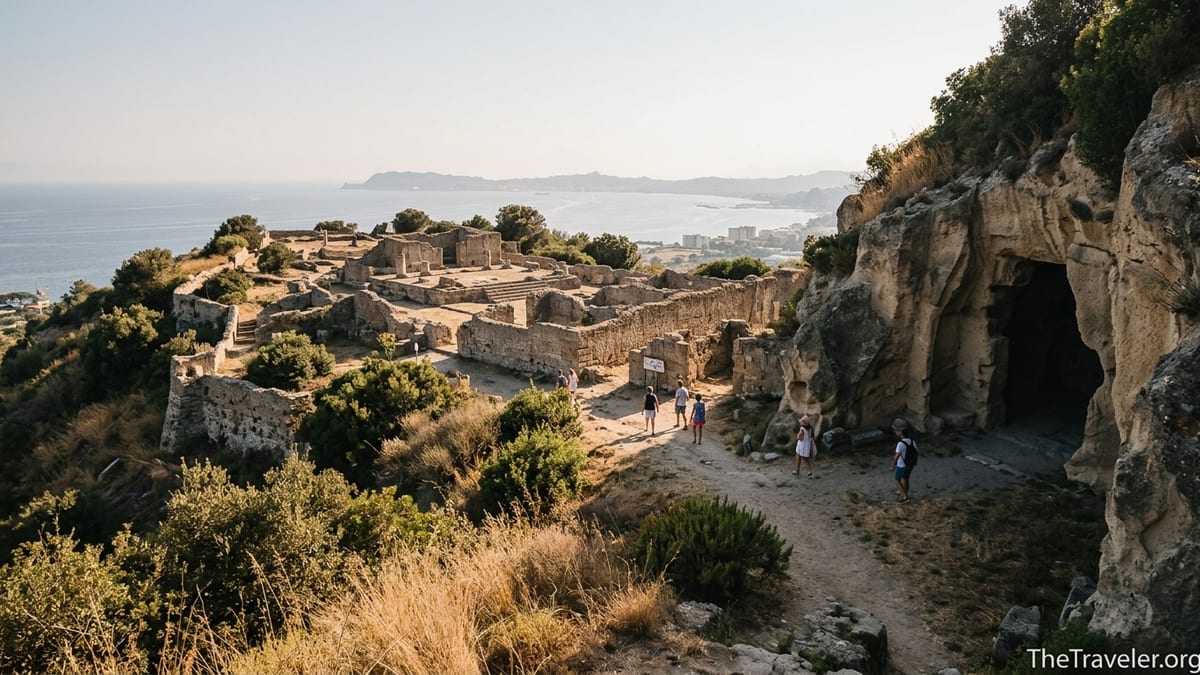
Where and What Is Cuma Today
Cuma, or Cumae in Latin, lies about 20 kilometers west of Naples in the municipality of Bacoli, within the volcanic landscape known as the Campi Flegrei. Travelers encounter it today as the Parco Archeologico di Cuma, part of the wider Phlegraean Fields Archaeological Park that also includes the Flavian Amphitheater in Pozzuoli and the thermal complex of Baiae. Practically, this means that if you are staying in Naples you can visit Cuma alongside other lesser known but remarkable sites on the same coast, often using a combined ticket valid for several days.
Reaching Cuma is straightforward but feels pleasantly off the usual tourist trail. Many visitors take the Cumana or Circumflegrea suburban rail lines from Naples to Fusaro, then continue by local EAV bus marked for Cuma Scavi, a short ride and a brief uphill walk to the entrance. Others opt for a rental car from Naples or Pozzuoli and follow signs for “Cuma” from the ring road, passing modern seaside resorts and lakefront promenades before the road climbs toward the ancient acropolis. Public transport timetables can change, so it is wise to check locally once you arrive in Naples, but in practice many travelers piece together the journey with a combination of train and bus for under 10 euros round-trip.
On arrival, you enter a guarded gate and pay at a small ticket office. As of 2026, standard entry to the Cuma Archaeological Park is in the same ballpark as other mid-size Italian sites, and many travelers choose the “Circuito Flegreo” combined ticket that covers Cuma plus Baiae, the amphitheater at Pozzuoli and the archaeological museum in the Castle of Baia, typically valid for three consecutive days. Exact prices and opening hours change seasonally, but visitors can expect a modest fee compared with the far higher prices at Pompeii or the Colosseum, making Cuma a good value for travelers who want deep history without the crowds or cost of the headline attractions.
The atmosphere feels rural rather than urban. There are no souvenir strips or chains here, just a small kiosk or vending machines at the entrance in many seasons, basic information panels in Italian and English, and wide dirt paths leading up the hillside. You will want good walking shoes, water and sun protection. In summer the tufa rock of the acropolis reflects heat, so many locals time their visits for the first opening hour or in the late afternoon when the sea breeze picks up and the light softens across the Bay of Pozzuoli.
The First Greek Colony in the West
Cuma’s real importance begins around the 8th century BCE, when Greek settlers from Euboea, probably from the cities of Chalkis and Eretria, established a colony on this headland. While there were other early Greek foundations in the central Mediterranean, Cuma is widely regarded as the first stable Greek colony on the Italian mainland, predating even the better-known city of Neapolis, today’s Naples. By choosing a hill protected by sea on one side and fertile plains on the other, the colonists secured both a defensible position and access to rich agricultural land and trade routes.
For travelers walking through the site today, this Greek chapter comes alive especially on the acropolis, the upper city reached by a rising path from the entrance. Archeologists have identified the remains of Greek temples that once dominated the summit, later converted and rebuilt across the centuries. Visitors can trace blocks of fine tufa masonry, fragments of column bases and scattered architectural terracottas. Some of the most impressive decorated pieces from Cuma, such as painted metopes showing mythological scenes, are now conserved in the Museo Archeologico dei Campi Flegrei in the Castle of Baia just a short drive away, encouraging travelers to treat these sites as an integrated circuit rather than isolated stops.
Cuma’s Greek community did not exist in isolation. From here, settlers founded the city of Parthenope on the hill of Pizzofalcone, which eventually evolved into Neapolis, the direct ancestor of modern Naples. This means that the metropolis where visitors enjoy pizza on Via dei Tribunali ultimately traces its roots back to this modest headland. In literary terms, Cuma also appears in early Greek sources as a frontier outpost, a place where the Greek world met the Italic peoples of the Campanian plain, including Oscan-speaking groups sometimes referred to as the Opicians. Standing on the acropolis with modern suburbs in the distance, it takes little imagination to see the site as a hinge between very different cultures.
The colony’s success brought wealth and influence but also conflict. In the 5th century BCE, Cuma was strong enough that its tyrant Aristodemus played a role in regional politics, yet by the 4th century the city faced pressure from the Samnites, a powerful Italic confederation. Eventually Cuma fell under Samnite control and later into the expanding orbit of Rome. For visitors, this layered history explains why Cuma’s ruins span such a wide chronological range, from archaic Greek sanctuaries to Roman fortifications and late antique basilicas, all compressed into a relatively small park.
Cuma and Rome: A Strategic Gateway
By the time of the Roman Republic, Cuma had become a critical strategic point on the Tyrrhenian coast. After Rome consolidated control in Campania during the 4th and 3rd centuries BCE, Cuma’s hilltop location and existing harbor facilities made it an ideal base for protecting maritime routes and monitoring the fertile plains behind the city. Under Augustus and his successors, the broader Phlegraean area, including Cuma, Baiae and Misenum, evolved into a mix of naval, residential and religious centers tied closely to the imperial court.
Travelers today see traces of this Roman phase particularly in engineering works on and beneath the acropolis. One of the most striking examples is the so-called Crypta Romana, a rock-cut tunnel that slices through the hill and once formed part of a military and logistical network. While early visitors sometimes confused it with the Sibyl’s cave, modern research associates the Crypta Romana with the defenses and communication lines built during the civil wars, when Octavian and his admiral Agrippa needed to secure this coastline in their struggle against Sextus Pompey. Walking through the shadowy passage, with its chisel marks still visible in the tufa, gives a vivid sense of Roman practical ingenuity.
Cuma also played a quieter but lasting role in the spread of Roman culture and language. As a long-established Greek city that shifted into Rome’s orbit, it became a conduit through which Greek religion, art and literacy influenced Rome, and through which Roman institutions in turn reshaped Greek communities. Inscriptions found at the site show a transition from Greek to Latin over the centuries, mirroring a process travelers can glimpse across southern Italy but that is particularly well documented here. Visiting both Cuma and the archaeological museum at Baia in a single day allows modern visitors to see how statues, dedications and everyday objects shift stylistically and linguistically as Greek elites adjusted to Roman rule.
For anyone interested in the broader story of Roman Italy, Cuma offers context that more famous sites sometimes lack. Pompeii and Herculaneum give snapshots of Roman life in the 1st century CE, frozen by disaster. Cuma, by contrast, offers a deep timeline showing how a Greek colony became a Roman city and then a Christian center over nearly a millennium. As you move from the Greek temple platforms through Roman tunnels and on to late antique churches, you are effectively walking through the stages by which Rome absorbed and transformed the cultures around it.
The Cave of the Cumaean Sibyl and the World of Myth
For many travelers, the highlight of a visit to Cuma is not a temple or a view, but a dim, trapezoidal corridor cut into the tufa rock on the flank of the acropolis. This is the so-called Antro della Sibilla, traditionally associated with the Cumaean Sibyl, the prophetess who appears in Roman literature as an oracle of Apollo. In Virgil’s Aeneid, the Sibyl guides the Trojan hero Aeneas down into the Underworld, prophesying the future of Rome. Later writers imagined her as the custodian of prophetic books consulted by Rome’s leaders in times of crisis.
The feature you see today is an imposing man-made tunnel approximately 130 meters long, running parallel to the hill. Its walls converge slightly toward the ceiling, giving a distinctive trapezoidal cross-section that amplifies echoes as you walk. Along one side open small lateral chambers, including a larger space at the far end where the Sibyl was once thought to have sat delivering her cryptic verses. Archaeological research suggests the passage probably dates to the late 4th or early 3rd century BCE and may originally have had a defensive or infrastructural function linked to the acropolis, later overlaid with religious associations.
Stepping into the tunnel is a powerful sensory experience. On a bright summer day the entrance glares white, but just a few steps inside the temperature drops and the light becomes a hazy strip receding in front of you. Moisture beads on the tufa, and the sound of footsteps reverberates more than feels natural. Guides often pause halfway down to let visitors stand in silence and imagine ancient petitioners coming here to consult the Sibyl. While scholars debate how exactly prophecy was practiced at Cuma, there is no question that the site has inspired centuries of art and literature, from Renaissance paintings of the Sibyl to modern historical novels set along the Bay of Naples.
In practical terms, access to the Sibyl’s cave can vary. Periodically in recent years, parts of the tunnel have been closed for conservation or safety assessments, particularly when rockfalls elsewhere in the park prompted broader checks. Travelers who have visited recently often report that at least a portion of the passage is open on regular visiting days, but open sections and lighting can change without much notice. For this reason, it is worth asking at the ticket office on arrival whether the Antro della Sibilla is fully open, partially accessible or closed, and planning enough time on the acropolis to adjust if staff route you along alternate paths.
Temples, Basilicas and the Birth of Christian Cuma
Beyond myth, Cuma is crucial for understanding the shift from polytheistic worship to Christianity in southern Italy. On the top of the acropolis, travelers find the remains of two major temple platforms traditionally labeled the Temple of Apollo and the Temple of Jupiter. These sanctuaries originated in the Greek period and were substantially rebuilt under the Romans. Later, in late antiquity, they were converted into Christian basilicas, reoriented to new liturgical needs while retaining earlier stonework in their walls and foundations.
As you walk through these structures today, you can see this palimpsest in the fabric of the buildings. Column drums lie scattered near blocks re-cut as supports for altars. In some areas, archaeologists have uncovered baptismal fonts and clusters of simple tombs dating from the centuries when Cuma became an important Christian center, roughly between the 4th and 7th centuries CE. These finds, some of which are visible in situ while others are displayed in the Baia museum, illustrate how existing sacred spaces were adapted rather than demolished during the Christianization of the region.
For visitors familiar with the grand basilicas of Rome or Ravenna, Cuma’s Christian remains may feel modest, but precisely this humility makes them valuable. Here you can stand where a local community, heir to centuries of Greek and Roman religious practice, gradually embraced new rituals while still surrounded by older iconography. Guides sometimes point out how certain floor plans mirror the layout of early churches known from written sources, and how clusters of graves testify to Cuma’s role as an episcopal seat, even as the city itself was shrinking in size and prestige.
From a traveler’s perspective, this mix of eras offers an unusually intimate encounter with religious history. On a typical visit you might start your day beneath a temple that once hosted sacrifices to Apollo, then walk just a few meters to examine the remains of a Christian baptistery. In the late afternoon, when the site is quieter, it is easy to imagine small congregations gathering in these spaces long after emperors had abandoned their seaside villas at nearby Baiae. Cuma thus encapsulates not only the rise of classical civilizations but also their transformation into the late antique world that would give birth to medieval Europe.
Exploring the Lower City and Everyday Life
While the acropolis draws most of the attention, Cuma’s lower city reveals the texture of everyday life across the centuries. Paths from the main gate lead gently downhill to areas where archaeologists have identified residential quarters, streets, cisterns and stretches of fortification wall. Compared with Pompeii, where entire blocks of houses stand with upper floors and wall paintings, the remains here are more fragmentary. Yet careful observation rewards the visitor who is willing to slow down.
In several zones, you can see the adaptation of earlier Greek urban planning to Roman needs, with traces of orthogonal street grids giving way to later expansions. Remains of shops and workshops suggest a thriving commercial community serving both locals and travelers moving along the coast road and through the nearby harbor. Some structures preserve elements of drainage and water management systems built in volcanic tufa, reminding modern visitors that the engineering challenges of life in the Campi Flegrei, with its unstable soils and hot springs, are not a recent phenomenon.
One particularly evocative area is the necropolis, where rows of tombs from different periods show how burial customs evolved over time. Vaulted Roman tombs coexist with simpler late antique graves, and in some sectors archaeologists have identified Christian burials marked by their orientation and associated symbols. Standing here, with modern Bacoli in the distance, visitors are confronted with the continuity of human presence on this headland, from archaic colonists to contemporary fishing families and commuters who ride the same coastal railway tourists use to reach the site.
Because Cuma receives far fewer visitors than blockbuster sites, it lends itself well to independent exploration. You may find yourself alone in an entire sector of the lower city for ten or fifteen minutes at a time, something almost unimaginable in the more famous Vesuvian sites. This solitude allows you to notice details like tool marks on stone blocks, traces of plaster and the way certain walls incorporate reused architectural fragments from earlier monuments. Bringing or renting a compact site map, or downloading one in advance, helps orient your walk, as onsite signage, while improving, can still feel sparse for those who want detailed explanations.
Planning Your Visit: Practical Tips and Nearby Highlights
For a typical traveler based in Naples, Cuma works well as a half-day or full-day excursion. Many visitors combine it with other Phlegraean sites such as the thermal ruins at Baiae, the Flavian Amphitheater in Pozzuoli or the lakes of Averno and Fusaro. A workable independent itinerary might look like this: morning train from Naples to Fusaro, bus up to Cuma for two to three hours of exploration, lunch at a simple trattoria near the Fusaro lakefront, then an afternoon visit to the Baia museum and baths before returning to the city in the early evening.
Weather and terrain matter. The site is largely open, with limited shade away from the tunnels, so in summer you should bring at least a liter of water per person, wear a hat and apply sunscreen. Paths are a mix of packed dirt, stone steps and uneven ancient paving. A small daypack with water, snacks and a light layer for the cooler interior of the tunnels is practical. Outside peak season, especially from November to March, visiting hours are shorter and rains can make some paths slippery, so sturdy footwear is important. Families with children often find that the combination of open space, tunnels and ruins offers enough variety to keep younger travelers engaged, provided you build in snack breaks and do not attempt to see everything at high speed.
Tickets can usually be purchased directly at the entrance without advance booking, which is a refreshing contrast to the timed reservations needed at places like the Colosseum. That said, if you are visiting during major Italian holidays such as around 15 August or on national free museum days, expect more local visitors and allow extra time. Carry some cash in case card readers are temporarily offline, a not uncommon occurrence at smaller Italian archaeological parks.
Nearby amenities are limited, which is part of Cuma’s charm but requires a bit of planning. There is typically no full-service café inside the park, so many travelers pick up panini and water near the train station or at a bar in Fusaro before heading up. After your visit, you can detour to the Casina Vanvitelliana, the elegant 18th century hunting lodge on an islet in Lake Fusaro, popular for photos and coffee stops. Alternatively, coastal restaurants in Bacoli and Miseno offer seafood lunches where you can reflect on the morning’s walk among the ruins while looking back toward the headland where Cuma’s acropolis sits.
The Takeaway
Cuma rarely appears on first-time Italy itineraries, overshadowed by Pompeii, the Amalfi Coast and Capri. Yet for travelers who are curious about how southern Italy became a crossroads of cultures, it is one of the most rewarding sites in the region. Here, within a compact archaeological park, you can trace the story of a Greek colony that seeded the birth of Naples, a Roman stronghold that guarded vital sea lanes and a Christian community that reshaped ancient temples into new forms of worship.
Beyond its historical importance, Cuma offers experiences increasingly hard to find at major attractions: space to wander in relative solitude, the chance to feel a direct physical connection with myth in the Sibyl’s cave, and sweeping views across a coastline that has drawn settlers, soldiers and saints for nearly three thousand years. Combined with nearby Phlegraean sites and easily reached from Naples, it rewards the traveler who is willing to look slightly beyond the standard route and, in doing so, gain a deeper sense of how Italy’s layered past still shapes the landscapes of the present.
FAQ
Q1. Where exactly is Cuma and how far is it from Naples?
Cuma is on the Campi Flegrei coast near Bacoli, about 20 kilometers west of central Naples. By public transport, most travelers reach it in roughly 40 to 60 minutes using a suburban train plus a short local bus ride.
Q2. Why is Cuma considered one of Italy’s most important ancient sites?
Cuma is widely regarded as the first stable Greek colony on the Italian mainland, founded in the 8th century BCE. It influenced the birth of Naples, became a key Roman stronghold, and later evolved into an early Christian center, creating an unusually long and well documented historical sequence in one place.
Q3. What is the Cumaean Sibyl and can I visit her cave?
The Cumaean Sibyl was a legendary prophetess of Apollo described by Roman authors like Virgil. Visitors to Cuma can walk through the Antro della Sibilla, a long rock-cut tunnel traditionally associated with the Sibyl. Access to the full length of the passage can vary depending on conservation and safety measures, so it is best to check at the ticket office on the day of your visit.
Q4. How do I get to Cuma using public transportation from Naples?
Most travelers take the Cumana or Circumflegrea suburban railway from central Naples to Fusaro station, then connect to an EAV bus signposted for Cuma Scavi, which drops you near the archaeological park after a short ride. Total one-way cost is typically under 10 euros per person, but you should confirm current timetables and routes once in Naples, since schedules and temporary closures can change.
Q5. How much time should I plan for a visit to Cuma?
If you are mainly interested in the acropolis and the Sibyl’s cave, two to three hours is usually enough for a relaxed visit. Travelers who enjoy archaeology and want to explore the lower city and necropolis in detail may prefer to budget three to four hours, especially if they are taking photographs or reading information panels carefully.
Q6. Are there guided tours available at Cuma?
On some days, especially weekends or during cultural events, the park or local associations organize guided visits in Italian. Independent guides based in Naples and Pozzuoli also offer private or small-group tours that include Cuma as part of a wider Campi Flegrei itinerary. If you want a guided experience in English, it is wise to arrange it in advance through a reputable local operator or your accommodation.
Q7. Is Cuma suitable for children and less experienced travelers?
Yes, with some planning. The site’s open spaces, tunnels and ruins can be engaging for children, but paths are uneven and there is limited shade, so sturdy shoes, sun protection and water are essential. Less experienced travelers should allow extra time for the public transport connections and avoid the midday heat in summer, choosing cooler morning or late afternoon slots instead.
Q8. What should I wear and bring when visiting Cuma?
Comfortable walking shoes with good grip are important, as surfaces include dirt tracks, rock steps and ancient paving. In warmer months, bring a hat, sunscreen and water since shade is scarce away from the tunnels. A light layer is useful for cooler seasons and for the interior of the cave, and many visitors carry simple snacks because food options near the park are limited.
Q9. Can I combine Cuma with other nearby sites in one day?
Yes. Many travelers visit Cuma in the morning and then continue to the thermal ruins and archaeological museum at Baiae or the Flavian Amphitheater in Pozzuoli in the afternoon. Using a combined ticket for the Phlegraean Fields sites makes this especially convenient and economical, and traveling by suburban train and local buses allows you to link these places without a car.
Q10. How does Cuma compare to Pompeii or Herculaneum for visitors?
Cuma is smaller and less visually dramatic than Pompeii or Herculaneum, with fewer standing buildings and mosaics, but it offers a much older historical horizon and a quieter, more contemplative experience. Where Pompeii presents a vivid snapshot of 1st century Roman life, Cuma lets you walk through almost a thousand years of change, from an early Greek colony to a Roman and then Christian city, often in near solitude.