


Hadrian’s Villa, or Villa Adriana, sits in the hills above Rome near the town of Tivoli, but it feels a world away from the city. This sprawling imperial retreat, built by Emperor Hadrian in the second century, is part palace complex, part countryside escape, and part open-air museum. For a first-time visitor, its size and slightly out-of-the-way location can be intimidating. With a bit of planning, though, it becomes one of the most rewarding day trips you can take from Rome.
Get the latest updates straight to your inbox!
Understanding Hadrian’s Villa Before You Go
Hadrian’s Villa is not a single “villa” in the modern sense but a vast complex of palaces, libraries, baths, gardens, and pools scattered over about 120 hectares just outside Tivoli. Much of it lies in ruins, but key areas such as the Canopus, the Maritime Theatre, and the imperial baths still give a powerful impression of the luxury and architectural ambition of Hadrian’s court. Walking through the complex is less like visiting a house and more like wandering a small Roman city in the countryside.
The site has been a UNESCO World Heritage site since 1999, recognized for its influence on later architecture and garden design. Many sculptures and decorative elements were removed in the Renaissance to enrich nearby Villa d’Este and major museums in Rome and Europe, so what you see today is a mixture of standing structures, fragments, and some reconstructions. Knowing this in advance helps you use a bit of imagination and, ideally, a good map or audio guide to “rebuild” the spaces in your mind as you walk.
Unlike compact city-center monuments such as the Pantheon, Hadrian’s Villa requires more time and energy. Plan for a minimum of two to three hours on-site, with more if you enjoy photography, archaeology, or slower exploration. Many travelers combine it with Villa d’Este in Tivoli on the same day, which can easily turn into a 7 to 8 hour outing from central Rome including travel.
Because so much of the experience is about understanding what you are looking at, first-timers benefit greatly from either a guided tour, the official audio guide available at the entrance, or a reliable guidebook. For example, standing at the Canopus pool is far more meaningful when you know it was inspired by an Egyptian sanctuary and used for elaborate imperial banquets, not just as a scenic water feature.
Practical Information: Tickets, Hours and Passes
Hadrian’s Villa is managed by the Parco Archeologico di Villa Adriana e Villa d’Este, which oversees both the ancient villa and Renaissance Villa d’Este. Opening hours vary seasonally but typically start around 8:15 in the morning and extend into late afternoon or early evening, with last entry about an hour and a half before closing. In summer, the site often remains open until early evening, while in winter it can close as early as mid-afternoon. It is wise to check the official schedule shortly before you visit, especially around holidays when hours can change.
Standard adult entry to Hadrian’s Villa is usually in the low double digits in euros, with reduced rates for EU residents in certain age brackets, and free or discounted entry on select national culture days. Prices can fluctuate, for example when special exhibitions are running, so treat any figure you see in guidebooks as approximate rather than fixed. At the ticket counter you will also find information about temporary closures of specific areas under restoration, which can affect your route inside.
If you plan to visit both Hadrian’s Villa and Villa d’Este, look for the combined pass, often marketed as the “Villae” pass or similar. Recent traveler reports describe a combined ticket in the mid-twenties in euros, which includes both sites and can be valid over multiple days rather than forcing you to rush both in a single afternoon. For many visitors this is better value than buying separate tickets, especially if you know you want to see both UNESCO sites or are staying overnight in Tivoli.
Audio guides at Hadrian’s Villa are available for an additional small fee, generally just a few euros. Some recent visitors have noted that the combined pass can slightly discount the audio guide price. You can also use your own smartphone with a downloaded map and notes, but cell coverage can be patchy in some corners of the site and battery life becomes an issue on hot days, so do not rely solely on streaming information.
Getting There: Rome to Hadrian’s Villa Without Stress
Hadrian’s Villa lies about 30 kilometers east of Rome. Reaching it is not difficult, but the details matter, especially if this is your first time navigating Italian regional transport. The most direct public route from central Rome is to ride Metro Line B to Ponte Mammolo and then take a Cotral bus towards Tivoli that stops near the entrance to the villa on Via Tiburtina. Local travelers commonly follow this route because it avoids backtracking from Tivoli town down to the site.
For example, a typical morning might look like this in practice: you board Metro B at Termini around 8:30, ride 20 minutes to Ponte Mammolo, then follow the signs to the bus area on the same level as the platform. Cotral buses to Tivoli run frequently, but they are not as precisely timed as urban buses. You buy your ticket at a kiosk or café near the platforms before boarding, then validate it on the bus. The ride to the Hadrian’s Villa stop on Via Tiburtina can take 45 minutes to an hour depending on traffic. From the roadside stop it is a short walk of around 10 to 15 minutes following signs up to the entrance gate.
An alternative is to take a regional train from Roma Tiburtina or Termini to Tivoli or Bagni di Tivoli (sometimes listed as Tivoli Terme), then transfer to a local CAT bus line that drops you closer to the site. This can be slightly faster on paper but more confusing on the ground, since you need to interpret local bus timetables in Italian and identify the correct stop near the villa. Recent travelers have described the route as manageable but a bit of a “puzzle” on arrival, especially when bus stops are poorly marked or timetables are loosely followed.
If you prefer simplicity, especially on your first visit or if you are traveling with family, consider a small-group tour or shuttle that includes round-trip transport from Rome. Several operators run day trips that combine Hadrian’s Villa and Villa d’Este, leaving from central meeting points near Termini or Piazza Barberini around 8:30 or 9:00 and returning to Rome by late afternoon. These packages typically include a guide and entry tickets and are more expensive than public transport, but they remove the stress of figuring out buses and schedules in a foreign language.
How Much Time You Really Need and How to Plan Your Day
Many first-time visitors underestimate the size of Hadrian’s Villa. Even if you focus only on the most famous monuments, expect to walk several kilometers, often on uneven surfaces. For a relaxed visit that covers the key areas, plan at least two and a half to three hours on-site. If you are an archaeology enthusiast or photographer, four hours is more realistic, especially in cooler months when you linger over details.
If you are combining Hadrian’s Villa with Villa d’Este, think of your day as divided into two substantial blocks. One common approach is to visit Hadrian’s Villa in the morning when temperatures are cooler, then have a late lunch and spend the mid-afternoon in Tivoli town exploring Villa d’Este’s fountains and gardens. For instance, you might arrive at Hadrian’s Villa shortly after opening, explore until about 11:30, then take a local bus or taxi up to Tivoli’s historic center, eat at a trattoria near Piazza Garibaldi, and enter Villa d’Este around 14:00.
Attempting to add a third site such as Villa Gregoriana on the same day is possible in summer, but it turns the day into a forced march and leaves little time for quiet appreciation. Many travelers report that even just the two main villas already fill 6 to 8 hours with walking, viewing and short breaks. If you are staying overnight in Tivoli, consider visiting one villa each day instead. This allows you to enjoy the cooler evening hours in town and spread out your sightseeing.
Also factor in transport cushion on both ends of your day. Buses between Rome and Tivoli can run late, and traffic on Via Tiburtina can be heavy in the late afternoon when everyone is returning to the city. If you have dinner reservations or timed-entry tickets back in Rome, build in at least an extra 30 to 45 minutes beyond the theoretical travel time to avoid stress.
What Not to Miss Inside Hadrian’s Villa
Because the site is so large, it is easy to wander without focus and miss some of the most evocative corners. On a first visit, prioritize a clear loop that includes the model of the villa near the start of the path, the Pecile, the Canopus, the large and small bath complexes, and the Maritime Theatre. The scale model is particularly useful, as it helps you understand the overall layout before you head out into the ruins.
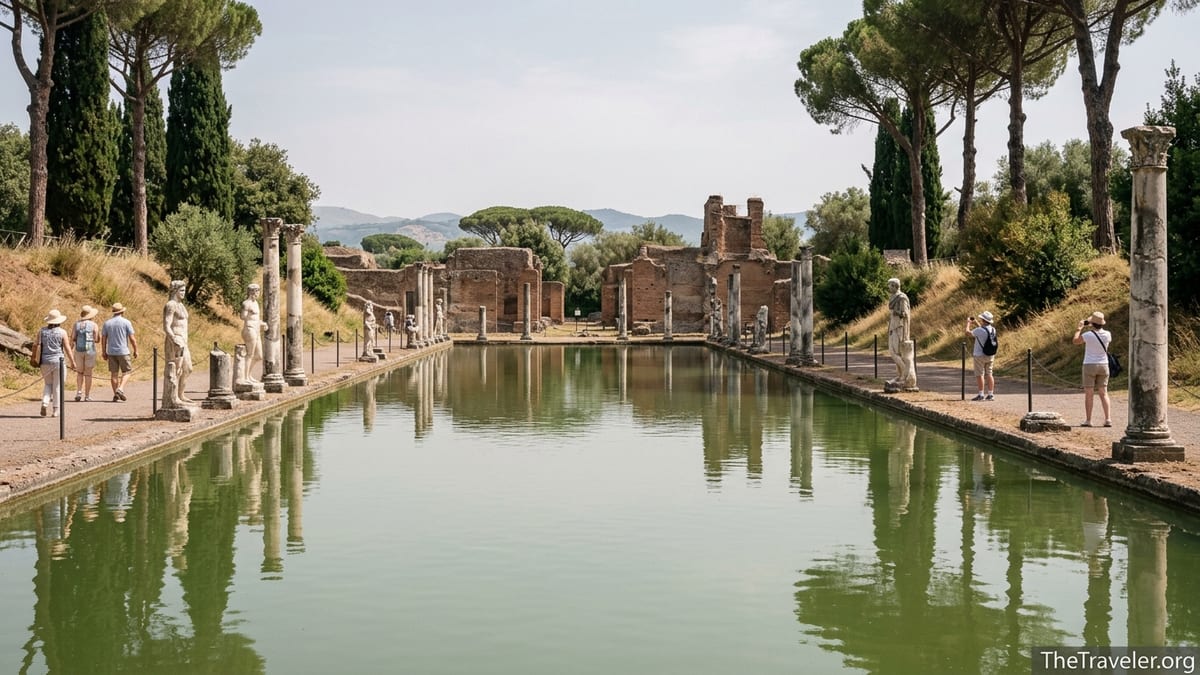
The Pecile, with its long rectangular pool and colonnaded promenade, once served as a grand garden courtyard where Hadrian could walk in all weather. Even today, standing at one end and looking down its length gives a sense of the emperor’s taste for dramatic vistas. From there, a signed path leads toward the Canopus, perhaps the most photographed area of the villa. This elongated pool lined with replica statues and arches was inspired by an Egyptian canal and used as a setting for lavish banquets. Many visitors find themselves lingering here, taking in the reflections of statues in the water and the surrounding cypresses.
The bath complexes illustrate the daily life of the imperial court. In the large baths, you can still see the remains of hot and cold rooms, underfloor heating systems, and soaring brick and concrete walls that once supported elaborate vaults. The smaller baths next door show a more intimate scale, perhaps used by the imperial household rather than large groups. Even without complete roofs and decoration, the height and mass of the walls make them impressive.
The Maritime Theatre is another highlight. This circular building surrounds an inner island once connected by a movable bridge, thought to be a private retreat for Hadrian. You cannot usually cross onto the island itself, but you can walk around the encircling colonnade and peer through the gaps in the walls. The interplay of water, curved architecture, and secluded space here has influenced architects for centuries. Allow time to pause, listen to the birds and the echo of your footsteps, and imagine what it would have been like as a quiet study or refuge.
Weather, Terrain and What to Pack
Hadrian’s Villa is almost entirely outdoors, with minimal shade in many areas. In summer, the Tiburtine hills can feel considerably hotter than central Rome by midday, especially when you are walking across open gravel and stone surfaces. In winter, the site can be chilly and windy, and paths may be muddy after rain. Whatever the season, dress for an outdoor hike rather than an indoor museum visit.
Comfortable walking shoes with good grip are essential. Expect gravel paths, patches of grass, occasional stone steps, and some uneven ground. Sandals with thin soles or dress shoes can quickly become uncomfortable on a two- or three-hour walk. Some visitors bring light trekking sandals or solid sneakers specifically for this day trip, switching back to city shoes once they return to Rome.
In warm months, bring a hat, sunscreen, and a refillable water bottle. There are drinking fountains on-site, but they are not present at every corner, so topping up when you see one is wise. Many travelers also bring a small snack such as fruit or crackers, since the options for food inside or immediately adjacent to the site are limited. A proper lunch is easier to find in Tivoli town before or after your visit rather than at the villa itself.
If rain is forecast, a lightweight waterproof jacket is more practical than an umbrella, given the wind and the need to keep hands free for climbing and taking photos. In cooler seasons, a scarf and an extra layer are helpful, as temperatures can drop quickly when clouds cover the sun. Photographers may want a lens cloth for dust and a small microfiber towel if brief showers pass through.
Accessibility, Facilities and On-Site Services
The age and topography of Hadrian’s Villa mean that complete accessibility is still a work in progress. Some main routes around the site are relatively flat and can be negotiated with assistance or mobility aids, while others involve slopes, stairs, or uneven terrain. The entrance area offers basic facilities such as restrooms and a small bookshop, but once you move deeper into the ruins, amenities are sparse. Plan bathroom breaks accordingly and do not expect café-style seating scattered throughout the complex.
Visitors with limited mobility will find it useful to consult the site’s official accessibility information in advance, which indicates which paths are more level and which areas might be challenging. For example, the route from the entrance down toward the Canopus involves some sloping terrain, whereas parts of the upper complex near the model and the Pecile are on broader, flatter paths. Asking staff at the gate for the most accessible route on the day of your visit can provide up-to-date advice, especially if certain paths are closed for restoration.
Guided tours arranged through reputable operators can sometimes better accommodate accessibility needs, for instance by adjusting pace and focusing on the most accessible highlights. A small-group tour with fewer people makes it easier for a guide to tailor the route. If accessibility is a major concern, contacting the tour company or the site management in advance and explaining your situation will help them provide realistic guidance and, where possible, accommodations.
There is typically security at the entrance and bag checks similar to other major Italian cultural sites. Large backpacks and bulky items may be discouraged, both for security and because narrow paths and ancient structures are not suited to them. A medium daypack is ideal, leaving your hands free while keeping valuables close. As always in popular tourist areas, keep an eye on your belongings, especially in busier seasons when school groups and tour parties arrive in numbers.
The Takeaway
Hadrian’s Villa rewards visitors who arrive prepared and unhurried. It is not a quick photo stop but a place to wander, imagine and absorb the scale of an emperor’s dream in stone and water. The combination of open landscapes, monumental architecture and relative quiet compared with central Rome gives it a contemplative atmosphere that many travelers remember long after their trip.
For a first visit, focus on getting the practical elements right: choose a realistic transport plan from Rome, allow three or more hours on-site, and wear clothing suited to an outdoor archaeological park. Take advantage of tools such as a site map, audio guide or guided tour to bring the ruins to life, especially at key spots like the Canopus, the baths and the Maritime Theatre.
If your schedule allows, pair Hadrian’s Villa with Villa d’Este in Tivoli for a full day exploring two very different expressions of Italian grandeur: imperial Roman and Renaissance. Whether you go independently by metro and bus or join an organized excursion, you will come away with a deeper sense of how Romans and later generations experienced luxury, nature and retreat from the city.
Most importantly, leave room in your day for moments of stillness. Sit by the Canopus and watch the reflections, stand beneath the towering remains of the baths, or circle the Maritime Theatre at a slow pace. These are the experiences that turn a visit to Hadrian’s Villa from a checklist stop into one of the most memorable days of your time near Rome.
FAQ
Q1. Can I visit Hadrian’s Villa and Villa d’Este on the same day?
Yes, many visitors combine both sites in one day. Plan at least 2 to 3 hours at Hadrian’s Villa and another 2 hours at Villa d’Este, plus travel and meal breaks.
Q2. How long does it take to get to Hadrian’s Villa from central Rome?
Using Metro Line B to Ponte Mammolo and a Cotral bus, most travelers take about 1.5 hours door to door, though traffic can add extra time.
Q3. Is Hadrian’s Villa suitable for children?
Yes, if they enjoy being outdoors and exploring. The open spaces, ruins and pools fascinate many kids, but bring snacks, water and sun protection.
Q4. Are there places to buy food at Hadrian’s Villa?
Food options immediately at the site are limited. It is best to bring a small snack and plan to eat a full meal in Tivoli town before or after your visit.
Q5. Do I need to book tickets in advance?
For most days, you can buy tickets on arrival, but checking current policies and, in peak season, pre-booking or joining a tour can save time and uncertainty.
Q6. What should I wear to visit Hadrian’s Villa?
Wear sturdy walking shoes, comfortable clothes suitable for the weather, and in warm months a hat and sunscreen. Treat it like a light outdoor hike.
Q7. Is there shade at the site during summer?
There are some shaded areas, but large sections are exposed. Plan to visit earlier or later in the day, rest in shaded spots and carry water.
Q8. Can I visit Hadrian’s Villa with limited mobility?
Some main paths are relatively level, but many areas have uneven ground and slopes. Check current accessibility information and consider a slower, focused route.
Q9. Are guided tours worth it for a first-time visit?
Yes, especially if you are new to Roman history. A guide or audio guide explains the function of each building and helps you visualize the original complex.
Q10. Is it safe to travel to Hadrian’s Villa by public transport alone?
Generally yes. Many solo travelers use the metro and regional buses without issues. As in any busy area, stay aware of your belongings and follow local advice.