


On a low ridge of hills outside modern Tivoli, about 30 kilometers east of Rome, the ruins of Hadrian’s Villa spread across the landscape in broken walls, pools, and fragments of marble. To a first-time visitor it can feel like a mysterious maze of brick and stone. To archaeologists and historians, however, this vast complex is one of the most important windows into the power, taste, and ambitions of Rome at its imperial height.
Get the latest updates straight to your inbox!
What Exactly Is Hadrian’s Villa?
Hadrian’s Villa, known in Italian as Villa Adriana, was the country residence of the Roman emperor Hadrian, who ruled from 117 to 138 CE. Built gradually during his reign, it was far more than a holiday house. At its peak, the complex extended over at least 120 hectares, making it closer to a small city than a simple villa. Modern estimates suggest that roughly 30 major buildings are still visible today, with many more buried beneath the soil or lost to time.
The villa sits near Tivoli, a town famous in antiquity for its cool breezes and hillside views over the Roman countryside. Hadrian chose this area as a retreat from the crowded capital, yet he continued to govern from here. Ancient authors describe him as a restless, highly educated ruler obsessed with architecture and travel, and the villa reflects that personality. Walking through the site, you encounter spaces designed for administration, audiences, ritual, relaxation, and private retreat, all layered together.
Today Hadrian’s Villa is a UNESCO World Heritage Site, recognized as an “ideal city” that fuses architectural traditions from Greece, Egypt, and Rome in a single monumental complex. Visitors enter through a modern gate and suddenly step into an expanse of olive trees, broken colonnades, and brickwork, with information panels that help you imagine the original marble and painted surfaces. It is one of the few places where you can physically wander through the urban imagination of a Roman emperor.
For a contemporary traveler, that means the site offers a rare combination: the freedom to explore largely open ruins on foot, and the chance to see how an emperor translated his travels and political vision into bricks, water, and stone.
How and Why the Villa Was Built
Construction at Hadrian’s Villa began early in Hadrian’s reign, around 117 to 120 CE, and continued in phases for nearly two decades. Rather than following a single master plan, the complex evolved as Hadrian returned from journeys around the Mediterranean. Each new courtyard, pool, or pavilion seems to echo a place that impressed him abroad. For instance, the elongated pool known as the Canopus appears to reference both the Egyptian canal near Alexandria and the cult of the god Serapis that Hadrian encountered in Egypt.
Politically, the villa allowed Hadrian to step back from the ceremonial intensity of Rome without giving up control. Here he could receive ambassadors, hold council with advisors, and preside over court cases in surroundings he had personally designed. The presence of reception halls, libraries, barracks for guards, and extensive service quarters shows that the site functioned as a working center of government as much as a pleasure retreat.
On the ground, visitors can still sense the different zones. Near the main entrance, wide roads once used for carts and supplies lead toward the heart of the complex. As you move inward, the architecture becomes more refined: courtyards framed by colonnades, steps leading down to reflective pools, and elevated terraces that once looked out over meticulously planned gardens. Archaeological surveys and recent geophysical work have revealed yet more hidden structures, suggesting that much of the villa remains to be interpreted.
From an archaeological perspective, Hadrian’s Villa is crucial because it preserves experimental architecture in concrete and brick. Curved walls, domes, and unusual vaulted ceilings show Roman engineers pushing the limits of what was structurally possible in the second century. Many of these ideas would influence later imperial buildings and even Renaissance architects who studied the ruins when Tivoli became a regular stop on the Grand Tour.
An Ideal City in Miniature
One of the reasons Hadrian’s Villa is so significant is that it represents a planned environment on a scale rarely preserved from antiquity. UNESCO describes it as an “ideal city,” and that is not an exaggeration. Instead of a single palace, the site includes theaters, baths, libraries, temples, formal gardens, and service areas laid out to create a self-sufficient microcosm of the Roman world.
For example, archaeologists have identified a so‑called Imperial Palace and Winter Palace clustered around key courtyards, where Hadrian and his inner circle likely lived and worked. Near them, twin library buildings, often referred to as the Latin and Greek libraries, underline the emperor’s reputation as a polyglot and intellectual. Though only the brick skeletons survive, niches in the walls still suggest where scrolls and statues once stood.
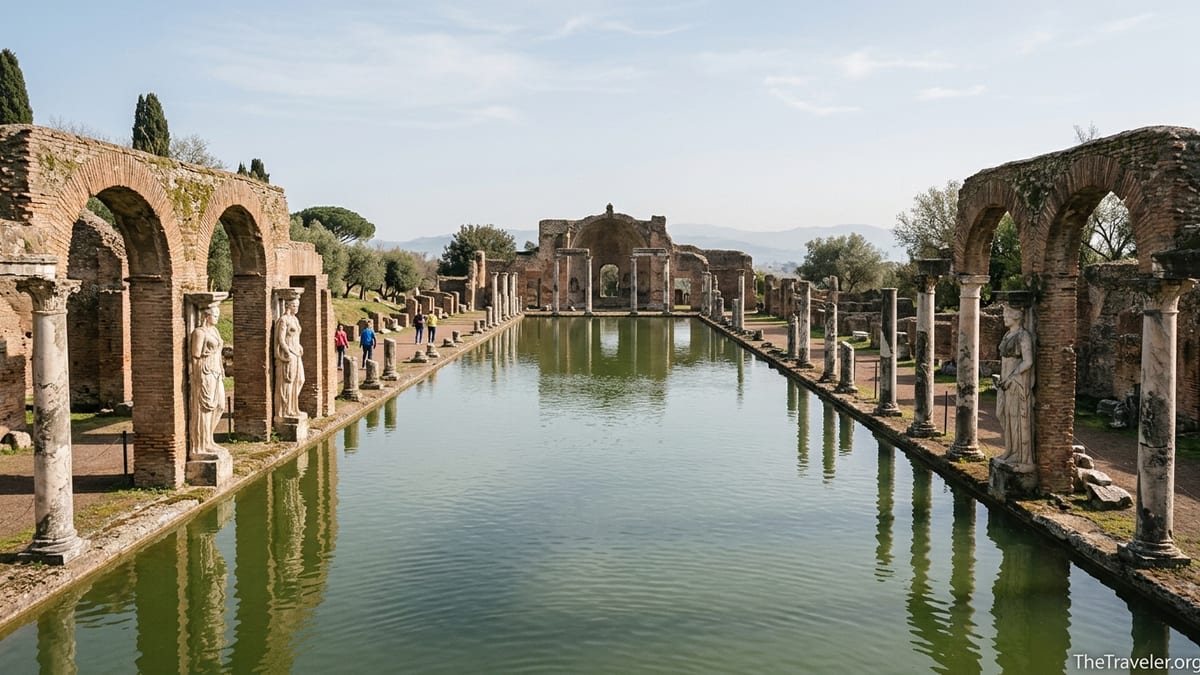
The hydraulic system hints at another layer of planning. Channels, cisterns, and underground tunnels carried water from springs in the hills to fountains, baths, and ornamental pools. When you stand at the Canopus, looking along the long basin lined with columns and statues, you are seeing not only a work of art but also the endpoint of a sophisticated water network. Recent surveys have used ground-penetrating radar to trace these buried conduits, offering new insights into Roman engineering choices.
For modern visitors, this urban complexity shapes the practical experience of the site. A thorough visit typically takes at least three to four hours of walking, and the distances between major features can surprise anyone expecting a compact “villa.” It is wise to bring water, a sun hat, and comfortable shoes, especially in summer, as shade is limited and pathways can be uneven. Several guided tours from Rome, often in the 60 to 90 euro range per person, highlight the main ceremonial axes so that visitors are not overwhelmed by the scale.
Signature Spaces: Canopus, Maritime Theatre, and More
Among the many structures at Hadrian’s Villa, certain spaces have become emblematic and help explain why archaeologists regard the site as exceptional. At the top of most itineraries is the Canopus, a long pool edged with columns, caryatids, and copies of famous statues. At one end stands a richly articulated semi-domed structure known as the Serapeum, combining niches, waterfalls, and dining spaces. Scholars see here a deliberate evocation of Egypt, where Hadrian traveled and where the cult of Serapis was important. Today, even with many original statues moved to museums in Rome, the Canopus remains one of the most photogenic spots on the site.
Not far away lies the so‑called Maritime Theatre, a circular building enclosing a small island ringed by a moat. A colonnaded walkway once wrapped around the water, and two small drawbridges allowed access to the island. Archaeologists interpret this as a private retreat for Hadrian, effectively a villa within the villa. Excavations have revealed traces of a tiny bath complex, sleeping quarters, and what might have been a study. For visitors, it is easy to imagine the emperor withdrawing here to read, sketch, or plan construction projects away from courtly bustle.
Other areas, such as the so‑called Golden Square, showcase more formal and monumental planning. This sector likely held grand reception halls framed by colonnades and gardens. Even in ruin, the vast paved courtyards and deep foundations communicate scale. Some sections, like the large bath complexes with different temperature rooms, help archaeologists reconstruct how the imperial household and staff moved through their daily routines.
These distinct spaces make the villa invaluable as a teaching site. University groups from Europe and North America regularly run field schools here, guiding students through the visible ruins and restricted excavation areas. If you visit in late spring or early summer, you may see teams with measuring tapes and tablets recording wall details or students learning how to identify different phases of brickwork, a reminder that the villa remains a living laboratory.
Why Archaeologists Prize Hadrian’s Villa
From an academic standpoint, Hadrian’s Villa is one of the richest archaeological sites in the Roman world for understanding how architecture, ideology, and daily life intersected in the imperial period. Unlike many city-center ruins that were heavily overbuilt in later centuries, Tivoli’s hillside location spared the complex from dense medieval and modern construction. This has allowed large-scale excavations, surveys, and, more recently, non-invasive techniques such as laser scanning and georadar.
Over the last decade, teams affiliated with Italian cultural authorities and international universities have mapped little-studied areas like the “Macchiozzo” sector, identifying new construction phases and previously unknown buildings. Careful analysis of brick stamps, mortar types, and decorative fragments helps archaeologists sequence which parts were built early in Hadrian’s reign and which belong to later modifications. Each discovery refines our understanding of how the emperor’s architectural experimentation unfolded over time.
The site has also yielded a remarkable quantity of sculpture, mosaics, and painted plaster that once decorated the buildings. Many of the finest pieces, including statues of deities, heroes, and Hadrian’s circle, were removed to collections in Rome and the Vatican centuries ago. Their stylistic mix, often combining Greek models with Roman portrait heads, reveals how Hadrian’s taste helped canonize certain artistic forms. Copies or casts sometimes return to the villa to give visitors a sense of the original visual impact without exposing fragile antiquities to weather.
For archaeologists, Hadrian’s Villa also serves as comparative material. The layout of its gardens, water features, and elite quarters can be contrasted with other large villas around Rome and across the Mediterranean. In some Greek and Italian sites, for instance, smaller island pavilions and nymphaea appear to echo Tivoli’s Maritime Theatre, suggesting that Hadrian’s experiments influenced aristocratic architecture far beyond his lifetime.
Visiting Hadrian’s Villa Today
For travelers, Hadrian’s Villa is accessible yet feels pleasantly removed from central Rome’s crowds. From Rome’s Tiburtina or Termini stations, you can typically reach Tivoli by regional train or bus in about 45 to 70 minutes, depending on connections. From Tivoli town or the nearby suburb named Villa Adriana, local buses or taxis take you the last few kilometers to the entrance. Many visitors also opt for organized day trips that combine the villa with nearby Villa d’Este, another UNESCO site famous for its Renaissance fountains.
The archaeological park operates year-round, with opening hours that shift seasonally, generally starting in the morning and closing around late afternoon or early evening. In many months the last entry is at least one and a half hours before closing, so checking the latest schedule before you go is important, especially in winter when daylight is short. Tickets bought on-site are usually in the single-digit euro range for adults, with reduced prices for EU citizens in certain age brackets, and occasional combined tickets that include Villa d’Este. Guided tours offered by local operators or specialized cultural companies can cost significantly more but may include transport from Rome and expert commentary.
On the ground, facilities are basic but adequate. Paths are mostly unpaved, and some sections involve short climbs or uneven stones, so sturdy footwear is wiser than sandals. There are restrooms near the entrance and occasionally within the park, but food options inside are limited. Many visitors pick up sandwiches or snacks at cafés in Villa Adriana suburb or Tivoli before entering. In summer, temperatures can be high and shade sparse, making a refillable water bottle and sun protection essential for a comfortable visit.
Time management matters at such a large site. If you have only two hours, you may want to focus on a loop that includes the Canopus, Maritime Theatre, and one of the major bath complexes, using the orientation boards to fill in context. With a half-day or full day, you can wander more widely, exploring quieter corners where low walls and scattered fragments show ongoing excavation trenches and conservation work. Occasional temporary exhibitions, often housed in restored pavilions, display recent finds or contextual material about Hadrian’s reign, so it is worth asking at the ticket office what is currently on view.
Hadrian’s Villa in the Wider Story of Rome
Beyond its immediate ruins, Hadrian’s Villa matters because it crystallizes broader trends in Roman history. Hadrian is often associated with consolidation rather than expansion. He traveled extensively through the provinces, inspecting frontiers from Britain to the Middle East. The villa can be read as a physical distillation of those journeys, a place where Greek theaters, Egyptian cults, and Roman engineering converged under imperial patronage.
The site also illuminates how emperors used architecture to shape their image. In Rome itself, Hadrian rebuilt the Pantheon with its famous dome, while in the provinces he sponsored temples, walls, and roads. At Tivoli, free from the constraints of a dense city, he could experiment with curved forms, hidden retreats, and theatrical views. That freedom produced an environment where personal taste and political messaging overlapped. The mix of imported statuary, exotic references, and carefully framed vistas broadcast the image of a cosmopolitan yet classically grounded ruler.
Later periods added their own layers. After Hadrian’s death in 138 CE, the villa remained in imperial use for some time but gradually declined. By late antiquity and the Middle Ages, structures were quarried for building stone. Renaissance popes and cardinals, inspired by classical culture, visited the ruins and removed sculptures and marble for palaces and gardens in Rome. At the same time, they commissioned the first serious drawings and measurements, turning Tivoli into an open-air school of ancient architecture that influenced designers well into the modern era.
Today, the site’s legal protection as a cultural property and its inclusion on the World Heritage List place it at the center of debates about conservation, tourism pressure, and development in the surrounding area. Ongoing efforts by Italian authorities aim to balance public access with the slow, meticulous work of excavation and stabilization. When you walk through a cordoned-off area or see scaffolding around a wall, you are witnessing that delicate balance in action.
The Takeaway
Hadrian’s Villa is not a single monument but an entire landscape of power, memory, and experimentation. For those interested in ancient Rome, it offers something that even the Forum or Colosseum cannot fully provide: the chance to explore the private yet political world of an emperor on a vast, carefully choreographed stage. Every pool, portico, and fragment of colored marble hints at a deliberate choice, rooted in Hadrian’s travels and his vision of a unified Mediterranean world.
For travelers, the villa rewards curiosity and time. It is a place to wander along quiet paths, pause by still water, and imagine processions of courtiers where now only swallows and archaeologists move. Combined with nearby Villa d’Este or a leisurely lunch in Tivoli’s historic center, it makes an easy yet profound day trip from Rome, grounding the grand narratives of empire in bricks and earth.
For archaeologists and historians, the site remains a deep archive. New surveys, careful excavation, and reexamination of old finds continue to refine how we understand Hadrian’s reign, Roman engineering, and the transmission of architectural ideas across centuries. The villa is both a ruin and a research project, and that double life is central to its status as one of ancient Rome’s greatest archaeological treasures.
Whether you arrive as a casual visitor or a dedicated student of antiquity, Hadrian’s Villa offers a rare experience: the ability to inhabit, however briefly, the designed world of an emperor whose imagination reshaped the landscape and whose legacy continues to shape our understanding of Rome.
FAQ
Q1. Where is Hadrian’s Villa and how far is it from Rome?
Hadrian’s Villa is near Tivoli, about 30 kilometers east of central Rome. By regional train or bus, most travelers reach Tivoli in roughly one hour, then continue a short distance by local bus or taxi to the archaeological park.
Q2. Why is Hadrian’s Villa considered one of ancient Rome’s greatest archaeological sites?
It preserves an unusually large and varied complex of imperial buildings, including baths, theaters, libraries, gardens, and ceremonial spaces, laid out as an “ideal city.” Its scale, experimental architecture, and rich finds of sculpture and decoration make it a key site for understanding Roman art, engineering, and imperial life.
Q3. How much time should I plan for a visit?
Most visitors should allow at least three to four hours to see the main highlights such as the Canopus, Maritime Theatre, and major bath complexes. Those with a strong interest in archaeology or photography often spend most of a day on-site, especially if combining the visit with nearby Villa d’Este.
Q4. What are the typical ticket costs and are guided tours worth it?
Standard adult tickets purchased at the entrance are usually in the single-digit euro range, with some reductions for eligible visitors. Guided tours, often priced from around 60 to 90 euros when including transport from Rome, can be worthwhile for first-time visitors who want historical context and a structured route through the large site.
Q5. What should I wear and bring when visiting Hadrian’s Villa?
Wear comfortable, closed-toe shoes suitable for uneven paths, and bring sun protection such as a hat and sunscreen, especially in warmer months. A refillable water bottle and light snacks are practical, as shade and food options inside the park are limited.
Q6. Is Hadrian’s Villa suitable for children and non-specialists?
Yes, although the site is large and involves a lot of walking. Children often enjoy exploring open spaces and imagining life in a Roman palace. Simple explanations of features like baths, pools, and the emperor’s private island retreat help keep younger visitors engaged without needing specialist knowledge.
Q7. Can I see original statues and mosaics at the villa?
Many of the finest statues and decorative pieces discovered at Hadrian’s Villa are preserved in museums in Rome and the Vatican for conservation reasons. On-site, you will see architectural remains, some original fragments, and occasional copies or casts that indicate how key spaces once looked, along with temporary exhibitions when available.
Q8. How does Hadrian’s Villa compare to other Roman sites like the Colosseum or Forum?
While the Colosseum and Roman Forum focus on public life in the city, Hadrian’s Villa reveals the private and administrative world of an emperor in a countryside setting. Its scattered buildings, water features, and gardens create a more open, park-like experience, emphasizing design, leisure, and imperial taste rather than mass spectacles.
Q9. Are there accessibility considerations at the site?
The terrain includes uneven ground, slopes, and some stairways, which can pose challenges for visitors with mobility issues. Certain paths and viewpoints are more accessible than others, so travelers who need step-free routes should check current accessibility information in advance and allow extra time to navigate the site.
Q10. When is the best time of year and day to visit Hadrian’s Villa?
Spring and early autumn are often the most comfortable seasons, with milder temperatures and greener landscapes. In summer, mornings or late afternoons are preferable to avoid midday heat. Regardless of season, arriving earlier in the day usually means fewer crowds and softer light for photography.