


Most travelers arrive at Hadrian’s Villa in Tivoli expecting a large country estate. Within minutes, many realize they have underestimated it, yet still leave without fully grasping its true size. The emperor’s retreat was, in effect, a private city spread across fields, hills and artificial terraces. Its scale is so sprawling that the human eye struggles to read it, especially when much of the architecture survives only as fragmentary walls and foundations. To understand Hadrian’s Villa, you have to learn to see its vastness in layers: on the map, in the landscape, and under your feet as you walk.
Get the latest updates straight to your inbox!
A “Villa” the Size of a Small Town
The name misleads many first-time visitors. “Villa Adriana” sounds like a large house with gardens, yet the site south of modern Tivoli once covered roughly 120 to 130 hectares, or close to 300 acres, according to UNESCO and archaeological studies. In simple terms, that is an area more extensive than Pompeii and comparable to a compact contemporary town. Today, only about a third of that area is included in the main archaeological park, which is why even a long visit can feel as if you are only skimming the surface.
To put this in travel terms, imagine walking from the Colosseum to the Vatican Museums in Rome. The total walking distance across the core areas of Hadrian’s Villa is in the same general order of magnitude, but broken up by ruins, tree lines and fields. From the Maritime Theatre at one end of the visitor circuit to the Canopus at the other, you easily cover more than a kilometer, much of it over uneven ground. Many visitors arrive on a half‑day bus tour from Rome and end up underestimating how much time they need just to walk between major highlights.
Modern reconstructions created by research teams such as those at the University of Virginia suggest around 30 distinct complexes within the villa: palaces, theaters, barracks, baths, libraries and service quarters. On the ground, however, this can feel surprisingly dispersed. Low walls and grassy platforms betray the footprint of buildings that once rose multiple stories high, so the vertical scale is missing. Without a guidebook map in your hand or a mental comparison to a modern campus or resort, it is easy to wander between ruins without recognizing that you are crossing a town‑sized imperial residence.
One way to sense the sheer extent is to pay attention to how the site swallows tour groups. A coach may arrive in the parking area with 40 to 50 visitors, all bunched together near the ticket office. Within 20 minutes, they have disappeared into the complex, absorbed by the large distances and multiple routes through the ruins. Moments later, you may find yourself walking entirely alone across a terrace that, in Hadrian’s day, would have thrummed with servants, guards and visiting dignitaries.
Reading the Landscape: Terraces, Hills and Hidden Edges
The scale of Hadrian’s Villa does not unfold on a simple flat plane. The emperor chose a hilly site on the edge of the Roman Campagna, and his architects cut, filled and terraced the slopes to create a sequence of artificial plateaus. Modern visitors often register only the nearest ruins and a few distant pines. The real boundaries of the complex lie beyond the immediate line of vision, hidden behind low ridges or down shallow valleys that fall away from the main paths.
As you walk from the entrance toward the so‑called Pecile, stop and look back. The car park and modern road quickly sink out of sight, leaving only rolling countryside and the Alban Hills in the distance. That visual isolation is deliberate. Hadrian’s architects built massive retaining walls and embankments to separate imperial space from the outside world. A grassy slope that you casually stroll along may in fact sit atop a 10‑meter‑high substructure, a kind of buried platform that allowed the emperor’s promenades to remain level while the natural terrain dipped and climbed underneath.
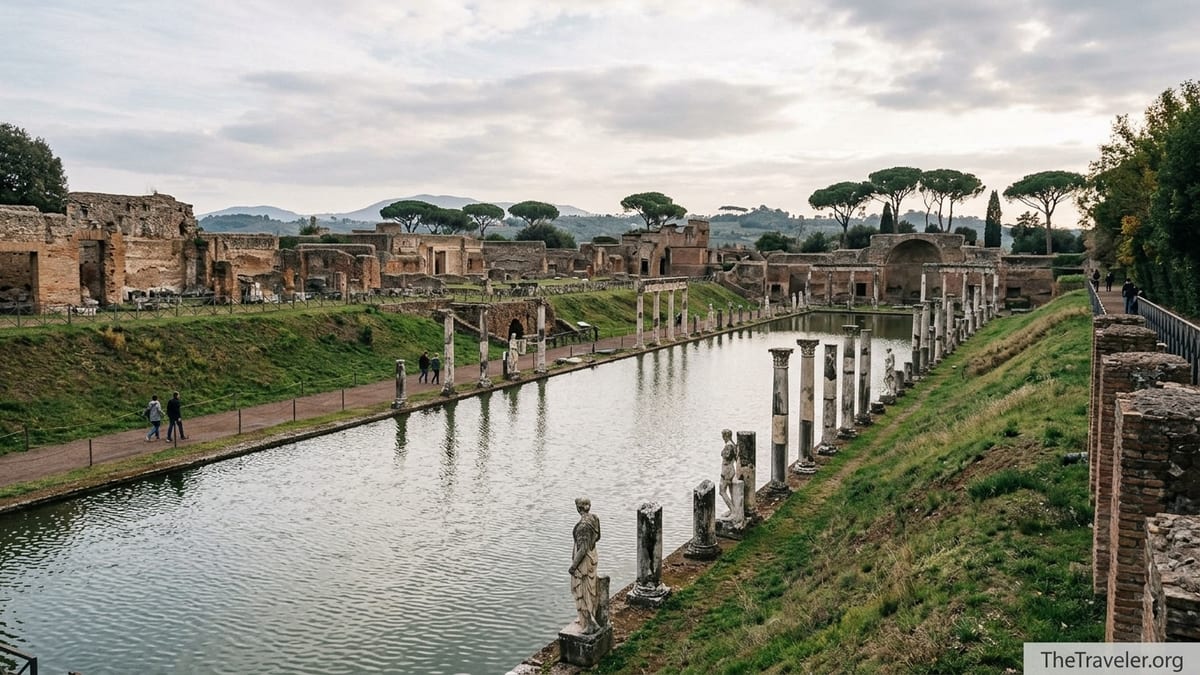
The most dramatic clue to this vertical manipulation appears around the Canopus, the long pool flanked by columns that evokes Egyptian themes. Stand at its northern end and notice how the entire waterway sits in a shallow valley, with higher ground enclosing it on three sides. What feels like a peaceful garden walk today was originally a carefully staged descent into an artificial world, complete with a domed dining hall at the far end. Above and behind you, additional terraces once held residential quarters and service areas. Without climbing the side paths up to the higher viewpoints, visitors can miss that they are essentially standing in the hollowed‑out heart of a larger man‑made landscape.
Even around the Maritime Theatre, which looks like a compact circular jewel, the surrounding terrain tells a story of scale. Excavations have shown that this self‑contained “villa within a villa” sat not in isolation, but within a dense cluster of other buildings and gardens. Today, the grass and trees fill in many of the gaps, visually shrinking what was once a crowded architectural field. When you walk a few dozen meters away and suddenly encounter another set of foundations, it is easy to treat them as separate stops rather than as part of one continuous monumental program.
Walking the Distances: How Scale Feels on Foot
Guidebooks often mention that the archaeological area involves “a lot of walking,” but the numbers are more revealing when translated into experience. If you trace a rough loop from the entrance past the Pecile, down to the Heliocaminus Baths, across to the Maritime Theatre, then onward to the Canopus and back via the so‑called Hospitalia and Piazza d’Oro, you will likely cover 3 to 4 kilometers in under three hours, without detours. Add time to pause for photos, read signs and navigate uneven steps, and it becomes clear why many visitors depart with tired feet and a nagging sense that they have not seen everything.
The terrain complicates matters. Paths are mostly compacted dirt and gravel, punctuated by original Roman paving and patches of grass. After rain, surfaces can become slick. In the summer sun, there is limited shade between major clusters of ruins, so the heat intensifies the feeling of distance. A traveler who might happily stroll a city for several hours can find the open, exposed walk between the Maritime Theatre and the Canopus surprisingly draining. That physical fatigue subtly warps your perception: when you are tired, everything feels farther away and more spread out than it appears on a map.
This is why many seasoned travelers recommend treating Hadrian’s Villa more like a national park than a single monument. Comfortable walking shoes are genuinely essential, and carrying water matters more here than at many urban sites in Rome. Tickets purchased at the on‑site office or as part of a combined Tivoli pass do not control how much ground you cover, but your energy levels do. Visitors who arrive on late‑morning bus tours from Rome, after a coach ride of 45 minutes to an hour, often find that their exploration window is effectively only two to three hours before they need to reboard. In that span, they see the showpieces but rarely connect them as parts of a cohesive, city‑scale estate.
If you want to feel the distances as Hadrian’s entourage might have, slow down and imagine the processions that once moved across these same routes. Courtiers, guards and servants would have walked from barracks and service wings to audience halls, baths and banqueting spaces several times a day. The emperor himself, who loved to travel, may well have used the long, shaded porticoes for exercise. Seen that way, the villa’s scale is less about static grandeur and more about the daily rhythm of moving bodies over significant distances.
Underground Highways: The Hidden Service City
Perhaps the most extraordinary, and least noticed, measure of Hadrian’s Villa’s scale lies underground. Archaeologists have long known that a network of service tunnels runs beneath large parts of the estate. These passageways allowed slaves and workers to move food, fuel and supplies without disturbing the carefully curated scenes on the terraces above. For modern visitors, the tunnels are mostly invisible, yet they effectively double the villa’s functional footprint, creating a hidden logistical city under the ceremonial one.
Only occasional glimpses are visible on a standard visit: a gated archway in a retaining wall, a ventilated shaft in the ground, or a dim corridor seen through a grate. These fragments hint at an extensive system that recent surveys and 3D reconstructions have begun to map. Some of the tunnels are tall enough for carts drawn by animals, others narrow gangways for individuals carrying baskets. When you cross one of the wide lawns near the central palace area, you may in fact be walking above a busy ancient corridor that once pulsed with the noise of footsteps, wheels and shouted orders.
This invisible infrastructure is essential to understanding scale. A modern luxury resort may hide its laundry and service routes in back‑of‑house corridors. Hadrian’s Villa takes that logic to an extreme, lowering nearly all utilitarian movement underground. The result is an estate that could host hundreds of people in marble‑clad settings without any obvious signs of labor on the surface. The very absence of visible kitchens, storerooms and stables in the areas most tourists see today testifies to how much of the complex is effectively hidden in plain sight.
For the traveler, imagining what happens below ground can transform the experience above. At the Canopus, picture ovens and storage rooms tucked behind the exedras, supplied by carts emerging from ramps and tunnel mouths. Around the Piazza d’Oro, where a long reflecting pool mirrors the sky, think of staff hurrying along dark passageways below, timing their movements to avoid emerging where the emperor might see them. Once you start looking for the service side of the estate, the villa’s scale expands mentally as well as physically.
Architectural Tricks That Distort Perception
Hadrian was famously fascinated by architecture, and his villa is filled with devices that toy with space and perspective. These tricks help explain why even attentive visitors can misread the complex’s true size. Many key buildings manipulate scale deliberately: circular courtyards, elongated pools and domed halls create self‑contained worlds that feel complete in themselves, drawing your focus inward rather than outward to the wider estate.
The Maritime Theatre is a prime example. Seen in photos, it looks like a single, enclosed sanctuary: a round island ringed by a moat and colonnade, with tiny rooms nestled inside. Standing there in person, your eye naturally follows the curve of the colonnade and the reflections in the water. The effect is intimate, almost miniature. It is easy to forget that this was only one retreat among many, itself part of a compound larger than most aristocratic villas around Rome. The architecture makes one small piece feel like the whole story.
The Pecile, by contrast, stretches along an enormous rectangular pool, once surrounded by a portico modeled loosely on the Painted Stoa in Athens. Even in its ruined state, the long wall that survives on one side exerts a strong visual pull. Walk along its length and you may assume you are tracing the central spine of the complex. In reality, this was just one promenade among several, with other major axes running toward the palace structures, the baths and the Canopus. Without a bird’s‑eye view, your mind tends to elevate whichever space you are currently in to the status of “center,” masking the broader network.
Inside the bath complexes, the play of light, vaults and pools springs another trap. The so‑called Large and Small Baths feature domed rooms, radiating apses and varying ceiling heights that change your sense of volume from chamber to chamber. A single frigidarium can feel monumental, its soaring concrete dome dwarfing your body. Step back outside into the open air, and the countryside seems oddly modest in comparison. The villa’s architects used this alternation between grand interior and open landscape as a form of spatial theater. Visitors today, moving quickly from highlight to highlight, often register only the drama of each space, not the cumulative effect of dozens of such buildings spread across a vast site.
Time, Staffing and the Population of a Private City
Another overlooked dimension of scale is human rather than purely spatial. The villa’s 300 or so acres were not empty gardens. While exact numbers remain debated, historians generally agree that a large permanent population lived and worked here: imperial family members, courtiers, guards, scribes, cooks, gardeners, stable hands and laborers, along with a stream of visiting officials and foreign delegations. When you stand alone on a ruined terrace, it is worth remembering that this platform may once have supported multi‑story residential blocks and reception halls buzzing with activity.
Think of the logistics required just to run the baths. Water had to be brought in through aqueducts from the Tiburtine hills, then heated in furnaces, circulated through hypocaust systems and drained away, all on a daily cycle. Fuel, likely in the form of wood, had to be carted in and ash carted out. Kitchens supporting the banqueting halls near the Canopus and other triclinia needed steady supplies of grain, oil, wine, fruit and meat, much of it produced on surrounding imperial estates. Even at a conservative estimate, the staff needed to sustain this machinery of comfort would have numbered in the hundreds.
Time magnifies this human scale. Construction of the villa appears to have unfolded over more than a decade in the early second century, with phases of expansion and remodeling as Hadrian refined his vision. After his death, later emperors reused and adapted parts of the complex. That means the site did not exist as a frozen, static layout but as a constantly evolving campus. When visitors today walk among ruins from different phases without noticing stylistic differences in brickwork or vaulting, they are traversing a century or more of imperial building history compressed into a single afternoon.
Comparisons help. A modern traveler might picture a university campus or government retreat such as Camp David, where clusters of buildings are distributed across forested land and connected by internal roads. Hadrian’s Villa operated on a comparable principle, with zones for administration, leisure, religious cults and private retreat. The difference lies partly in density: few contemporary estates combine so many theaters, baths, gardens and ceremonial halls in a single compound. Recognizing the villa as a living, working environment as well as a landscape of ruins adds a dimension that most visitors never consciously register.
Practical Ways to Experience the Massive Scale Today
While much of Hadrian’s Villa’s original grandeur survives only in traces, there are concrete steps you can take to better perceive its size on a modern visit. The first is simply to allow enough time. Instead of the typical two‑hour slot on a combined Tivoli tour with nearby Villa d’Este, consider dedicating at least half a day, or ideally most of a day, to the villa alone. This gives you room to walk slower loops, revisit key viewpoints and let distances sink in. Travelers who stay overnight in Tivoli and visit early in the morning or late in the afternoon often report that the site feels more expansive when not compressed into a rushed schedule.
Second, start with an overview. Near the entrance, look for the visitor information area where a scale model of the villa is often displayed alongside plans and aerial photos. Spend ten minutes tracing routes with your finger: from the palace core to the Canopus, from the Pecile to the baths, from the Maritime Theatre out to peripheral zones. As you later walk those same paths on the ground, mentally compare what you see with the model. This simple habit turns each ruin from an isolated attraction into a waypoint on a much larger map.
Third, seek out elevation. Whenever a side path offers a slightly higher vantage, take it. From the upper edges of the Pecile or the slopes above the Canopus, you can look back across multiple terraces at once and begin to understand how far the estate really spreads. Photographers instinctively climb for such angles, but even non‑photographers benefit from pausing at these spots and tracing the outlines of the ruins against the modern treeline and the hills beyond Tivoli.
Finally, mix official information with your own observations. Audio guides and panels do an excellent job of explaining individual buildings, but they can unintentionally encourage a stop‑start mentality focused on “sights.” Try occasionally turning the commentary off and simply walking for five or ten minutes without narrative, paying attention only to the changes in terrain, wind and noise. When the ruins thin out and you find yourself crossing a seemingly empty field, remember that archaeologists continue to uncover new structures beyond the currently excavated areas. The emptiness is part illusion, part promise of discoveries yet to come.
The Takeaway
Hadrian’s Villa resists easy comprehension because its scale operates on several levels at once: geographic, architectural, logistical and human. What looks on a tourist map like a single archaeological site was, in effect, an emperor’s private metropolis, larger than many ancient cities and equipped with its own hidden service network underground. The surviving ruins, lovely but fragmentary, tend to shrink that vision in the minds of hurried visitors. A circular courtyard here, a long pool there, a set of baths in between: all memorable, yet easily mistaken for isolated marvels rather than facets of a vast whole.
To truly appreciate the villa’s massive scale, travelers must learn to read what is no longer visible: the vanished upper stories of buildings, the buried tunnels, the terraces that flatten hills, the daily journeys of the hundreds who lived and worked here. With enough time, careful observation and a willingness to walk a little farther than the nearest viewpoint, the site slowly resolves from a collection of picturesque ruins into a coherent, city‑sized landscape of power and imagination. That moment of realization, when you suddenly sense how far Hadrian’s ambition reached across these hills outside Rome, is one of the quietest yet most profound experiences the villa can offer.
FAQ
Q1. How large is Hadrian’s Villa compared with other ancient sites?
Hadrian’s Villa covered roughly 120 to 130 hectares, making it larger than Pompeii and closer in footprint to a small ancient town than to a typical country residence.
Q2. How much of the original complex can visitors see today?
Only part of the original estate is included within the modern archaeological park, but that area still takes several hours to walk and explore at a reasonable pace.
Q3. How long should I plan to spend at Hadrian’s Villa to appreciate its scale?
Allow at least three to four hours on site. A half‑day or more gives you time to walk longer circuits and connect different zones into a mental map.
Q4. Is Hadrian’s Villa difficult to walk around?
The site involves uneven paths, gentle slopes and limited shade, so it can feel demanding, especially in summer. Comfortable shoes and water are essential.
Q5. Are there viewpoints that help show how big the villa really is?
Yes. Higher paths near the Pecile, the Piazza d’Oro and above the Canopus offer broader views across multiple terraces, helping you see how far the ruins extend.
Q6. Can visitors go into the underground tunnels beneath the villa?
Most underground service tunnels are closed to the public for safety and conservation, though you can glimpse some entrances and passages from the main paths.
Q7. Is it better to visit Hadrian’s Villa on a guided tour or independently?
Guided tours are useful for orientation, but visiting independently with a map or audio guide lets you linger in key areas and better feel the distances involved.
Q8. How does Hadrian’s Villa compare to Villa d’Este in Tivoli?
Hadrian’s Villa is a sprawling ancient imperial complex spread over fields and terraces, while nearby Villa d’Este is a compact Renaissance villa famous for its fountains.
Q9. What is the best season to experience the villa’s landscape?
Spring and early autumn usually offer milder temperatures and greener surroundings, making it more pleasant to walk long distances and explore the open terrain.
Q10. Do I need any special preparation to understand the site’s size?
Glancing at a plan or model before you start, then comparing it with what you see on the ground, greatly helps in grasping how city‑sized the complex once was.