


There are places where history stays politely on the page, and then there is Hadrian’s Villa. Walking through the emperor’s sprawling retreat outside Rome, with cypresses rustling and marble fragments underfoot, I realized this was not just another ruin. It felt like stepping through a backstage door into the working life of ancient Rome, where emperors negotiated, servants rushed along hidden corridors, and distant provinces were recreated in brick, water and stone.
Get the latest updates straight to your inbox!
First Glimpse of an Emperor’s Escape
Hadrian’s Villa, or Villa Adriana, sits on a low hillside outside the modern town of Tivoli, about 30 kilometers east of Rome. From the entrance you cannot yet grasp its scale, but the statistics hint at it: the complex originally sprawled over at least 120 hectares, of which around 40 are accessible today. Rather than a single palace, it was a self-contained micro-city with palaces, theaters, baths, libraries, gardens and service quarters, conceived in the early 2nd century as Emperor Hadrian’s countryside retreat and effective second capital.
Arriving from Rome is its own shift in time. One moment you are on the Metro B to Ponte Mammolo; the next you are boarding a Cotral bus that leaves the city’s concrete outskirts and climbs into the Lazio hills. The ride takes around 45 minutes to an hour depending on traffic. Most buses toward Tivoli stop in the modern suburb of Villa Adriana; from there it is roughly a 15-minute walk along Via di Villa Adriana to the archaeological entrance, passing apartment blocks, cafes and a supermarket before the road suddenly opens onto stone walls and pine trees that have watched this approach for centuries.
Tickets are typically in the low double digits in euros, with modest combined passes available if you are also visiting Villa d’Este up in Tivoli on the same day. Queues are rarely as intense as those at the Colosseum or the Vatican Museums, but on spring weekends and in September school groups and tour coaches can fill the ticket area. Pick up the paper map offered at the desk. It is basic, but essential: once inside, the villa’s open fields and ruined walls quickly disorient first-time visitors.
Crossing through the modern gate is when the noise of the present drops away. Gravel crunches underfoot, and instead of Roman traffic, you hear the call of swallows darting over brick vaults. The scale feels almost rural: wide lawns punctuated by ruins rather than a tight archaeological park. That spaciousness is your first clue that this was designed less as a showpiece and more as a retreat where an emperor could spread out, wander, and think.
Walking the Pecile: Rome’s Climate-Controlled Promenade
Many itineraries sensibly start at the Pecile, a vast open courtyard ringed by a portico. Today it takes a few minutes to cross its length; in Hadrian’s time it framed a central water basin that acted as ancient air conditioning. The open pool cooled breezes drifting under the shaded colonnades, creating a microclimate where courtiers could walk even on high-summer days in the Tiburtine hills.
Standing at one end of the Pecile, you get your first panoramic view: ruined arches of the baths to your left, cypress and pine marching across distant walls, and slices of the Sabine Mountains beyond Tivoli. This is where Hadrian may have taken reflective strolls, perhaps dictating letters to secretaries or discussing provincial matters while freedmen and guards trailed a few discreet paces behind. Today, visitors use those same lines of sight to orient themselves, tracing the network of paths that lead down toward the estate’s heart.
Even in ruin, the architectural language remains legible. The regular rhythm of the brick pillars suggests the original covered walkways, while fragments of colored marble pavements in the shade hint at the opulence once underfoot. On a warm afternoon, you can feel why Hadrian spent long stretches here instead of in crowded, humid Rome: a light breeze carries the scent of dry grass and wild herbs, with only low conversation and the distant whir of a strimmer from nearby fields to remind you that modern life goes on outside the perimeter fence.
From the Pecile, paths drop toward the baths complex. A quick glance at the map can be sobering: what seems like a generous site plan in print becomes, in reality, long walks between clusters of buildings that make it obvious you are not in a “villa” as we casually use the word, but a meticulously planned imperial campus.
The Baths: Feeling Daily Life in Cold Stone
The Large and Small Baths at Hadrian’s Villa are among the most vivid places to picture daily life. Unlike the imperial fora in central Rome, where public ceremony and monumental facades dominate, these rooms are about routines: washing, sweating, gossiping, and relaxing. As you walk in, high brick arches open into domed halls that once echoed with voices and splashing water.
Traces of hypocaust systems beneath the floors reveal how underfloor heating warmed the caldarium, while deep niches in the walls once held statues or benches. You can still pick out the sequence of spaces familiar from other Roman baths: frigidarium for cold plunges, tepidarium for warm transitions, and caldarium for the hot soak. Here, though, the clientele would have been a very specific slice of Roman society: the emperor’s household, invited guests, staff and guards taking turns in shifts while others worked or drilled elsewhere on the estate.
In one vaulted hall of the Small Baths, shafts of sunlight slice through broken brickwork, striping the floor with light and shadow. Pigeons coo in the upper cavities where marble revetments once shimmered. It is not difficult to imagine a senator visiting from the city stepping into the same space, shivering slightly as attendants scraped oil and dust from his skin, while in a back corridor a kitchen slave hurried past with platters bound for an evening banquet.
The baths also demonstrate Hadrian’s architectural experimentation. Some domes here are not simple hemispheres but play with octagonal or irregular footprints, cousins to structures he commissioned in Rome. It is one of the points where the villa stops being a private retreat and becomes a laboratory, where new engineering solutions were tested in brick and mortar before appearing in urban monuments.
The Maritime Theatre: An Island Within a Sanctuary
Of all the structures at Hadrian’s Villa, none feels more intimate than the so-called Maritime Theatre. From a distance, it resembles a circular brick crown slightly sunken into the ground, ringed by a colonnade of Ionic columns. Approaching, you realize the inner circle is cut off by a narrow water channel, creating a tiny artificial island in the middle, once spanned by two small drawbridges that could be raised for privacy.
Archaeologists interpret this micro-villa as Hadrian’s private refuge within the already secluded estate: a retreat for reading, designing buildings, or perhaps entertaining a very small circle out of sight of the wider court. Its internal layout, sketched today by low walls and foundations, included all the components of a compact Roman house: bedrooms, a dining room, a study, maybe even a tiny library. Wandering the circular ambulatory, you tread the same route the emperor might have paced late at night while working through dispatches from Britain, Egypt or Judaea.
The water surrounding the inner island would once have reflected marble columns and painted stucco. Today, the channel is usually dry or filled with grass and wildflowers, but its outline remains clear. Stand on the outer ring and you can imagine the soundscape: the soft splash of oars from the nearby pools, the rustle of scrolls, the murmur of trusted advisors discussing philosophy or frontier reports.
For modern visitors, the Maritime Theatre often marks the moment when Hadrian stops being a distant name and becomes a person. You can picture him here more easily than on a triumphal podium in Rome: a man in his sixties, perhaps, escaping the demands of ceremony, surrounded by architectural fragments of places he loved from his travels across the empire.
Canopus and Serapeum: The Empire in Miniature
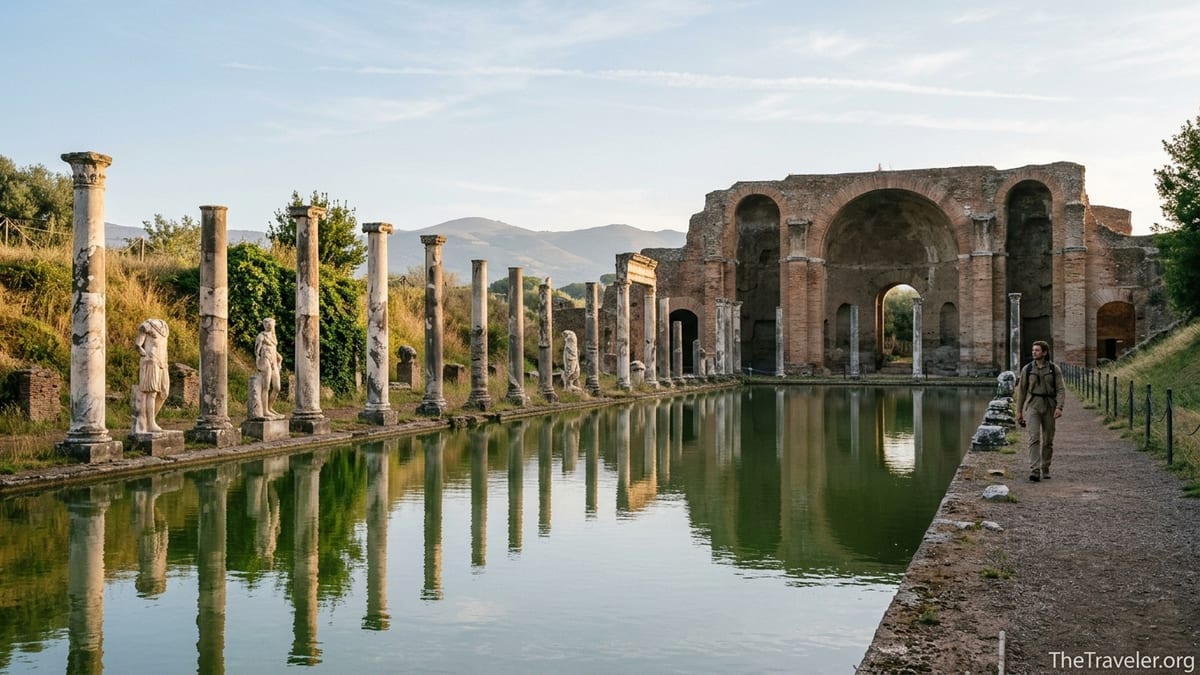
If the Maritime Theatre is about introversion, the Canopus is spectacle. From the upper path, a long rectangular pool stretches into the distance, flanked on one side by a rhythm of columns and statues. These include replicas of caryatids reminiscent of the Erechtheion in Athens and sculptures inspired by the Nile, a reminder that the whole ensemble echoed an Egyptian canal near Alexandria while wearing firmly Roman architectural clothing.
Today the water is still, a greenish mirror broken by the occasional duck. When the sun is high, reflections of broken columns ripple in the surface, and visitors pause under the surviving arches to photograph the perspective. This is the view that appears most often on postcards and in guidebook spreads: Hadrian’s cosmopolitan vision arranged around a single axis of water and stone.
At the pool’s far end rises the Serapeum, an extravagant dining complex once covered by a vast semi-dome with cascading water features. The niche where banqueters reclined still curves high above you, its brick ribs exposed where marble and stucco once gleamed. Historians imagine summer evening feasts here, couches arranged under the semi-dome, musicians playing, and artificial waterfalls cooling the air while torches flickered along the colonnade. The blend of Egyptian religious reference and Roman luxury is pure Hadrian: intellectually playful, architecturally ambitious, and designed to impress a well-traveled elite.
Standing in the Serapeum ruins, with swifts looping under the surviving arches, it is easy to reconstruct a more sensory past. You can almost smell roasted meats from the kitchens hidden behind the reception spaces, hear Greek spoken as often as Latin among the guests, and feel the subtle message broadcast by such a setting: Rome ruled the Mediterranean, but here, on this hillside, the Mediterranean also came to Rome.
Behind the Scenes: Servants’ Corridors and Working Spaces
What makes Hadrian’s Villa feel particularly real is not just imperial showpieces but the infrastructure that supported them. Away from the Canopus and grand baths, you find long service corridors, storage vaults and barracks-like structures that reveal the daily grind of the people who kept this place running. Narrow passageways disappear under arches, linking kitchens to dining halls and baths to furnace rooms, allowing slaves and staff to move unseen while elite guests enjoyed clean vistas and ordered gardens above.
In some areas, you can walk along sunken cryptoporticoes, covered walkways that would once have bustled with movement: kitchen workers carrying amphorae of oil and wine, gardeners dragging tools, messengers hurrying between administrative offices. The worn thresholds and deep ruts in ancient drain channels are small but powerful reminders that this was a workplace as much as a pleasure resort.
There were also quarters for guards and possibly for lower-ranking staff, though much of the housing has vanished or lies unexcavated. The sheer distance between key clusters on the site suggests the need for internal transport: carts, pack animals, and perhaps litters carrying higher-status guests between the baths, dining complexes and residential wings. When you find yourself covering nearly ten kilometers over the course of a day’s visit, it becomes easier to imagine the logistical complexity of keeping supplies, water and people moving across the estate.
Modern signs do point out some of these lesser-known spaces, but many visitors hurry past them en route to headline monuments. Taking time to detour down an unassuming staircase or follow a shadowed corridor often yields the strongest sense of connection, because this is where the villa stops being abstract architecture and becomes a functioning organism populated by cooks, scribes, gardeners and soldiers.
Practicalities: Making Your Own Day in Hadrian’s Villa
For travelers based in Rome, Hadrian’s Villa works well as a half-day or full-day outing. Public transport is affordable but involves a couple of steps. One common route is Metro B to Ponte Mammolo, then a Cotral bus toward Tivoli that stops near the suburb of Villa Adriana. Tickets are usually a few euros each way and can be bought at kiosks or tabacchi shops in or near the station. From the bus stop, allow time for the uphill walk to the entrance. An alternative is the regional FL2 train from Roma Tiburtina or Termini to Tivoli town, followed by the local CAT bus line 4 or 4X toward Villa Adriana, though bus frequencies can be irregular, especially midday and on Sundays.
Organized tours departing from central Rome bundle transport, site admission and a guide, and often pair Hadrian’s Villa with Villa d’Este’s fountains. These can be good value for travelers short on time or nervous about Italian regional buses. Prices vary but often fall into a mid-range bracket for full-day excursions, roughly equivalent to what you might pay for a guided Colosseum tour, with the benefit of air-conditioned coaches and someone else monitoring timetables.
Inside the villa, facilities are improving but still relatively simple. There are restrooms near the entrance and in a couple of central points, and a small café or kiosk offering drinks, coffee and packaged snacks, though hours and options can be limited outside peak season. Bringing a refillable water bottle is essential; several fountains on site provide potable water, and summer temperatures can be severe. Comfortable walking shoes are non-negotiable, as paths alternate between gravel, grass and uneven stone, and shade is intermittent.
Most visitors spend between two and four hours wandering the site. A sensible strategy is to follow a loose loop: Pecile and baths first, then the Maritime Theatre, down to the Canopus and Serapeum, and back via lesser-known areas like the so-called Piazza d’Oro and service quarters. Photography enthusiasts may want to time their visit for morning or late afternoon, when the low sun throws textured shadows across brickwork and columns, bringing relief to details that look flat under the midday glare.
From Ruins to Imagination: Why It Feels So Immediate
Many Roman sites impress by sheer scale or preservation, but Hadrian’s Villa does something subtler: it integrates ruins, landscape and movement in a way that makes the ancient world feel inhabitable. Part of this comes from its setting. Unlike urban monuments hemmed in by modern streets, the villa still breathes with open space. You walk between olive trees and pines, with birds and cicadas providing the soundtrack rather than car horns. That continuity of landscape bridges the gap between past and present more effectively than any reconstructed facade.
The other key lies in variety. Over the course of a single visit you move through ceremonial spaces, intimate retreats, working corridors and vast leisure complexes. Each demands a different kind of imagination. At the Pecile, you think about diplomatic walks; at the Maritime Theatre, quiet study and design; in the baths, the physical routines of bathing and exercise; at the Canopus, theatrical banquets and imperial showmanship. The site lets you assemble a multi-layered picture of Roman life without ever needing to spell it out on plaques.
Recent archaeological work adds further texture. New excavations continue to reveal earlier phases and hidden structures, including older Republican-era remains beneath later palatial buildings. As research progresses, scholars refine their understanding of how different sectors were used and how the estate evolved during and after Hadrian’s reign. For visitors, this ongoing discovery underscores a simple truth: the villa is not a finished story under glass, but an active conversation between past and present, where each trench or scan can subtly shift our view of imperial Rome.
By the time you retrace your steps to the entrance, coated in a fine film of dust and sun, it is difficult to think of Hadrian merely as a name in a textbook. You have walked his promenades, traced the boundaries of his retreats, and followed the same axes of water, stone and shade that structured his days. In that sense, the villa succeeds in what the best travel experiences always do: it turns history into a place you have personally moved through, not just something you have read about.
The Takeaway
Hadrian’s Villa rewards visitors who are willing to slow down. It is less instantly legible than the Colosseum or the Pantheon, but its combination of monumental architecture, intimate spaces and working infrastructure offers a fuller, more human portrait of the Roman world. Walking between its pools, baths and corridors, you can feel the rhythms of an imperial household rather than just its public face.
As a day trip from Rome, it is both accessible and refreshingly uncrowded compared with the city’s headline attractions. Paired with the hillside gardens of Villa d’Este or an overnight stay in Tivoli, it turns into a deeply satisfying short escape that balances history with landscape. You leave with more than photos of scenic ruins; you carry a mental map of an emperor’s retreat and a sharper, more grounded sense of how ancient Rome actually functioned behind its marble facades.
FAQ
Q1. How long should I plan to spend at Hadrian’s Villa?
Most visitors are satisfied with about three hours on site, which allows time to see the main highlights and wander a few lesser-known areas without rushing.
Q2. What is the best way to get to Hadrian’s Villa from central Rome?
A common route is Metro line B to Ponte Mammolo, then a Cotral bus toward Tivoli that stops near Villa Adriana, followed by a short walk to the entrance.
Q3. Can I visit Hadrian’s Villa and Villa d’Este on the same day?
Yes, many travelers do both in one day, using local buses or taxis between the sites or joining an organized tour that includes round-trip transport and guides.
Q4. Do I need to book tickets to Hadrian’s Villa in advance?
Advance booking is not always essential, but in peak seasons such as spring and early autumn it can be helpful to check current policies and availability before you go.
Q5. Is there food available inside Hadrian’s Villa?
There is usually a small café or kiosk near the entrance offering drinks and light snacks, but options can be limited, so many visitors bring water and simple provisions.
Q6. How physically demanding is a visit to Hadrian’s Villa?
The site involves substantial walking on uneven surfaces, gentle slopes and some steps. Comfortable shoes and sun protection are important, especially in warmer months.
Q7. Are guided tours available on site?
Yes, there are often licensed guides available near the entrance, and some organized tours from Rome include a guide who accompanies you through key areas of the villa.
Q8. Is Hadrian’s Villa suitable for children?
Children who enjoy exploring open spaces and ruins usually like the site, though there are few interactive exhibits, so bringing stories or simple activities can help keep them engaged.
Q9. Can I access Hadrian’s Villa with limited mobility?
Some areas have step-free or gently sloping paths, but others are difficult due to uneven terrain. Checking the latest accessibility information before visiting is advisable.
Q10. What time of year is best to visit Hadrian’s Villa?
Spring and autumn offer the most comfortable temperatures and softer light. Summer can be very hot, while winter visits are quieter but may be cooler and wetter.