


West of central Naples, past the stadiums of Fuorigrotta and the seaside suburb of Bagnoli, the city suddenly opens onto a strange, low landscape of craters, steaming vents and mirror-like lakes. This is the Phlegraean Fields, or Campi Flegrei, one of the most fascinating and closely watched volcanic areas on the planet. It is a place where the ground itself moves over years and decades, where Roman markets have risen and sunk with the sea, and where more than half a million people live directly above a restless caldera. For travelers, it offers an unusually vivid window into how geology, history and everyday life intersect.
Get the latest updates straight to your inbox!
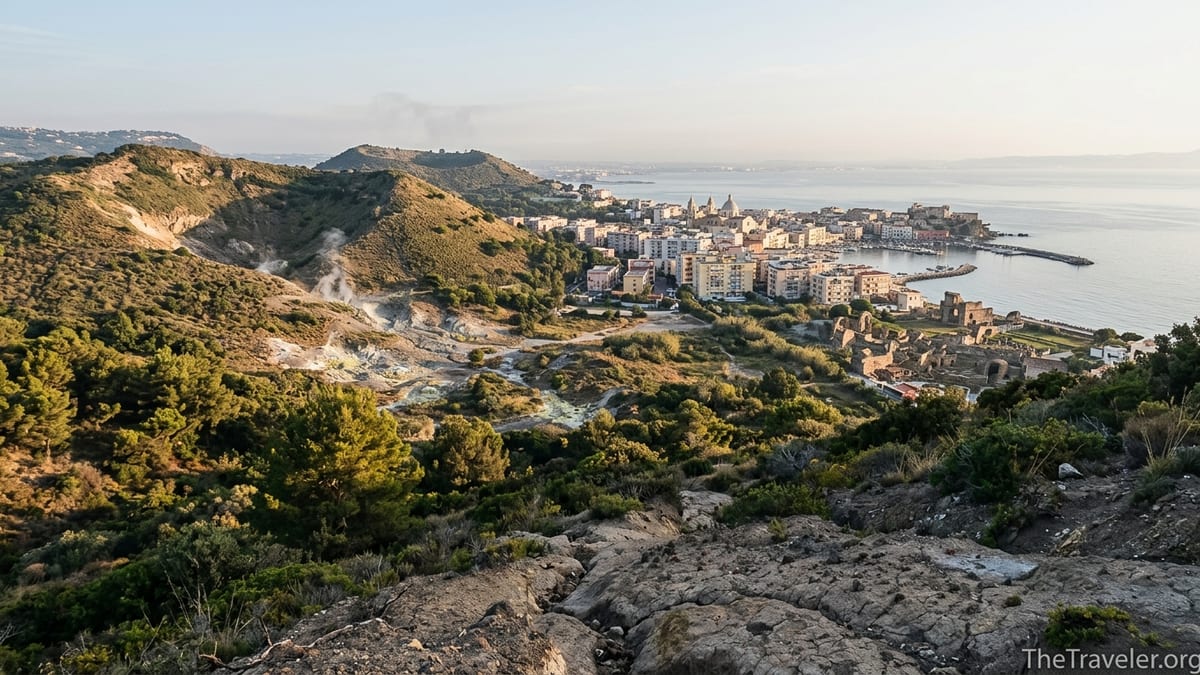
What and Where Are the Phlegraean Fields?
The Phlegraean Fields, known in Italian as Campi Flegrei, form a large volcanic caldera immediately west of Naples in southern Italy. Rather than a single cone like Mount Vesuvius across the bay, the system appears as a broad, low bowl roughly 12 to 15 kilometers across, ringed by hills and dotted with around forty volcanic centers. The area includes the towns of Pozzuoli, Bacoli, Monte di Procida and Quarto, as well as western neighborhoods of Naples such as Bagnoli and Fuorigrotta.
Geologists consider Campi Flegrei a supervolcano because of colossal eruptions in its distant past. Around 39,000 years ago, an event known as the Campanian Ignimbrite eruption blanketed much of southern Italy and left deposits recognizable as far away as the eastern Mediterranean. Later, about 15,000 years ago, another major eruption reshaped the caldera. Today, when you stand on the seafront at Pozzuoli or look back toward Naples from the hills above the port of Baia, you are effectively standing inside the rim of this ancient structure.
For visitors, the Phlegraean Fields are not a single fenced-off volcano but a lived-in landscape. Suburban trains on Naples Line 2 and the Cumana railway trundle through stations called Pozzuoli, Bagnoli and Cantieri, while buses weave between ordinary apartment blocks and unmistakably volcanic features. You might step off at Pozzuoli to visit the Roman amphitheater or the market, then realize that the smell of sulfur in the air and the warm, damp patches underfoot are reminders that the heat source is still there, just a few kilometers down.
The name itself hints at the area’s character. “Phlegraean” derives from the Greek for “burning,” a nod to the fires and fumes that impressed ancient travelers. Even today, areas like the Solfatara crater just above Pozzuoli and the Pisciarelli fumarole field near the Agnano district of Naples illustrate why people have long imagined the region as a gateway to the underworld.
A Volcanic Giant with a Human Face
Although the Phlegraean Fields are scientifically categorized as a supervolcano, the way this risk plays out is very human and very local. Roughly 500,000 people live in what Italian authorities classify as the red zone, the area that would require rapid evacuation in the event of a serious eruption. This includes the historic center of Pozzuoli, the coastal towns of Bacoli and Monte di Procida, and densely populated corners of western Naples. Daily life continues with schools, markets and football matches, but always with an undercurrent of awareness that the ground is restless.
Evidence of this restlessness is easy to see. In Pozzuoli, just off the harbor, the archaeological site often called the Temple of Serapis is in fact a Roman marketplace. Three marble columns are scarred by bands of holes left by marine mollusks, proof that the ground subsided below sea level and then rose again over centuries. Guides on site often point to these marks as one of the clearest visual records of a phenomenon known as bradyseism, the slow rising and sinking of the earth’s surface that has long characterized Campi Flegrei.
In practical terms, this means people in the Phlegraean Fields live with both long-term slow movements and short, sharp swarms of small earthquakes. In the late twentieth century, episodes of uplift forced the evacuation of parts of Pozzuoli’s old town as streets cracked and the harbor’s depth changed. More recently, from around 2005 onward, the caldera has again entered an active phase, with thousands of small quakes recorded and measurable uplift centered near the port of Pozzuoli and the nearby Solfatara area.
This scientific story plays out through small details a visitor might notice: metal plates on pavements that mark monitoring points, discreet seismological stations on hillsides, and civil protection posters in local schools and community centers. For travelers, these signs are reminders that Campi Flegrei is not just a geological curiosity but a place where hazard, resilience and community planning are all part of the landscape.
Why Scientists Watch Campi Flegrei So Closely
The importance of the Phlegraean Fields extends far beyond the Bay of Naples. Because the caldera is so large and has produced major eruptions in the past, it is one of the most closely studied volcanic systems in the world. Italian and international teams use satellite radar, GPS networks, gas sensors and seismic arrays to track what is happening beneath the surface. Recent research has shown that the current period of unrest is characterized by ongoing uplift, changes in gas composition and a pattern of small to moderate earthquakes, including events felt clearly across Naples in May 2024 and March 2025.
Scientists are particularly interested in how pressure builds and migrates in the complex system of magma and hydrothermal fluids beneath the caldera. Studies published in 2025 and 2026 propose that deep magmatic gases are feeding the shallower hydrothermal system, affecting rock strength and potentially bringing the system closer to a critical threshold. Some researchers describe this as an accelerating phase, though they stress that it is still impossible to predict whether the current unrest will culminate in an eruption, plateau into a new steady state or resolve in another way.
For travelers, the key point is that Campi Flegrei is treated as an active volcano at a raised attention level. Italy’s Civil Protection Department maintains a color-coded alert system, and Campi Flegrei has been at a yellow alert in recent years. Yellow does not mean an eruption is imminent; it means that parameters are above background, monitoring is intensified, and local authorities update emergency plans. If you visit Pozzuoli or Baia, you are entering a high-tech outdoor laboratory where every small tremor and gas plume is recorded and interpreted.
Importantly, scientists and civil protection officials work to communicate this without sensationalism. When a swarm of small quakes rattles windows in Bagnoli or Pozzuoli, local media may report it prominently and social networks fill with comments, but official channels emphasize both the ongoing nature of the unrest and the procedures in place. As a visitor, you can check information panels at railway stations or municipal offices that summarize basic advice: know evacuation routes, follow instructions if sirens or alerts sound, and avoid crowding roads unnecessarily during minor events.
Living and Traveling on Moving Ground
One of the most striking aspects of the Phlegraean Fields is how ordinary life unfolds in an extraordinary setting. On a weekday morning, commuters in Pozzuoli stroll past the steaming fumaroles of the La Pietra area on their way to the Cumana railway. Children play football on pitches built on ancient lava flows. Cafes in Bacoli serve espresso with views across a bay that is itself part of the flooded caldera rim. Visitors often comment that nothing in the streets suggests they are in a high-risk volcanic zone, until a mild tremor or a civil protection drill momentarily brings the reality into focus.
Bradyseism shapes more than abstract risk models; it affects infrastructure and planning decisions. Railway operators periodically adjust timetables and maintenance schedules around Pozzuoli Solfatara station, where track and platform levels must be monitored as the ground subtly rises. Local authorities sometimes halt new roadworks or building projects during more intense phases of uplift to keep access routes clear. In recent years, parts of prisons and apartment blocks have been temporarily evacuated as a precaution when structural inspections detected stress possibly linked to ground movement.
For travelers, this means occasional disruptions: an archaeological site may close without much warning for safety checks after a stronger quake, or a museum might restrict access to certain galleries. In May 2024, for example, the Archaeological Park of the Phlegraean Fields temporarily closed several of its 25 sites, including portions of Cuma and Baia, for structural inspections after clusters of tremors. Such closures are usually short-lived, but when planning a day trip from Naples, it is wise to verify the status of key sites through local tourist offices or by asking your accommodation to check the latest updates.
Despite these challenges, tourism continues, with many visitors choosing to stay in Pozzuoli or on the coast near Baia for a quieter base than central Naples. Hotels and guesthouses have adapted by keeping guests informed about basic safety procedures, much as accommodations in earthquake-prone cities like Tokyo or Santiago do. Travelers often leave with an enhanced appreciation for how communities adapt to living with an active volcano beneath their feet.
Highlights for Visitors: Craters, Lakes and Roman Remains
The Phlegraean Fields are as rich in sights as they are in scientific intrigue. One of the most atmospheric spots is the ancient port town of Pozzuoli. Here you can explore the Flavian Amphitheater, one of the largest Roman arenas in Italy, and descend into its vaulted underground passages, where the smell of damp rock hints at the geothermal heat below. A short walk away, the Macellum or so-called Temple of Serapis vividly illustrates the long history of uplift and subsidence, its columns bearing the scars of centuries spent alternately under and above the sea.
Further along the coast, the Castle of Baia looms on a headland with sweeping views over the bay and the islands of Ischia and Procida. Inside, the archaeological museum showcases sculptures and artifacts recovered from villas and spas that once lined the shore. Just offshore lies the Submerged Archaeological Park of Baia, where parts of ancient Roman villas, mosaics and columns now rest a few meters below the surface. Divers and snorkelers can arrange guided excursions with licensed local operators who provide equipment, boats and marine guides, turning the caldera’s slow subsidence into an underwater museum visit.
Inland, volcanic lakes offer quieter corners of the landscape. Lake Avernus, once thought by the Romans to be an entrance to the underworld, now hosts walking paths lined with vineyards and citrus trees. On weekends, locals from Pozzuoli and Naples come here to jog, picnic and dine at small family-run restaurants that serve fresh seafood and local Falanghina wines. Nearby Lake Fusaro is framed by pine trees and the elegant Bourbon-era hunting lodge known as the Casina Vanvitelliana, often photographed at sunset with gentle ripples on the water.
Many visitors once considered the Solfatara crater itself a highlight, with its steaming vents, boiling mud pools and lunar landscape of pale ash and sulfur. However, the site has been closed to the public since a fatal accident in 2017 and remains off-limits in 2026. Travelers can still sense the volcanic activity from viewpoints along surrounding roads and from smaller fumarolic areas like Pisciarelli near Agnano, but should respect all fences and closure notices, both for safety and to avoid interfering with scientific work.
Safety, Civil Protection and Responsible Travel
Because Campi Flegrei combines a dense urban population with an active volcanic system, Italy has invested heavily in planning and public information. The Civil Protection Department coordinates with the Vesuvius Observatory and other scientific bodies to monitor the caldera and regularly reviews evacuation and emergency plans. For residents of the red zone, this translates into periodic drills, information leaflets distributed door to door, and clear signage indicating assembly points and escape routes.
For travelers, safety in the Phlegraean Fields is largely a matter of preparation and awareness, not fear. Before a visit, it is wise to familiarize yourself with the basic alert levels used in Italy, and once on the ground, to pay attention to local instructions. Hotels in Pozzuoli or Bacoli may display emergency information near reception; staff can usually explain what to do in the unlikely event of a stronger seismic swarm or an official alert. Tour guides at archaeological sites are accustomed to answering questions about volcanic risk and can point out safe areas and exit routes.
Responsible travel also means respecting restricted zones. At fumarole fields like Pisciarelli, for example, the temptation to step closer for a dramatic photo is real, but the soft, altered ground can be unstable and sometimes extremely hot just below the surface. Authorities periodically reconfigure barriers and paths as new vents open or existing ones intensify. Following marked trails and the guidance of wardens or guides protects both you and ongoing scientific measurements.
Finally, travelers can support local resilience by choosing operators and accommodations that engage with, rather than downplay, the volcanic context. Some guesthouses in Pozzuoli collaborate with local scientists to host public talks or informal evenings where researchers explain current monitoring efforts. Booking this kind of experience not only enriches your understanding of Campi Flegrei but also helps sustain a culture of transparent risk communication in the region.
Geology Meets Myth, History and Culture
Long before modern volcanology, the Phlegraean Fields captured the imagination of writers and travelers. The ancient Greeks associated the area with battles between gods and giants, while the Romans saw nearby Lake Avernus and caves around Cuma as threshold points between the living world and the realm of the dead. The Roman poet Virgil set the entrance to the underworld here in his epic, the Aeneid, and described landscapes that still feel recognizable to anyone who has walked the sulfur-scented paths above Pozzuoli or gazed into the mist hanging over Lake Avernus.
During the Renaissance and the era of the Grand Tour, European visitors flocked to the area to experience what guidebooks of the time called the “wonders of the burning fields.” Writers like Goethe and Stendhal wrote about their visits to Solfatara and the ancient ruins along the coast, impressed by a setting where nature’s power and classical civilization seemed interwoven. Some early scientific observations of bradyseism and fumarolic activity in Campi Flegrei can be traced to this period, when curiosity about the earth’s inner workings began to overlap with romantic fascination.
Today, culture and geology continue to interact in quieter ways. Local festivals in Pozzuoli and Bacoli often reference the sea and the earth together, blending fishing traditions with rituals tied to saints associated with protection from earthquakes and eruptions. Restaurants build menus around ingredients shaped by volcanic soils and the nearby sea, offering dishes like spaghetti with clams from the Gulf of Pozzuoli or wines from vineyards planted on the flanks of ancient craters.
Visitors who spend a few days in the area often remark that it feels different from more familiar Italian destinations such as Sorrento or the Amalfi Coast. The Phlegraean Fields may lack the polished postcard image of those resorts, but they offer something more complex: a lived-in, sometimes gritty landscape where the weight of history and the potential of future change are palpable. Walking from a bustling piazza in Pozzuoli up toward the hills of the caldera rim, you move through layers of Greek colonies, Roman imperial architecture, medieval fortifications and modern apartment blocks, all built on ground that is still very much alive.
The Takeaway
The Phlegraean Fields near Naples are important because they concentrate, in a relatively small area, some of the strongest forces that shape our planet and some of the richest layers of Mediterranean history. As a supervolcanic caldera with a record of major eruptions, Campi Flegrei is a key natural laboratory for understanding how large volcanic systems behave and how early warning signs might be read. As a densely inhabited urban and suburban zone, it is also a testing ground for how societies can plan, communicate and adapt to long-term geological risk.
For travelers, visiting the Phlegraean Fields means stepping into this complex story. You might explore Roman ruins that bear the scars of centuries of uplift and subsidence, glide over submerged villas in Baia’s underwater park, or sip coffee in a Pozzuoli cafe while a minor tremor ripples through the cups. You will see how local people live not in the shadow of a single dramatic volcano, but on the gently rolling floor of an enormous caldera, where every stone, crack and column tells part of a deeper narrative.
Approached with curiosity and respect, a trip to Campi Flegrei can reshape how you think about volcanoes, risk and resilience. It highlights that volcanic landscapes are not just dramatic peaks to be photographed from afar, but complex, inhabited regions where science, culture and everyday life are inseparable. In a world where more cities will have to reckon with environmental hazards, the way the Phlegraean Fields balance vigilance and normalcy may prove as significant as their spectacular geology.
FAQ
Q1. Where exactly are the Phlegraean Fields located?
The Phlegraean Fields lie immediately west of central Naples in southern Italy, encompassing Pozzuoli, Bacoli, Monte di Procida, Quarto and several western districts of Naples.
Q2. Are the Phlegraean Fields the same as Mount Vesuvius?
No, they are separate volcanic systems. Vesuvius is a single stratovolcano east of Naples, while the Phlegraean Fields form a broad caldera west of the city with many smaller vents and craters.
Q3. Is it safe to visit the Phlegraean Fields right now?
At present, daily life and tourism continue normally, although the area is under heightened scientific monitoring. Visitors should follow local guidance, respect any temporary closures and stay informed through official information channels while traveling.
Q4. Can I visit the Solfatara crater?
No, the Solfatara crater has been closed to the public since a fatal accident in 2017 and remains off-limits in 2026. You can, however, view parts of it from surrounding roads and visit other nearby volcanic features that are open and supervised.
Q5. What are the best sites to see in the Phlegraean Fields?
Popular highlights include the Flavian Amphitheater and Macellum in Pozzuoli, the Castle and archaeological museum of Baia, the Submerged Archaeological Park of Baia, and the volcanic lakes Avernus and Fusaro, along with views of the caldera from coastal promenades.
Q6. What is bradyseism, and how does it affect the area?
Bradyseism is the slow rising and sinking of the ground due to changes in pressure within the volcanic system. In Campi Flegrei, it has periodically lifted and lowered parts of Pozzuoli and the coastline, affecting buildings, harbor depths and infrastructure planning.
Q7. Has Campi Flegrei erupted in recent history?
The last eruption in the Phlegraean Fields occurred in 1538, when the small cone of Monte Nuovo formed near Pozzuoli. Since then, the caldera has experienced significant unrest and ground deformation but no new eruptive vents at the surface.
Q8. How do locals prepare for volcanic and seismic risk?
Residents participate in civil protection drills, receive information materials about evacuation routes and safety procedures, and live with ongoing monitoring of earthquakes and ground movement. Schools, municipalities and community groups all play a role in preparedness.
Q9. How can I explore the area without a car?
You can reach the Phlegraean Fields by using Naples suburban rail lines, such as Line 2 to Pozzuoli and the Cumana railway toward Baia and Torregaveta, complemented by local buses and taxis. Many key sites are within walking distance of train stations.
Q10. Why are the Phlegraean Fields considered so important globally?
Campi Flegrei is important because it combines a supervolcanic caldera with a large urban population, making it a critical case study for volcanic monitoring, risk assessment and emergency planning. It also preserves exceptional archaeological and cultural heritage shaped by thousands of years of interaction between people and a dynamic landscape.