


Tucked inside the cloisters of Florence’s Basilica di Santa Croce, the Pazzi Chapel is one of the most influential works of Renaissance architecture, yet many first-time visitors walk right past it. Understanding where it is, how tickets work, and what you are actually looking at once you step inside will turn a quick stop into one of the most rewarding experiences of your time in Florence.
Get the latest updates straight to your inbox!
Understanding Where the Pazzi Chapel Is and How to Get In
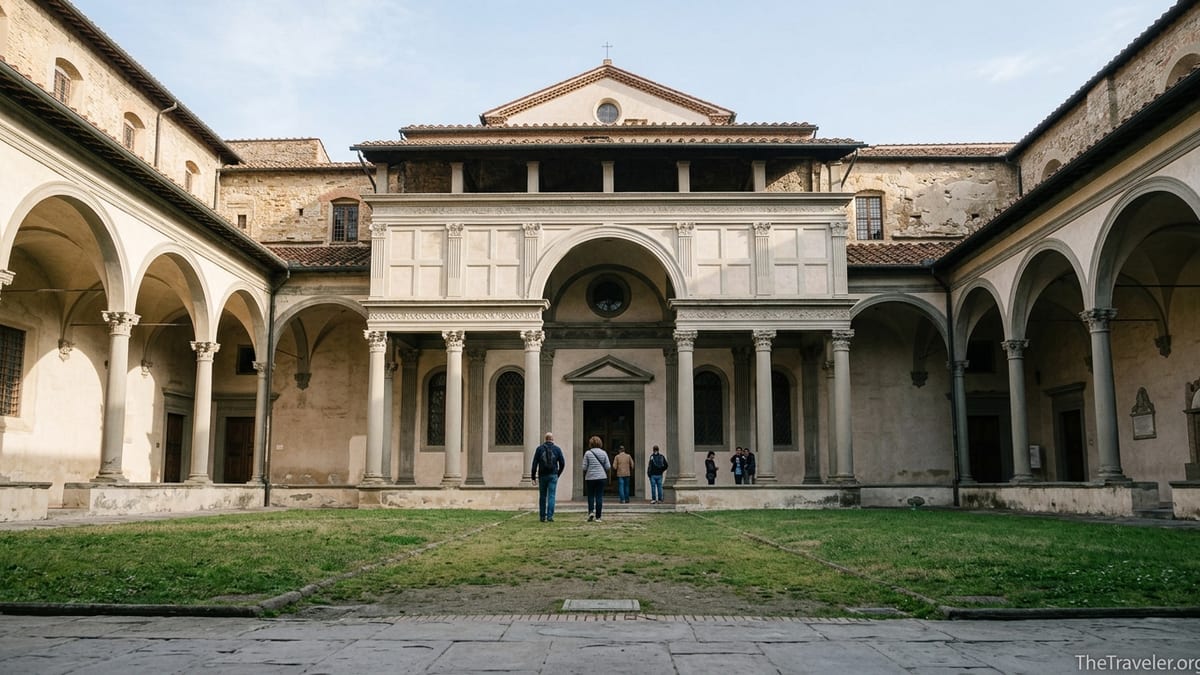
The Pazzi Chapel is not a standalone building on a city street, which is why many first-time visitors struggle to find it. It sits inside the first cloister of the Basilica di Santa Croce complex, on the south side of the church. To reach it, you first enter the Santa Croce monument complex and only later walk into the cloister where the chapel stands facing the courtyard. You do not approach it directly from Piazza Santa Croce.
Access to the Pazzi Chapel is included in the standard ticket for the Basilica di Santa Croce, which typically covers the basilica interior, the cloisters, museum areas and the chapel itself. You do not buy a separate Pazzi Chapel ticket at the door of the cloister. In practice, this means that if you purchase a timed ticket for Santa Croce from an official ticket office or a reputable reseller, you have already paid for the Pazzi Chapel. On busy spring and autumn weekends, many visitors book a late-morning slot around 10:30 or 11:00 so they can see the church when the light is strongest in the cloister and still avoid the mid-afternoon crowds.
The main visitor entrance to Santa Croce is not through the big marble facade that faces the square, but around the corner, on the north side of the complex. This often surprises first-time visitors who line up at the front doors only to be redirected. Once you have scanned your ticket and visited the basilica interior, you exit through a side door into the first cloister. Directly ahead across the lawn is the small, temple-like facade of the Pazzi Chapel with its portico and central arch. Give yourself at least 20 to 30 minutes for the chapel itself within a broader 1.5 to 2 hour visit for the whole Santa Croce complex.
Opening hours for Santa Croce, and therefore access to the Pazzi Chapel, can vary slightly by season and day of the week. As of mid 2026, daytime visiting hours commonly fall within late morning to late afternoon, with shorter hours on Sundays and religious holidays. It is wise to check times shortly before you travel and avoid turning up just before last entry, because staff begin clearing the cloisters and chapel well before official closing time.
Tickets, Costs and Whether You Need to Book Ahead
For most travelers, the Pazzi Chapel will be accessed with a standard Santa Croce ticket that costs in the rough range of a mid-priced museum entry in Florence. Prices can shift slightly year to year, and reduced rates usually exist for children, students and seniors, so think in terms of a modest but not symbolic fee. Combined passes that include several Florentine churches and museums sometimes feature Santa Croce; if you are buying such a pass, read the description carefully to confirm that the basilica and its cloisters are covered.
In high season between roughly April and October, especially on weekends, pre-booking a timed ticket helps you avoid waiting in a slow-moving line outside the entrance. Timed tickets typically give you a 15 to 30 minute entry window rather than a rigid to-the-minute appointment. For example, if you hold an 11:00 entry, arriving at 10:50 or 11:10 is usually acceptable. This flexibility matters because Santa Croce is a short walk from other major sights like the Duomo and Piazza della Signoria, and it is easy to underestimate how long earlier visits will take.
Several guided tours of Santa Croce advertised by local operators and global booking platforms include a brief stop inside the Pazzi Chapel. These tours often combine the basilica, cloisters and a walk through the surrounding neighborhood. If you are especially interested in architecture, an art historian-led tour can be worthwhile because the guide will explain the chapel’s geometric proportions and symbolic elements that are easy to miss if you only have a guidebook in hand. On the other hand, if you are traveling on a tight budget, a standard ticket plus a good printed plan from the Santa Croce ticket office can be enough to appreciate the space independently.
Be cautious of street touts in the square who try to sell “skip the line” passes at inflated prices or offer vague “church tours” without clear inclusions. For a first visit it is safer to buy from the official ticket desk, the Santa Croce Opera website through which the basilica manages entries, or a well-known ticketing brand that clearly states that Pazzi Chapel access is part of the Santa Croce itinerary.
Dress Code, Photography and On-site Etiquette
Although the Pazzi Chapel is now part of a museum-like circuit, it remains a consecrated Christian space and is integrated into an active Franciscan complex. A modest dress code is enforced at the Santa Croce entrance. In practice, this means that shoulders and knees should be covered for both men and women. A light scarf over sleeveless tops or a long shirt over shorts is normally sufficient. In hot months many visitors carry a lightweight scarf specifically for church visits, using it for Santa Croce in the morning and then later for the Duomo or Santa Maria Novella.
Photography rules inside the complex can differ from one area to another. In the basilica interior, non-flash photography is typically allowed, but in more delicate spaces such as the Pazzi Chapel staff sometimes restrict or entirely prohibit photography to protect works and preserve a contemplative atmosphere. You may see signs at the entrance to the cloister or chapel indicating whether cameras are currently allowed. Even if photography is permitted, tripods, flashes and large camera rigs are usually not, and staff may ask visitors taking elaborate shots to move along if the space is crowded.
Because the chapel is relatively small, voices easily bounce off the plaster and pietra serena stone. Guides are usually asked to speak softly or use whisper systems, and large group tours may be limited in number at any one time. As a first-time visitor, you will enjoy the space more if you take a moment to stand or sit quietly along the stone bench inside, letting your eyes adjust to the light from the oculus and windows before you begin analyzing details. Quick selfies in the doorway are common, but extended photo sessions in the center of the room can block sightlines in a space where everyone is trying to look up at the same dome.
Food and drink are not allowed in the chapel or cloisters. If you are carrying a takeaway coffee from a bar in Piazza Santa Croce, finish it before you enter the complex. Water bottles are acceptable, and in summer it is wise to bring one, but keep them sealed in your bag while inside the chapel itself. Sitting on the grass of the cloister lawn to picnic is discouraged; use nearby squares or the riverside instead if you want a casual snack after your visit.
What You Are Actually Looking At: Space, Symbols and Details
The Pazzi Chapel is celebrated as one of the clearest expressions of early Renaissance architectural ideas. Designed in the 15th century and traditionally associated with Filippo Brunelleschi, it is based on a strict system of proportion where the primary module is a cube surmounted by a shallow “umbrella” dome. When you step inside, the space feels calm and ordered rather than overwhelming, especially compared with the soaring vertical drama of Gothic churches. This sense of balance is intentional: every bay, arch and pilaster is carefully related to the others in a kind of three-dimensional geometry lesson.
One of the first things you will notice is the contrast between the pale plastered walls and the gray pietra serena stone that outlines arches, columns and cornices. This gray stone is the same material Brunelleschi used in the Old Sacristy of San Lorenzo, and it became something of a visual signature for Florentine Renaissance interiors. In the Pazzi Chapel, the stone elements act like the drawing lines of a plan that has been made visible on the walls and ceiling, guiding your eye around the space.
Look up into the central dome and you will see circular glazed terracotta medallions, or tondi, with cherubs and symbols of the Lamb of God. These were produced by the Della Robbia workshop, the same family of ceramicists whose bright blue and white reliefs you will see in museums across Florence. Around the lower walls are twelve glazed terracotta roundels showing the Apostles. Their relatively small scale means they can be overlooked by visitors who only focus on the dome, so it is worth doing a slow circuit around the interior to see each one. In the squinches that support the dome, four polychrome tondi represent the Evangelists, also in terracotta.
Step toward the raised chancel at the eastern end and look at the stained-glass windows. The upper oculus shows God the Father in blessing, while the tall window behind the altar depicts Saint Andrew, alluding both to the chapel’s dedication and to its patron, Andrea de’ Pazzi. Above the chancel, the small dome is painted with an astrological sky showing constellations as they appeared over Florence on a specific date in the 1440s. Scholars have debated its exact meaning, but for a first-time visitor it is enough to recognize that this is a rare fifteenth-century attempt to fix a moment in cosmic time on a chapel ceiling. Take a moment to compare this painted starscape to the more famous painted heavens you may have seen in reproductions of the Old Sacristy in San Lorenzo or the interior of the Baptistery.
A Brief History: From Family Prestige to Architectural Icon
The Pazzi family, who commissioned the chapel, were among the wealthiest and most powerful dynasties in 15th-century Florence, second only to the Medici. In 1423 a serious fire damaged part of the Santa Croce convent, including dormitories and the library. In the aftermath, Andrea de’ Pazzi funded the construction of a new chapter house for the Franciscan friars that would also serve as his family’s chapel. Design work is generally attributed to Brunelleschi in the late 1420s and 1430s, with construction starting around 1443.
Brunelleschi died in 1446, and later phases of the chapel, especially the porch facing the cloister, were completed by other architects. The porch with its Corinthian columns and small central dome, decorated with the Pazzi coat of arms in glazed terracotta rosettes, was finished around the early 1460s. In 1478, the infamous Pazzi Conspiracy against Lorenzo de’ Medici collapsed, leading to the exile and disgrace of much of the family. Work on decorative elements slowed or stopped, and the chapel’s association shifted over time from a symbol of family prestige to an exemplar of a new architectural language.
For modern visitors, part of the chapel’s fascination lies in its relative purity. Unlike many other Florentine interiors that were remodeled in later centuries, the Pazzi Chapel has largely retained its original 15th-century appearance. When you step inside today, you are experiencing a space that Renaissance humanists, friars and laypeople would recognize. This makes it an ideal place to connect classroom images of early Renaissance architecture with a real, three-dimensional environment that you can walk through, listen in and feel.
Later generations of architects, from Palladio to modern classicists, studied the Pazzi Chapel extensively. In many architecture schools today, first-year students still analyze its plan and elevation to understand proportion and harmony. As a first-time visitor, you do not need formal training to appreciate these qualities. Simply stand in the center of the floor, slowly rotate, and notice how every opening and column relates to another across the space, creating a quiet rhythm very different from the crowded streets outside.
Planning Your Visit in the Wider Context of Santa Croce
Because the Pazzi Chapel is only one part of a much larger complex, it helps to think about its place within your overall Santa Croce visit. Most visitors begin in the basilica itself, where you will find tombs and monuments to figures such as Michelangelo, Machiavelli and Galileo. After exploring the main nave and side chapels, you follow signs leading to the cloisters and museum spaces. The transition from the darker church interior to the airy green cloister is part of the experience; many visitors pause here to catch their breath before stepping into the intimacy of the Pazzi Chapel.
A useful strategy is to walk once around the cloister first, taking in its arched walkways and views of the chapel’s exterior from different angles. This helps you understand how the building fits into the convent fabric. From one corner you can see the chapel’s side wall with its small windows, from another the facade and porch frame the lawn. Only after this circuit should you go inside, where the geometric order of the interior will feel like a natural continuation of the ordered courtyard outside.
If you are keen on photography, the best exterior views of the Pazzi Chapel are usually mid to late morning when sunlight reaches into the cloister but is not yet harshly vertical. On overcast days the soft, even light can be excellent for close-up shots of the gray stone details against the plaster. Rainy days are less of a problem here than at outdoor monuments, because the cloister is partially sheltered and the chapel interior itself is fully covered, making Santa Croce and the Pazzi Chapel a good choice for a wet-weather sightseeing day.
After your visit, you exit the complex through museum areas and another cloister, eventually reaching the street near the river. Many travelers then either head toward the nearby leather school, which operates in former monastic dormitories and recalls Santa Croce’s postwar social history, or wander back to Piazza Santa Croce for a coffee. Planning your route so that the Pazzi Chapel falls roughly in the middle of your Santa Croce visit rather than as a rushed afterthought at the end will help you give it the attention it deserves.
Practical Tips for First-time Visitors
Allow enough time. Many first-time visitors budget only an hour for the entire Santa Croce complex because they think of it as “just another church.” In reality, between the basilica, its artworks, the cloisters, the Pazzi Chapel and the museum spaces, it is easy to spend two hours or more without feeling you have lingered excessively. If you only have a short window, decide in advance that you will prioritize the basilica nave, the first cloister and the Pazzi Chapel over more peripheral rooms.
Consider timing in relation to other sites. If you have already climbed the Duomo dome or Giotto’s Campanile earlier in the day, you may arrive at Santa Croce tired and less receptive to the subtleties of the Pazzi Chapel. Many seasoned travelers plan Santa Croce for a morning when their minds are fresh and leave more physically demanding sights for later. In summer, mornings also mean lower temperatures in the cloister and a gentler light inside the chapel.
Think about your route to and from the site. Santa Croce lies slightly east of the densest tourist zone around the Duomo. From the cathedral area, the walk takes roughly 10 to 15 minutes along narrow streets that can be busy with pedestrian and bicycle traffic. Allow that margin when planning your timed entry. If staying in the Oltrarno district across the river, you can reach Santa Croce in a similar timeframe by crossing either Ponte alle Grazie or Ponte Vecchio and then walking a few blocks inland.
Finally, remember that Santa Croce is occasionally affected by restoration campaigns, special liturgies or extraordinary events which may temporarily close certain chapels or alter visitor routes. Even when Giotto’s frescoed chapels or other areas are under scaffolding, the Pazzi Chapel has generally remained accessible because it forms part of the cloister circuit. Staff at the entrance will be able to tell you on the day whether any areas are closed, so it is worth asking specifically if access to the first cloister and the Pazzi Chapel is fully open before you buy a same-day ticket.
FAQ
Q1. Where exactly is the Pazzi Chapel located within Florence?
The Pazzi Chapel is inside the Basilica di Santa Croce complex, opening onto the first cloister on the south side of the church, a short walk east from Florence’s historic center.
Q2. Do I need a separate ticket for the Pazzi Chapel?
No. Entry to the Pazzi Chapel is included in the standard Santa Croce ticket, which covers the basilica, cloisters and related museum spaces.
Q3. How much time should I plan for the Pazzi Chapel itself?
Most visitors spend about 20 to 30 minutes inside the chapel, often as part of a 1.5 to 2 hour visit to the entire Santa Croce complex.
Q4. Is photography allowed inside the Pazzi Chapel?
Rules can vary, but photography is sometimes restricted or prohibited inside the chapel even when it is allowed in the main basilica. Always follow posted signs and staff instructions.
Q5. Is there a dress code I should follow?
Yes. As in other Florentine churches, shoulders and knees should be covered. A light scarf or wrap is useful if you are wearing sleeveless clothing.
Q6. Can I visit the Pazzi Chapel without visiting the rest of Santa Croce?
In practice, no. The chapel is reached through the cloisters inside the Santa Croce complex, so you pass through the main visitor route even if your main goal is the chapel.
Q7. Are guided tours worth it for a first visit?
Guided tours can be valuable if you are particularly interested in architecture and want detailed explanations of the chapel’s proportions, symbolism and history. Independent visits are still rewarding with a good map or leaflet.
Q8. When is the best time of day to visit the Pazzi Chapel?
Late morning is often ideal, when natural light in the cloister and chapel is strong but not harsh, and crowds are manageable compared with mid-afternoon.
Q9. Is the Pazzi Chapel accessible for visitors with limited mobility?
Access routes within Santa Croce have been gradually improved, but some thresholds and uneven surfaces remain in the cloister area. Visitors with mobility needs should check current accessibility details with the site before visiting.
Q10. What should I look for inside the Pazzi Chapel if I only have a few minutes?
Focus on the contrast of gray pietra serena stone and white plaster, the central dome with its glazed terracotta medallions, the twelve Apostle roundels on the walls and the small dome over the chancel painted with an astrological sky.