


Most travelers step into the Pazzi Chapel at Santa Croce, snap a few photos of the cool gray stone and perfect dome, then move on to the next Florentine highlight. Yet this small Renaissance masterpiece, traditionally linked to Filippo Brunelleschi, rewards the kind of slow, attentive looking that modern sightseeing rarely allows. Beneath its calm surfaces lie calculated proportions, symbolic details and even acoustic tricks that most visitors never notice at all.
Get the latest updates straight to your inbox!
The Chapel Most People Walk Past
The Pazzi Chapel sits in the first cloister of the Basilica di Santa Croce, slightly removed from the main church that pulls in the tour groups. Many visitors with timed tickets for Santa Croce walk straight across the cloister, note the serene portico and central dome, and treat the chapel almost as a pretty backdrop rather than a major work of Renaissance architecture. If you are following a tight schedule that also includes the Duomo, the Uffizi and Ponte Vecchio in a single day, it is easy to give the chapel five minutes when it really deserves at least twenty.
Part of what makes the chapel so easy to overlook is its scale. Compared with the soaring nave of Santa Croce or the overwhelming bulk of Brunelleschi’s cathedral dome, the Pazzi Chapel feels almost domestic. It was commissioned in the 1430s by the powerful Pazzi banking family to serve both as their private chapel and the Franciscans’ chapter house, essentially a refined meeting room for the friars. Today, that original function is not obvious. There are no pews, no elaborate main altar, and no Baroque overlays. To the casual eye, it can look almost empty, which is precisely why its elegant design details can be missed.
For many travelers, the chapel is also overshadowed by the infamous Pazzi Conspiracy of 1478, when members of the family joined a plot against the Medici and were later exiled. The story appears in guidebooks and walking tours, but it tends to fix attention on politics rather than architecture. Standing inside the chapel, however, you see a different legacy of the Pazzi name: a room that embodies the quiet ideals of early Renaissance design, where proportion and clarity mattered more than display.
Proportions You Feel Before You See
Most visitors sense that the Pazzi Chapel feels harmonious without realizing that this effect is the result of a strict proportional system based on simple geometric forms. The plan combines a rectangular hall with a central dome, yet the interior feels almost like a cube, with the height of the main space closely matching its width. The span of each bay along the walls relates to the diameter of the dome, so that your eye moves through a rhythm of equal intervals. Even if you never study a floor plan, your body registers this order when you stand at the center of the room.
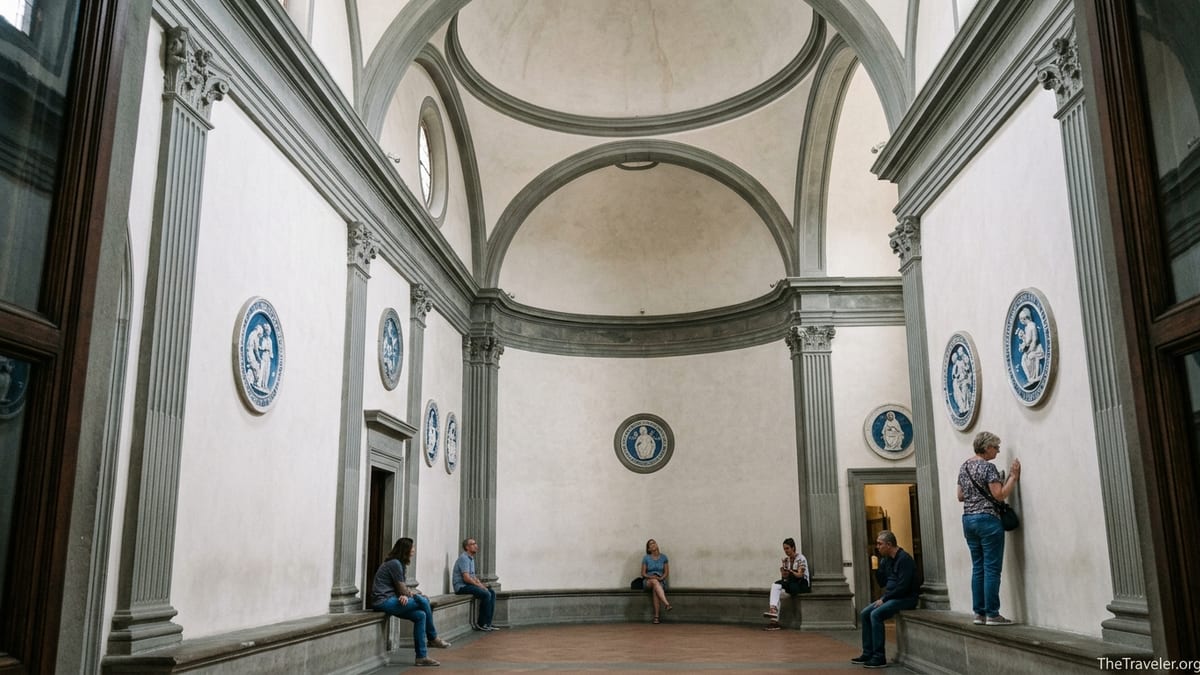
A practical way to experience these proportions is to pause on the central circular stone in the floor, roughly beneath the dome, and slowly turn in place. As you rotate, you will notice that the arches to the side chapels, the windows and the round decorative medallions fall into repeated patterns. Look, for example, at how the height of the stone pilasters matches the springing of the arches, and how the entablature line runs like a continuous horizon around the room. Many visitors take a quick panoramic photo from this central point but do not linger long enough to see how deliberately every vertical and horizontal line has been placed.
Compared with Gothic churches, where height is often emphasized to inspire awe, the Pazzi Chapel’s proportions are almost conversational. The height of the main interior is close to that of a modest modern townhouse, so you do not feel dwarfed. Instead, you feel placed within a measured grid. Architecture students sometimes bring sketchbooks and stand quietly under the dome, tracing these relationships. If you spend even a few minutes imitating them, you will begin to appreciate how mathematical the elegance of the space really is.
Pietra Serena: The "Drawing" On the Walls
Another feature that most visitors notice but rarely interpret is the use of pietra serena, the cool gray sandstone that defines the chapel’s structural lines. Against white plaster walls, every arch, pilaster and entablature is picked out in this stone as if drawn in ink on paper. Travelers often remark that the interior feels like a three-dimensional architectural drawing, but they may not realize how unusual this was in the fifteenth century, when heavily carved stone and colored marbles were still common in prestigious chapels.
To see the effect clearly, stand near the entrance and look back and forth between the chapel and the cloister outside. In the cloister, you will likely notice aged brick, stucco and patches of fresco. Inside the chapel, by contrast, the contrast between white plaster and pietra serena is sharp and deliberate. The stone outlines the key structural elements: arches, pilasters, the circular frame of the dome and the frames around the doors and windows. Visitors who walk in, look up at the dome, and walk out again often fail to notice small but telling details, such as the way each pilaster’s capital aligns perfectly with the springing of the arches, or the subtle molding profiles on the entablature.
A concrete example can be seen at the small aedicule framing the central door to the sacristy on the far side of the chapel. Most people register it as a simple gray-and-white doorway. Look closer and you will see a miniature temple form: pairs of pilasters supporting an entablature and pediment, all executed in pietra serena. The same vocabulary repeats on a larger scale in the main interior, creating a kind of visual echo. Once you train your eyes to follow the stone, the room becomes a lesson in how a reduced palette can still convey richness and variety.
Terracotta Medallions and a Hidden Sky
Many travelers recognize the name Luca della Robbia from the bright glazed terracotta works scattered around Florence, but they do not always realize that some of his most refined medallions decorate the Pazzi Chapel. On the walls below the dome, round blue and white reliefs depict the seated Apostles, their figures modeled in delicate detail against luminous glazes. Above, in the pendentives that transition from the square room to the circular dome, circular medallions depict the four Evangelists with their symbolic creatures. Because the chapel’s lighting can be soft, especially on overcast days, these works sometimes read as simple decorative spots of color rather than as individual masterpieces.
If you arrive when the cloister is quiet, step closer to one of the Apostle medallions and look at the way the glaze catches the light. The white robes have a soft sheen, while the deep blue backgrounds can appear nearly black in shadow. This difference in reflectivity helps the figures stand out even when the sun is low. Most visitors, intent on photographing the dome, give only a cursory glance to these medallions, yet they were a key part of the original decorative program. In a practical sense, they also provide visual anchors around the room, breaking up the flatness of the walls and reinforcing the circular motif that culminates in the dome itself.
Look up to the small dome over the apse space and you will notice a painted starry sky, a theme that Brunelleschi’s circle used elsewhere in Florence. The deep blue with gold stars creates the illusion of an open firmament above the altar area. Many people miss this entirely because their gaze jumps straight to the main dome or is distracted by the visitors entering and exiting. An easy way to notice it is to stand near the center and look not at the highest dome, but a bit off to the side, where this smaller cupola rises above the sanctuary. For photographers using a wide-angle lens, tilting slightly toward this starry dome can capture a detail that rarely appears in standard guidebook images.
Light, Acoustics, and the Way the Room "Behaves"
Visitors are usually struck by how calm the Pazzi Chapel feels compared with Santa Croce’s busy nave, yet few realize how carefully its windows and surfaces manipulate light and sound. The windows are relatively small and placed high, which keeps direct sun from glaring into your eyes and instead bathes the walls and dome in a gentle, diffuse glow. On a bright summer afternoon, the pietra serena outlines remain legible without sharp shadows, so the geometry reads clearly from almost any angle. On cloudy winter days, the interior can feel hushed and almost monochrome, making the blue-and-white medallions appear even more intense.
The acoustics are another subtle feature. Because the chapel originally served as a chapter house, it needed to support clear speech and chant rather than amplified music or large choirs. The smooth plaster walls and domed ceiling reflect sound evenly, creating a gentle resonance. If you speak quietly while standing in the center of the room, you may notice that your voice carries more than expected. Several small tour groups can talk at once without the space feeling unbearably loud, yet a single voice leading a commentary from the center can be heard at the edges. Travelers who attend occasional concerts or vespers services here often comment afterward on how intimate the sound feels, as if the room is reinforcing the human voice instead of competing with it.
A simple way to experience this is to wait until the chapel is relatively empty and read a short passage aloud from your guidebook in a normal, conversational tone. You will hear a soft bloom of reverberation, especially beneath the main dome. This is not the dramatic echo of a vast cathedral but a controlled resonance suitable for a small community. Most tourists never test this, either out of shyness or because they feel rushed. Yet taking ten seconds to listen to your own voice in the space can reveal an aspect of the design that is otherwise invisible.
Details at Human Height That Most Eyes Skip
Because the dome is so commanding, many visitors spend most of their time looking up. As a result, they miss a scattering of low-level details that sit at or just above eye level. For example, along the lower walls you can spot simple stone benches built into the architecture. These are not modern museum additions but part of the original design, reflecting the chapel’s function as a meeting room where friars would sit along the perimeter during chapter discussions. When the space is not crowded, try sitting on one of these benches. The perspective you gain, with the pilasters rising just in front of you and the dome framed above, is very different from the usual standing tourist’s view from the center.
Another frequently overlooked element is the floor. Unlike the richly patterned stone pavements of Santa Maria Novella or the Duomo, the Pazzi Chapel’s floor is relatively restrained, but its modest geometric layout echoes the broader proportional system. Look for the subtle alignment between floor joints, the bases of the pilasters and the axes of doors and windows. These relationships are far easier to notice if you deliberately lower your gaze rather than keeping it fixed on the ceiling. Travelers wearing soft-soled shoes will also notice that the stone radiates coolness in summer and retains a faint chill in shoulder seasons like April and October, which contributes to the chapel’s overall sense of calm.
At the entry zone under the portico, many people pause only long enough to photograph the facade, yet this semi-outdoor space contains its own layer of refinement. The coffered wooden ceiling and simple pietra serena columns create a transitional room between the lively cloister and the quiet interior. If you stand here for a few minutes, you can watch how groups compress and expand as they pass through, giving you a sense of how the architecture gently regulates movement. Noticing this threshold behavior is a small pleasure that most rushed visitors never experience.
Context Within Santa Croce and Renaissance Florence
Seen in isolation, the Pazzi Chapel can feel like an abstract exercise in balance. Placed back into its context, it becomes a bridge between medieval Florence and the new Renaissance ideals. When the chapel began rising in the 1440s, Santa Croce was still dominated by its Gothic church and the tombs of figures such as Dante and later Michelangelo and Galileo. The Pazzi family, eager to signal both piety and cultural sophistication, commissioned a building that spoke the architectural language of their moment: clear geometry, classical details and disciplined ornament.
Most visitors today move from Brunelleschi’s chapel to other Florentine landmarks overwhelmed by decoration, such as the gilded Baptistery doors or the painted ceilings of the Palazzo Vecchio. Returning in your mind to the Pazzi Chapel after seeing those spaces can sharpen your appreciation. Where many later works rely on color, narrative fresco cycles and sculptural abundance, the chapel depends on a few repeated forms: circles, squares and rectangles. It is instructive to visit the Old Sacristy at San Lorenzo or the Medici Chapels on another day and compare how each space balances structure and display. Travelers who make that comparison often report that the Pazzi Chapel lingers in memory precisely because it holds back so much.
Practically speaking, the chapel also offers a respite within a busy sightseeing day. Santa Croce’s cloister, where the chapel stands, is usually quieter than the main nave. In high season, when entrance lines at the Duomo and Uffizi can stretch to an hour or more, it is not uncommon to find yourself sharing the Pazzi Chapel with only a handful of other visitors. Taking advantage of this relative solitude to slow down, sit, and observe details is one of the most rewarding ways to experience Florence’s Renaissance heritage away from the crowds.
The Takeaway
For many travelers, the Pazzi Chapel is a brief stop on the way to more famous Florentine sights. Yet its quiet power lies in details that reveal themselves only with time: the measured proportions you feel intuitively before you ever analyze them, the disciplined use of pietra serena that turns structure into drawing, the luminous terracotta medallions that punctuate the walls, and the gentle acoustics that hold a human voice as if in cupped hands. None of this shouts for attention. It invites it.
If you plan a visit to Santa Croce, consider reserving an extra pocket of time specifically for the chapel. Arrive early or linger late, sit on the stone bench, stand beneath the dome, read a passage aloud and study a single medallion up close. In doing so, you will experience something that most visitors never do: not simply seeing the Pazzi Chapel, but understanding how its elegant design continues to shape the way people move, speak and feel inside it nearly six centuries after it was conceived.
FAQ
Q1. Where exactly is the Pazzi Chapel located within Santa Croce?
The Pazzi Chapel stands off the first cloister on the south side of the Basilica di Santa Croce in Florence, just beyond the main church interior.
Q2. How much time should I plan to spend inside the Pazzi Chapel?
Most visitors spend five to ten minutes, but allowing twenty to thirty minutes lets you appreciate the proportions, medallions and acoustic qualities more fully.
Q3. Is the Pazzi Chapel always included with a Santa Croce ticket?
Access is typically included with standard admission to the Santa Croce complex, though specific ticketing arrangements can vary over time and should be checked locally.
Q4. Who designed the Pazzi Chapel?
The design has traditionally been attributed to Filippo Brunelleschi, though modern scholars debate how much of the executed building is by him and how much by his collaborators.
Q5. What is the best time of day to see the chapel’s interior light?
Late morning and early afternoon usually offer soft, even light that highlights the contrast between the white plaster walls and the gray pietra serena stone.
Q6. Are photos allowed inside the Pazzi Chapel?
Photography without flash is generally permitted for personal use, but current rules may change, so it is wise to confirm posted signs or ask staff during your visit.
Q7. Why does the chapel feel so calm compared with other Florentine churches?
The modest scale, controlled light, restrained decoration and carefully designed acoustics all contribute to a sense of calm that contrasts with larger, busier interiors.
Q8. Can I sit down inside the Pazzi Chapel?
Yes, there are low stone benches integrated into the walls where you can sit quietly, provided you respect any temporary barriers or instructions from staff.
Q9. Is the Pazzi Chapel suitable for visitors with limited mobility?
The chapel is on the ground floor off the cloister, and access is generally straightforward, but exact conditions and any steps or thresholds should be checked on site.
Q10. Do I need a guided tour to appreciate the chapel’s design?
A guided tour or audio guide can highlight historical context, but with a bit of advance reading and unhurried observation, independent visitors can still appreciate its subtle elegance.