


More news on this day
As summer and winter storms increasingly snarl air traffic, passengers are confronting a complicated patchwork of legal protections that hinges on where they fly and which jurisdiction’s rules apply when weather delays or cancels their flights.
Get the latest news straight to your inbox!
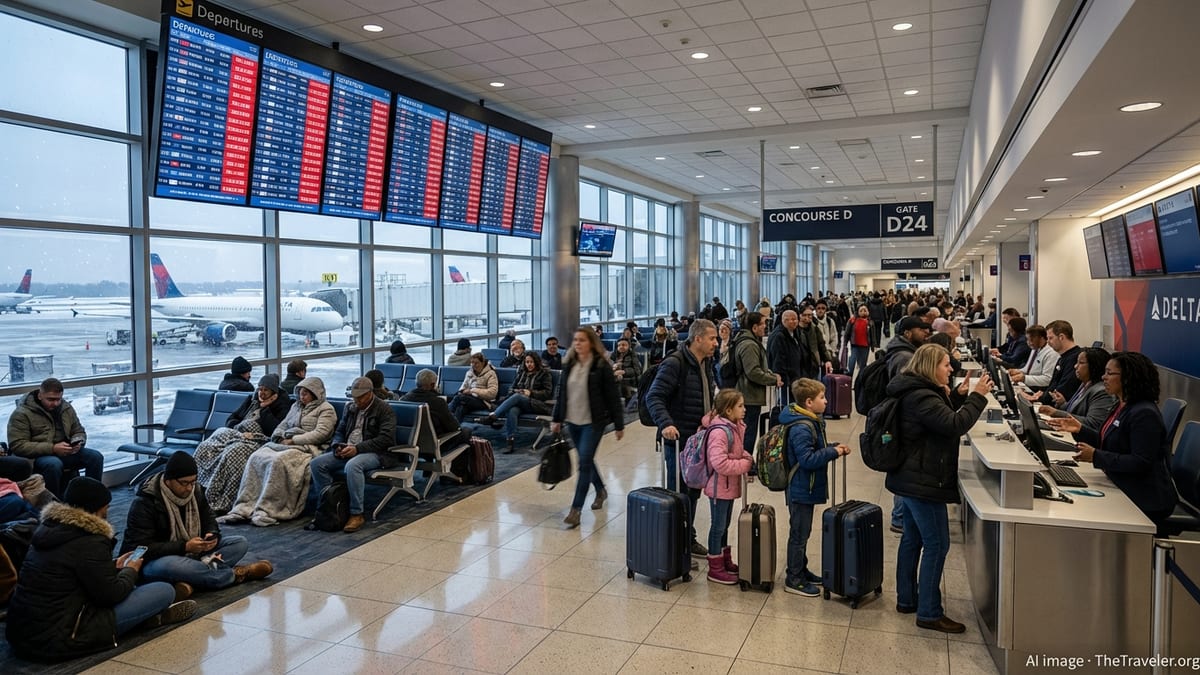
Weather Disruptions and the Limits of Protection in the United States
In the United States, federal rules draw a clear line between flight disruptions within an airline’s control and those caused by external factors such as severe weather or air traffic restrictions. Publicly available guidance from the U.S. Department of Transportation (DOT) states that when a flight is cancelled or significantly changed for any reason, including bad weather, passengers are entitled to a refund if they choose not to travel and the airline cannot or will not rebook them on an acceptable alternative. This applies to unused tickets and to unused portions of partially completed trips, and covers both domestic and international itineraries operated by U.S. carriers.
Beyond refunds, however, there is no federal requirement that airlines provide meals, hotel rooms or other expense reimbursement when delays or cancellations are attributed to weather. DOT materials and rulemaking documents note that most U.S. carriers treat weather as outside their control and exclude weather-related disruptions from hotel and meal obligations that may apply in more routine, “controllable” delays. In practice, that means stranded passengers during a storm often rely on each carrier’s voluntary customer-service commitments, which may include travel credits or hotel vouchers but are not guaranteed in law.
DOT has signaled a shift in this area. A rulemaking effort launched in 2024 focuses on mandatory minimum standards of treatment for controllable delays and cancellations, such as ensured meals, rebooking and accommodation. Yet the proposals, as described in federal agenda documents, continue to distinguish controllable disruptions from those caused by weather. For now, passengers facing bad-weather cancellations in the United States can count on a refund if they do not travel, but must consult individual airline policies for any additional assistance.
EU: Strong Rights, but Weather Often Counts as “Extraordinary Circumstances”
By contrast, European Union rules provide some of the world’s most robust air passenger protections, but they also explicitly treat many weather events as “extraordinary circumstances.” Under Regulation (EC) No 261/2004, travelers whose flights are cancelled or experience long delays generally have rights to re-routing or a refund, as well as care in the form of meals, refreshments and hotel accommodation where necessary. These protections apply to flights departing from any EU airport on any carrier and to flights into the EU on EU and certain other European airlines.
Compensation for inconvenience is handled differently. The regulation creates fixed cash amounts when cancellations or long delays are within the airline’s responsibility. However, interpretative guidelines from EU institutions clarify that meteorological conditions incompatible with safe flight operations are typically considered extraordinary circumstances. In those cases, airlines remain obliged to provide care and offer re-routing or a refund, but they may be exempt from paying the additional financial compensation if they can show that the disruption could not have been avoided even with all reasonable measures.
Recent EU discussions on revising passenger-rights legislation aim to make these boundaries clearer. Draft materials published by EU bodies outline a non-exhaustive list of extraordinary circumstances, which includes certain extreme weather scenarios and airport capacity restrictions triggered by storms. Airlines, enforcement bodies and courts are expected to apply this list case by case, but the underlying principle remains: severe weather usually preserves rights to care and re-routing, while limiting automatic cash compensation.
Canada’s APPR: Evolving Rules for Weather-Related Delays
Canada’s Air Passenger Protection Regulations (APPR) establish a three-part framework that distinguishes disruptions within the airline’s control, those within its control but required for safety, and those outside its control. According to official guidance from the Canadian Transportation Agency (CTA), bad weather, security incidents and similar external events fall into the “outside the airline’s control” category. For these events, airlines must provide certain standards of treatment and rebooking, but they are not generally required to pay monetary compensation for inconvenience.
For cancellations or long delays outside an airline’s control, the APPR requires carriers to ensure passengers complete their itinerary as soon as possible. Published summaries from the CTA indicate that airlines must rebook affected travelers on their own services or those of partners within a set time window, and may be required to turn to competing airlines if they cannot meet that standard. Passengers can also opt for a refund in cases where rebooking does not meet regulatory timelines or where travel no longer serves its purpose, though the specifics may depend on whether the passenger has already accepted an alternative flight.
Canada is in the midst of tightening these rules. Government briefing documents highlight legislative changes intended to strengthen the presumption that passengers are owed compensation and to streamline complaints before the CTA. Transport Canada materials indicate that regulators are revisiting the APPR to close gaps laid bare during recent disruption-heavy travel seasons, including the treatment of events characterized as outside the airline’s control. For now, however, travelers facing storms in Canadian airspace can expect rebooking and care obligations rather than guaranteed cash payments.
How Travelers Can Navigate a Patchwork of Weather Rules
Across jurisdictions, one common thread emerges: bad weather rarely triggers cash compensation by itself, but it almost always preserves a core right to choose between completing the trip later or securing a refund. In the United States, this right to a refund after a cancellation or significant schedule change is the central federal protection. In the European Union and Canada, laws likewise ensure that passengers can either be re-routed at the earliest opportunity or receive their money back when their original flight cannot operate as planned.
The differences matter most when it comes to what happens beyond the ticket price. In Europe, even when weather counts as an extraordinary circumstance, airlines must generally provide meals, refreshments and, if necessary, hotel stays while passengers wait for their new flight. Canadian rules also prescribe standards of treatment, with details varying according to airline size and the degree of control over the disruption. In the United States, similar assistance is often a matter of airline policy rather than a legal guarantee, and weather-related incidents are frequently excluded from contractual promises of hotels or meals.
Consumer advocates point to this divergence as a key reason for travelers to familiarize themselves with the rules of the region they are flying in. Official portals in the U.S., European Union and Canada all maintain public-facing guides that outline when refunds are mandatory, how rebooking should work and how to file complaints when carriers do not follow through. For passengers stranded by storms at major hubs, those pages, alongside airline contracts of carriage, have become essential reading in understanding what support they can demand and what remains at the airline’s discretion.
As climate-related disruptions become more frequent, regulatory agencies on both sides of the Atlantic are reassessing how far protections should go. Current proposals in North America focus on codifying minimum standards of treatment for controllable disruptions while largely keeping weather in a separate category. European institutions are refining the definition of extraordinary circumstances without abandoning the principle that safety-critical weather events fall outside the compensation regime. For travelers, the immediate takeaway is practical: bad weather may not yield a payout, but it does not erase basic rights to a refund, re-routing and, in many cases, assistance while waiting.
Key Official Resources for Travelers
Several official resources provide detailed, jurisdiction-specific explanations of passenger rights when weather affects air travel. In the United States, the Department of Transportation’s refund guidance explains when passengers are entitled to get their money back after cancellations or significant schedule changes, regardless of cause. In Europe, institutional portals summarize the scope of Regulation (EC) No 261/2004, including when airlines must provide care and when extraordinary circumstances, such as severe meteorological conditions, limit compensation. In Canada, the CTA’s guide to flight delays and cancellations, along with the full text of the APPR, outlines rebooking duties and standards of treatment in situations beyond an airline’s control.
These documents also describe how to escalate complaints. Travelers can typically start with an airline’s customer relations department, then turn to national enforcement bodies or dedicated tribunals if they believe legal obligations have been ignored. While processes differ, regulators in all three regions collect data from complaints, which in turn informs ongoing debates over whether current weather-related rules strike the intended balance between airline viability and passenger protection.
For passengers weighing whether to travel during a storm-prone season, these public sources provide more than fine print. They sketch an emerging global standard in which safety remains paramount and weather is treated as largely outside airline control, but where the right to a refund or re-routing is increasingly seen as a baseline guarantee rather than a privilege granted at a carrier’s discretion.
U.S. Department of Transportation: Refunds
European Union: Air passenger rights
Canadian Transportation Agency: Flight delays and cancellations