


For many travelers, Ganja is little more than a name on a map: a historical city in western Azerbaijan, famous for a medieval poet and a few old monuments. But visitors who actually make the detour west from Baku discover a place that feels surprisingly creative, green and lived in. Beyond its historical reputation, Ganja is a city of lakes and vineyards, of family-owned teahouses and bustling parks, where everyday life is as compelling as any museum.
Get the latest updates straight to your inbox!
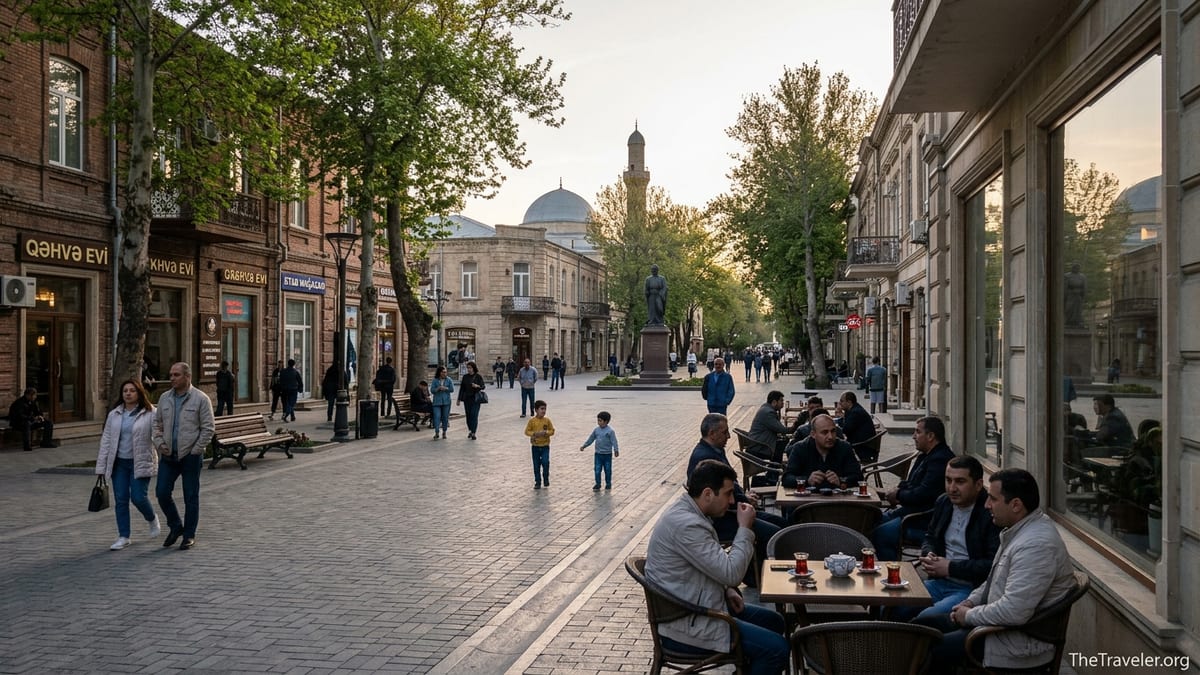
Ganja’s Relaxed, Lived-In Atmosphere
What strikes most travelers first is that Ganja feels like a real city rather than a polished open-air museum. This is Azerbaijan’s second largest city, but its center is compact, walkable and human in scale. Around Khanlar Square and the pedestrian streets nearby, you see students from Ganja State University mixing with families pushing strollers and elderly men in flat caps arguing over backgammon boards. Cafes set out simple plastic tables alongside more stylish espresso bars, and the soundtrack is more likely to be local pop from a phone speaker than curated lounge playlists.
Prices reflect this everyday character. A hearty plate of kebab or qutab with salad in a small neighborhood café can cost the equivalent of just a few US dollars, and a glass of Azerbaijani tea often comes automatically with lemon and jam. Travelers who have spent time in Baku frequently remark how much more relaxed Ganja feels: traffic is lighter, the skyline lower, and you can cross the central squares without needing to dodge tour groups.
Even in peak summer, when domestic visitors arrive from Baku and the Caspian coast, Ganja rarely feels overwhelmed. Hotels range from simple guesthouses run by local families to a handful of mid-range business hotels, but you will not find international chains dominating the skyline. For many visitors, that is part of the charm: your morning might start with a homemade breakfast of fresh tomatoes, bread and local cheese, served by a host eager to point out the best bakery or park.
The result is a destination that rewards unhurried exploration. You can spend a day simply wandering from the central boulevard to side streets, ducking into teahouses and small bakeries, watching life unfold at a pace that feels distinctly different from the capital on the coast.
Living History: From Nizami to Brick Houses and Blue-Tiled Shrines
Ganja’s reputation is rooted in its past, especially the legacy of the 12th-century poet Nizami Ganjavi. Just outside the city, his mausoleum rises as a tall column of stone surrounded by manicured gardens and sculptural panels depicting scenes from his epic poems. Travelers typically reach it by short taxi ride from the center or by local bus, joining local families who come to stroll, pay respects or simply enjoy the leafy grounds.
In the city itself, Nizami’s name appears everywhere: on streets, schools and cultural centers. Yet what impresses many visitors is how this history is integrated rather than isolated. A traveler might visit the small memorial house museum dedicated to Nizami in a residential neighborhood, then turn a corner to find children playing football or a greengrocer stacking crates of pomegranates. The city’s past lives side by side with ordinary routines.
Other historical landmarks echo this sense of continuity. The 17th-century Shah Abbas Mosque anchors one of the main squares with its brick façade and distinctive domes. On Friday afternoons you may see worshippers streaming in, while tourists linger in the courtyard to admire the calligraphy and brickwork. A short walk away, the Chokek Hammam, an old bathhouse, hints at Ganja’s former role as a regional trading and cultural hub.
Perhaps the most unexpected historical site is the Imamzade complex at the city’s edge, a shrine with vivid blue-tiled domes and an intricately decorated courtyard. Many visitors arrive in the late afternoon when the light catches the tiles and families gather in the gardens. The complex is still an important pilgrimage site, so travelers often comment on how moving it is to see faith practiced in such a beautiful setting rather than preserved behind ropes and panels.
Nature on the Doorstep: Lakes, Forests and Mountain Air
Ask travelers what surprised them most about Ganja and many will mention how easy it is to escape into nature. Less than an hour’s drive to the south, Goygol National Park wraps around deep-blue Lake Goygol in the foothills of the Lesser Caucasus. Day trips are straightforward: shared taxis and organized tours leave from Ganja, and independent travelers can often negotiate a round-trip fare with a local driver for a modest fee relative to European standards.
The lake itself, created centuries ago by a powerful earthquake, is framed by dense forests and mountain ridges. Visitors walk along marked paths that hug the shoreline, pausing at viewpoints and wooden platforms. Simple snack stands near the entrance sell tea in glass cups, grilled corn and local fruits in season, from cherries in late spring to apples in autumn. In summer, local families set up picnics under the trees, and travelers are often invited to join for bread, cheese and stories about life in the region.
More active visitors use Ganja as a base for hiking in the surrounding hills. From Goygol, rough tracks and trails branch off toward higher viewpoints and smaller lakes. One popular extension, Maral Gol, typically involves a short minibus ride or hike from the main lake area followed by a climb through forest to a more secluded alpine lake. Conditions can change with weather, so many travelers choose to go with local guides who know the trails and can arrange simple picnic lunches of lavash bread, herbs and grilled meat.
Even without leaving the city limits, green space plays a central role in Ganja’s appeal. Urban parks with mature trees and wide paths provide shade in the hot months, and evening strolls are a daily ritual. Benches fill with couples and families, and small vendors push carts with ice cream or sunflower seeds. For travelers coming from cities with limited public space, the amount of greenery and the way residents use it can be a memorable part of the visit.
Cafés, Wine and the Slow Pleasures of Western Azerbaijan
Beyond its monuments, Ganja offers a quietly developing food and drink scene rooted in local products. Western Azerbaijan has long been associated with viticulture, and wineries in the region around Ganja and nearby cities produce both table wines and more ambitious vintages. While options are more limited than in established wine regions of Europe, travelers increasingly report tastings at small cellars or restaurants that highlight regional labels along with international classics.
In the city center, modern cafés sit alongside older, Soviet-era teahouses. A typical day of grazing might start with strong Azerbaijani coffee or a cappuccino in a contemporary café with large windows and minimal design, followed by lunch at a canteen-style spot where workers and students line up for plates of stewed vegetables, pilaf and grilled meat. Later, you might settle into a chaykhana, a traditional teahouse, where tea is served from a samovar with sugar cubes and local sweets like pakhlava.
The prices encourage lingering. A pastry and tea can cost less than a ride on an intercity bus, and even mid-range restaurants remain affordable by Western European standards. Travelers often comment that they are able to try multiple places in a single day without worrying about the bill, sampling everything from rich piti stew to lighter dishes built around fresh herbs and vegetables.
For those interested in nightlife, Ganja’s offer is understated but growing. A few lounges and bars play live music on weekends, and some modern restaurants turn up the volume after dinner, but this remains a city where evenings are more about conversation than clubbing. Many visitors find themselves sitting on park benches with a takeaway coffee late into the night, watching as the city gradually quiets around them.
Creative City: Street Art, Youth Culture and Everyday Crafts
Travelers often arrive in Ganja expecting only ancient poetry and religious architecture, then are surprised to find a creative, youthful energy in the streets. In certain neighborhoods, faded apartment blocks are brightened by murals and small pieces of street art. While the scale is modest compared to major European cities, it signals a growing youth culture that uses walls and courtyards as informal galleries.
Local universities and cultural centers regularly host small exhibitions, theater performances and concerts that are open to the public, often at very low ticket prices. A traveler might stumble into a student art show in a civic hall one afternoon, then find a classical music performance at the Ganja State Philharmonic in the evening. These events rarely appear in English-language listings, so curious visitors often rely on hotel staff, café noticeboards or simple conversations to find out what is happening that week.
Craft traditions provide another creative thread. In and around the central markets, small workshops sell handwoven textiles, copper items and woodwork. Some travelers describe browsing stalls for embroidered tablecloths or small copper cups to take home, bargaining gently in a mix of English, Russian and gestures. The atmosphere is generally relaxed rather than aggressive, and vendors often offer tea while explaining how items are made.
There are also small but growing initiatives that blend tradition and modern tastes. A young designer might sell tote bags printed with Nizami quotes at a café counter, while a local ceramics studio offers short workshops where visitors can try shaping clay. These experiences are rarely polished enough to be called “tourist products” in the formal sense, but that informality is precisely what many travelers appreciate.
Everyday Encounters and Warm Hospitality
Beyond scenery and sights, what many visitors remember most about Ganja are the small human moments. A shopkeeper who refuses payment for an extra bottle of water, a bus driver who calls a relative to help translate, a family who insists you taste their homemade jam in the park. These gestures are common across much of Azerbaijan, but in a city with fewer foreign visitors they can feel particularly spontaneous.
Language can be a hurdle, as English is less widely spoken in Ganja than in Baku. However, travelers often find that a few words of Azerbaijani or Russian, combined with patience and humor, go a long way. Restaurant staff may bring out menus on their phones with machine translations, and younger locals are often eager to practice their English. The process of ordering a simple meal or arranging a taxi can become a shared puzzle rather than a transaction.
Public transport and local services add flavor to the experience. Short rides on city buses are inexpensive, and routes to major sights like the Nizami Mausoleum or the Imamzade complex are used by locals every day. For intercity travel, many visitors arrive in Ganja by train or bus from Baku or Tbilisi, sharing compartments or minibuses with families carrying bags of produce, luggage and gifts. These journeys provide a window into daily mobility in western Azerbaijan.
Safety and comfort levels are generally described as good by recent visitors. Solo travelers, including women, often report feeling at ease walking in central areas after dark, especially along well-lit boulevards and around the main squares. As in any city, normal precautions apply, but Ganja’s atmosphere is more small-city convivial than big-city edgy, which boosts its appeal to those seeking calmer urban experiences.
The Takeaway
Ganja’s historical reputation is deserved. The legacy of Nizami, the brick mosques and blue-tiled shrines, and the echoes of caravan routes give the city a depth that appeals to history enthusiasts. Yet what modern travelers love most about Ganja lies beyond that past: the easy access to forests and lakes, the slowly evolving café and wine scene, the everyday creativity in its markets and murals, and above all, the ordinary kindness that shapes each day.
This is not a city built around sightseeing checklists or themed districts. Instead, it offers a kind of travel that unfolds through small discoveries: a view of the mountains from a city park bench, a shared taxi ride to a lakeside trail, a conversation over tea in a family-run guesthouse. For visitors willing to slow down and look past Ganja’s historical label, the reward is a destination that feels authentic, approachable and quietly memorable.
FAQ
Q1. Where is Ganja and how do travelers usually get there?
Ganja is in western Azerbaijan, roughly halfway between Baku and Tbilisi. Most travelers arrive by domestic flight from Baku, intercity bus or train, or by road as part of a wider Caucasus itinerary.
Q2. How many days do travelers typically spend in Ganja?
Many visitors find that two full days in Ganja works well, allowing time to explore the city and take a day trip to nearby nature areas like Goygol National Park.
Q3. Is Ganja safe for solo travelers, including women?
Recent traveler reports describe Ganja as generally safe and relaxed. Solo travelers, including women, often feel comfortable walking in central areas with standard big-city precautions.
Q4. What is the best time of year to visit Ganja?
Spring and autumn are usually the most pleasant, with mild temperatures and clear views around the lakes and mountains. Summer can be hot in the city but is popular for lake trips.
Q5. Do people in Ganja speak English?
English is not as common as in Baku, but younger residents and some hotel and café staff speak at least basic English. Many travelers get by with simple phrases, translation apps and gestures.
Q6. How much should I budget for food and local transport?
Costs are relatively low by Western standards. Simple meals in local cafés are inexpensive, and city buses and shared taxis within Ganja are typically very affordable.
Q7. What should I wear when visiting religious sites in Ganja?
Modest clothing is recommended. At mosques and shrines, visitors should cover shoulders and knees; women may be asked to cover their hair with a scarf.
Q8. Can Ganja be visited as a day trip from Baku?
It is technically possible but not ideal. Travel times make a same-day return rushed, so most travelers prefer at least one night in Ganja to enjoy the city and nearby nature.
Q9. Are there guided tours available to places like Lake Goygol?
Yes, local agencies and some hotels can arrange guided tours or private drivers to Goygol National Park and surrounding areas, often including brief hikes and photo stops.
Q10. What makes Ganja different from Baku for visitors?
Ganja feels more compact, local and low-key than Baku. It offers fewer big-city attractions but more of a relaxed, everyday atmosphere and quick access to forests and lakes.