


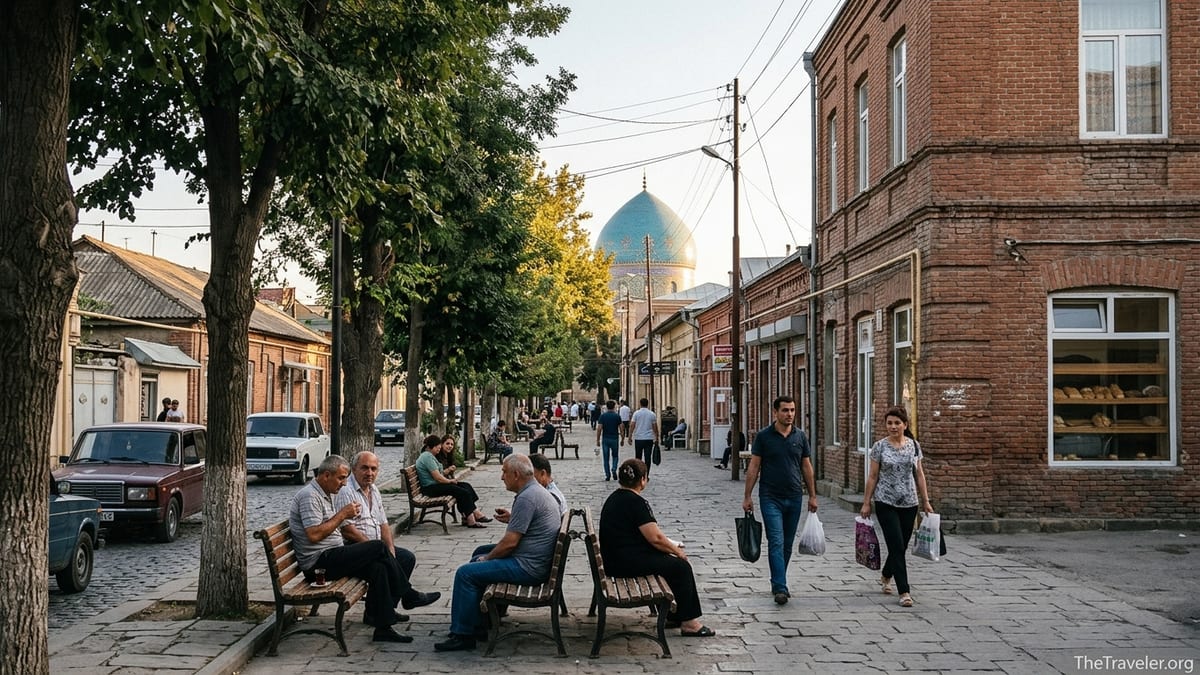
For many visitors, Azerbaijan begins and ends in Baku: a glittering Caspian capital of mirror-glass towers and manicured boulevards. Yet travelers who venture a few hours west discover a very different Azerbaijan in Ganja, the country’s historic second city. Red-brick streets, family-run teahouses, student-filled parks, and centuries-old shrines create a quieter, more local rhythm that feels a world away from the capital’s high-rise skyline.
Get the latest updates straight to your inbox!
Ganja: Azerbaijan’s Historic Second City With a Local Pulse
Ganja is one of the oldest cities in Azerbaijan, with roots stretching back many centuries and a long history as a regional political and cultural center. Today it is the country’s second-largest city by population, but it does not feel like a busy metropolis. Instead, low-rise brick buildings, tree-lined streets and compact neighborhoods give Ganja the scale of a walkable provincial town. You can cross the central districts on foot in under half an hour, passing corner bakeries, Soviet-era apartment blocks and small workshops that still shape daily life for residents.
For travelers used to Baku’s polished waterfront and heavy traffic, arriving in Ganja can feel like stepping behind the scenes. The pace is slower, English is less widely spoken and international brands are few. You are more likely to find a local grocery selling fresh herbs and homemade pickles than a global coffee chain. That difference is exactly what appeals to independent travelers who want to sense how Azerbaijanis live beyond the capital, from their weekend rituals in city parks to the way families gather in local tea gardens after work.
Ganja’s location in the foothills of the Lesser Caucasus also shapes the city’s character. The air is cooler than on the Caspian coast, and in the evenings locals stroll along leafy avenues leading toward the hills. Just south of the city, villages and forests give way to mountain roads and small resorts. Within an hour’s drive you can reach natural lakes, old German-influenced settlements and spa towns, all of which are part of the extended “Ganja experience” that regional travelers talk about when they recommend the city.
Despite this rich setting, Ganja still receives a fraction of the visitors who flock to Baku or well-known mountain towns like Gabala and Sheki. Many travelers encounter it only as a name on a train timetable. Those who choose to stop find a city where tourism infrastructure exists but has not yet reshaped daily life. Instead of busloads of tour groups, you are more likely to share a museum or shrine with families from neighboring regions, and perhaps be invited for tea by a curious local keen to practice a few words of English or Russian.
Getting to Ganja: The Scenic Step Beyond Baku
Reaching Ganja from Baku has become easier in recent years, and the journey itself helps travelers understand just how different Azerbaijan’s regions can be. Intercity trains link the two cities in roughly four to six hours, depending on the service, crossing plains and agricultural land before climbing gently toward the west. Typical one-way fares on regular trains start at the equivalent of roughly 6 to 15 US dollars, making rail travel an affordable option even for budget travelers. Trains are generally clean and reserved seating means you can relax with tea and snacks as the countryside rolls by.
Those short on time often choose intercity buses or shared taxis, which cover the 300-kilometer route in about four to five hours, depending on traffic. Shared taxis from Baku’s main bus terminal tend to be slightly faster and may cost a bit more than the bus, but they appeal to travelers who prefer flexible departure times and fewer intermediate stops. It is common to negotiate a per-seat price in Azerbaijani manats before departure; drivers often gather passengers heading in the same direction and depart once the car is full.
Once in Ganja, many travelers are surprised to discover that the city is emerging as a hub for exploring western Azerbaijan. A new rail connection now links Ganja with the mountain resort town of Gabala, using modern trains built by a Swiss manufacturer and covering the distance in under two hours. This allows visitors to base themselves in Ganja for a few days and make day trips into the mountains without relying solely on road transport. Regional buses and minibuses from the local bus station connect Ganja with Naftalan, Goygol and smaller towns, making it straightforward to combine city life with countryside escapes.
Transport prices within the city remain modest by European standards. Local buses and marshrutkas usually cost the rough equivalent of a few dozen US cents per ride, and ride-hailing apps like Bolt tend to be cheaper and more transparent than hailing a taxi on the street. Because distances are short, many visitors end up walking most of the time, using taxis only at night or when heading to outlying sights such as the Imamzadeh complex or the nearby lake district.
Old Streets, Brick Facades and Everyday Life
One of the first things travelers notice in Ganja is that much of the center is built from warm red brick rather than stone or glass. This gives the city a distinctive visual identity in Azerbaijan and immediately contrasts with Baku’s mix of ornate limestone facades and futuristic towers. Residential streets near the center feature low houses with small gardens, age-worn wooden doors and grapevines trained over simple metal frames. Walking these streets in late afternoon, when neighbors chat by front gates and children play in alleys, offers as much insight into local life as any formal attraction.
In the heart of the city, the main square and surrounding avenues host a mix of Soviet-era civic buildings, fountains and modest shopping streets where tailors, cobblers and phone repair kiosks still do steady business. Roadside stalls sell seasonal fruit from nearby villages: pomegranates in autumn, cherries and mulberries in early summer, and stacked watermelons in high season. It is common to pay just a few manats for a kilogram of fresh produce, especially if you are willing to buy from older vendors standing behind rough wooden tables rather than inside polished supermarkets.
Ganja is also known for a quirky piece of vernacular architecture that has become one of its most photographed landmarks: the Bottle House, a two-story home decorated with thousands of colored glass bottles. Originally built in the Soviet period, the facade incorporates glass fragments arranged into patterns and inscriptions, including the city’s name. Visitors often combine a stop here with a stroll through the surrounding neighborhood, where ordinary residents hang laundry on balconies and call children up from the street at dusk. The mix of an unusual tourist sight embedded in a very normal residential setting captures the way Ganja folds curiosity into routine life.
Because there are relatively few foreign visitors, Ganja residents tend to notice newcomers. Travelers frequently describe chance encounters that lead to offers of help, directions or even tea in a nearby cafe. In practice, this means that walking without headphones, using a few basic phrases in Azerbaijani or Russian, and being open to conversation can quickly turn a simple errand into an unexpected cultural exchange. For those seeking a “local” side of Azerbaijan, it is often these unscripted interactions on ordinary streets that leave the strongest impressions.
Tea Gardens, Markets and Everyday Food Culture
Food and drink in Ganja are less influenced by international trends than in Baku, which makes everyday eating a revealing window into local habits. Around the central streets and parks, small canteens and family-run cafes serve filling plates of plov, kebabs, stewed beans and fresh salads at prices that remain accessible for domestic travelers. A simple meal of grilled meat, lavash bread, pickles and tea might cost the equivalent of 5 to 10 US dollars for two people, depending on the setting. Portions tend to be generous, and it is common to linger over tea long after plates have been cleared.
Tea culture remains strong across Azerbaijan, and Ganja is no exception. In the evenings, you will see men of all ages gathering in chaikhanas, traditional teahouses where small tulip-shaped glasses of black tea are served on trays alongside sugar cubes and slices of lemon or jam. Many of these teahouses are tucked into courtyards or down side streets off the main squares, their interiors furnished with simple wooden tables and sometimes television sets broadcasting football matches. Women and mixed groups also frequent cafes and modern tea rooms, especially near popular parks and shopping streets.
One popular local ritual is to buy sweets or pastries from neighborhood bakeries and bring them to a nearby park or tea garden. Ganja has several well-kept green spaces where families spread out on benches and low walls with paper bags of fresh baked goods. The most famous is Khan Baghi, a riverside park that once formed part of a historic palace garden. Today it functions as a public escape from the city’s traffic, with walking paths, shady trees and food kiosks that stay open into the evening. Watching couples stroll, grandparents push prams and teenagers cluster around mobile phones here offers a concentrated glimpse of daily social life in the city.
Markets and small grocery shops add another layer to Ganja’s local flavor. Open-air stalls and covered markets stock regional specialties such as local cheeses, dried fruits and homemade pickles in glass jars. Many vendors travel in from surrounding villages to sell produce raised on small family plots. Visitors who make the effort to shop in these markets, even for something as simple as walnuts or herbs, often find themselves drawn into short conversations about where the goods come from and how they are used in traditional dishes like piti, a slow-cooked meat and chickpea stew.
Sacred Sites and Living Traditions
Spiritual life plays a visible role in Ganja’s identity, and several religious sites draw both pilgrims and ordinary residents. The most important is the Imamzadeh complex, located a short drive north of the city. This large religious and architectural ensemble centers around a mausoleum believed to house the grave of a descendant of an early Shia imam. Over the centuries, the complex has grown to include domed structures, mosques, graves and courtyards, many of them restored in recent years. The central dome, tiled in shades of blue, rises above gardens where visitors walk slowly, pray or sit quietly under the trees.
For travelers, a trip to the Imamzadeh complex offers far more than historical architecture. It is one of the best places in western Azerbaijan to observe living religious traditions in a largely non-touristic setting. On weekends and religious holidays, families arrive from nearby towns with children and elders, carrying bags of fruit and sweets. Some light candles or leave small offerings near particular graves, while others simply stroll the grounds, take photos and share simple meals at picnic tables. Modest dress and respectful behavior are expected, but visitors are generally welcome, and staff or fellow pilgrims may offer basic explanations if they see foreigners looking curious but uncertain.
Back in central Ganja, several older mosques and religious buildings are woven into the urban fabric. Some date back several centuries, while others reflect the architectural styles of the 19th and early 20th centuries. Travelers who pass at prayer times can hear the call rising over nearby streets, mingling with car horns and the chatter of pedestrians. Even those who choose not to enter religious buildings often sense how these spaces anchor neighborhoods and shape the rhythms of daily life.
Another historical site that helps visitors understand Ganja’s past is the Chokek Hamam, a traditional bathhouse built centuries ago and now protected as a cultural monument. While some historical baths in the region have been revived as commercial spas, Chokek Hamam is primarily valued today for its architecture and heritage. Standing outside its brick domes and small windows, it is easy to imagine the role such bathhouses once played as social and hygienic hubs, where residents gathered to bathe, gossip and mark life events in a society long before modern plumbing.
From Student City to Gateway for Nature and Wine
Ganja’s atmosphere is strongly influenced by its youth. The city hosts universities and colleges that draw students from across western Azerbaijan, and their presence is felt in the cafes, bookshops and budget eateries that cluster near campuses and central parks. On warm evenings, these areas fill with groups of friends sharing hookah or ice cream, laughing over music playing softly from phones and debating where to continue the night. Compared to Baku’s polished rooftop bars, the scene here feels simpler and more grounded, but no less energetic.
For many travelers, however, the real appeal of Ganja lies in what surrounds it. To the south, the Goygol region is home to one of Azerbaijan’s most scenic lakes and a string of villages with historic German connections. During the 19th century, settlers from what is now Germany established communities here, leaving behind timbered houses and a winemaking tradition that still influences the area. Today, vineyards and wineries around Goygol and nearby settlements welcome visitors for tastings and tours, giving travelers a chance to sample local wines that rarely make it to international markets.
Several regional tour operators in Ganja offer day trips that combine a visit to Lake Goygol with stops at wineries or village guesthouses for lunch. Prices vary by season and the level of comfort, but small-group excursions often cost the equivalent of 30 to 60 US dollars per person, including transport. Independent travelers can also reach the area by taxi or regional bus and then coordinate directly with wineries or local guides. Sitting in a simple tasting room with views of the hills, sipping a glass of dry white or semi-sweet red while listening to stories about how the local wine industry evolved, many visitors sense they have reached a part of Azerbaijan rarely seen in international advertising campaigns.
To the east, improved rail connections now link Ganja with Gabala, a mountain resort town known for its ski slopes, cable cars and forested hills. Travelers can ride a modern train through the countryside in under two hours, then spend the day hiking, visiting a rope park or simply enjoying cooler air and mountain views before returning to Ganja in the evening. This makes it possible to combine urban and outdoor experiences without committing to a full itinerary change, a flexibility that appeals to travelers who prefer to travel slowly but still want occasional bursts of adventure.
Staying in Ganja: Accommodation and Practicalities
Despite its size, Ganja’s hotel scene remains relatively modest, with a mix of mid-range business hotels, smaller family-run properties and a handful of higher-category options aimed at domestic conferences and events. Prices fluctuate with demand, but travelers can often find comfortable double rooms in central locations for the equivalent of 30 to 70 US dollars per night, including breakfast. These properties typically offer basic amenities such as Wi-Fi, air conditioning and on-site cafes, though service levels and English proficiency may vary.
Guests who prefer more intimate stays sometimes opt for guesthouses or small boutique-style hotels housed in older buildings. These are often family-run, with hosts who are eager to help arrange taxis, make restaurant recommendations or even accompany guests to local markets. Because foreign visitors remain relatively rare, hosts may be especially curious and attentive, which some travelers appreciate and others may find intense. Clear communication about expectations, arrival times and any dietary needs helps avoid misunderstandings and contributes to warmer interactions on both sides.
In terms of safety, Ganja is generally perceived as calm, particularly in central areas. Normal big-city precautions apply, such as keeping valuables secure and avoiding poorly lit streets late at night, but violent crime involving tourists is rare. As in many parts of Azerbaijan, traffic can be more of a practical concern than security; pedestrians should cross main roads carefully and assume that cars may not always slow for crosswalks. Solo travelers, including women, commonly report feeling comfortable walking in busy areas, especially around parks and central boulevards in the early evening when families are out.
Language can present more of a challenge in Ganja than in Baku, where English has become more common in customer-facing roles. In Ganja, Azerbaijani is dominant and older residents often speak Russian as a second language. Younger people are increasingly studying English, but fluency varies. Travelers who learn a few simple Azerbaijani phrases for greetings, thanks and basic requests often find that this small effort softens interactions and sparks smiles. Translating key addresses into the local script on your phone or a paper note is also useful for taxis and guesthouses that may not be accustomed to frequent foreign visitors.
The Takeaway
Ganja appeals to travelers looking for a more local side of Azerbaijan precisely because it is not yet a polished tourist product. Its charms lie in red-brick streets where neighbors chat at garden gates, in teahouses where elderly men debate the news over glasses of black tea, and in parks where families gather at dusk while teenagers scroll through their phones. The city’s sacred sites and historical landmarks add depth, but they are woven into a living urban fabric rather than standing apart as secluded museums.
From a practical standpoint, Ganja offers just enough infrastructure to make independent travel comfortable while still requiring curiosity, patience and a willingness to adapt. Trains and buses connect it easily to Baku and nearby mountain regions; modestly priced hotels and guesthouses provide straightforward bases; and food remains affordable, abundant and rooted in regional traditions. At the same time, the relatively low number of foreign visitors means that interactions tend to be unmediated and unscripted, shaped by genuine interest rather than rehearsed hospitality.
For travelers who want more from Azerbaijan than a whirlwind tour of Baku’s landmarks, Ganja and its surrounding countryside present an appealing alternative. A few days here allow time to absorb local rhythms, visit places that matter deeply to residents, and explore nearby lakes, vineyards and mountain towns without rushing. The city might not yet feature prominently in global travel campaigns, but that is exactly why those searching for a more authentic, everyday Azerbaijan are increasingly circling Ganja on the map.
FAQ
Q1. How many days should I spend in Ganja to get a good feel for the city? Most travelers find that two to three full days in Ganja allows enough time to explore the city center, visit the Imamzadeh complex and fit in a half-day trip to nearby nature or a winery, without feeling rushed.
Q2. Is Ganja safe for solo travelers, including solo women? Central Ganja is generally calm and feels safe for solo travelers who follow normal urban precautions, such as staying in well-lit areas at night and using reputable taxis or ride-hailing apps for late journeys.
Q3. Can I visit Ganja as a day trip from Baku? It is technically possible by taking early morning and late evening trains, but most visitors prefer to stay at least one night so they can explore at a relaxed pace and experience the city in the evening.
Q4. Do people in Ganja speak English? English is becoming more common among younger residents and in some hotels, but Azerbaijani is dominant and Russian is widely understood, so learning a few local phrases or using translation apps is helpful.
Q5. What is the best way to get around Ganja without a car? The center is compact enough to explore on foot, supplemented by inexpensive local buses, marshrutkas and ride-hailing services for longer trips or visits to outlying sights like the Imamzadeh complex.
Q6. Are there good vegetarian or vegan options in Ganja? While menus focus on meat dishes, many eateries serve vegetable-based stews, salads, bread, rice and seasonal produce, so vegetarians can usually find options, though strict vegans will need to communicate their needs clearly.
Q7. When is the best time of year to visit Ganja? Spring and early autumn are ideal, with mild temperatures and pleasant conditions for walking and day trips; summers can be hot, while winters are cooler and quieter but still manageable for city exploration.
Q8. Can I use cards in Ganja, or should I carry cash? Larger hotels and some restaurants accept bank cards, but smaller shops, markets and local transport usually prefer cash in Azerbaijani manats, so carrying a reasonable amount of local currency is advisable.
Q9. Is Ganja a good base for visiting nearby attractions like Goygol and Gabala? Yes, Ganja works well as a base thanks to regional buses, taxis and a newer train connection to Gabala, making it easy to combine city life with day trips into nearby nature and wine country.
Q10. Do I need to join a tour to enjoy Ganja, or can I explore independently? Confident travelers can easily explore Ganja on their own using public transport and taxis, though joining occasional local tours for places like Lake Goygol or wineries can add context and simplify logistics.