


Western Azerbaijan is having a moment. Improved rail links, better bus connections and a growing crop of family-run guesthouses mean more travelers are venturing beyond Baku to explore cities such as Ganja and Sheki. Both promise history, hearty food and a warm welcome, yet they deliver very different kinds of trips. If you only have time for one, deciding between Ganja and Sheki can shape your entire experience of Azerbaijan.
Get the latest updates straight to your inbox!
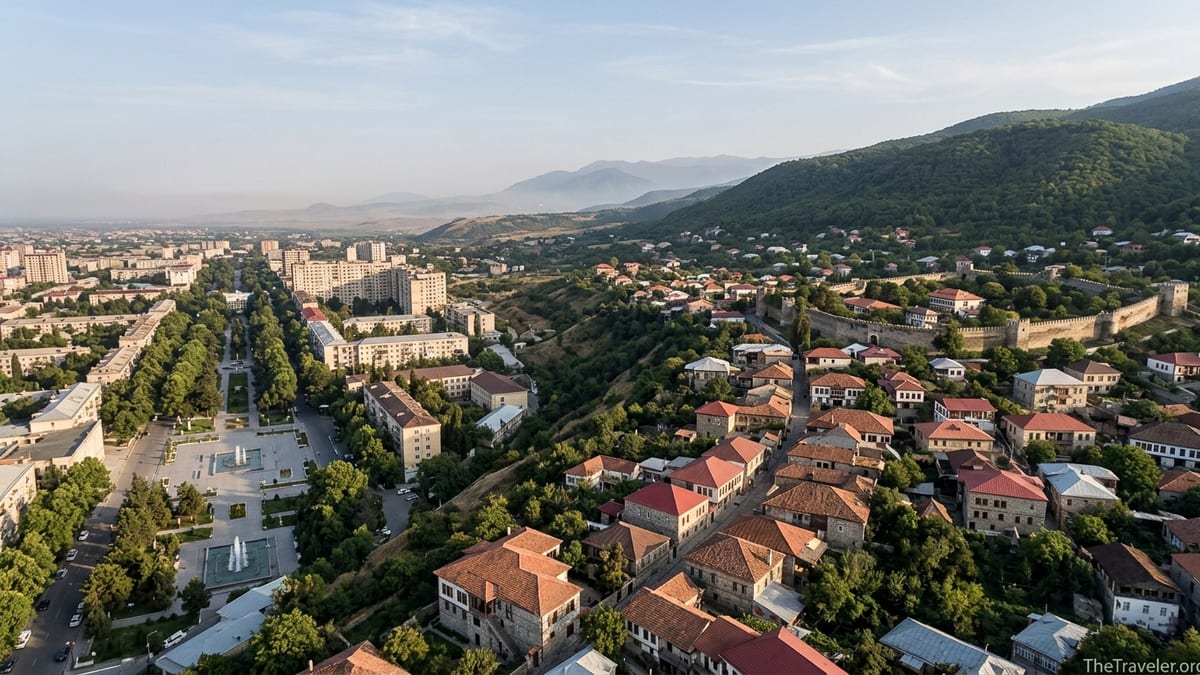
First Impressions: City Vibes vs Mountain Calm
Ganja is Azerbaijan’s second-largest city and feels like it. Arriving at Ganja railway station after the five-hour train ride from Baku, you step into a busy, modern city of broad avenues, Soviet apartment blocks and restored historical quarters. The central Heydar Aliyev Square, with its fountains and municipal buildings, sets an urban tone that will feel familiar to anyone who has traveled in the post-Soviet region.
Sheki, by contrast, is compact and deeply atmospheric. Ringed by the forested foothills of the Greater Caucasus, it feels more like a mountain town than a city. When you step off the bus or night train and drive the last stretch into town, you see red-tiled roofs climbing up the hillsides and stone houses fronted by grapevines. The pace slows noticeably: shopkeepers sit outside drinking tea, and cows still wander side streets on the outskirts.
For travelers who like nightlife, shopping and the sense of being in a “real” working city, Ganja often feels more satisfying. There are modern cafes, malls and a growing craft beer and shisha-bar scene that stays active late into the evening. Those who prize quiet streets, mountain views and a sense of stepping back a century or two usually warm to Sheki immediately.
In practical terms, Ganja works well as a base for people who want some buzz after a day of sightseeing. Sheki is better suited to travelers who value atmosphere over amenities and are happy to trade choice of venues for cobbled lanes and starry, silent nights.
Getting There and Around: Trains, Buses and New Connections
From Baku, both Ganja and Sheki are straightforward to reach, but the experience is different. Ganja is on the main east-west railway. Fast trains cover the roughly 360 kilometers from Baku in about five hours, and there are also frequent intercity buses from the Baku International Bus Terminal. This makes Ganja especially attractive if you like the predictability of rail travel and want to minimize road time.
For Sheki, travelers typically choose between the overnight sleeper train and daytime buses. Recent guides describe a daily night train leaving Baku’s central station close to midnight and arriving at Sheki’s small station before dawn, giving you most of a full day in town after sleeping on board. Buses from the Baku International Bus Terminal also run several times a day and usually take around five to six hours depending on traffic and rest stops. Fares for both routes are generally modest by European standards, which makes either option budget friendly.
There are two nuances that might influence your choice. First, Ganja also has domestic flights from Baku operated by Azerbaijan Airlines in some seasons, so travelers short on time can sometimes fly in just over an hour instead of spending half a day on the road or rails. Second, a new train connection now links Ganja with Gabala, a mountain resort town. This means you can combine a night or two in Ganja with a side trip to Gabala’s cable cars and lakes without needing to negotiate private taxis.
Local transport once you arrive is more straightforward in Ganja. The city has an upgraded bus fleet operating regular routes, and ride-hailing apps are reasonably well represented. In Sheki, there are marshrutka minibuses and plenty of informal taxis, but app-based rides can be patchy late at night and around the train station. In practice, many travelers in Sheki walk between the walled historic center, guesthouses and restaurants, only hiring a taxi for out-of-town sights such as nearby villages or the road toward the Georgian border.
History and Culture: Poets, Palaces and the Silk Road
Historically minded travelers will find rich stories in both cities, but the focus is different. Ganja traces its roots back more than a millennium and is associated with Nizami Ganjavi, the 12th-century poet whose romantic epics are revered across the Persian-speaking world. You can visit the Nizami Mausoleum on the city outskirts, a monumental complex rebuilt in granite and marble, and see statues and murals dedicated to his works around town.
In Ganja’s center, the Juma Mosque, originally built in the 17th century and reconstructed in later periods, and the Chokek Hammam bathhouse evoke the city’s role as a regional commercial hub. A more unusual cultural stop is the Bottle House, a private home decorated with thousands of glass bottles embedded in its façade. The house was built in the mid-20th century by a local craftsman in memory of his brother and has become one of Ganja’s most photographed curiosities.
Sheki’s historical appeal is more concentrated and visually striking. The star attraction is the Palace of the Sheki Khans, an 18th-century summer residence of the local rulers. Set inside the old fortress walls, the palace is celebrated for its stained-glass shebeke windows and intricate interior frescoes. Because the entire historic core, including the palace and caravanserai, is part of a UNESCO World Heritage listing focused on the Silk Road, there is a clear narrative about Sheki as a key waypoint on trade routes between East and West.
Walking through Sheki’s cobbled streets above the fortress, you pass old brick workshops, small mosques and traditional houses with deep balconies. Many have been converted into guesthouses and tea houses, but the scale remains human, and it is easy to imagine caravans passing through. Cultural centers occasionally stage mugham music performances or handicraft demonstrations, so with a bit of planning you can time a visit to coincide with live traditional music in the fortress quarter.
Food, Wine and Nightlife: Where to Eat and Linger After Dark
Azerbaijani cuisine is hearty and generous in both cities, but they shine in different ways. In Ganja, the restaurant scene is broader, ranging from simple canteens near the market to more polished venues popular with local professionals. Expect to find well-executed plov, grilled kebabs and seasonal salads, along with dishes influenced by neighboring Georgia and Turkey. Prices in mid-range places are often lower than in central Baku, so you might pay the equivalent of a modest European lunch for a full multi-course dinner with tea.
Ganja is also quietly developing a café culture. Around the center you will find coffee shops with espresso machines, laptop-friendly tables and local desserts. Some newer venues serve craft beers from microbreweries in Baku or imported labels, while shisha lounges and dessert cafés stay open late, giving the city a sociable evening atmosphere even on weeknights.
Sheki is not as diverse, but it is deeply satisfying for travelers who like food that feels tied to place. The most famous local export is Sheki halva, a layered, syrup-soaked pastry that you buy in slabs from family-run sweet shops near the bazaar. Sitting in a tea house with a pot of black tea, slices of halva and views of the hills is one of Sheki’s essential experiences. Local restaurants lean into traditional dishes such as piti, a slow-cooked lamb and chickpea stew served in clay pots, and qutab pancakes filled with herbs or minced meat.
Nightlife in Sheki is quieter. Many visitors dine at their guesthouse or at one of the restaurants inside restored caravanserais and then retire early, especially after arriving on the night train. A few small bars and hotel lounges serve drinks, but there is far less of a late-night café scene than in Ganja. If evenings out are important to you, Ganja offers more variety and more reliably open venues, while Sheki excels at long dinners followed by early nights and fresh mountain air.
Nature, Day Trips and Active Experiences
If your priority is nature and walking, Sheki has a clear edge. The town sits just below the forested slopes of the Greater Caucasus, and hiking trails begin within a short taxi ride. A common half-day excursion is to drive toward the mountain village of Kish, visit its ancient Albanian church, then continue on foot along the valley for views of peaks and pastures. Even without formal hikes, simply strolling the upper streets of Sheki in late afternoon gives you layers of rooftops framed by green hills.
Sheki also works well as a jumping-off point for overland trips to Georgia. Shared taxis and local transport link the town with the Balakan border crossing, which many independent travelers use when connecting Sheki with Kakheti wine country or onward journeys to Tbilisi. This cross-border aspect can be attractive if you are building a wider Caucasus itinerary.
Ganja, on the other hand, feels more urban, but it has its own access to nature. Lake Goygol National Park, set around a deep-blue mountain lake to the south of the city, is one of Azerbaijan’s most photographed natural areas. From Ganja you can join a local tour or hire a taxi for a day trip that combines lakeside walks with stops at smaller nearby lakes and viewpoints. The newly established rail connection between Ganja and the resort town of Gabala is also opening up easy access to cable cars, ski slopes in winter and forest walks in summer.
For active travelers who want to mix city streets with easy access to scenery, Ganja plus side trips to Goygol or Gabala creates a varied program. For those who prefer to stay in a place where nature and town blend together, with trails almost at the doorstep, Sheki remains the stronger choice.
Costs, Accommodation and Practicalities
In terms of core travel costs, Ganja and Sheki are comparable and typically cheaper than Baku. A one-way train ticket in second class from Baku to Ganja or to Sheki generally costs roughly the price of a simple restaurant meal in Europe, while long-distance buses are usually slightly cheaper. Taxis within town, when booked through local apps or hailed on the street, are inexpensive, though visitors should always agree a fare in advance when rides are not metered.
Accommodation style may influence your decision more than nightly rates. In Ganja, you will find a mix of mid-range hotels, business-oriented properties and a handful of boutique-style stays. Rooms in centrally located three-star hotels often come with buffet breakfasts and cost less than similar properties in Baku. This suits travelers who want elevators, 24-hour reception, and services like laundry and airport transfers.
Sheki’s lodging scene is dominated by guesthouses, small hotels and converted caravanserais. Many are family run, with breakfasts built around homemade jams, fresh bread and local cheeses. Rooms can be simpler, and heating or air-conditioning may be uneven in older buildings, but the trade-off is character: thick stone walls, creaking wooden balconies and leafy courtyards. For travelers who prefer predictable international standards, this can be a downside; for those who value atmosphere and personal contact with hosts, it is one of Sheki’s great strengths.
One practical point is seasonality. In winter, Ganja’s urban character means it remains active, with indoor cafes and shopping centers providing shelter from the cold. Sheki, while magical under snow, can feel very quiet in the off-season, with some guesthouses and restaurants operating on reduced hours. In peak summer, both can be warm, but Sheki’s elevation and tree cover usually keep evenings cooler than in Ganja.
Who Should Choose Ganja, and Why
Ganja tends to work best for travelers who like medium-sized cities, efficient transport and a sense of everyday life rather than a purely historic bubble. If you are coming from Baku and want a destination that fits naturally into a wider domestic rail itinerary, perhaps linking on to Gabala or even toward the Georgian border by train, Ganja slots in neatly.
The city particularly suits travelers interested in modern Azerbaijani culture alongside history. You can spend a morning at the Nizami Mausoleum, an afternoon in parks or at Lake Goygol, and then an evening in a café with local students and office workers. This blend of old and new can be appealing for solo travelers who like people-watching and for digital nomads who want familiar urban infrastructure but at lower costs than Baku.
Ganja is also a sensible choice for short trips. If you only have one or two nights to spare beyond Baku, the direct train or flight options reduce transit friction, and you can see the main landmarks and fit in a day trip to the nearby lakes or Gabala without feeling rushed. Families with older children may appreciate the straightforward logistics and more varied restaurant options.
In short, pick Ganja if your ideal Western Azerbaijan experience combines city energy, easy onward connections and day trips to nature, rather than nature being embedded in your accommodation doorstep.
Who Should Choose Sheki, and Why
Sheki usually becomes a favorite of travelers who prize atmosphere over efficiency. If your dream of Azerbaijan involves wooden balconies, cobbled slopes and evenings in candlelit caravanserai courtyards, Sheki delivers that with relative ease. It is especially rewarding for photographers: the interplay of red rooftops, stone walls and green hills means you can find satisfying compositions on almost every corner.
The town suits slow travelers and those on overland journeys between Azerbaijan and Georgia. Spending two or three nights in Sheki gives time to explore the fortress and palace, visit the village of Kish, linger in tea houses and perhaps take a taxi out toward the border for onward travel. Because the core sights are concentrated, you do not need to rush, and walks between guesthouses, bazaar and fortress naturally structure the day.
Sheki is also strong for travelers who value close interaction with hosts. Many guesthouse owners help arrange taxis, hikes or onward transport and may invite guests to taste homemade preserves or local wines. For solo travelers or couples who enjoy conversation and are comfortable with small-town rhythms and earlier nights, this can be a highlight of the trip.
Choose Sheki if your priority is a historic small-town setting, easy contact with local life and being within sight of mountains at all times, even if it means fewer big-city comforts and a slightly more involved journey from Baku.
The Takeaway
Choosing between Ganja and Sheki is less about which is “better” and more about what kind of Azerbaijan you want to experience. Ganja is the more practical choice, tied into the main rail and road network, with a fuller range of cafes, shops and after-dark options. It shows you how a large Azerbaijani city outside Baku works in daily life and gives easy access to lakes and resorts through new transport links.
Sheki, on the other hand, is the romantic choice. With its UNESCO-listed historic center, mountain backdrop and slow tempo, it offers a concentrated slice of Silk Road atmosphere and small-town hospitality. The night train or bus ride from Baku is part of the experience, and arriving at dawn to see the hills catch first light is reason enough for many travelers to make the journey.
If time allows, many visitors find that spending at least one night in each gives the most complete picture of western Azerbaijan: Ganja for its urban scale and connections, Sheki for its setting and character. If you must choose just one, city lovers and rail enthusiasts will likely be happier in Ganja, while walkers, photographers and romantics are more likely to fall for Sheki.
FAQ
Q1: Is Ganja or Sheki easier to reach from Baku for a short trip?
Ganja is generally easier because it sits on the main railway line and also has domestic flights from Baku in some seasons, which shortens travel time for quick visits.
Q2: Which city is better if I want to see traditional architecture?
Sheki is better for traditional architecture, thanks to its walled historic center, caravanserais and the Palace of the Sheki Khans with its stained-glass windows.
Q3: Where will I find more restaurant and café options, Ganja or Sheki?
Ganja has a broader range of restaurants and cafes, including modern coffee shops and late-opening venues, while Sheki focuses more on traditional eateries and tea houses.
Q4: Is Sheki suitable for winter travel, or should I choose Ganja instead?
Sheki can be beautiful in winter but quieter, with some places on reduced hours, whereas Ganja’s urban character and indoor venues usually make it more practical in the cold months.
Q5: Can I combine Ganja or Sheki easily with a trip to Georgia?
Sheki combines more naturally with Georgia because of its relative proximity to the Balakan border, which many overland travelers use when heading toward Kakheti or Tbilisi.
Q6: Which city is better for budget travelers?
Both are generally affordable, but Sheki’s family-run guesthouses and simple eateries can make daily costs slightly lower, while Ganja may tempt you to spend more on variety and activities.
Q7: Is it realistic to visit both Ganja and Sheki on a five-day Azerbaijan itinerary?
Yes, it is possible to visit both in five days if you plan transport carefully, for example using trains or overnight options, but you will have a fairly active schedule.
Q8: Are there good day trips from Ganja and Sheki?
From Ganja, popular day trips include Lake Goygol and the resort town of Gabala, while from Sheki many visitors go to the mountain village of Kish and nearby valleys.
Q9: Which destination is better for travelers who do not speak Russian or Azerbaijani?
Both see enough visitors that you can usually manage with basic English, but Ganja’s larger size and more formal hotels can make it slightly easier to find English-speaking staff.
Q10: If I love photography, should I prioritize Ganja or Sheki?
Sheki is usually the stronger choice for photography because of its mountain setting, cobbled streets and historic architecture, though Ganja offers good urban and street scenes.