


For many travelers to Azerbaijan, Ganja is either a quick stop between Baku and the mountains or an intriguing question mark on the map. As the country’s second largest city, it promises leafy parks, Soviet-era quirks and a slower, more local pace than the capital. It also comes with tradeoffs, from security advisories to limited nightlife. Before you decide whether to carve out time for Ganja, it helps to understand the real pros and cons in practical, on-the-ground terms.
Get the latest updates straight to your inbox!
Understanding Ganja: Why This City Is On Travelers’ Radar
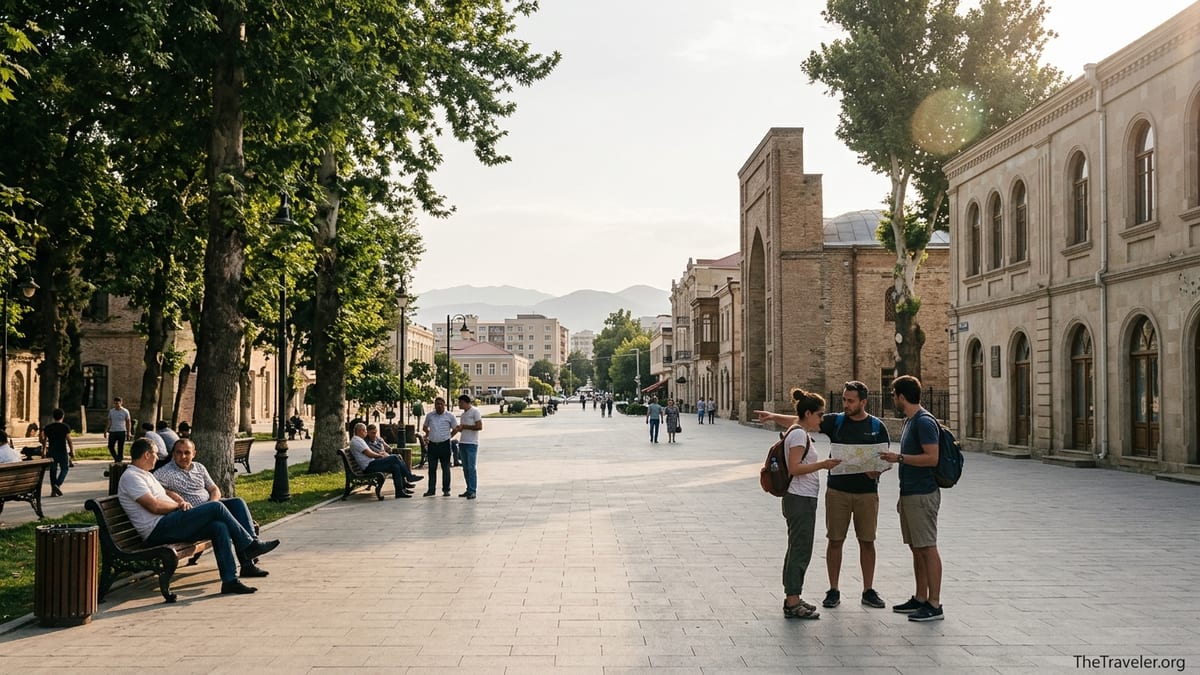
Ganja sits in western Azerbaijan at the northeastern foot of the Lesser Caucasus Mountains and has long been one of the country’s key cultural and economic centers. It is noticeably more relaxed than Baku, with broad avenues, grand parks and a compact historic core that can be explored comfortably in a day or two. You are unlikely to see the bus tour crowds that fill the Icherisheher Old City in Baku, but you will see families strolling in the evenings, students gathering near fountains and older residents sitting on benches to chat.
The city’s appeal lies in its mix of history and everyday life rather than in must-see blockbuster sights. Visitors typically combine a walk through Khan’s Garden and the central square with stops at the Juma Mosque, the quirky Bottle House and the mausoleum of the poet Nizami Ganjavi. The enormous Heydar Aliyev Park Complex on the eastern edge of town adds a sense of scale that surprises many first-time visitors who expect only a modest provincial city.
Ganja is also a springboard to nearby nature, particularly Lake Goygol and the surrounding national park area. Many travelers base themselves in Ganja for a night, then take a day trip into the hills for fresh air and hiking. Because the city lies on the main east–west transport corridor, it is relatively easy to weave into an overland itinerary between Baku and the northwestern towns of Sheki or Qakh, or onward by road toward the Georgian border.
For all of these reasons, Ganja has become a common “second stop” on independent travel routes around Azerbaijan. Yet it remains far less documented than Baku, which means you need to weigh benefits and drawbacks carefully instead of assuming a similar experience.
Getting There and Around: Convenience vs Time Cost
From Baku, the most common way to reach Ganja is by train. Overnight and daytime services typically cover the roughly 360 kilometer journey in about 4 to 5 hours, with standard tickets priced in the range of 6 to 15 Azerbaijani manat depending on class and schedule. Trains tend to be more comfortable and predictable than long-distance buses, and many travelers appreciate arriving directly at Ganja’s central station rather than at an out-of-town bus terminal.
Buses from Baku’s main bus terminal to Ganja run regularly, often taking 5 to 6 hours depending on traffic. Prices are generally low, with one-way tickets commonly under the equivalent of 10 US dollars. This can be an economical choice if train tickets are sold out, though the comfort level and air conditioning can vary by operator and vehicle. Some travelers also choose to hire a private car or shared taxi along the same route, which cuts the journey time but increases cost and exposure to road traffic conditions.
If you are tight on time, domestic flights between Baku and Ganja are occasionally available on Azerbaijan Airlines, but schedules and frequencies change and fares are usually much higher than train or bus tickets. Flight times are short, yet the need to travel to and from airports, clear security and account for delays often erodes any real advantage on a 350 kilometer route. For many visitors, the balance tilts toward rail as the most practical compromise between time and money.
Once in Ganja, you can navigate most places on foot or by inexpensive taxi. The city center, including Javad Khan Street, the central square and Khan’s Garden, is compact. A taxi ride from the train station to central hotels usually costs only a few manat, and rides to outlying areas like Heydar Aliyev Park or the Ganja International Airport stay within a budget-friendly range. There is no metro system, and local buses can be confusing if you do not read Azerbaijani or Russian, so many short-term visitors rely almost entirely on walking and ride-hail taxis where available.
The Upsides: Green Spaces, Everyday Culture and Lower Costs
One of Ganja’s strongest pros is the abundance of open, green space compared with Baku. The Heydar Aliyev Park Complex on the eastern side of town covers hundreds of hectares, with long tree-lined alleys, ornamental lakes, a triumphal arch and a monumental main avenue. It is the sort of place where local families rent small electric cars for children, teenagers gather for photos and visitors can stroll for an hour without retracing their steps. Within the center, Khan’s Garden and the surrounding streets create a pleasant, human-scale core that feels designed for pedestrians rather than cars.
The cost of visiting Ganja is often lower than in the capital. Midrange hotels in central locations can sometimes be found for the equivalent of 30 to 60 US dollars per night, and budget guesthouses or family-run accommodations can be cheaper still. Simple restaurant meals, such as kebabs, piti (a local lamb and chickpea stew) or plov, typically cost notably less than in Baku’s trendier neighborhoods. Taxis around town are inexpensive enough that taking a cab instead of deciphering bus routes often costs only a few extra dollars over the course of an entire day.
Culturally, Ganja offers a glimpse of everyday Azerbaijani life that feels more grounded than the polished surfaces of Baku Boulevard. You might watch older men playing backgammon in the shade of Khan’s Garden, observe wedding parties taking photos in Heydar Aliyev Park or visit a neighborhood bakery where staff do not speak English yet are happy to help you point and choose. Travelers who enjoy slow, observational travel often cite this everyday atmosphere as the main reason to include Ganja.
Another advantage is the city’s location for day trips. From Ganja, you can arrange a taxi or private driver to Lake Goygol and the nearby national park. While prices vary by bargaining skills and season, a half-day or full-day excursion in a private car is often quoted in the range that feels reasonable compared with similar trips in Western Europe. The scenery around Goygol, with forested slopes and turquoise water framed by the Lesser Caucasus, is among the most photogenic in Azerbaijan and can be a welcome contrast to urban sightseeing.
The Downsides: Security Advisories, Limited Nightlife and Modest Sights
Any honest account of visiting Ganja has to start with security considerations at the national level. As of mid 2026, the United States and some other countries advise their citizens to reconsider travel to Azerbaijan due to tensions and incidents in certain regions. While Ganja itself is not an active conflict zone, this overall context means conditions can change, and insurance coverage or consular services might be affected. Travelers should always check the latest government advisories from their own country before finalizing plans and be prepared for possible route or schedule adjustments.
On a more local scale, Ganja has experienced isolated incidents of violence in previous years, including attacks on police facilities. These events are not part of everyday life for residents, and most visitors pass through without witnessing anything unusual. However, they serve as a reminder to stay informed, avoid political gatherings, and be cautious around any large security presence or demonstrations. Solo travelers should apply the same common-sense measures they would in any unfamiliar city, such as using licensed taxis, staying in reputable accommodation and keeping valuables out of sight.
Beyond safety, a more routine drawback is that Ganja simply does not have a long list of headline attractions. If you expect a compact “old town” comparable to Tbilisi or a broad array of museums like Baku, you will likely be underwhelmed. Most visitors spend one full day walking between the Nizami Mausoleum, the Ancient Gates of Ganja, the Juma Mosque and the Bottle House, then feel they have largely covered the city’s main highlights. Additional days tend to focus on relaxation or excursions rather than intensive sightseeing.
Nightlife and dining are also relatively limited. You will find cafes, teahouses and a handful of restaurants serving Azerbaijani staples, but you should not expect a big range of international cuisines or late-night venues. Alcohol is available, yet the atmosphere is more low-key and domestically oriented than in Baku. For some travelers this calm is a plus, but for others it can feel quiet or monotonous after sunset, especially outside summer weekends when more locals are out.
What You Will Actually See: Key Sights in Real Terms
In the city center, a typical walking route starts at the central square and Khan’s Garden, then continues along Javad Khan Street. Here you will pass the Friday Mosque of Ganja, also known as the Shah Abbas Mosque, whose brick facade and twin minarets recall the Safavid period. A short walk away, the Bottle House reveals one of the city’s most talked-about oddities: a two-story residence decorated with thousands of glass bottles embedded into its walls. It was built in the mid 20th century by a local craftsman, and while you cannot always enter, simply circling the exterior provides ample photo opportunities.
Further out, the Nizami Mausoleum stands as a cylindrical monument dedicated to the medieval poet Nizami Ganjavi. The structure is set in a landscaped park on the edge of town, and many visitors pair a visit here with a stop at the nearby Ancient Gates of Ganja, historic city gates now relocated and preserved as a monument. The combination provides a concise look at how Ganja’s history spans literary heritage and urban fortifications without requiring an entire day.
The Imamzadeh complex, a religious shrine with distinct blue-tiled domes and a peaceful courtyard, lies a short drive north of the center. Modest dress is expected, and women may be asked to cover their hair on site. Inside the complex, you will see local worshippers and families visiting the shrine rather than tourist groups, which gives the site an authentic feel. Many travelers hire a taxi for an hour or two to visit Imamzadeh and then return to the city center for lunch.
Finally, the Heydar Aliyev Park Complex offers an experience that is as much about scale as about specific monuments. Its long central avenue leads toward a triumphal arch and large government buildings, lined with ornate lighting, fountains and manicured lawns. Visiting in the early evening, when locals come out to stroll and the lights switch on, gives the best sense of how the space functions as Ganja’s main recreational corridor. Those who enjoy people-watching will find this one of the most rewarding places in the city.
Accommodation, Budget and Practicalities
Ganja’s hotel stock is smaller than Baku’s, but it spans a range from simple guesthouses to modern business-style properties. Well-rated midrange hotels near the center typically charge nightly rates that are modest by Western European standards, especially outside peak summer months. Business travelers sometimes occupy the higher-end options, leaving independent tourists to choose between comfortable yet unpretentious hotels and lower-cost guesthouses one or two streets back from main squares.
For budgeting, many travelers find that a full day in Ganja can be comfortably managed on a moderate budget covering accommodation, three meals, local transport and a small buffer for entrance fees or taxis to outlying sights. Since most major attractions are free or low cost, your main expenses will be your room and any private transport you choose to Lake Goygol or Imamzadeh. Cash in Azerbaijani manat is widely used, though card payments are increasingly accepted in larger hotels, supermarkets and some restaurants. ATMs are available in central areas, but it is sensible to carry enough cash for smaller purchases and taxis.
Language is another practical consideration. In Ganja, fewer people speak conversational English than in Baku’s tourist areas. You are more likely to encounter Azerbaijani and Russian, especially among taxi drivers, market vendors and bus staff. A translation app and a few key phrases scribbled down can make a big difference. Menus in casual eateries may not be translated, so be ready to point at dishes or accept the staff’s recommendations for grilled meat, salads and soups.
Seasonality strongly affects the experience. Summers can be hot, with average daytime highs in July often near 30 degrees Celsius or higher. Spring and early autumn, particularly May and September, usually bring more pleasant temperatures with green parks and manageable heat. Winters are cold, occasionally snowy, and the city feels quieter, which appeals to some travelers but reduces opportunities for long, comfortable strolls in the parks.
Who Ganja Is Ideal For (And Who Might Skip It)
Ganja tends to reward travelers who enjoy second cities and regional hubs rather than headline destinations alone. If you have already visited Baku’s waterfront and old city, and you are curious about what life looks like in a large Azerbaijani city away from the capital’s oil-fueled gloss, Ganja provides that contrast. It is also well suited to overlanders crossing between Azerbaijan and Georgia, those with a strong interest in Soviet-era urban planning, or anyone who wants to combine a city stay with a nature trip to Lake Goygol.
Time is the key constraint. If your entire stay in Azerbaijan is only three or four nights, adding Ganja may dilute your experience in Baku and leave little room for the mountain villages or Caspian coast. The city’s main sights can be covered in a day, but you still need to allocate roughly half a day each way for travel to and from Baku by train or bus. For very short trips, it often makes more sense to focus on Baku and one nearby region such as Gobustan or the Absheron Peninsula.
Travel style also matters. Independent travelers comfortable with limited English signage, simple guesthouses and figuring out intercity transport generally find Ganja manageable. Those who prefer fully guided group tours, boutique hotels and a dense menu of dining and nightlife options may feel that Ganja does not justify the effort. Families with small children might view the extensive parks as a plus, while the longer travel times and limited child-focused attractions could be a minus.
Ultimately, Ganja works best as part of a broader itinerary through western Azerbaijan and the Caucasus, rather than as a sole destination. For visitors with a week or more in the country, it can slot naturally between Baku and the scenic northwest. For those squeezing Azerbaijan into a few days, it often remains an interesting idea for a future, slower trip.
The Takeaway
Visiting Ganja offers a grounded look at Azerbaijan that contrasts sharply with the glass towers and high-end restaurants of Baku. You gain wide boulevards, relaxed parks and a lived-in city where tourism is present but not dominant. Costs are lower, crowds are thinner, and encounters with local life feel less curated. Coupled with day trips to nearby mountain lakes, the city can deliver a quietly rewarding stop on a longer Caucasus journey.
At the same time, the tradeoffs are real. National-level security advisories demand that you stay informed and flexible. The list of sights, while appealing, is modest, and nightlife or international dining options are limited. Reaching the city takes time, and language barriers are more evident than in Baku. For some travelers, these factors will be minor inconveniences; for others, they will tip the balance toward skipping Ganja entirely.
If you have a week or more in Azerbaijan, enjoy second cities and do not mind a slower, more local rhythm, Ganja is worth serious consideration. If your schedule is tight or you prioritize iconic, photogenic old towns and a dense checklist of attractions, you may prefer to invest your time elsewhere. Either way, understanding the real pros and cons before you go will help you shape an itinerary that matches your expectations rather than relying on the city’s status as simply “Azerbaijan’s second city.”
FAQ
Q1. Is Ganja safe for foreign travelers right now?
Travelers routinely visit Ganja without incident, but overall travel advisories for Azerbaijan are elevated, so you should check your government’s latest guidance, avoid political gatherings and stay alert to any local security developments.
Q2. How many days should I spend in Ganja?
Most visitors find that one full day is enough to see the main city sights, with an additional day if you plan a trip to Lake Goygol or want a very relaxed pace.
Q3. What is the best time of year to visit Ganja?
Spring and early autumn, especially May and September, usually offer comfortable temperatures and green parks, while summers can be hot and winters quite cold and quiet.
Q4. Can I visit Ganja as a day trip from Baku?
It is technically possible by early train or car, but the journey each way is about 4 to 5 hours, so most travelers prefer to stay at least one night to avoid an exhausting day.
Q5. Is English widely spoken in Ganja?
English is less common than in Baku’s tourist districts. You will hear mostly Azerbaijani and Russian, so a translation app and some patience are helpful when dealing with taxis and casual eateries.
Q6. What are the must-see sights in Ganja?
Key stops include Khan’s Garden and the central square, the Juma Mosque, the Bottle House, the Nizami Mausoleum, the Ancient Gates of Ganja, Imamzadeh shrine and the Heydar Aliyev Park Complex.
Q7. How much should I budget per day in Ganja?
Budgets vary, but many independent travelers can cover a midrange hotel, meals, taxis and minor entrance fees on a moderate daily budget that is noticeably lower than in Western Europe.
Q8. Is Ganja a good base for visiting Lake Goygol?
Yes. Many travelers use Ganja as a base, hiring a taxi or private car for a half or full day to reach Lake Goygol and the surrounding park, then returning to the city in the evening.
Q9. What should I wear when visiting religious sites in Ganja?
Dress modestly when visiting mosques or shrines: long trousers or skirts, covered shoulders, and a headscarf for women if requested at the entrance, along with respectful behavior.
Q10. Is Ganja worth visiting if I only have four days in Azerbaijan?
If you have just four days total, many travelers prioritize Baku and a nearby region like Gobustan or the Absheron Peninsula; Ganja becomes more attractive once you have a week or more to explore.