


Laurel Falls is one of the most photographed waterfalls in Great Smoky Mountains National Park, and also one of its busiest trails. With a little planning, you can time your visit for softer light, fewer people in your frame, and stronger water flow that turns an already scenic cascade into a truly memorable shot. Here is how to pick the best season, day, and hour to visit Laurel Falls if your priorities are photography, lighter crowds, and a lively waterfall.
Get the latest updates straight to your inbox!
Understanding Laurel Falls: What Makes Timing So Important
Laurel Falls sits off Little River Road between Sugarlands Visitor Center and Cades Cove, reached by a paved trail of about 2.4 to 2.6 miles round trip with around 300 feet of elevation gain. That relatively short, paved approach is a major reason it is often described as one of the most popular, and at times the most crowded, waterfall trails in the Smokies. On a sunny Saturday in July, it is normal to see the small footbridge at the base of the falls lined with visitors taking selfies and family portraits.
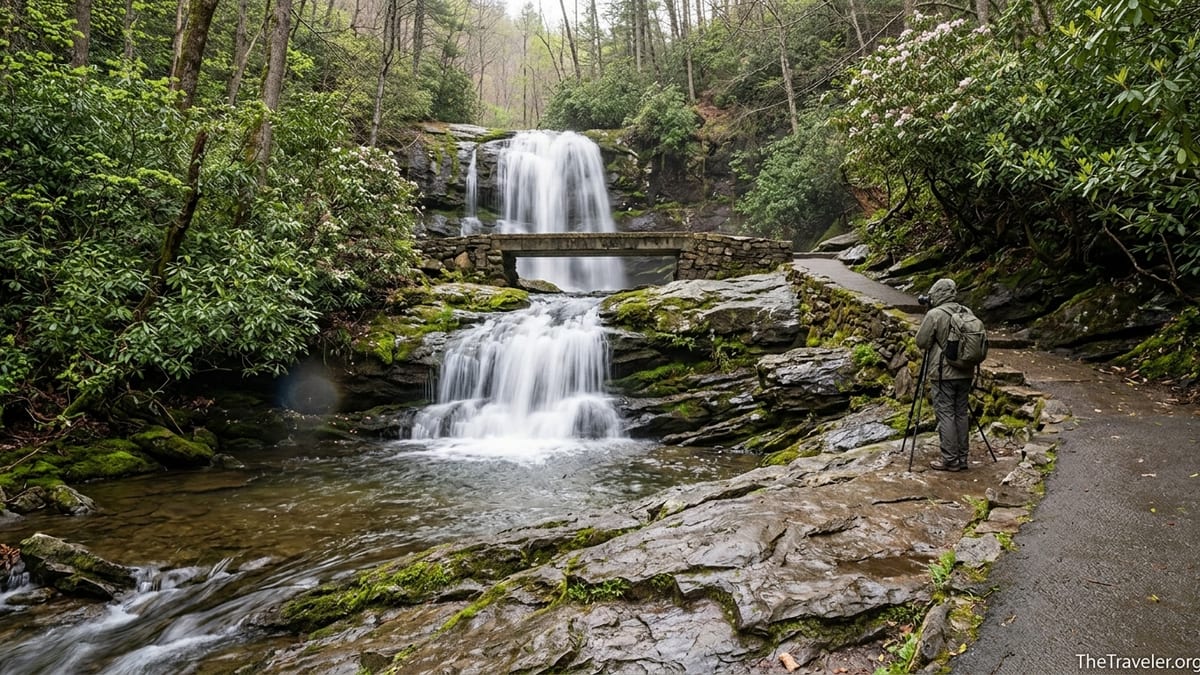
The falls themselves drop in two main tiers with a walkway crossing the midsection, which creates classic compositions for photos but also means your subject area is the same narrow spot where everyone stops. When you combine that layout with limited parking, crowd patterns, and seasonal swings in water volume, timing your visit becomes as important as the camera you carry.
Because Laurel Falls is close to Gatlinburg and Pigeon Forge, it draws day trippers who often arrive late morning and early afternoon after breakfast and a drive into the park. That rhythm is consistent enough that simply shifting your hike to earlier or later in the day, or to a different season, can radically change how crowded the trail feels and how much time you have to set up your tripod without someone bumping your elbow.
Layered over those crowd patterns is the Smokies’ weather. Spring typically brings heavier rainfall and snowmelt at higher elevations, which feeds stronger flow over the falls. Late summer can still be lush but may see lower flow after dry spells, and autumn is often the driest season, sometimes leaving Laurel Falls more of a delicate veil than a roaring cascade. Understanding how these forces work together is the key to planning your visit.
Best Seasons for Strong Water Flow and Lush Surroundings
If your top priority is capturing Laurel Falls with robust water flow, late winter through spring is generally the best window. From roughly late February through May, higher precipitation and snowmelt help feed the Little River watershed and its tributaries, which in turn keeps the falls fuller and more dynamic. Photographers who visit in March often report a wide, muscular curtain of water, especially after a storm system has moved through the region.
Spring also has another visual payoff: fresh foliage and wildflowers. The trail is named for the mountain laurel that blooms in late spring, typically late May into early June depending on the year. Hitting that bloom window lets you frame the falls with flowering shrubs, especially along the upper part of the trail and near the base where laurel and rhododendron cluster around the rocks. Many visiting photographers will base themselves in Gatlinburg for a long weekend in May, watching the forecast for a rainy day followed by a clear morning, then head to Laurel Falls first thing to catch both bloom and flow.
Early summer, roughly June and early July, often retains good water levels from spring rains, though it becomes increasingly humid. If your visit is fixed to school vacation calendars, aim for early June on weekdays to balance healthy flow with slightly lower crowds than prime mid-summer holiday weeks. You will likely find the vegetation at its fullest, with bright green leaves and dense undergrowth framing the stream below the falls.
By contrast, fall is typically the driest season in the Smokies, so Laurel Falls can be gentler and more translucent. What you lose in volume, however, you gain in color. In mid to late October, maple and birch on the surrounding slopes turn yellow and orange, and the hike itself becomes almost as photogenic as the waterfall. Photographers who prioritize color over raw water flow often plan an October sunrise at Clingmans Dome or Newfound Gap, then descend to hike Laurel Falls in late afternoon when the warm foliage glows but the harshest midday light has faded.
When to Go for Fewer Crowds: Months, Days, and Hours
Because Great Smoky Mountains is the most visited national park in the United States, there is no completely empty season at Laurel Falls. But the feel of the trail changes dramatically between a summer holiday Saturday and a gray weekday in January. If your goal is fewer people in the frame, the most effective tactic is to combine off-peak seasons with off-peak hours.
In terms of months, January, February, and early March before spring break usually see the lightest visitation at Laurel Falls, aside from holiday weekends. You may find patches of ice or snow on the trail in colder snaps, but midwinter visitors often describe having long stretches of the path nearly to themselves, especially early in the day. Late fall after the foliage peak, typically early November, can also feel markedly quieter, with day-trippers already shifting their focus to holiday activities in nearby towns.
Within any season, weekdays are generally better than weekends. A Tuesday or Wednesday visit in April or May can be noticeably calmer than a Saturday in the same month. For example, a traveler staying in Pigeon Forge for a spring break week might find the main parking pullouts along Little River Road jammed by 10 a.m. on Saturday, yet be able to pull directly into a marked spot at 7:30 a.m. on Wednesday before workday crowds arrive.
Hour of the day may matter most of all. Regular Smokies hikers consistently report that arriving at Laurel Falls trailhead before 8 a.m. gives you the best odds of parking in the small lot and hiking the paved path with only a handful of other early risers. After 9 a.m., the lot and permissible roadside spaces often fill, and by late morning peak-season days can see a steady queue of hikers streaming up and down the trail. Late afternoon, especially after 4 p.m., can also bring a lull as day visitors head back toward Gatlinburg for dinner, though in midsummer the long daylight means you will still share the path with families and casual strollers.
Chasing the Best Light: Photography Timing and Conditions
Even if you succeed in dodging crowds, your images will suffer if you arrive when the light is harsh. Laurel Falls faces roughly north, receiving indirect light much of the day, but in bright midday sun the contrast between reflective water, dark rock, and deep forest shadow can exceed what many cameras handle gracefully without blown highlights or black shadows. Photographers usually prefer early morning or late afternoon, not only for the crowd benefits but also for the quality of the light filtering through the trees.
On clear days, arriving at the trailhead around sunrise, which can range from about 7:30 a.m. in winter to earlier than 6:30 a.m. in June, gives you soft, angled light along the walk and a still relatively even exposure at the falls themselves. A typical approach for serious photographers is to leave Gatlinburg about 45 minutes before sunrise, drive Little River Road with minimal traffic, and start up the trail as the forest begins to brighten. By the time you reach the falls, you can work in gentle, cool light without direct sun striking the water.
Overcast days are especially good for waterfall photography. The cloud cover acts like a giant diffuser, softening shadows and eliminating hot spots on the water surface. If you are staying multiple days in the area and see a rainy forecast, consider shuffling your itinerary so that a drizzly morning is your Laurel Falls day. Bring a light rain jacket, pack your camera in a dry bag, and accept a little spray in exchange for rich, saturated greens and silky water rendered with slower shutter speeds.
As for gear, a mid-range zoom lens is usually ideal. Something in the 24–70 mm range on a full-frame camera lets you frame the entire two-tier waterfall at wider angles and tighten in on people on the bridge or interesting rock patterns with a quick twist of the zoom ring. Many photographers find that shooting around f/8 to f/11 on a tripod, with shutter speeds from 1/4 to 1 second, yields pleasing water blur without overdoing the effect. A circular polarizing filter helps cut glare on wet rocks and enhances color in leaves and moss along the banks.
Balancing Water Flow With Safety and Access
Stronger water flow usually makes Laurel Falls more dramatic, but it can also affect safety and trail conditions. After heavy rain, pools form on the paved path in shady stretches, and slopes beside the trail can become slick. The small stone bridge at the base of the upper falls can collect spray, turning its surface into a slippery patch underfoot. Photographers who step backward while framing a shot need to move deliberately and check footing before repositioning, especially with a full backpack or tripod over the shoulder.
In late winter and early spring, cold snaps can leave icy patches on shaded sections of the pavement and on rocks around the falls. Spikes or microspikes are rarely essential on this trail, but sturdy hiking shoes with good tread are far safer than smooth-soled sneakers. If you are visiting in February or early March expressly for high flow, it is wise to check the weather the night before, then stop at Sugarlands Visitor Center on the way to ask staff about any current trail advisories or slick conditions.
Summer thunderstorms can also influence timing. Short, intense afternoon storms are common in July and August. If radar shows storms developing over the mountains, many local hikers will aim to start Laurel Falls by mid-morning and be back at the trailhead by early afternoon. While the falls can be dramatic immediately after heavy rain, lightning and high winds make exposed road sections and forest trails risky. Consider enjoying the fuller flow the following morning instead, when skies often clear and the creek is still running strong.
Seasonal management decisions can also affect your plans. In recent years the park has cracked down on unsafe roadside parking near the trailhead to reduce traffic hazards and improve pedestrian safety. That means you cannot rely on simply pulling onto a roadside shoulder if the lot is full. If you are visiting at a busy time and arrive to find no parking, it helps to have an alternative hike in mind for that morning, such as Cataract Falls near Sugarlands or a quieter streamside walk in the Greenbrier area, then return to Laurel Falls later in your trip.
Practical Itineraries: How to Build Laurel Falls Into Your Day
For many visitors, Laurel Falls anchors a half-day outing from Gatlinburg or Pigeon Forge. A common approach for photographers is to treat the hike as a sunrise or early-morning mission, then spend the rest of the day exploring nearby overlooks and less crowded walks. For example, you might leave a hotel near downtown Gatlinburg at 6:30 a.m., arrive at the trailhead shortly after 7, hike to the falls by 7:45, and have an hour or more to work on compositions before most casual visitors arrive. By 9:30 a.m., you are back at your car and can continue along Little River Road toward Cades Cove or return to town for a late breakfast.
If you prefer evening light, consider structuring your day the other way around. Spend the morning driving Newfound Gap Road, exploring higher-elevation views or a short hike like Clingmans Dome when the parking lots are still manageable. Break for lunch in Gatlinburg or at a picnic area, rest during the early-afternoon heat, then head for Laurel Falls in the late afternoon. Starting the hike around 4:30 or 5 p.m. in spring or early fall often lets you catch warm, golden tones on the surrounding trees without the heavy midday crowds.
Families juggling multiple interests can fold Laurel Falls into a broader itinerary that keeps kids engaged while maximizing light and crowd conditions. One example is to schedule a morning visit to the Gatlinburg aquarium or the Great Smoky Arts & Crafts Community on a cloudy or rainy day, then watch the radar for a break in the weather. When the rain tapers off mid-afternoon, you can drive the short distance to the trailhead and enjoy wet, glistening foliage and strong water flow, with many day visitors already back in town.
Another practical option is to combine Laurel Falls with a scenic drive and picnic. Many travelers stock up on sandwiches in Gatlinburg or Pigeon Forge, hike Laurel Falls first thing in the morning, then continue west along Little River Road toward Metcalf Bottoms or further to Cades Cove picnic areas. This approach lets you avoid driving the busy loop road twice while daylight is strongest, and gives you flexibility to leave the park via Townsend or back through Gatlinburg depending on traffic.
The Takeaway
Laurel Falls rewards visitors who think like both photographer and planner. For stronger water flow, target late winter through spring or just after rainy spells, while remembering that icy or slick conditions may require more careful footing. For fewer crowds, prioritize winter weekdays, early mornings year-round, and late afternoons outside major holiday windows, and be prepared to adjust if the small trailhead parking area is full when you arrive.
In all seasons, the most reliable recipe for satisfying photos is simple: arrive early, aim for soft or overcast light, bring footwear suitable for wet or uneven surfaces, and build Laurel Falls into a broader day in the Smokies rather than expecting a quick roadside stop. Doing so not only improves your chances of coming home with images free of crowds and full of motion, but also lets you experience the quieter side of a famously busy park.
FAQ
Q1. What is the best month to visit Laurel Falls for strong water flow?
Late February through May usually offers the strongest water flow at Laurel Falls, thanks to winter snowmelt at higher elevations and frequent spring rains.
Q2. When is Laurel Falls least crowded?
Laurel Falls is typically least crowded on winter weekdays, especially in January and early February, and during early morning hours year-round before about 8 a.m.
Q3. What time of day is best for photography at Laurel Falls?
Early morning shortly after sunrise and late afternoon before sunset generally provide the best light, with softer contrast and fewer people on the bridge and viewing area.
Q4. Is Laurel Falls worth visiting in summer?
Yes, summer visits can be beautiful, with lush green foliage and comfortable temperatures in the morning, but you will need to arrive early or late in the day to avoid heavy crowds and midday heat.
Q5. How long does the hike to Laurel Falls usually take?
Most visitors complete the round trip in about 1.5 to 2 hours, including time to photograph the falls and take short breaks along the 2.4 to 2.6 mile paved trail.
Q6. Can I get good photos of Laurel Falls on a cloudy or rainy day?
Cloudy and lightly rainy days are often ideal for waterfall photography, producing even light, richer colors, and smooth water textures, as long as you protect your gear from moisture.
Q7. Do I need any special camera equipment for Laurel Falls?
You can capture good images with a smartphone, but a tripod, a mid-range zoom lens, and a circular polarizing filter help stabilize shots, control reflections, and frame both wide and tighter compositions.
Q8. Is Laurel Falls accessible in winter?
Yes, the trail is usually accessible in winter, but snow or ice can make some sections slippery, so check current conditions with park staff and wear footwear with good traction.
Q9. How do parking and permits work for visiting Laurel Falls?
You will need a valid Great Smoky Mountains National Park parking tag displayed in your vehicle, and because roadside parking is restricted near the trailhead, arriving early is important to secure a legal spot.
Q10. Are there other nearby spots to photograph if Laurel Falls is too crowded?
If parking is full or the trail feels too busy, consider nearby alternatives such as Cataract Falls near Sugarlands Visitor Center or quieter streamside trails in areas like Greenbrier or Tremont.