


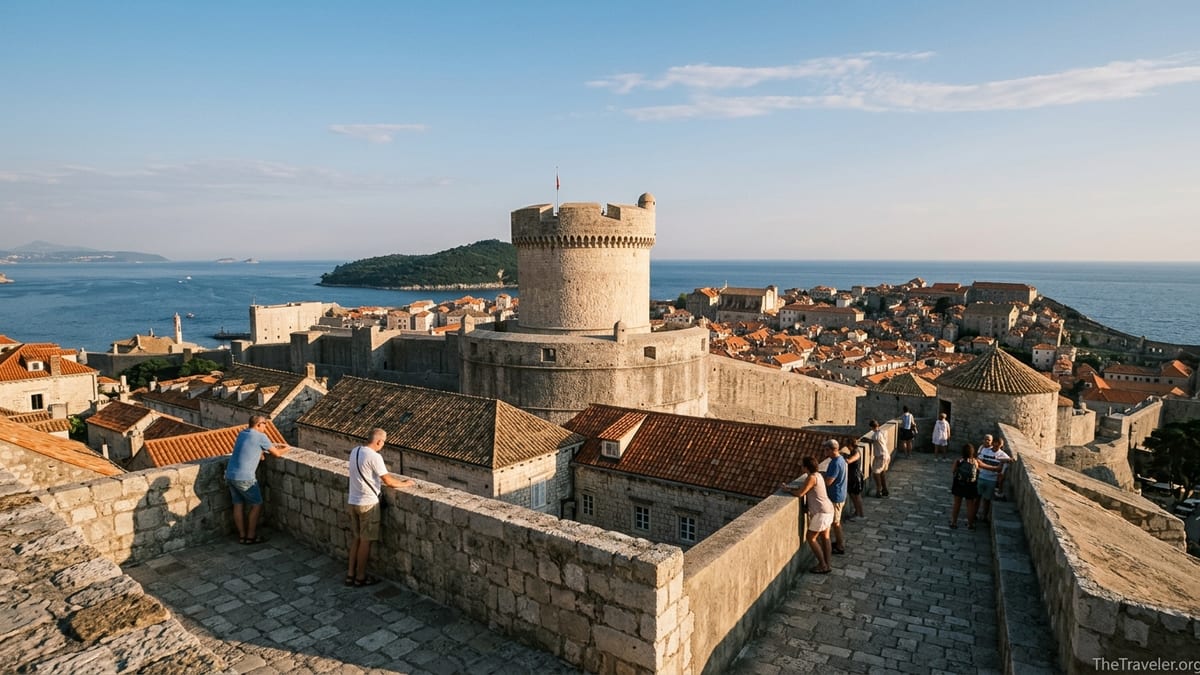
Walk any stretch of Dubrovnik’s famous city walls and one landmark pulls your eye again and again: the round, stone bulk of Minčeta Tower. Perched on the northwestern corner of the fortifications and rising above the terracotta roofs, it is the highest point on the walls and, for many travelers, the single most memorable viewpoint in the Old Town. Reaching the top means tackling a lot of steps, but the reward is a 360-degree panorama that ties together everything people dream about when they picture Dubrovnik: orange rooftops, narrow alleys, distant islands and the open Adriatic.
Get the latest updates straight to your inbox!
What Makes Minčeta Tower So Special
Minčeta Tower is not just another stop on the circuit of Dubrovnik’s city walls. Architecturally, it is the most striking of the four major corner fortifications and the visual symbol of the city’s defenses. Its circular design rises above the neighboring ramparts, which means that even as you approach it from the walls walkway, you can already feel the elevation increasing under your feet. This extra height, only a few meters in absolute terms, makes an outsized difference to the views once you reach the top platform.
Unlike viewpoints at street level or from nearby forts, Minčeta is embedded directly in the stone ring that once protected the Republic of Ragusa. When you stand on its upper terrace, the parapets and battlements frame your view in the same way they did for guards centuries ago. You look down almost vertically onto the tangle of polished limestone streets, tiny squares and church domes of the Old Town, with no modern high-rises to break the spell. It feels less like observing a city and more like hovering above an intact medieval stage set.
Today, most visitors experience Minčeta as part of the one-way loop around the walls. The tower comes roughly midway through the 2‑kilometer circuit, which means you are usually fully immersed in the rhythm of the walk by the time you reach it: you have seen the harbor side, peered into courtyards and watched kayakers pass below the cliffs. Minčeta acts as the emotional peak of that journey. Travelers who have visited both the tower and other high viewpoints almost always mention Minčeta when asked which spot they remember most vividly.
For many people the tower is also their first real sense of how tightly packed Dubrovnik is. From the ground, the Old Town can feel labyrinthine. From Minčeta, you suddenly see how compact the walled core is, how close the sea really lies on three sides, and how the hills rear up directly behind the city. It is a moment of orientation that transforms the rest of your visit, because the map of Dubrovnik finally snaps into focus.
The Views You Get From the Top
The main reason Minčeta Tower stands out among Dubrovnik’s viewpoints is simple: the views are astonishing in every direction. Looking south, the terracotta sea of rooftops rolls away towards the bell tower of the Franciscan Monastery, the long limestone strip of Stradun and the harbor. On a clear day, you can pick out laundry lines strung between second-floor windows, rooftop terraces where locals sip coffee and tiny stone staircases that you might have just climbed yourself an hour earlier.
Turn west and your line of sight jumps beyond the walls to Fort Lovrijenac, sitting on its own rocky outcrop. From street level you see the fort in isolation, but from Minčeta you can appreciate how the Old Town and Lovrijenac formed a single defensive unit. Many visitors recognize this angle from popular television scenes, yet it is only at this height that you understand how little distance really separates the two fortifications. Photographers often wait on the upper terrace for clouds to drift over the bay and throw moving shadows across the outer fort.
To the north and east, the mood shifts: instead of sea, your gaze climbs the steep residential slopes outside the walls and up towards Mount Srđ. From here, the cable car line is visible as it rises toward the hilltop viewpoint, and the contrast between the flat, densely built Old Town and the green hillside beyond is striking. You can also see how modern Dubrovnik wraps around the historic core, with buses winding down the access roads that most visitors use to reach Pile Gate and Ploče Gate.
What makes these views special is not just the beauty but the layering of detail. One minute you are admiring the pattern of terracotta tiles; the next you notice the different styles of church towers, the outline of Lokrum Island offshore, or the tiny arches of cloisters half hidden behind walls. This is why many travelers find themselves lingering far longer on Minčeta than anywhere else along the walls: each circuit of the tower’s upper path reveals another scene that feels worth a photograph.
How Minčeta Compares to Other Dubrovnik Viewpoints
Dubrovnik is rich in viewpoints, and first-time visitors often wonder whether they really need to climb both Minčeta Tower and the cable car to Mount Srđ, or whether a terrace view from a café will do. Each perspective offers something different. Mount Srđ, reached either by cable car or a taxing hike, gives you a postcard-perfect aerial shot of the entire Old Town, the cruise port and the islands scattered beyond. It is unbeatable for wide, cinematic panoramas and sunset photos with the sun sinking behind the Elaphiti Islands.
Minčeta, by contrast, is more intimate and immersive. You are still close enough to hear snatches of conversation drifting up from the streets below or the clink of cutlery from restaurant terraces wedged between old houses. The scale feels human rather than grand. For travelers who like to understand how a city is put together, Minčeta gives more usable information: you can trace the line of Stradun, see how side alleys connect, and plan which church, monastery or museum to visit later that afternoon simply by sighting their towers from above.
Other corners of the walls provide excellent views too. The waterfront section near St John’s Fortress looks out over the Old Port, with fishing boats and small excursion vessels heading to Lokrum Island. The southern walls above the sheer cliffs drop directly to the sea and overlook popular cliff bars where visitors sip drinks at sunset. These stretches are atmospheric, but they rarely provide the all-round visibility you get from Minčeta. On most of the circuit you are looking out primarily in one direction; on Minčeta, you can walk the circular walkway and take in all four cardinal points in a matter of minutes.
Even comparisons within the walls themselves tend to favor Minčeta for variety. If you are short on time or energy and debating whether to continue around the full loop, many guides suggest pushing on at least as far as Minčeta before turning back at the nearest exit staircase. Travelers who do so often report that this was the moment the walls walk “clicked” for them: a single, concentrated burst of views that justified the admission fee and physical effort.
Getting There, Tickets and Practical Details
Minčeta Tower sits on the northern section of the walls, roughly above the land side of the Old Town. You cannot access it directly from street level; instead, you must first enter the city walls and then walk to the tower along the one‑way route. The most popular access point is near Pile Gate, where a wide staircase rises from just inside the gate to the ticket booth and entrance turnstiles. There are additional entry points closer to the Old Port and near Ploče Gate, but all lead ultimately to the same circuit and to Minčeta.
As of mid‑2026, a standard adult ticket to walk the Dubrovnik city walls typically costs in the region of 35 to 40 euros, depending on season and which sales channel you use. Children and teenagers usually pay a reduced price. The walls ticket covers the entire loop, including Minčeta Tower, and commonly includes entry to Fort Lovrijenac on the neighboring rock. Many visitors find that buying a Dubrovnik city pass or tourist card can offer better value if they plan to visit museums and ride local buses as well, since those passes often bundle the walls ticket with several other attractions for a combined price.
The walls opening hours change with the seasons. In summer they usually open in the morning and operate until early evening, with last entry well before sunset to give walkers time to complete the loop before closing. Outside peak season, the hours are shorter and may be affected by weather, especially strong winds or heavy rain. It is wise to check the latest schedule locally the day before you plan to visit, either at tourist information offices in the Old Town or at your accommodation reception.
Once inside, expect a lot of stairs. The full circuit includes many short, steep flights, and the climb up to Minčeta is among the most demanding. Travelers who track their step counts routinely record more than a thousand steps across the whole walk. Because of this, closed shoes with a decent grip are advisable, especially in high summer when the stone can become slick with dust or sweat. There is no elevator access to the walls or the tower, so anyone with significant mobility issues will find this viewpoint difficult or impossible to reach.
Best Time of Day and Season for the Views
When you visit Minčeta Tower can make a huge difference to how much you enjoy it. Dubrovnik receives intense summer sunshine, and the walls are almost entirely exposed. In July and August, afternoons on the ramparts can be extremely hot, with very little shade. For many travelers, a morning visit soon after opening provides the best compromise: the sun is already high enough to light the rooftops, but the stones have not yet soaked up the heat of the day and group tours are only just beginning to arrive.
Late afternoon and early evening are also popular, particularly in shoulder seasons like May, June, September and early October. At these times the light softens, shadows lengthen and the colors of the tiles and sea become richer. From Minčeta, you can watch sunlight sliding across the roofs toward the western cliffs, and on days with scattered clouds the interplay of light and shade across the Old Town is spectacular. In high season, some travelers choose to start their walls walk around 5 or 6 pm to avoid the worst of the heat, timing their arrival on Minčeta for the golden hour.
Winter and early spring bring a different atmosphere altogether. Daylight hours are shorter and some businesses close, but the walls are far quieter, and you may find yourself with surprisingly uncrowded views from the tower. The light in the colder months is often clearer and cooler in tone, which makes the details of the stonework and distant islands stand out sharply. A light jacket or windproof layer is useful, as the exposed height of the walls can make the breeze feel stronger than in the streets below.
Regardless of season, allow more time than you think you will need. Even fit visitors often underestimate how much they will stop to take photographs or simply rest and soak up the scenery. A full, relaxed circuit of the walls can easily take two hours or more, especially if you pause for a cold drink at one of the small refreshment kiosks on the ramparts. Plan your schedule so that when you reach Minčeta, you can linger rather than rush through the viewpoint on your way to the next commitment.
Photography Tips: Capturing Minčeta’s Iconic Vistas
For photographers, Minčeta Tower is one of Dubrovnik’s most rewarding platforms, but getting great images does require a little planning. The upper walkway is relatively narrow, with a low wall on the city side and open battlements on the outward side. Tripods can be awkward here when the path is busy, so most visitors rely on handheld shots. A standard smartphone camera is more than capable of capturing the panorama, but a wider‑angle lens on a mirrorless or DSLR camera can help you fit more of the skyline into a single frame.
If you are shooting with a phone, try using the ultrawide setting when you are facing south over the rooftops or west toward Fort Lovrijenac. This exaggerates the sweep of tiles and the curve of the walls, though you should take care to keep the horizon level to avoid distorted buildings. For more intimate images, switch back to a normal lens and focus on specific details: a bell tower framed between battlements, an alley falling steeply towards the sea or a lone figure walking along Stradun far below.
Light is your biggest ally. In the middle of the day, harsh sunlight can flatten the scene and create deep shadows, especially around church spires and chimneys. If circumstances force a midday visit, use those contrasts creatively: black silhouettes of towers against bright sea and sky can produce dramatic results. In the softer light of early morning or late afternoon, look for the way the sun rakes across rooftops, bringing out the textures of tiles and stone. From Minčeta’s height, you can also experiment with patterns, capturing repeating rooflines or the alternating sequence of sunlit and shaded streets.
Finally, remember that some of the best images from Minčeta include people. A companion leaning on the parapet, a couple pointing out to sea or even another visitor pausing with a camera can provide scale and a focal point for your composition. Just be mindful of others’ privacy and of the flow of foot traffic on the narrow path. If you are visiting in a group, agree a quick rotation at the prime spots on the tower terrace so that everyone gets a chance at the classic shot.
Is the Climb Worth It? Who Will Enjoy Minčeta Most
The honest answer is that Minčeta Tower is not for everyone, but for many types of traveler it becomes a highlight of their time in Dubrovnik. If you enjoy cityscapes, historic architecture or simply collecting memorable views, the combination of height, context and beauty here is hard to beat. Travelers who like to understand a place visually, using a high vantage point to orient themselves before exploring at street level, will find the climb especially valuable.
On the other hand, visitors with severe fear of heights or significant mobility challenges may struggle. The walls are generally safe, with solid parapets on the city side, but some sections feel exposed and the steps are high and uneven in places. If you are unsure, consider testing your comfort level on the lower stretches of the walls first. There are occasional rest points with small cafés or benches where you can pause if you become tired before or after the Minčeta section.
Families with children often debate whether to include the walls walk in their itinerary. Many do and report that older children enjoy the sense of adventure: spotting landmarks from above, watching boats, or trying to find their accommodation among the rooftops. Parents of very young children, however, should be aware that strollers are impractical on the many stairs and that small hands will need close supervision near balustrades and openings.
If you are visiting Dubrovnik on a cruise stop with only a few hours in port, you will need to make a deliberate choice. A complete walls circuit plus time on Minčeta can easily take half your available shore time once you factor in queues and the walk from the cruise shuttle bus drop‑off. Some short‑stay visitors decide instead to ride the cable car or to explore the Old Town at ground level, saving the walls for a potential future trip. Those who prioritize the walls usually come away convinced that Minčeta’s views justified the trade‑off.
The Takeaway
Minčeta Tower is more than just a photogenic landmark on Dubrovnik’s skyline. It is the point where the city walls experience reaches its climax, a place where history, geography and everyday life in the Old Town converge in a single sweeping panorama. From its upper terrace you see not only the famous red roofs, but also the line of the defensive circuit, the steep streets that knot behind the main promenade, the separation between Old Town and new districts, and the open sea that shaped Dubrovnik’s fortunes.
Reaching that viewpoint requires effort, time and a paid ticket, and it will not suit every visitor. Yet for travelers who can manage the stairs and who value seeing a destination from above as well as within, Minčeta offers some of the finest views in the Adriatic. Plan your visit for the cooler hours, take your time on the ascent, and give yourself the freedom to linger at the top. The memory of standing on that stone platform, with the city unfolding beneath you and the islands on the horizon, is likely to stay with you long after you leave Dubrovnik’s gates.
FAQ
Q1: Do I need a separate ticket to visit Minčeta Tower?
Entry to Minčeta Tower is included in the standard Dubrovnik city walls ticket, so you do not need to buy a separate ticket for the tower.
Q2: How many steps are there to reach Minčeta Tower?
The full walls walk involves well over a thousand steps in total, and the approach to Minčeta includes some of the steepest sections, so expect a sustained climb even if exact step counts vary.
Q3: How long does it take to walk from the walls entrance to Minčeta?
From the main entrance near Pile Gate, most visitors reach Minčeta in roughly 30 to 45 minutes, depending on crowds, photo stops and overall walking pace.
Q4: What is the best time of day to enjoy the view from Minčeta?
Early morning and late afternoon usually offer the most comfortable temperatures and the best light, with softer shadows and warmer colors over the rooftops.
Q5: Is Minčeta Tower suitable for people with a fear of heights?
The walls and tower have solid parapets, but some sections feel exposed and quite high, so visitors with a strong fear of heights may find the experience challenging.
Q6: Can children safely visit Minčeta Tower?
Many families visit with children, but close supervision is essential on the stairs and around battlements, and strollers are not practical because of the many steps.
Q7: Are there places to rest near Minčeta Tower?
There are occasional rest spots and small refreshment kiosks along the walls route, including near the northern section, where you can pause before or after climbing Minčeta.
Q8: What should I wear when visiting Minčeta Tower in summer?
Light, breathable clothing, a hat, sunscreen and comfortable closed shoes with good grip are recommended, as the stone surfaces can become hot and there is little shade.
Q9: Can I visit Minčeta Tower in bad weather?
Access to the walls and tower may be restricted or temporarily closed in high winds or heavy rain, so in unsettled weather it is wise to check conditions locally before buying tickets.
Q10: Is Minčeta Tower worth it if I am also taking the cable car to Mount Srđ?
Yes, the two viewpoints complement each other: Mount Srđ offers a distant, wide panorama, while Minčeta provides a closer, more detailed and immersive view of the Old Town.