


There is a moment on Dubrovnik’s city walls when the old stones and Adriatic light conspire to stop you in your tracks. For me it happened on the highest ramparts of Minčeta Tower, where the tourist buzz fell away and one particular view wrapped itself around the old town, the sea and, unexpectedly, my own life. I have seen famous skylines and grand canyons, but that view from Minčeta has followed me home in a way few places ever do.
Get the latest updates straight to your inbox!
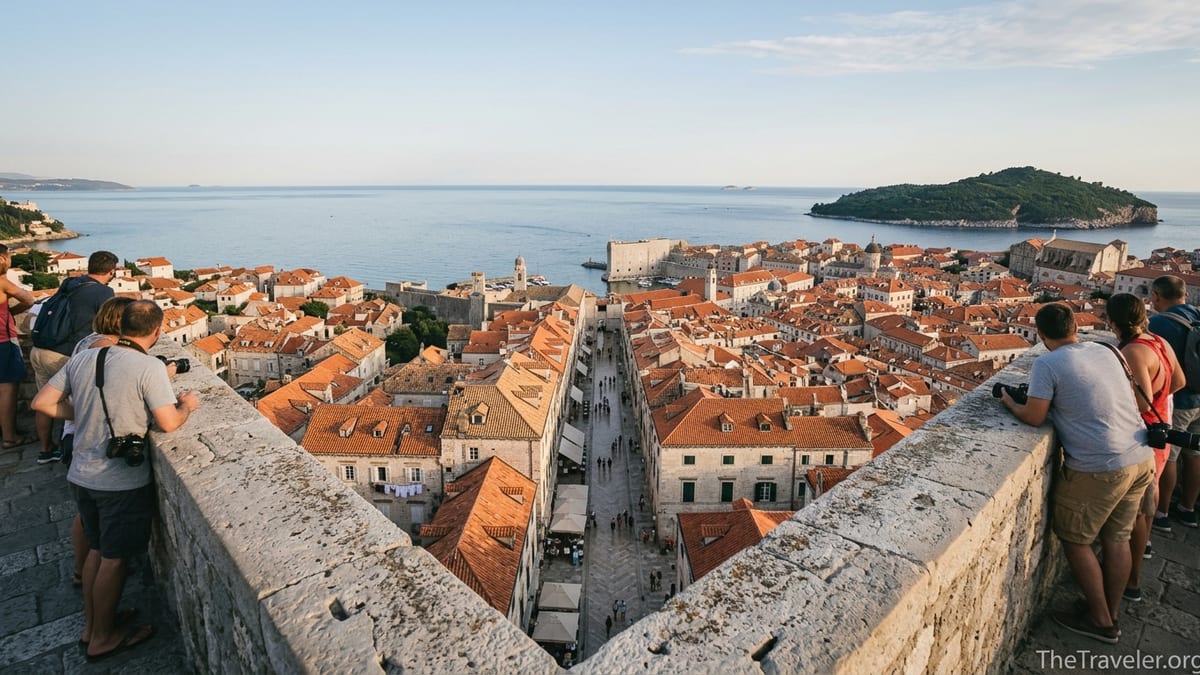
Climbing Toward the Highest Point of the Walls
Minčeta Tower is not a subtle landmark. From almost anywhere in Dubrovnik’s old town it rises above the sea of terracotta tiles, a round, muscular crown of stone that has guarded the landward side of the city for centuries. When you begin the circuit of the walls from Pile Gate and follow the one-way path clockwise, Minčeta waits like a final exam near the back of the loop, a cluster of steep steps that send people to the shade, catching their breath, before they push on to the top.
By the time I reached its base, the late afternoon sun had turned the city a warm, chalky gold. Cruise ship day-trippers were already peeling off the route, lured by gelato on the Stradun below. I climbed the narrow staircase inside the tower behind a family from Glasgow and ahead of a solo traveler in a faded Game of Thrones T-shirt, all of us funneled through the same slit of stone. Halfway up, the wall opened briefly to the north and a small breeze slipped in, carrying the faint smell of pine from the hills beyond the city.
At the top, the crowd briefly thickened again. People fanned out along the circular platform, some posing for quick photos and moving on, others leaning into the parapet and falling quiet. I found a gap along the outer edge, hands on the warm stone, and finally saw the view that would not let me go.
The View That Stayed With Me
Standing on Minčeta Tower, you see Dubrovnik arranged like a living model city at your feet. The red roofs are not uniform; some tiles are sun-bleached pink, others almost russet, a patchwork that hints at earthquakes, shelling and careful restoration. The Stradun slices the old town in a straight pale line, polished by centuries of footsteps, ending in the square where the bell tower pulls your eye upward again. Laundry hangs between alleys that look almost too narrow to fit two people shoulder to shoulder, yet you can see café umbrellas squeezed into any pocket of space that will hold a pair of tables.
Turn slightly and the scene changes. To the east, the Adriatic opens in a huge sheet of blue, darker near the walls where the water deepens and lighter where it meets the limestone at the base of the fortifications. Kayak groups cluster like red and yellow commas around Lokrum Island, which sits low and green offshore. Farther out, a Jadrolinija ferry leaves a slow white trail behind it, sliding toward the Elaphiti Islands and reminding you that this city is still a gateway, not just a museum piece.
But the detail that lodged in my memory was more intimate: a quiet courtyard wedged deep inside the maze of roofs, visible only from this height. Children were kicking a ball against a wall painted with the faint outline of a goal. An elderly woman in a blue dress sat in the shade of a fig tree, fanning herself with a newspaper. A cat threaded through the scene like a small gray shadow. There were no tour groups, no selfie sticks, no souvenir stands, just a slice of everyday Dubrovnik framed by 15th-century stone. That contrast between the city as global backdrop and the city as home is what I carried away.
Seeing King’s Landing, Finding Dubrovnik
For many travelers, Minčeta Tower first appears on-screen long before it appears in person. The tower’s base, thick and imposing, was used as the exterior of the House of the Undying in the city of Qarth for the second season of Game of Thrones, part of the broader transformation of Dubrovnik into King’s Landing. Walking the walls today, it is easy to spot fans quietly replaying scenes in their heads: the staircase where a queen once walked in cinematic shame, the fort that stood in for the Red Keep, the harbor that launched imaginary fleets.
On Minčeta, I watched a young couple acting out their own version of that pilgrimage. One of them posed dramatically by the merlons while the other framed the photograph, counting down like a director. When they switched places, a guide nearby pointed out the exact angle where the show’s camera had captured Daenerys circling the fortress, her dragons stolen, her story pivoting. A small group nodded, more familiar with plotlines than with Venetian sieges or Ragusan diplomacy.
Yet the longer you stand on the tower, the more the fictional overlay peels back. The flags snapping in the wind belong to the Republic of Croatia and to Dubrovnik, not to any invented house. The stones under your feet predate television, phones and, in many cases, the countries visitors fly in from. Information boards along the walls describe how Minčeta once anchored the city’s landward defenses, its height making it a lookout against advancing armies rather than bus tours. The modern ticket system, the timed entries and the limits on cruise ship passengers are all reminders that the city is still busy negotiating where tourism ends and local life begins.
The Practicalities Behind a Perfect Moment
That quiet, lingering view from Minčeta only happened because of a few practical choices. First among them was timing. The city walls have shifted to an advance booking system, and during peak months like July and August many of the midday slots vanish quickly. I chose a late afternoon entry on a day when only two mid-sized cruise ships were in port, instead of four or five, something local operators increasingly track as part of Dubrovnik’s efforts to temper overtourism. The difference on the walls is noticeable: fewer clogged staircases, shorter queues at narrow sections, more space to breathe at the viewpoints.
The price also nudges you to make the most of the experience. As of 2026, walking the walls costs around 35 euros per adult, often folded into the Dubrovnik Pass, a city card that also includes several museums, galleries and city buses. It is not a casual expense for many travelers. On the day I visited, I met a pair of backpackers from Poland at the entrance gate debating whether the ticket would be worth it when they were trying to keep daily costs under 70 euros, including accommodation. They ultimately bought the one-day city pass, reasoning that they could use the included bus rides to reach the cable car station and save a few euros there.
Small decisions on the day matter too. I carried a refillable water bottle and topped it up at the public fountain near Onofrio’s Fountain just inside Pile Gate. On the walls themselves, drinks at the tiny kiosks cost considerably more than in shops outside the old town. I wore a hat and light clothing, grateful for every patch of shade around Bokar and the northern stretches of the ramparts. Watching others wilt in sandals with little grip, especially on the smooth stone steps of Minčeta, confirmed that this is not just a photo-op stroll but a genuine two-kilometer walk that can feel longer in the heat.
A City Negotiating Its Own Reflection
From Minčeta’s height, Dubrovnik’s balancing act is visible in miniature. On one side you see rooftop terraces where boutique hotels have turned once-private spaces into sunset bars, their cushions and lanterns just visible from above. On another, you catch empty roofs where local families still dry laundry or tend small gardens of potted herbs. The city’s dependence on tourism is obvious, yet so is the effort to hold on to its own rhythm. Since 2025, Dubrovnik has tightened controls on short-term rentals in the historic center and limited the number of cruise ships in port at any given time, in part to keep streets passable and in part to ensure that residents are not entirely priced out of their own city.
On the walls, these policies translate into subtle, everyday experiences. The groups of 40 following a raised umbrella have become smaller and more spread throughout the day, nudged by time slots and crowd-monitoring apps. Local guides talk as much about the “Respect the City” initiative as they do about royal intrigues, explaining why buses can no longer simply disgorge passengers at the gates whenever they please. There is a sense that the city has looked at its own reflection in the mirror of international tourism and decided to make some adjustments before the image hardened into something unlivable.
Watching a maintenance crew repoint mortar along a stretch of the wall below, I was struck by how deliberately the city invests in its own preservation. These walls are not just scenery; they are an active, expensive responsibility. Every ticket, every controlled entrance, every slightly frustrated visitor who cannot simply turn up without a reservation is part of a larger equation: how to keep the view from Minčeta, and the community beneath it, intact for the next wave of travelers and for those who never leave.
Beyond the Tower: Context for That One View
What anchored that Minčeta moment for me was how it fitted into the wider topography of Dubrovnik. Earlier that day, from the slopes of Mount Srđ, I had seen the city as a postcard: the entire walled peninsula jutting into the sea, Lokrum green and domed just offshore, the cruise port and suburban sprawl tucked out of sight behind. From that angle, Dubrovnik looked almost too perfect, like a model laid out under glass. From sea level later, on a short kayak trip that hugged the base of the walls, the stones loomed above in a sheer, almost intimidating curtain.
Minčeta sat between those perspectives. From its parapet, the scale is human again. You see faces clearly, hear the murmur of conversation from terraces, pick out individual shutters swung open to admit the evening air. The city becomes a place where you could, in theory, choose a single street, find an apartment, and make a life. You notice the butcher chatting with a regular below, the school group following a teacher across the Stradun, the off-duty waiter hurrying home down an alley tourists rarely enter. It feels less like a monument and more like a stage where real lives play out between each arriving and departing flight.
That completeness of view, between postcard and close-up, is rare in popular destinations. In Venice, for instance, the best known vantage points either compress the city into a single canal or stretch it out across the lagoon. In Dubrovnik, Minčeta somehow manages both intimacy and overview. It gives you enough distance to understand the layout of the old town but not so much that the texture of daily life disappears. Long after leaving, when I picture Dubrovnik, it is that balanced frame I return to, not the harbor, not the cable car, not even the iconic western walls plunging directly into the sea.
The Takeaway
Travel memories often cling to the details we do not expect. I arrived in Dubrovnik curious about the famous walls, half-intrigued by their television alter ego, ready for views and crowds and high-season pricing. I did not expect one quiet slice of the city, glimpsed from Minčeta Tower, to follow me home like a persistent thought. Yet it has: the courtyard with the fig tree, the game of football, the cat slipping along the edge of the frame, all held in place by those thick, timeworn stones.
If you go, the best way to make your own version of that memory is to treat the walls as more than a box to tick. Book your slot with intention, choose your time of day, arrive with water, good shoes and enough space in your schedule that you do not rush past the moments in between the major viewpoints. Let yourself linger on Minčeta, even when others are shuffling on toward the exit, and pay attention to the small, unscripted scenes unfolding below. Long after ticket prices have changed again and the conversation about overtourism has moved on to new frontiers, that layered view of Dubrovnik as both spectacle and home is likely to be what stays with you too.
FAQ
Q1: Where exactly is Minčeta Tower on the Dubrovnik city walls?
Minčeta Tower sits on the northwestern side of Dubrovnik’s city walls, roughly opposite the harbor, along the inland-facing stretch overlooking the modern city and hills beyond.
Q2: How much does it cost to visit Minčeta Tower and the walls?
Access to Minčeta Tower is included in the standard city walls ticket, which in 2026 is around 35 euros per adult, often bundled into the Dubrovnik Pass.
Q3: Do I need to book my city walls visit in advance?
Yes, especially in high season. Dubrovnik now uses timed entry and advance booking for the walls to help manage crowds, and popular midday slots can sell out.
Q4: What is the best time of day to visit Minčeta Tower for the view?
Early morning and late afternoon tend to be best, with softer light, slightly cooler temperatures and fewer cruise passengers on the walls compared with midday.
Q5: How physically demanding is the climb up to Minčeta Tower?
The climb involves several steep staircases and uneven stone steps. Most reasonably fit visitors manage it, but it can feel strenuous in summer heat or for those with mobility issues.
Q6: Can I visit Minčeta Tower without walking the entire circuit of the walls?
You must enter through one of the official gates to the walls and follow the one-way route, but you can choose to exit soon after Minčeta rather than completing the full loop.
Q7: Is Minčeta Tower suitable for children?
Many families visit with children, but close supervision is essential near the parapets and on stairs. There are railings, yet the walk is high, exposed and can be very hot.
Q8: What should I bring for a comfortable visit to Minčeta Tower?
Bring plenty of water, sun protection such as a hat and sunscreen, comfortable shoes with good grip, and a small daypack rather than a large bag to navigate narrow stairways.
Q9: Is Minčeta Tower accessible for wheelchair users or those with limited mobility?
Unfortunately, no. The city walls and Minčeta Tower have many stairs and uneven surfaces, and there are currently no lifts or ramps to reach the tower itself.
Q10: Can I still recognize Game of Thrones locations from Minčeta Tower?
Yes. Fans will recognize the tower’s base as the exterior of the House of the Undying, and from the walls you can also spot other familiar backdrops from the series around the old town.