


Third party claim firms like SkyRefund promise to turn delayed and cancelled flights into quick cash with minimal effort. For many passengers that can be a convenient solution. Yet in plenty of situations, using SkyRefund is unnecessary, more expensive than it needs to be, or simply not the smartest route. Knowing when to skip a claim company and deal with the airline yourself can save you money, time and frustration.
Get the latest updates straight to your inbox!
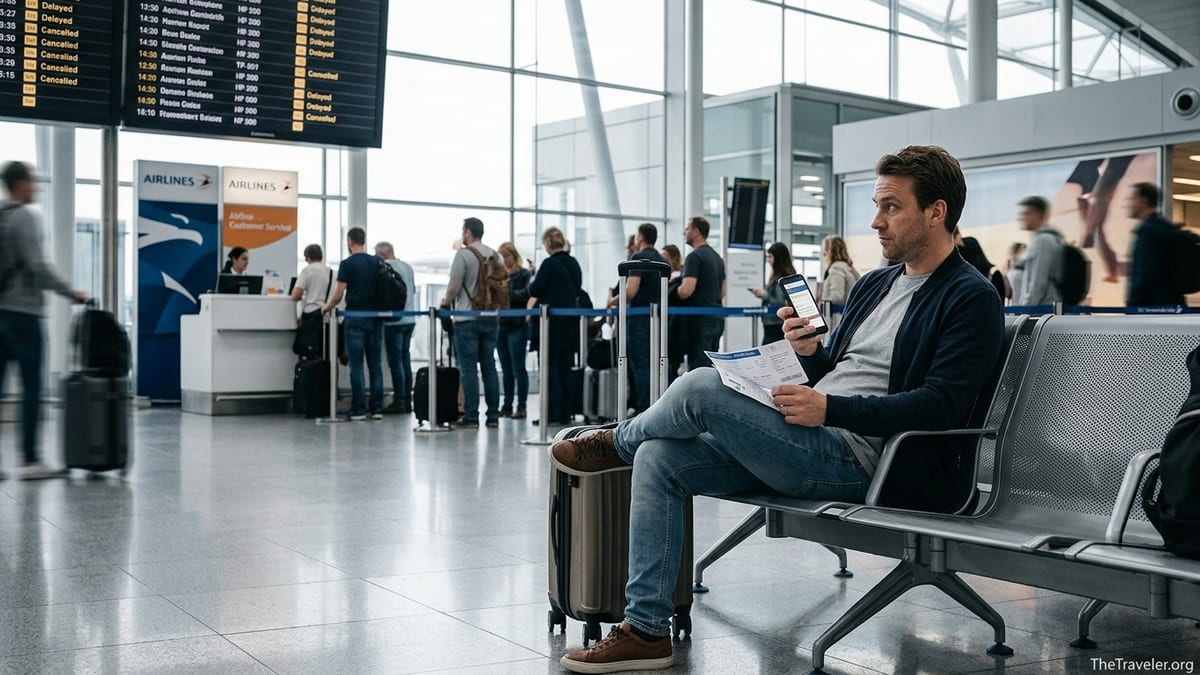
How SkyRefund Works and What It Actually Costs
SkyRefund is a European claims company that helps passengers pursue compensation for disrupted flights under regulations such as EU261 and UK261, as well as other passenger rights regimes. You give SkyRefund your flight details, sign an authorisation form, and the company pursues the airline on your behalf. If they secure money, they keep a portion as their fee and transfer the rest to you.
According to SkyRefund’s own information, the standard commission is 35 percent of the compensation, including VAT, and it is charged only if the claim is successful. If the company has to escalate a case to court, a further 15 percent legal action fee may apply on top of the standard fee. On a typical EU261 payout of 400 euros for a delayed London to Athens flight, that means you could pay 140 euros to SkyRefund in a straightforward case, or up to 200 euros if litigation is required, leaving you with 200 to 260 euros instead of the full 400.
To many travellers, the “no win, no fee” model feels safe. You do not pay anything up front and you do not need to study regulations or argue with airline agents. But you are paying for that convenience with a sizeable slice of your compensation. Airlines like Ryanair have publicly warned passengers that claims companies can take more than 40 percent of a 250 euro EU261 payout, and SkyRefund’s own commission structure sits close to that level when legal fees are involved.
SkyRefund has thousands of public reviews describing successful claims, including cases where passengers were not getting any response from carriers before the company stepped in. At the same time, some reviewers complain about high fees, slow communication or confusion over how much they would actually receive. That mixed picture is typical of this sector and highlights the importance of deciding whether you really need a middleman in the first place.
When Claiming Directly With the Airline Is Straightforward
In many everyday disruption scenarios, you can submit a claim directly to the airline in less than half an hour, at no cost, and receive the full payout if you are entitled to compensation. Most major European and transatlantic airlines now provide online compensation or complaint forms on their websites, usually hidden under headings such as “Customer relations,” “Refund and compensation,” or “EU261 claims.”
Consider a concrete example. An American traveller flies from Paris to New York with a US carrier, and the flight arrives in New York more than four hours late due to a technical issue with the aircraft. Under EU261, that Paris departure is covered even though the airline is based in the United States. Passengers on this route commonly report receiving the standard 600 euro compensation per person after submitting a simple online form or email to the airline’s customer relations department, attaching their boarding passes and a brief description of the delay.
In another real world scenario, a family flying from Lisbon to Berlin on a low cost European carrier experiences a four hour delay where the cause is within the airline’s control. The airline’s website features a short webform asking for the booking reference, passenger names and bank details. Travellers in similar situations often report being paid 400 euros per person within a few weeks, with no legal help. If the same case went through a claims company at a 35 percent fee, each person would lose 140 euros.
Direct claims tend to be easiest when the route clearly falls under EU261 or UK261, the delay or cancellation time threshold is clearly met, and the airline has an accessible online system. If the disruption was an obvious technical or crew issue, and you still have your booking confirmation and boarding pass, you may find that a single well written complaint is enough. For passengers comfortable filling out online forms in English or another major European language, there is little justification for giving up more than a third of the money.
Travellers Who Should Think Twice Before Using SkyRefund
Some passengers are particularly likely to lose money unnecessarily if they sign up with SkyRefund without reflecting on their circumstances. One clear group are frequent short haul European flyers who already know the basics of EU261. A consultant commuting regularly between Amsterdam and Frankfurt, for example, may experience occasional disruptions but also knows that compensation is standardized. Once that traveller has successfully claimed once or twice directly, continuing to pay 35 percent to a third party for every delay quickly stops making sense.
Another group who might be better off claiming directly are travellers who booked with airlines that actively encourage self service claims and provide user friendly online tools. Carriers such as Ryanair publicly advise passengers to avoid “claims chasers” and instead use their direct EU261 claim forms. If you are flying on a carrier that maintains a visible, structured complaints process and publishes EU261 information clearly, there is a good chance a self filed claim will be processed, even if the airline initially pushes back.
Passengers who can access strong local consumer protections or alternative dispute resolution schemes may also be giving up leverage by going through a claims intermediary. In countries like the United Kingdom, Spain or Germany, civil aviation authorities or accredited mediation bodies allow travellers to escalate disputes for free, or at very low cost. A traveller from Manchester to Malaga might first file a claim directly with the airline, then escalate through a national dispute resolution body if the airline rejects the claim. Using SkyRefund bypasses some of those consumer tools and channels your case into the company’s internal strategy instead.
Finally, travellers who are in no particular hurry for the money, and who are comfortable handling a few email exchanges, often find that self advocacy not only preserves their full compensation but also gives them more control. If you are willing to wait several weeks and nudge the airline a couple of times, you may achieve the same result that a claim company would, without sacrificing a third of your entitlement.
Case Studies: When Claim Firms Add Little Value
Real life examples from travellers show how quickly commissions can add up when a claims company is involved. Imagine a couple flying from Madrid to London whose flight is cancelled due to a crew shortage. They are rebooked on a flight the following day and finally arrive in London eleven hours later than planned. Under EU261, they are likely entitled to 250 euros each. If the airline offers compensation directly by email, and the couple has already signed with a claim firm, the firm could claim the full 500 euros, deduct around 175 euros in fees at 35 percent, and pass on only about 325 euros in total to the passengers.
On routes with higher payouts, the numbers stand out even more. A solo traveller flying from Rome to New York on an EU carrier, delayed more than four hours due to a technical fault, may be entitled to 600 euros. Many airlines have online forms for exactly this scenario, and there are multiple public accounts of travellers receiving full 600 euro payments after a short email exchange. Passing such a straightforward case to SkyRefund would likely leave the passenger with around 390 euros after a 35 percent fee, and potentially just 300 euros if legal escalation were needed.
There are also situations where the airline itself directs passengers to a claim partner. Some travellers report that at disrupted flight desks in European airports, printed leaflets or QR codes link directly to third party companies that handle claims. While this may appear official, the effect is that passengers are steered into sharing their claim value with a private firm instead of submitting a free complaint through the airline’s own channels. For a group of four on a disrupted Lisbon to Copenhagen flight, that redirection could mean losing several hundred euros in aggregate fees.
In each of these examples, the work involved in filing directly is modest: keeping boarding passes, noting the actual arrival time, and filling out a short online form. Unless there are complicating factors such as disputed weather conditions or complex itineraries, a savvy traveller is often capable of handling the claim without external help.
When SkyRefund Might Be Useful Despite the Fee
There are, however, travellers and situations where using SkyRefund or a similar company can still be reasonable. Passengers who are not comfortable communicating in the airline’s language or who struggle with digital forms may find the service worth the cost. An elderly traveller from a non European country, for example, whose Paris to Lisbon flight was cancelled, might appreciate having a company handle everything, especially if they are unfamiliar with EU regulations or lack easy online access.
Complex cases can also benefit from professional help. If your itinerary involved multiple legs, codeshares or a mix of EU and non EU carriers, it may not be obvious which airline is responsible for compensation, or whether any regulation applies at all. A traveller on a multi segment journey from Warsaw to Bangkok via Doha, with a disruption that affects the onward connection, may face a more intricate legal landscape than someone on a simple point to point hop inside the EU. In that sort of case, even if you could learn the rules, you might prefer someone else to handle the arguments.
Another scenario where SkyRefund might be attractive is when you have already tried to claim directly and hit a wall. Some airlines are known for resisting EU261 payouts, issuing generic refusal letters that blame air traffic control, security issues or other “extraordinary circumstances.” If you have made a good faith attempt to claim, gathered documentation, and still feel stonewalled, bringing in a specialist may at least increase the pressure on the airline, especially if the company is prepared to pursue court action.
That said, before turning to a claim company it is often worth exploring free alternatives such as filing a complaint with the relevant national enforcement body, a civil aviation regulator or an alternative dispute resolution scheme in the country of departure or the airline’s base. These official channels sometimes achieve results similar to what a private firm would obtain, though timelines can be long.
How to Decide if You Should Claim Yourself
Choosing between SkyRefund and a direct claim is ultimately a cost benefit decision. Start by asking how clear your entitlement appears. If your disruption was a same day delay of more than three hours or a cancellation announced at short notice for a European route, operated by an EU or UK carrier, and not obviously caused by extreme weather or air traffic control strikes, you likely have a reasonably strong EU261 or UK261 claim.
Next, consider your personal comfort level with paperwork and persistence. Are you willing to fill out a webform with your booking reference, flight number and a brief account of what happened, then follow up once or twice over email? If so, you stand a good chance of keeping 100 percent of any compensation instead of losing a third. Many travellers report that airline claim portals accept uploads of boarding passes and automatically confirm receipt, so the process may be less daunting than it appears.
Then think about the value of your time and the size of the potential payout. For a single 250 euro claim, giving away 35 percent just to avoid a half hour of form filling may not be a good trade. On the other hand, if your claim is small or uncertain, and you do not have the energy to chase it, paying a success based fee can feel more acceptable. You might decide that receiving 160 euros effortlessly is better than possibly receiving nothing after investing hours of research and correspondence.
Finally, check whether your travel insurance, credit card protections or membership programs already include assistance for disrupted flights. Some premium cards and insurances offer dedicated claims support, translation help or legal advice for EU261 cases. If you already pay for those benefits, using them could be more advantageous than signing a separate contract with a commission based firm.
Practical Tips for Filing an Airline Claim Yourself
If you decide to avoid SkyRefund and claim directly, a few practical habits increase your odds of success. First, always keep your boarding passes, booking confirmation emails and any written communication from the airline. Take a photo of departure and arrival boards at the airport showing the delay, and note the exact time the aircraft door opens at your destination, since EU261 timing is based on when passengers are allowed to disembark.
Find the airline’s official claim or complaint form, usually in the “Help,” “Contact us” or “Customer relations” section of its website. Look specifically for references to “EU261” or “UK261” for European carriers. When filling in the form, be concise and factual. State your booking code, route, flight number, date, original schedule, actual arrival time and what the airline told you at the airport. If other passengers received written confirmation of the delay reason, try to obtain a copy or a photo.
In your message, make clear what you are seeking. Mention the regulation you believe applies and the standard compensation amount for your route distance. For instance, you might write that you are seeking 400 euros for a three hour and twenty minute arrival delay on a four hour intra European flight. Attach scans or photos of your boarding passes and any receipts for meals or hotels the airline did not cover on the day of disruption.
After submitting, keep records of the airline’s responses. If the company rejects your claim and you believe the reason is incorrect or vague, research the appropriate aviation authority or dispute resolution body in the airline’s home country or the country of departure. Submitting a formal complaint there, with copies of your documents and the airline’s reply, is often free and can either unlock a fresh review or provide useful evidence should you eventually decide that hiring a specialist is worth it.
The Takeaway
SkyRefund exists because claiming flight disruption compensation can be confusing, bureaucratic and intimidating for many travellers. The company and its competitors step in to simplify the process and often succeed in extracting money that airlines do not hand over easily. For some passengers, especially those facing language barriers or complex itineraries, this service can be worth the price.
Yet the price is real. SkyRefund’s standard commission of around a third of your compensation, and the potential for additional legal fees, means you can lose a significant portion of what regulations intended you to receive. In many common delay and cancellation scenarios, particularly on clear cut European routes, a straightforward direct claim to the airline can work just as well without costing you anything.
The travellers who should most seriously consider avoiding SkyRefund are those who are digitally confident, willing to spend a little time reading the basics of EU261 or UK261, and dealing with airlines that offer online claim systems. By preparing documentation, being persistent and making use of official consumer protection channels, these passengers can often secure full payouts on their own.
Before signing an agreement with any claims company, pause and evaluate your case, your comfort with paperwork and your existing protections. Deciding to handle the claim directly is not just about saving a fee. It is also about understanding and exercising the rights that modern air passengers have, rather than outsourcing them by default.
FAQ
Q1. Is SkyRefund a scam or a legitimate company?
SkyRefund is a legitimate European claims company that operates on a success based fee model. It helps passengers pursue compensation from airlines but keeps a substantial commission from any payout.
Q2. How much does SkyRefund actually charge?
SkyRefund’s standard commission is about 35 percent of the compensation amount, including VAT, and a further 15 percent may be added if legal proceedings are required, meaning you could lose up to half of your payout in complex cases.
Q3. When is it better to claim compensation directly from the airline?
It is usually better to claim directly when your case is straightforward, such as a clear delay or cancellation on an EU or UK route, and the airline offers an accessible online complaint or EU261 claim form.
Q4. Do airlines process direct claims fairly without a claim company?
Many airlines do process direct claims fairly, especially when the facts are clear and the disruption is obviously within their control, though some carriers may initially reject claims or respond slowly.
Q5. What if the airline denies my direct EU261 claim?
If your direct claim is denied, you can escalate to the relevant national enforcement body, civil aviation authority or alternative dispute resolution scheme before deciding whether to involve a company like SkyRefund.
Q6. Can I switch to claiming directly after signing with SkyRefund?
Once you sign an authorisation or assignment with SkyRefund, the company generally controls the claim; switching to a direct claim later can be difficult or may require formally cancelling the agreement first.
Q7. Are there situations where using SkyRefund makes sense?
Using SkyRefund can make sense if your case is complex, you face language or digital barriers, or you have already tried and failed to secure compensation directly from the airline.
Q8. How long does a direct airline claim usually take?
Timelines vary, but many straightforward EU261 claims submitted directly are resolved within a few weeks to a couple of months, depending on the airline’s workload and responsiveness.
Q9. What documents do I need to claim directly with an airline?
You typically need your booking confirmation, boarding passes, a record of the actual arrival time, receipts for extra expenses and any written communication from the airline about the disruption.
Q10. Can I use both travel insurance and a company like SkyRefund?
You can hold both, but you usually cannot be compensated twice for the same loss; if your insurance or credit card benefits already cover delays and cancellations, adding a paid claim company may be redundant.