


For executives, founders and ultra-high-net-worth travelers who need to move quickly and discreetly, the private aviation landscape can feel crowded: jet cards, memberships, charter brokers, fractional programs and full aircraft ownership all compete for attention. Flexjet sits at the upper end of this spectrum, courting Fortune 500 corporations and wealthy individuals who value consistency, high-touch service and access to a modern, globally capable fleet. Yet Flexjet is not the right fit for everyone. Understanding who actually benefits from its model, and in what situations, is critical before committing capital and time to a long-term aviation solution.
Get the latest updates straight to your inbox!
Understanding What Flexjet Really Offers
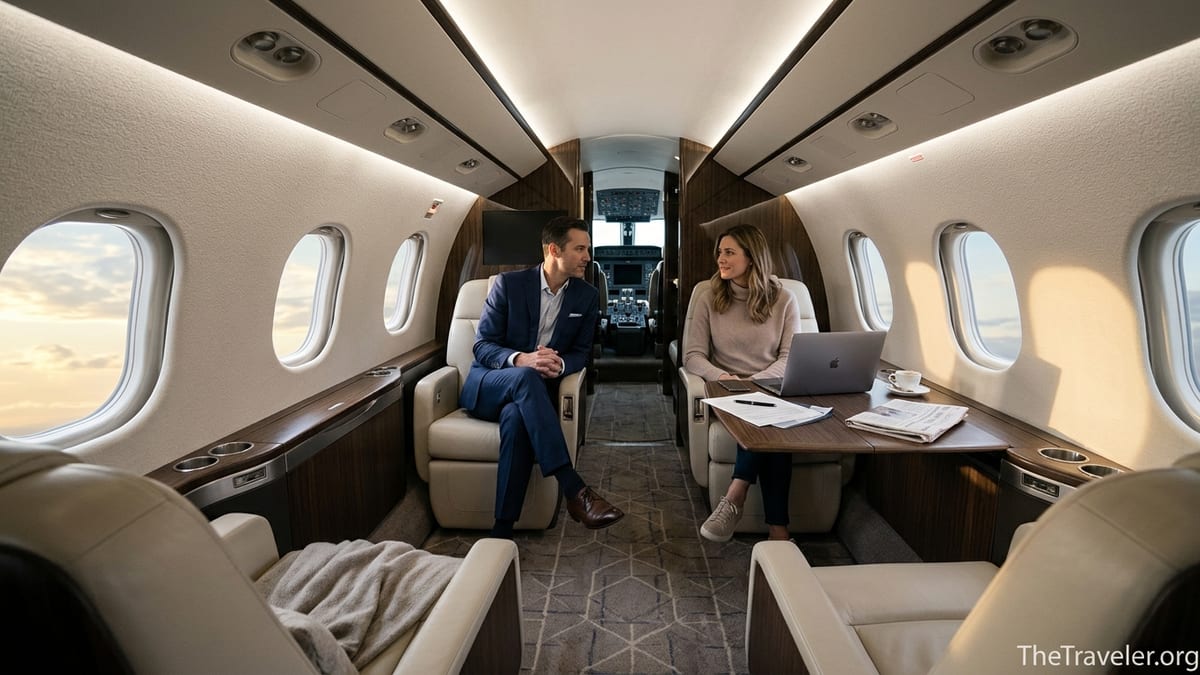
Flexjet is best known as a premium fractional jet ownership and leasing provider, with a focus on business and luxury travelers who fly regularly and demand predictable service. The company reports a roughly even split between Fortune 500 corporate clients and ultra-high-net-worth individuals, and highlights a high retention rate, which suggests that its service is designed for people who view private aviation as a core utility rather than an occasional indulgence. Instead of selling ad hoc flights, Flexjet sells access to a fleet through dedicated programs that trade flexibility and service guarantees for longer commitments and higher spend.
The fleet itself skews modern and high-performance. Flexjet operates aircraft such as the Gulfstream G650 for long-range intercontinental missions and the Embraer Praetor 600 and Phenom 300 for transcontinental and regional routes, along with other cabin sizes to match different mission profiles. For some U.S. and European jet owners, Flexjet has layered in a private helicopter division built around Sikorsky S-76 helicopters, which can be used to bridge the last miles into city centers or remote estates. In practice, this means a traveler can fly from New York to Palm Beach on a super-midsize jet and then transfer directly to a branded helicopter to land closer to a waterfront home.
Program choices range from fractional ownership shares and leases, which involve multiyear commitments and sizeable capital or credit exposure, to shorter-term Jet Card style products designed for travelers who want to trial the brand or commit to a fixed bucket of hours. Flexjet positions its 25-hour card as a stepping stone toward full fractional ownership, with prepaid hours on a specific aircraft type at a set occupied hourly rate plus applicable taxes and surcharges. For corporate flight departments, Flexjet also offers tailored solutions that sit alongside existing owned aircraft, providing overflow capacity or specialized aircraft like the G650 for occasional long-range trips.
Because the company emphasizes dedicated, non-union crewing and its own private terminals in select cities, its promise is less about simply providing an airplane and more about offering a controlled ecosystem. Regular clients will often see the same pilots and cabin servers, use branded lounges away from crowded fixed-base operators and benefit from a central team that learns their preferences down to catering orders and preferred ground transportation providers. This premium positioning shapes who should realistically consider Flexjet and who might be better served by charter or lighter-touch membership products.
Ideal Profile 1: Corporations With Predictable High-Value Travel
One of the clearest fits for Flexjet is the mid to large corporation with a steady flow of executive and project travel that justifies dozens or hundreds of private flight hours each year. This might be a publicly traded industrial firm sending teams between its Midwest headquarters and manufacturing plants in Texas and Mexico, or a technology company with frequent board and investor meetings on opposite U.S. coasts. For these organizations, commercial schedules, especially into secondary airports, often do not align with business needs, and the direct cost of private aviation must be weighed against executive time and deal velocity.
In a typical scenario, a company might commit to a 1/8 fractional share on a super-midsize jet such as a Praetor 600, which usually equates to around 100 annual flight hours. Over a five-year term, the business pays an upfront share price, fixed monthly management fees and an occupied hourly rate when flying. This structure makes sense when internal travel patterns are relatively predictable: for example, a leadership team that travels 8 to 10 days a month on average, with regular routes like Chicago to Raleigh or Houston to Denver that benefit from using smaller airports closer to plants or offices.
Flexjet’s dedicated corporate solutions teams are geared toward this type of client. A real-world use case could involve a financial services firm based in New York that needs guaranteed access to a long-range jet like the Gulfstream G650 for quarterly visits to London, Zurich and Dubai, while also needing a mix of super-midsize and midsize jets for North American roadshows. Instead of purchasing a single large-cabin aircraft and relying on charter for everything else, the firm might split its spend between a fractional share in a G650 program and supplemental hours or a lease on a smaller jet. Flexjet’s large-cabin fleet and European presence support this kind of hybrid pattern, allowing the company to standardize service quality across continents.
Another practical advantage for corporations is budget visibility. With fractional or lease programs, the finance team can forecast a large share of flight costs based on known rates and expected hours. This can be particularly attractive compared to on-demand charter, where high-demand periods such as major events in Davos, Las Vegas or New York can cause hourly rates to spike sharply. Companies that must move teams during these peak windows, like a media conglomerate moving camera crews and executives to major sporting events, often place a premium on guaranteed availability even when systemwide demand is elevated.
Ideal Profile 2: Ultra-High-Net-Worth Individuals and Families
Flexjet is also designed for private individuals and families for whom flying private is a frequent and integrated part of life. These are typically people who already own multiple homes, coordinate complex schedules around school terms and international business and routinely travel to destinations that are not well served by commercial airlines. A family that spends winters in Aspen, summers in the Hamptons and shoulder seasons in London and the south of France, while also running businesses in New York and Dallas, is the archetype of the Flexjet lifestyle client.
For such travelers, a 50-hour or 100-hour annual flying pattern is common, especially when factoring in last-minute weekend trips, holidays and unplanned business meetings. A fractional share or lease on a super-midsize jet can be justified when the family consistently flies four to six passengers on routes such as Teterboro to Eagle County, Dallas to San Jose del Cabo or London to Marrakech. With Flexjet, they might choose the Praetor 600 as a primary aircraft for most missions, while occasionally upgrading into a G650 for longer transatlantic flights. The ability to interchange hours across aircraft types at predefined ratios can reduce friction in planning these varied trips.
Luxury-minded individuals often care about much more than the aircraft specifications. Flexjet’s emphasis on consistent cabin service, curated catering and branded lounges appeals to clients who want a seamless experience from car door to car door. Consider a family leaving Manhattan for a long weekend in the Hamptons: they could be driven to a Flexjet partner heliport, board a Sikorsky S-76, and be on the lawn of their East Hampton property in under an hour, bypassing summer highway traffic. For longer trips, they might depart from a private Flexjet terminal in cities where these exist, reducing time spent in general aviation lounges.
This level of service does come at a price. While Flexjet does not widely publish specific hourly rates, indicative industry figures suggest that occupied hourly costs for a super-midsize aircraft can run into several thousands of dollars per hour, with additional monthly management fees for fractional owners. That makes Flexjet most appropriate for individuals whose annual travel spend is measured in high six or seven figures, and for whom the time and lifestyle benefits outweigh not only commercial business class but also traditional on-demand charter. It is often a step taken by clients who have already chartered extensively and now want guaranteed standards and familiar crews.
Ideal Profile 3: Frequent Flyers Needing Helicopter and Last-Mile Solutions
Where Flexjet begins to differentiate itself more sharply is in multimodal travel, particularly for travelers in the Northeastern United States and Florida who regularly contend with congested roads between airports and urban or coastal destinations. Flexjet’s helicopter division, built around Sikorsky S-76 helicopters, is targeted at exactly this crowd. Jet owners in the program can interchange a portion of their jet hours into helicopter hours, effectively turning a flight from a city airport into a push to the doorstep of a city-center office, Manhattan townhouse or barrier-island retreat.
A practical example is a chief executive based in Midtown Manhattan who frequently travels to client meetings in Boston and Philadelphia while commuting on weekends to a waterfront home in the Hamptons. A typical itinerary might involve a morning helicopter pickup from a Manhattan heliport to Teterboro, followed by a Flexjet super-midsize jet to Boston Logan or a nearby regional airport, and then a return flight in the evening with an S-76 leg back into the city. On Fridays, the same executive could skip the fixed-wing leg altogether and fly directly from Manhattan to an East Hampton or Montauk helipad, arriving in time for dinner without touching the Long Island Expressway.
In Florida, where Flexjet’s helicopter services are also active, similar patterns play out between Miami, Palm Beach, Naples and private communities set back from the coast. A hedge fund principal, for instance, might fly a Gulfstream G650 from London to Palm Beach on a long-range overnight trip and then transfer to a helicopter for the short hop to a property in a gated oceanfront enclave. For these travelers, the value proposition is measured finely in minutes saved and predictability gained, particularly during high season when traffic and airport congestion are worst.
Because helicopters require specialized crews, maintenance and infrastructure, very few private aviation providers operate an integrated fixed-wing and rotary-wing fleet under a single brand. Travelers who know they will regularly need this last-mile capability, and who prefer to deal with a single provider for both the jet and the helicopter, are among those who stand to benefit most from Flexjet’s model. Others, who only occasionally need a helicopter, may find it more economical to rely on stand-alone helicopter charter companies rather than structurally embedding rotary-wing flying into their jet program.
Ideal Profile 4: Global Travelers With Complex Itineraries
Flexjet’s emphasis on large-cabin, long-range jets and its presence in both North America and Europe make it a natural fit for clients whose lives and businesses span continents. Travelers regularly flying between the United States and Europe, or combining transatlantic sectors with onward regional legs, can use aircraft like the Gulfstream G650 and Praetor 600 to knit together itineraries that commercial schedules rarely serve nonstop. A multinational law firm coordinating partners across New York, London and Frankfurt, for example, might use a G650 to shuttle small teams between these hubs during multi-day deal negotiations.
For entrepreneurs in sectors like private equity or real estate, Flexjet’s portfolio can support routings such as New York to Berlin, followed by Berlin to a secondary city in southern Europe, with the flexibility to adjust departure times at short notice. The ability to operate into smaller airports closer to project sites, such as Cannes Mandelieu instead of Nice, or Teterboro instead of JFK, can shave hours off door-to-door times. When combined with Flexjet’s interchange structures between Europe and the U.S., these travelers gain not only range but also the option to match aircraft size to each leg’s passenger count and runway profile.
Some clients are increasingly sensitive to sustainability and fuel efficiency, especially those with public-facing brands or institutional investors asking pointed questions about environmental, social and governance policies. Flexjet has highlighted its participation in sustainability initiatives, including the use of fuel offsets and partnerships around more efficient aircraft, and it has placed future-oriented orders with manufacturers working on high-efficiency jets. While none of this makes private aviation carbon neutral, clients who must fly but want to marginally improve the environmental profile of their travel may see value in working with a provider that openly addresses these concerns and invests in newer, more efficient aircraft types.
It is important, however, to distinguish between global travelers who truly need long-range capability and those for whom it is more aspirational. A family that takes one or two transatlantic vacations a year but otherwise flies short domestic legs might be better served by a combination of charter and occasional commercial business class tickets. Flexjet’s global strengths are best leveraged by those who genuinely run cross-border operations or spend significant portions of the year on different continents.
When Flexjet May Not Be the Right Fit
Despite its strengths, there are many situations in which Flexjet is not the optimal solution. One obvious case is the traveler who only needs a handful of private flights per year. A small professional services partnership that charters a light jet three or four times annually for client pitches, or a family that splurges on a private flight for an annual ski trip, will usually find that the capital commitment and monthly fees of fractional ownership or leasing outweigh any benefits. For them, on-demand charter via reputable brokers or digital platforms remains the more sensible choice.
Another group that might think twice about Flexjet includes ultra-flexible travelers who rarely know their schedules far in advance and demand near-spontaneous departures across widely varying routes. While Flexjet programs do offer relatively favorable guaranteed availability compared with many jet card products, any structured program has blackout periods, peak-day restrictions or notice requirements that help the operator manage its fleet. A celebrity who decides mid-afternoon to fly a different entourage to a different city every evening during a tour might find it easier, at least in the short run, to work with charter brokers who can scour the entire market for last-minute aircraft rather than relying on a single provider’s fleet.
Cost-conscious high-net-worth individuals also need to be realistic. Some wealthy travelers who primarily fly between a couple of well-served city pairs, like New York–Miami or Los Angeles–San Francisco, continue to find good value in first or business class on commercial airlines, especially when they do not insist on full aircraft privacy. Even for those committed to flying private, shopping the charter market or using capped-rate membership programs can sometimes deliver lower effective hourly costs than locking into a fractional share with high upfront investment. Travelers who are still experimenting with private aviation and have not yet built a consistent flying pattern may want to spend a year or two chartering before graduating to Flexjet’s more structured offerings.
Finally, personality fit matters. Flexjet’s brand appeals strongly to clients who enjoy a club-like environment, with dedicated service teams, private terminals and familiar crews. Some travelers, however, prefer anonymity and the ability to sample different operators and aircraft interiors. They may value the novelty of regularly trying different jets, crews and cabin layouts, something more easily achieved by working through charter brokers with access to a wide range of operators rather than committing to one operator’s aesthetic and service style.
The Takeaway
Flexjet occupies a specific and somewhat rarefied space in private aviation. It is built for users who treat private flying as a core tool rather than a luxury add-on: corporations that need reliable executive lift, ultra-high-net-worth individuals whose personal and professional lives span multiple homes and continents, and travelers for whom helicopters and last-mile logistics are not an occasional perk but a regular necessity. When used in this context, with annual flight hours easily running into the dozens or hundreds and a clear appetite for a curated ecosystem, Flexjet’s fractional and lease structures can deliver a strong mix of convenience, predictability and service depth.
On the other hand, occasional flyers, cost-driven travelers and those still exploring whether private aviation truly fits their lifestyle are usually better served by on-demand charter or more flexible membership models. The capital and contractual commitments that underpin Flexjet’s strengths are the same features that can feel rigid for those without stable, high-intensity travel needs. The key is to map your real-world flying patterns, budget and expectations for service against what Flexjet actually provides, rather than the aspirational image of private jets in general.
For the right traveler, Flexjet can feel less like a transportation provider and more like an extension of one’s office and home, with familiar crews, consistent aircraft and the ability to move seamlessly from city center to remote retreat. For everyone else, it remains a benchmark brand worth understanding, even if the smartest move is to watch from the sidelines or approach private aviation through lighter, more experimental options before stepping into the fractional arena.
FAQ
Q1. How many hours a year do I need to fly for Flexjet to make sense?
Most Flexjet clients tend to fly at least 50 to 75 hours per year, with many corporate and ultra-high-net-worth travelers exceeding 100 hours. Below this level, on-demand charter often remains more economical, though a 25-hour card can be a useful bridge for those testing whether their usage will grow.
Q2. Is Flexjet cheaper than chartering private jets ad hoc?
For occasional users, Flexjet is rarely cheaper than booking individual charters. Its value comes from predictable pricing, guaranteed availability and consistent service for regular flyers. Once your annual hours grow and you place a premium on reliability during peak periods, the higher upfront commitment can be offset by these operational advantages.
Q3. What kinds of aircraft does Flexjet operate?
Flexjet operates a range of light, midsize, super-midsize and large-cabin jets, including popular models such as the Embraer Phenom 300, Praetor 600 and Gulfstream G650, along with a fleet of Sikorsky S-76 helicopters in select markets. This variety allows clients to match aircraft size and range to each specific trip.
Q4. Do I have to buy a fractional share to use Flexjet?
No. While fractional ownership and leasing are Flexjet’s core products, the company also offers shorter-term solutions, including a 25-hour style jet card program. These options are typically used by travelers who are not yet ready for a multiyear commitment or who want to experience the service before investing in a share.
Q5. Who is the typical Flexjet client?
Flexjet serves a roughly even mix of Fortune 500 corporations and ultra-high-net-worth individuals. Typical clients include company founders, senior executives, family offices and affluent families who split time among multiple homes and conduct business in several cities or countries.
Q6. How does Flexjet handle international travel?
Flexjet supports extensive international travel, especially between North America and Europe, through its long-range aircraft such as the Gulfstream G650 and its operational presence on both sides of the Atlantic. Clients can use large-cabin jets for transoceanic legs and then switch to smaller aircraft for regional segments at their destination.
Q7. Does Flexjet offer any sustainability or environmental initiatives?
Flexjet promotes its use of newer, more fuel-efficient aircraft types and offers options such as carbon offset programs and participation in sustainable aviation fuel initiatives where available. These measures do not eliminate emissions but can modestly reduce or mitigate the environmental impact compared with older fleets and less structured programs.
Q8. How do Flexjet’s helicopters fit into a typical itinerary?
Flexjet’s Sikorsky S-76 helicopters are primarily used for short regional hops and last-mile connections in markets such as the Northeastern United States and Florida. Common use cases include transfers between city heliports and airports, as well as direct flights to coastal communities, estates or remote properties that are difficult to reach by road.
Q9. What level of notice does Flexjet usually require to book a flight?
Specific notice requirements depend on the program, aircraft type and whether the day is classified as peak or non-peak. In general, standard days may require a day or two of notice, while peak-demand periods can require longer lead times. Many regular clients, especially corporations, plan frequent routes well in advance to secure preferred departure windows.
Q10. How should I decide between Flexjet and other private aviation options?
The decision comes down to your annual flight hours, route patterns, budget and service expectations. Travelers who fly often, value consistent crews and aircraft, and need guaranteed access during busy periods are natural Flexjet candidates. Those with sporadic or experimental private travel needs are usually better off starting with on-demand charter or lighter membership products before considering a fractional or lease commitment.