


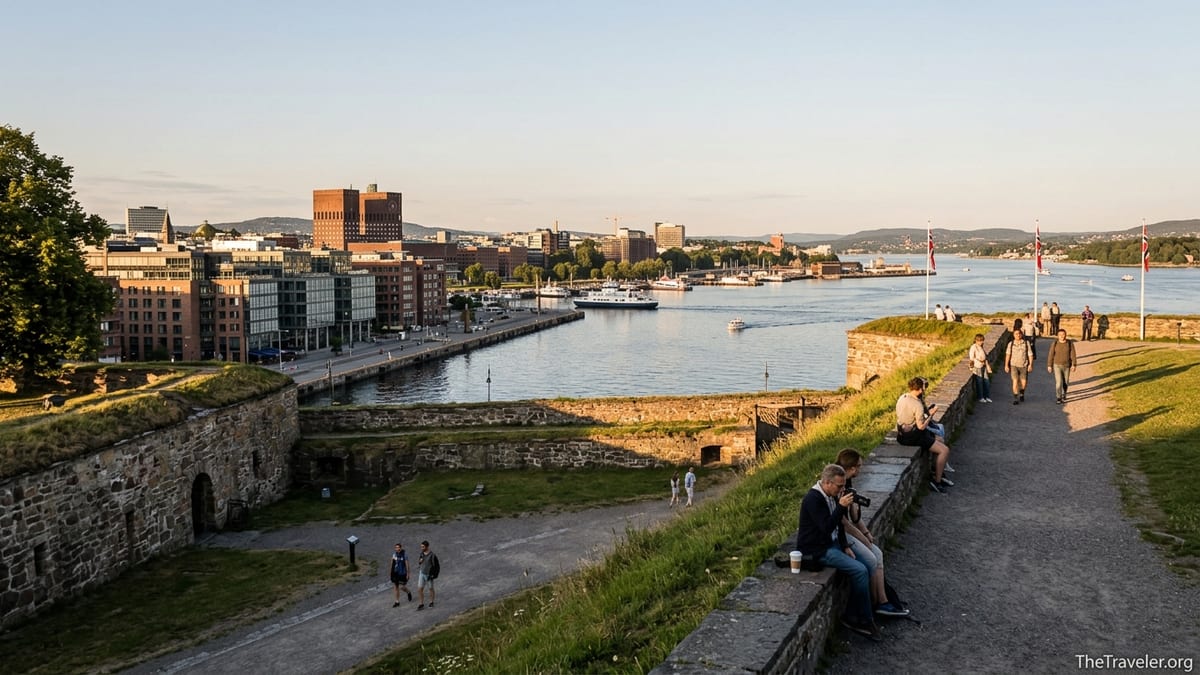
Stand on the ramparts of Akershus Fortress and you can read Norway’s story in a single sweep of the eyes: medieval stone walls at your back, glass-fronted office blocks on the waterfront below, ferries cutting across the Oslofjord where foreign navies once tried to break through. Few places in the Norwegian capital offer such an immediate sense of how the past and present still share the same compact patch of land. For travelers who want more than just pretty views, Akershus feels like Oslo’s hidden window into the country’s complicated, resilient history.
Get the latest updates straight to your inbox!
A Fortress That Grew Up With Oslo
Part of what makes Akershus Fortress so compelling is that it has been evolving alongside Oslo for more than 700 years. The first stone walls were raised in the late 1200s after earlier defenses proved too weak, turning a rocky headland above the harbor into the kingdom’s new stronghold. Standing today in the cobbled courtyard, with the skyline of modern Bjørvika visible through the main gate, it is easy to imagine medieval traders pulling their ships into what was then a tight, vulnerable harbor town. The same slope you stroll up from the city center is the one soldiers once hurried along with pikes and powder.
Unlike many European castles that ended as romantic ruins, Akershus remained a working fortress and power center well into modern times. Over the centuries the medieval castle was reshaped into a Renaissance residence, a prison, a garrison and even a ceremonial royal mausoleum. That continuity means when you walk from the lower artillery batteries up to the castle’s chapel, you are not moving through a frozen museum piece but through spaces that governments and armies have repeatedly adapted to new threats. Oslo City Hall’s brick towers and the sleek glass of the National Museum across the water underline how close the country’s political and cultural life still sits to its old defensive heart.
For visitors, this close overlap of eras is immediately practical. It is a ten- or fifteen-minute walk from the busy Jernbanetorget transport hub by Oslo Central Station to the main fortress gate, and another few minutes up through the inner courtyards. You quite literally rise out of the traffic and tram tracks into a self-contained world of stone and grass. The change in atmosphere feels abrupt: one moment you are passing chain coffee shops and office workers on bikes, the next you are peering at arrow slits cut into the walls.
Free-to-Wander Ramparts With Million-Krone Views
Akershus also functions as one of Oslo’s most generous public parks. The fortress grounds are open daily and entrance to the outdoor areas is free, which matters in a city where a simple café latte can approach the equivalent of 5 to 6 US dollars. Locals use the lawns and ramparts much like any other green space. On warm evenings in July you will see office workers in shirtsleeves sharing packets of strawberries on the grass, students reading on the low stone walls, and joggers looping past the bastions with the fjord breeze in their faces.
Travelers benefit from this relaxed attitude. You can wander the ramparts at your own pace, pausing to trace the fortress walls with your fingers and then turning outward to the view of Aker Brygge’s restaurants, the ferries to Nesodden sliding away from the quay, and cruise ships easing into port. Many first-time visitors plan only a quick look and end up staying an hour or two, using the fortress as a quiet balcony above the waterfront, especially in late summer when the light lingers well past 9 pm.
The lack of a turnstile at the gate also makes Akershus an attractive option if you are trying to keep a tight budget. It is entirely possible to spend half a day here spending nothing more than the cost of a takeaway coffee from a kiosk near the City Hall. Even if you choose to go inside one of the museums or the castle itself, you can walk the walls, photograph the harbor and follow the information boards around the grounds without showing a ticket. For many visitors, that combination of deep history and free access is what makes the fortress feel like Oslo’s best-kept open secret.
Inside the Castle: Royal Power and Everyday Life
Step through the gate into Akershus Castle and the mood shifts from open parkland to intimate interior history. Tickets are usually priced in the range of what you would pay for a simple restaurant main course in central Oslo, and entrance is included with the city’s official sightseeing pass, which makes the castle more affordable if you are planning several museum visits in one day. Once inside, you move through a series of furnished halls, royal chambers and banquet rooms that bring the abstract idea of “Norwegian monarchy” down to the level of wallpaper and worn stair treads.
In the richly decorated halls, guides like to point out details that travelers would otherwise miss: the way Renaissance tapestries were used as insulation against North Sea winters, or how the royal crypt in the castle chapel holds the remains of modern Norwegian monarchs, a reminder that the building never fully retreated into the past. Standing quietly in the chapel, with faint traffic noise filtered through thick stone, it is easier to grasp how fragile Norway’s independence has often felt. The country only regained full sovereignty from Sweden in 1905, and the decision to bury kings here rather than in a countryside cathedral underscores how central this fortress has remained to national identity.
Practical touches keep the experience grounded. Guided tours in English are typically offered on weekends in high season, often at fixed times around midday and mid-afternoon, lasting under an hour. The castle is compact enough that families with children can manage it without fatigue, yet detailed enough that history enthusiasts can linger over carved wooden ceilings and glass cases containing period weapons and uniforms. For travelers used to palaces roped off at arm’s length, the relative lack of crowds on a normal weekday afternoon can feel surprisingly intimate.
From Occupation to Resistance: Norway’s WWII Story on Foot
If the castle tells the story of kings and power, the Norway’s Resistance Museum and the Norwegian Armed Forces Museum, both set within the fortress, bring the narrative right down to the level of teachers, farmers and students facing occupation. The Resistance Museum occupies a 17th-century building close to a memorial courtyard where Norwegian patriots were executed during the German occupation. Exhibits lead visitors from the invasion of April 1940 through clandestine newspapers, sabotage operations and underground radio transmitters, using original objects rather than replicas wherever possible.
In practical terms, you might pay the equivalent of a modest bistro lunch for admission, or use a combined ticket that also covers the Armed Forces Museum and the castle. Many travelers describe the Resistance Museum as one of Oslo’s most moving experiences. You walk past simple artifacts like coded letters, primitive weapons dropped by Allied aircraft, and armbands worn by members of the Milorg resistance network. Black-and-white photos show ordinary Oslo streets almost unchanged, except for the German uniforms and flags. For visitors from larger nations, it can be eye-opening to realize how thinly stretched Norway’s defenses were and how much depended on individual courage rather than heavy weaponry.
A short walk downhill brings you to the Norwegian Armed Forces Museum, housed in a solid brick arsenal building near the lower gate. Where the Resistance Museum zooms in on the five war years, this one zooms out to cover Norway’s entire military history from medieval levy armies to modern NATO deployments. Travelers with an interest in military technology will find Viking swords, early cannons, uniforms from the union with Denmark and Sweden, and Cold War-era equipment. Families appreciate the clear chronological layout, which works almost like a timeline you can walk, making it easier for teenagers and younger travelers to piece together how Norway’s story connects to broader European conflicts.
Seen together, the two museums make the phrase “window into Norway’s past” literal. In the Resistance Museum you might stand before a display about an illegal newspaper printed in a cramped Oslo apartment; step back outside and you can look over the city where those same streets still exist. In the Armed Forces Museum you see how the fortress shifted from medieval bastion to national symbol. Then you emerge onto the grass, where children play under the same walls from which cannons once faced the sea.
Everyday Oslo Life Inside the Fortress Walls
One reason Akershus does not feel like a sealed-off monument is that parts of the complex are still in use. The Norwegian Ministry of Defence occupies offices within the fortress perimeter, and you may see uniformed personnel heading into modern buildings just steps from 17th-century stone. Occasional official ceremonies, from military parades to remembrance events on Norway’s Liberation Day on 8 May, take place here. For visitors, glimpsing this ongoing use is a reminder that the site is not purely theatrical. The fortress remains part of how the state presents itself to its citizens and to the world.
Yet outside those clearly marked areas, Akershus is disarmingly informal. On a weekday morning you might see kindergarten groups in reflective vests picnicking on the grass, or local photographers testing long exposures of the harbor just after dawn. In December, when daylight is brief and the air cuts close to freezing, residents still walk their dogs along the paths, stopping to greet friends beneath the same walls tourists photograph in July. Street musicians occasionally set up near the main gate on sunny days, playing to a mix of tour groups and office workers cutting through on their way to meetings.
This blend of everyday life and layered history is what makes the fortress feel like a window rather than a closed archive. Travelers are not confined to a strict route. You can detour down a quiet path to a lesser-used bastion, discover an information board explaining a 17th-century gun battery, then emerge unexpectedly next to a modern glass office building outside the walls. The transitions between old and new are so frequent that you become more aware of how Oslo has grown around its fortress rather than simply replacing it.
Planning Your Visit: Practical Details That Shape the Experience
Because Akershus sits right in the city center, you can fold a visit into almost any Oslo itinerary. Many travelers pair it with a morning visit to the waterfront opera house or the MUNCH museum, then walk along the harbor promenade toward the fortress in the afternoon. If you are arriving by cruise ship, the fortress walls are often one of the first landmarks you see as you sail into the harbor, and the walk from the quay to the lower gate typically takes less than ten minutes at an easy pace.
The fortress grounds are generally open daily, but the specific opening hours for Akershus Castle, the Resistance Museum and the Armed Forces Museum vary by season. In the high summer months it is common to find opening times stretching from late morning into the later afternoon, while in winter hours are often shorter and some days may be closed. It is worth checking current schedules closer to your travel date, especially if you are visiting outside June, July or August. English-language guided tours of the castle are typically concentrated on weekends and peak season, and group sizes can be modest compared with larger European attractions, which keeps the experience personal.
In terms of cost, a rough rule of thumb is that a single museum ticket at Akershus sits in the same price band as an inexpensive main course at a casual Oslo restaurant. The city’s official sightseeing pass, which includes public transport, can represent good value if you plan to see multiple sights in a single day, since Akershus Castle and the Armed Forces Museum are generally among the attractions covered. Since the outdoor areas are free, budget-conscious travelers often choose to explore the grounds thoroughly, then select just one or two paid interiors that match their interests, whether that is royal history, broader military narrative or the resistance story.
Weather has a strong impact on how Akershus feels. On a blue-sky afternoon in late June the lawns and walls invite lingering, and you can comfortably spend several hours moving between sunny viewpoints and cool interior rooms. On a raw, windy day in March, the fortress can feel stark and exposed, but ducking into the Resistance Museum or the castle itself offers both shelter and context. Sensible shoes matter more than fashion here, as many paths are cobbled or uneven, and in winter there can be ice on shaded slopes. Even in summer a light jacket or sweater is advisable, as the breeze from the fjord can be surprisingly cool when you are standing on the ramparts.
Reading Norway’s National Story Through One Landmark
What ultimately sets Akershus apart from other Norwegian sights is how many chapters of the national story you can access without leaving its walls. The medieval fear of foreign attack is written into the thickness of the curtain walls. The centuries of union politics and royal ceremony echo in the castle chapel and banquet halls. The trauma and resilience of the Second World War live in the Resistance Museum’s modest rooms and in the memorial courtyard. The ongoing reality of Norway’s role in international security is reflected in the Armed Forces Museum and the working offices of the Ministry of Defence.
For travelers, that concentration of history means a visit to Akershus can serve as a kind of orientation session for the rest of a trip through Norway. After walking the fortress, you may find that a later visit to the Viking Ship Museum, the polar exploration exhibits at Bygdøy or even a ferry ride along the Oslofjord all feel more connected. You have already seen how geography, trade, politics and conflict intersect over time in one specific place. The sea you look out on from the ramparts is the same route used by medieval merchants, German warships and modern container vessels.
Perhaps most importantly, Akershus shows how Norwegians choose to remember their own past. The absence of heavy-handed pageantry, the coexistence of picnicking locals and solemn memorials, and the practical reuse of old buildings hint at a national comfort with layered, sometimes uncomfortable history. As a visitor, peering through that window into the past can help make the rest of Oslo’s museums, monuments and everyday neighborhoods feel more legible.
The Takeaway
Akershus Fortress rewards both casual wanderers and committed history enthusiasts. You can treat it as a scenic detour above the harbor, a free alternative to a city park with better views, or as a multi-hour dive into royal ceremony, military technology and underground resistance. Either way, the experience is anchored in a real, compact piece of ground where key episodes of Norwegian history unfolded.
In a city transforming its waterfront with new museums, apartments and office towers, Akershus remains the fixed point against which change is measured. From its grassy ramparts and echoing halls you gain a perspective on Oslo that is not purely visual, but historical and emotional too. That is why, for many travelers, this hilltop fortress feels less like a standard attraction and more like Oslo’s hidden window into Norway’s past.
FAQ
Q1. Is it free to visit Akershus Fortress?
The outdoor fortress grounds and ramparts are free to access, while entry to Akershus Castle and the on-site museums requires a paid ticket or city pass.
Q2. How much time should I plan for a visit?
If you only walk the grounds and enjoy the views, an hour can suffice, but visiting the castle and both museums comfortably can take half a day.
Q3. Are there guided tours in English?
Yes, guided tours of Akershus Castle in English are typically offered in the main summer season, often on weekends at set times around midday and mid-afternoon.
Q4. Can I visit Akershus Fortress in winter?
Yes, the grounds remain open in winter, though paths can be icy and museum hours are usually shorter, so it is wise to check seasonal schedules in advance.
Q5. Is Akershus suitable for children and strollers?
Families are common, but the steep cobbled paths and uneven surfaces can be challenging for strollers, so a baby carrier and sturdy shoes are often more practical.
Q6. Do I need to book tickets in advance?
For most of the year you can usually buy tickets on arrival, though checking current advice before peak summer weekends or holidays is recommended.
Q7. Is there food or drink available inside the fortress?
You may find seasonal cafés or kiosks nearby, but many visitors bring snacks or grab coffee from the harborfront before climbing up to the fortress lawns.
Q8. Can I combine Akershus with other Oslo sights in one day?
Yes, its central location makes it easy to pair with the opera house, MUNCH museum, City Hall or harborfront neighborhoods within a single day’s walking itinerary.
Q9. Are there security restrictions at the fortress?
Some buildings remain in active use by the Norwegian armed forces, so certain areas are off-limits and you should respect signs, fences and any instructions from staff.
Q10. Is Akershus Fortress accessible by public transport?
Yes, it is within a short walk of major tram, bus and metro stops near Oslo Central Station and the City Hall area, so you rarely need a taxi to reach it.