


Akershus Fortress sits on a rocky headland above the Oslofjord, guarding Norway’s capital with stone walls that have watched over the harbor since the late 1200s. For many visitors it ends up as a quick photo stop between the opera house and Aker Brygge, but with a bit of planning you can turn it into one of the most rewarding walks in Oslo, pairing some of the city’s best views with immersive medieval and World War II history. This guide shows you exactly how to explore Akershus without missing the highlights.
Get the latest updates straight to your inbox!
Getting Oriented: Fortress vs Castle and What Is Free
The first step to exploring Akershus efficiently is understanding the difference between the fortress and the castle. The term Akershus Fortress refers to the entire walled complex on the hill above the harbor: the outer gates, cobbled lanes, lawns, ramparts, bastions, and several museums. This whole area is treated much like a public park and, in normal seasons, you can walk the grounds for free from early morning until late evening.
At the core of the complex sits Akershus Castle, a compact medieval and Renaissance building with steep roofs and pale stone walls. The interior of the castle is ticketed and operates with limited opening hours that can change when state events are held. Inside you find the Royal Mausoleum, the Castle Church, reception halls, and darker vaulted spaces such as the former dungeons. You can easily have a memorable visit to Akershus without going inside the castle, but the interior adds depth if you are interested in royal and military history.
For most travelers on a short stay in Oslo, the smart strategy is to treat the fortress grounds and viewpoints as the “must do” portion of the visit, then add one indoor site if time and budget allow. Because the lawns, courtyards, and ramparts are free, you can spend an hour soaking up views over the Oslofjord and Aker Brygge even if you are watching your expenses closely.
It also helps to know what not to expect. Akershus is not a sprawling palace complex like Versailles, but a more austere northern fortress. Rooms are smaller and darker, and the mood is closer to a working stronghold than to a lavish royal residence. Understanding that in advance helps you appreciate the site on its own terms rather than judging it against larger European castles.
Planning Your Visit: Timing, Access, and Practical Details
Location and access are straightforward. The fortress is a short walk from Oslo City Hall and the harborfront. Many cruise ships dock right below at Akershus Quay, which means some passengers can reach the main gate in under ten minutes on foot. If you arrive via public transport, riders often walk from Nationaltheatret station along the waterfront or hop off the tram at Kontraskjæret and follow signs up through the stone archway entrance.
The fortress grounds usually open early, often around 6:00 in the morning, and stay accessible until late evening. Exact gate times can shift with the season, and some gates may open or close at different hours, so it is worth checking the day before your visit, especially in winter. In contrast, indoor attractions such as the castle interior, the Armed Forces Museum, and the Norwegian Resistance Museum typically operate standard daytime hours, roughly late morning to midafternoon. If you plan to visit inside the castle, build your day around those shorter opening windows.
From a timing perspective, two windows consistently reward visitors with great light and fewer crowds. Early morning offers quiet ramparts and soft light over the harbor, ideal if you want uncluttered photographs of the Oslo skyline, ferries, and the opera house roof. Late afternoon and the hour before sunset, particularly from May to September, give warm golden light on the stone walls and the fjord, and you will often see locals using the lawns as their after-work park.
Practical preparation makes the difference between a leisurely visit and a frustrating one. Wear shoes with decent grip; the cobblestones, gravel, and occasional patches of ice or packed snow in winter can be surprisingly slippery, especially on the steeper paths up to the ramparts. In colder months, wind off the Oslofjord can make the headland feel much chillier than the city streets below, so pack a windproof layer, hat, and gloves even if the rest of Oslo feels mild.
The Essential Walking Route for the Best Views
To avoid wandering aimlessly and missing key viewpoints, follow a simple loop through the fortress. After passing through the main gate, many visitors turn left toward the small visitor center near the Karpedammen pond. It is worth stepping inside to pick up a free paper map and check which buildings are open that day. Staff can also point out if parts of the castle are closed for official events, which happens occasionally during state visits or ceremonies.
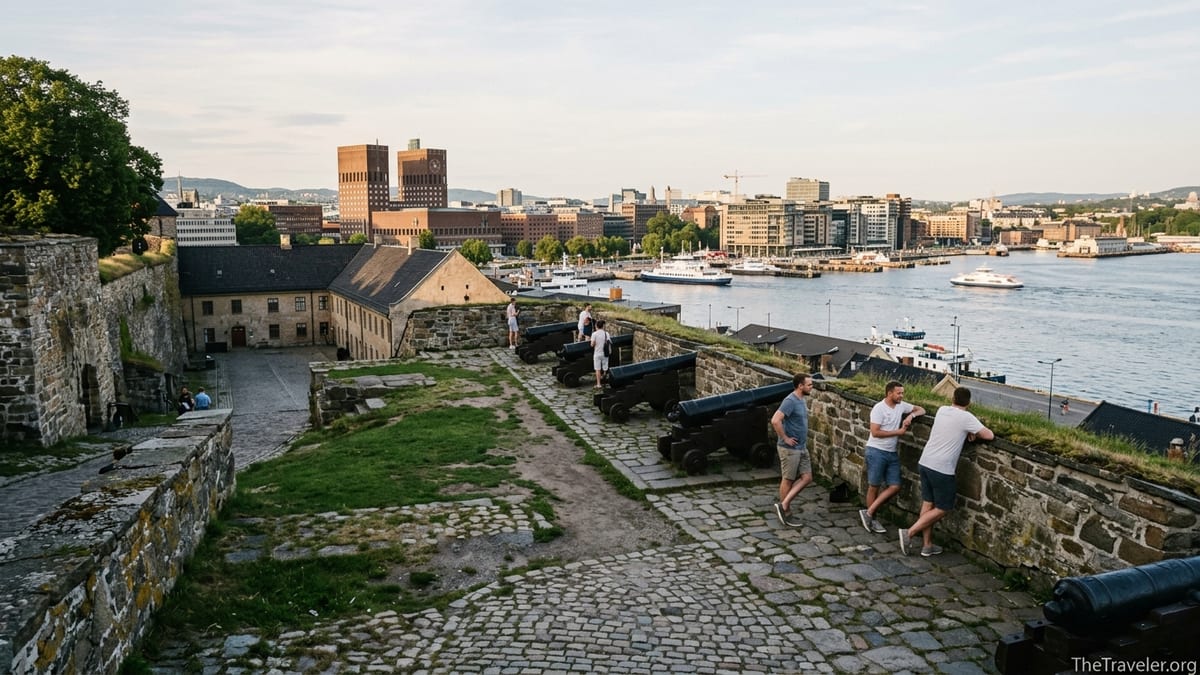
From the visitor center, head uphill and aim directly for the southern ramparts, often referred to locally as the cannon bastions. This stretch of wall looks down over the Oslofjord, the cruise terminals, and the modern glass and steel of Aker Brygge. On clear days, ferries and island boats crisscross the water while office workers cluster at café terraces below. Many travel photographers cite this section as the single best elevated view of central Oslo that you can reach in under fifteen minutes of walking from the city hall.
Continue along the ramparts toward the western side of the fortress. Here, the views shift from open water to a layered cityscape: Oslo City Hall’s twin brick towers, the newer Barcode district’s narrow high-rises, and the sloping white roof of the opera house in the distance. In summer, couples and families often sit on the grassy slopes below the walls, using the cannons and bastions as informal picnic spots. In winter, you may have entire stretches of the wall to yourself, with snow softening the outlines of the bastions and footprints tracing previous visitors’ routes.
As you loop back toward the interior, drop down into the main cobbled courtyard just below the castle. This angle gives a classic fortress feel: thick stone walls, timbered gatehouses, and views up to the castle façade. From here, you can either continue exploring the free outer grounds or divert into the paid attractions, depending on your interests and available time.
Inside Akershus Castle: What Not to Miss
Buying a ticket to Akershus Castle makes sense if you are drawn to royal history, architecture, or the more atmospheric corners of medieval buildings. Inside, you move through a sequence of rooms that range from formal audience halls with painted ceilings and chandeliers to simpler stone chambers that once served as prisons or storerooms. Because the castle is still used for Norwegian state events, some rooms may be closed on specific days, another reason to confirm details at the visitor center.
One of the most historically significant spaces is the Royal Mausoleum, where several Norwegian monarchs and their consorts are entombed. The room is relatively modest in scale compared with royal crypts in larger European capitals, but its very simplicity reinforces the restrained Norwegian aesthetic. Nearby, the Castle Church offers a contrasting sense of vertical space and light, with wooden furnishings and an understated altar that reflect Lutheran traditions.
Visitors who enjoy stories of sieges and resistance usually gravitate toward the older sections of the castle, where thick walls and narrow windows evoke its defensive origins. Guides sometimes point out marks in the masonry that date back centuries or explain how the fortress survived attacks and occupations that reshaped Norway. In some areas, exhibits highlight Akershus’s role as both a prison and a symbol of authority, including during the Second World War when the occupying forces used it as a stronghold.
If your time in Oslo is limited, think of the castle interior as a one to one and a half hour commitment added on top of your walk around the grounds. Many travelers with tight cruise ship schedules choose to walk the ramparts and visit one indoor site, often the Norwegian Resistance Museum, rather than trying to fit everything into a single rushed stop.
Key Museums and Stories: Resistance, Armed Forces, and Beyond
Akershus Fortress houses two main museums that focus on military history, each with a different angle. The Norwegian Resistance Museum concentrates on the period of Nazi occupation from 1940 to 1945. Exhibits use personal stories, original artifacts, and recreated scenes to explore how ordinary Norwegians resisted, from clandestine newspapers hidden in firewood to sabotage operations against heavy water facilities. Travelers who have visited the museum often comment on its emotional impact and the way it connects Norway’s wartime struggles with familiar locations in modern Oslo.
The Armed Forces Museum covers a broader sweep of Norwegian military history, stretching from the Viking era through the Cold War. Visitors pass displays of uniforms, weapons, and vehicles, including artillery and armored vehicles in the outdoor courtyard. For travelers who enjoy hardware and strategic overviews, it can easily fill one to two hours. Those who are less interested in military detail may find the Resistance Museum more engaging and focused.
On a typical visit, it is realistic to combine the fortress walk with one museum and still feel unhurried. For example, a Saturday plan might involve a late morning stroll around the ramparts, an early afternoon visit to the Resistance Museum, and then a coffee break at the harbor below. Museum tickets are usually modestly priced compared with larger European capitals, and they are often included in the Oslo Pass, which can save money if you plan to visit multiple paid attractions in the city over one or two days.
Beyond formal museums, the fortress itself functions as an open-air exhibit. Interpretation boards around the grounds outline key episodes, from medieval sieges to the role of Akershus in modern national ceremonies. If you prefer more narrative context, several local walking tour companies include the fortress on World War II or “Old Oslo” itineraries, often timing their route to coincide with the best viewpoints for photography.
Seasonal Tips and Realistic Time Planning
The way you experience Akershus Fortress changes with the seasons, and planning around that can help you avoid disappointment. In summer, especially from June through August, the lawns and open spaces feel like a central city park. Office workers come up for picnic lunches, locals sunbathe on the slopes below the walls, and occasional open-air events or concerts take place within the grounds. If you visit in peak summer, allow extra time to linger, and expect a more relaxed, social atmosphere.
In late autumn and winter, daylight is short and the fortress can feel very different. The wind off the fjord is sharper, and icy patches develop on cobbles and steps. Many travelers treat Akershus as a short scenic detour of 30 to 45 minutes on their way between other indoor attractions such as the National Museum and the opera house. The upside is a quieter, more atmospheric visit, with views over a steel-blue fjord and the possibility of snow dusting the cannon lines.
Realistically, you should budget at least one hour if you only want to walk the grounds and enjoy the viewpoints, and around two and a half to three hours if you plan to add either the castle interior or one museum. Trying to fit all three major indoor sites plus a full rampart walk into a single short stop, such as a half-day cruise call, tends to leave visitors rushed and unsatisfied. Instead, prioritize based on your interests: views and general history, royal interiors, or detailed wartime stories.
Time of day also shapes your photographic results. Morning light falls from behind the city, illuminating the harbor and fortress walls, while late afternoon backlights the fjord and silhouettes ferries and islands. If your schedule is flexible, consider visiting twice: a quick early walk on your first day in Oslo to get oriented, then a slower sunset visit later in your trip when you understand the city’s layout and can better appreciate how strategically Akershus commands the harbor.
Common Mistakes to Avoid at Akershus Fortress
Several recurring missteps prevent visitors from getting the most out of Akershus. One of the most common is treating it only as a backdrop for harbor photos taken from below. While the view of the fortress from the promenade near the cruise terminal is certainly scenic, the reverse view from the ramparts down to the city is even better and does not require much extra effort.
Another frequent mistake is arriving at the castle doors without checking the day’s opening status. Because Akershus Castle continues to host official events, there are days when certain rooms or even the entire interior close at short notice. Travelers who skip the visitor center or neglect to verify current information risk spending time climbing up only to find locked doors. Building a little flexibility into your plan, and having a backup such as the Resistance Museum or an extended rampart walk, keeps your visit enjoyable even if plans change.
Footwear and clothing are also underestimated. Visitors in smooth-soled fashion boots or summer sandals often struggle on cobblestones, particularly on damp or frosty days. Similarly, those who come up from the relatively sheltered streets in lightweight jackets are sometimes surprised by the stronger wind along the walls, cutting their visit short. Treat the fortress more like a low hill walk than an indoor museum in terms of what you wear.
Finally, many travelers rush past the interpretation boards and the quieter inner courtyards, focusing only on big views and photo angles. Taking ten extra minutes to read a panel about a historic siege, or to stand in one of the smaller yards where soldiers once drilled, adds context that can make the open views feel more meaningful. Akershus is not only a viewpoint but a place where decisions affecting Norway’s history were made.
The Takeaway
Exploring Akershus Fortress without missing its best views and historic sites comes down to a few simple choices. Understand the difference between the free fortress grounds and the ticketed castle interior, then decide in advance whether you want to add a museum. Aim for early morning or late afternoon when the light over the Oslofjord is at its most flattering, and give yourself enough time to complete a full loop along the southern and western ramparts.
Use the visitor center near Karpedammen to collect a map and confirm what is open on the day of your visit, and come prepared for uneven ground and changeable weather. If you have a strong interest in World War II history, consider prioritizing the Norwegian Resistance Museum; if royal architecture and ceremonial spaces appeal more, step inside Akershus Castle. Either way, the views from the cannon-lined walls, with ferries sliding across the fjord and the city spread below, will likely be the memory that stays with you long after you have left Oslo.
FAQ
Q1. How much time do I need to see Akershus Fortress properly?
Most visitors should plan at least one hour for a relaxed walk around the grounds and viewpoints, and around two and a half to three hours if they want to add the castle interior or one of the museums. Trying to do everything in under an hour usually feels rushed and makes it harder to appreciate either the views or the history.
Q2. Is it free to visit Akershus Fortress?
Walking the fortress grounds, ramparts, and courtyards is free, and you can usually enter from early morning until late evening. Tickets are required for the interior of Akershus Castle and for museums such as the Norwegian Resistance Museum and the Armed Forces Museum, although these fees are modest by European standards and are sometimes included in city passes.
Q3. When is the best time of day to visit for views and photos?
Early morning offers soft light, fewer people, and calm views over the harbor, which suits photographers who like quiet scenes. Late afternoon and the hour before sunset, especially from late spring to early autumn, provide warmer tones on the stone walls and the Oslofjord, creating dramatic images from the southern ramparts.
Q4. Do I need a guided tour to understand the history?
You do not need a guided tour, since there are information boards around the grounds and exhibits inside the castle and museums that explain key events. However, joining a local walking tour that includes Akershus can deepen your understanding, particularly of the World War II period and the fortress’s strategic role in protecting Oslo.
Q5. Are the paths and ramparts suitable for people with limited mobility?
The main courtyard and some sections of the grounds are relatively level, but many routes involve cobblestones, slopes, and steps that can be challenging for visitors with limited mobility or for strollers. There are a few gentler approaches, and staff at the visitor center can point out the most accessible paths, but not all rampart sections or interior rooms are easy to reach.
Q6. Can I visit Akershus Fortress in winter?
Yes, the fortress is open in winter, and the views over a snow-dusted city and fjord can be striking, but conditions are colder and sometimes icy. Plan for a shorter outdoor visit, wear shoes with good traction, and bring a warm, windproof layer, as the headland is more exposed than the streets below.
Q7. Is Akershus Fortress suitable for children?
Many families find Akershus enjoyable for children, thanks to its open spaces, cannons, and castle towers that invite imaginative play. Parents should supervise youngsters on the ramparts, where drops and uneven surfaces require care, and may want to choose exhibits selectively, since some wartime displays in the museums can be intense for very young visitors.
Q8. What should I wear and bring for a comfortable visit?
Comfortable walking shoes with good grip are important, as the terrain includes cobblestones and gravel. In cooler months bring layers, a hat, and gloves to handle wind from the fjord, and in summer consider sunglasses, sunscreen, and a refillable water bottle, since you may spend an hour or more exposed on the walls and open lawns.
Q9. Are there places to eat or get coffee nearby?
There are no full-service restaurants inside the fortress itself, but you are only a short walk from the harborfront and Aker Brygge, where cafés and eateries line the waterfront. Many visitors choose to picnic on the lawns with takeaway food from the city or to enjoy a coffee by the water either before or after their fortress visit.
Q10. Can I combine Akershus Fortress with other Oslo sights in one day?
Yes, the fortress combines easily with other central attractions. A common one-day route links a morning walk along the harbor and opera house area, a midday visit to Akershus for the views and one museum, and an afternoon in nearby neighborhoods such as Aker Brygge or the city center, all within comfortable walking distance.