


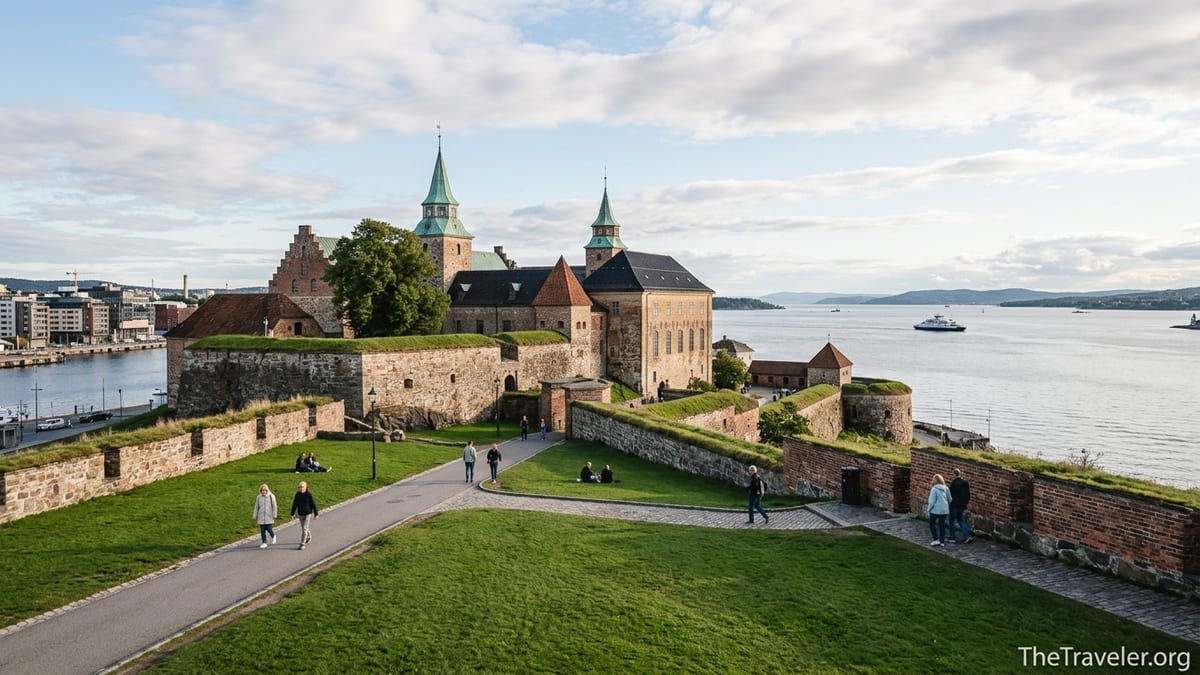
Akershus Fortress, rising above Oslo’s harbor with its stone ramparts and pointed towers, is one of Norway’s most atmospheric historic sites. Part castle, part fortress and part city park, it is both a symbol of royal power and a favorite place for locals to walk the dog, meet friends or simply watch the ferries glide across the Oslofjord. Planning your time here well can turn a quick look at the walls into one of the most rewarding half days of your trip to Oslo.
Get the latest updates straight to your inbox!
Understanding Akershus Fortress and Why It Matters
Akershus Fortress is not just a single building but a fortified complex that has guarded Oslo’s harbor since the late 13th century. The medieval castle at the top of the hill later evolved into a Renaissance residence and, over the centuries, a prison, military base and ceremonial site. Today, it houses museums, the royal mausoleum and government functions, while its lawns and ramparts remain open to the public as a green space with wide views over the city and fjord.
For many visitors, Akershus feels like a bridge between Oslo’s past and present. One moment you are walking through a stone gate that once held back sieges; the next you are looking across at the contemporary glass of the Oslo Opera House and the waterfront food halls at Vippa. It is compact enough to explore in a few hours yet layered with enough history that you can easily fill most of a day if you add the museums and a guided tour.
Because the fortress grounds themselves are free to enter, Akershus is also a rare budget friendly highlight in a city that can otherwise feel expensive. Travelers who are watching their kroner often use the fortress as their main afternoon activity, pairing a stroll on the ramparts with a picnic bought from a supermarket or bakery in nearby Kvadraturen.
When planning your visit, it is useful to distinguish between three main elements: the open fortress grounds, which are free; Akershus Castle, which has paid admission and set opening times; and the two main museums within the complex, the Armed Forces Museum and Norway’s Resistance Museum. Deciding which of those you want to see will shape how much time and money you need to allocate.
Location, Access and Getting Oriented on Arrival
The fortress sits directly above the harbor in central Oslo, a short walk from Oslo City Hall and the busy Aker Brygge and Rådhusbrygge quays. From the central railway station, most travelers simply walk: allow around 15 to 20 minutes at a relaxed pace along the waterfront, passing the Opera House and ferries before the hill of Akershus rises on your right. Arriving on foot also helps you appreciate how strategically the fortress commands the approach to the old city.
There are several gates into the complex, but most visitors use the main entrance on the western side near Myntgata and the small park in front of the fortress. As you pass under the stone arch and through the outer walls, the traffic noise fades and the cobblestones, cannons and grassy banks take over. The main paths slope gently uphill to the inner castle, but be prepared for uneven surfaces and some short, steeper sections.
Oslo’s public transport system can deposit you very close to the fortress if you prefer not to walk. Tram and bus stops around Aker Brygge, Rådhuset and Kvadraturen are all within five to ten minutes on foot of the main gate. Many visitors staying in neighborhoods like Grünerløkka or Frogner take a tram to the city center, then walk the remaining distance. Even on a tight schedule, such as a few hours between trains, you can usually fit in a circuit of the fortress grounds if you start from the station and head straight down to the harbor.
Once inside, look out for the information boards and simple map signs posted around the paths, especially near the visitor center and at key junctions. These show the layout of the ramparts, the location of the museums and the path up to the castle entrance. If you plan to visit multiple paid sites, it is worth making the visitor center your first stop to check opening hours for that particular day and ask staff about any restricted areas or events that might affect where you can roam.
Opening Hours, Tickets and Typical Costs
The fortress grounds are generally open every day and function as a public park, meaning you can wander the ramparts early in the morning or at sunset without buying a ticket. This is one reason Akershus is popular with joggers and local residents out for an evening stroll. The paid elements, however, keep more conventional museum style hours that vary by season and day of the week, so always verify the latest details before you go.
Akershus Castle, which includes state rooms, the castle church and royal mausoleum, usually charges an adult admission in the ballpark of 150 to 200 Norwegian kroner, with reduced prices for children, students and seniors. A family ticket that covers two adults and several children can bring the per person cost down if you are traveling together. For example, recent visitor information has quoted adult prices in the high hundreds of kroner with family admissions somewhere around 250 to 400 kroner, depending on the combination of sites and any current offers.
Many travelers opt for a combined ticket sold through the fortress visitor center, which typically includes entry to Akershus Castle, the Norwegian Armed Forces Museum and Norway’s Resistance Museum for a modest discount compared with buying three separate admissions. This tends to make sense if you already know you want a history focused half day at the fortress, especially on a rainy afternoon when being indoors has extra appeal.
If you plan a broader Oslo itinerary that includes several attractions, it can also be worth comparing the combined fortress ticket with the Oslo Pass, the city’s official tourist card which often includes free or discounted entry to key museums and public transport within the city zone. Some visitors find that a 24 hour Oslo Pass pays for itself with just Akershus Castle, one or two major art museums and the included tram and bus rides.
What to See: Highlights Inside and Outside the Walls
Even if you choose not to step inside a single paid building, Akershus is rich in scenic corners and historic details. One classic route is to enter via the main gate, follow the cobbled lane upwards past old barracks and cannon positions, then loop along the outer ramparts. From different points on this circuit you can look down at the modern harborfront of Aker Brygge, across to the Opera House and the new Munch Museum, or out along the Oslofjord with its tree clad islands and passing ferries.
The castle courtyard area, near the very top of the hill, is the atmospheric heart of the complex. Here, wind worn stone walls, pointed towers and a small chapel clustered together give a sense of medieval Oslo in miniature. On many days you will see a detachment of the Norwegian Armed Forces standing guard, and at certain times there are formal ceremonies or a changing of the guard that visitors can quietly watch from the side. On a crisp winter day with snow on the roofs and low Nordic light, the scene is particularly striking.
Inside the castle, the main draw for many travelers is the sequence of richly decorated halls and chambers that chart the evolution of the building from fortress to royal residence. You might walk through vaulted stone rooms that once stored gunpowder, then emerge into a grand hall lined with tapestries, portraits of Danish Norwegian monarchs and long banquet tables. The small castle church and the royal mausoleum, where several members of Norway’s royal family are buried, provide a sobering counterpoint to the ceremonial grandeur.
Elsewhere within the walls, the Armed Forces Museum presents Norwegian military history from Viking times through the Second World War and into the modern era, while the Resistance Museum focuses on the occupation of Norway during the 1940s, with personal stories, artifacts and photographs. Travelers with an interest in World War Two often report spending longer than expected in the Resistance Museum, as the exhibits bring to life how ordinary Oslo residents experienced resistance and repression during those years.
Planning Your Time: Suggested Itineraries and Seasons
How long you spend at Akershus depends on how deep you want to go into the history and how much you enjoy slow wandering with a view. Many visitors on a short stay in Oslo allocate around two hours to the fortress: roughly one hour for a scenic loop of the grounds and ramparts, and another hour either for the castle interior or a museum. This works well if you are combining Akershus with nearby attractions like City Hall and the waterfront neighborhoods in a single day.
For a more immersive visit, plan on three to four hours. One common pattern is to arrive mid morning, explore the grounds and viewpoints while the light is softer and the air cooler, then enter the castle around midday when museum opening hours are in full swing. After the castle, you might choose one of the museums depending on your interests: families with children often find the Armed Forces Museum engaging because of the uniforms, weapons and vehicles on display, while history enthusiasts may gravitate to the Resistance Museum.
Seasonally, Akershus has a different character at different times of year. In summer, the lawns fill with picnicking locals, there may be outdoor concerts or special events in certain courtyards, and you can linger on the ramparts late into the evening thanks to the long Nordic daylight. In winter, the fortress can be quieter and more atmospheric, with snow lining the walls and a clear view over a harbor sometimes edged with ice. Be aware that opening hours for interior spaces are often shorter in the low season, and some tours or events run only from spring through autumn.
Spring and early autumn are often a sweet spot for many travelers: temperatures are comfortable for walking uphill, the light can be beautiful, and the site is generally less crowded than in peak summer. Whatever the season, it is wise to build a little flexibility into your schedule. If a sudden rain shower sweeps in from the fjord, you can duck into a museum and then resume your rampart walk once the weather clears.
Guided Tours, Events and Experiential Options
Independent wandering is rewarding at Akershus, but guided tours can add context that would be easy to miss on your own. At various times of year, the fortress organises guided visits to the castle interiors in English and Norwegian, typically lasting around 45 to 60 minutes and focusing on the architectural phases, royal stories and ceremonial functions of the building. Signs at the visitor center or inside the ticketed areas usually list that day’s departures and prices.
In addition to official tours, several independent operators in Oslo offer themed walks that incorporate Akershus. For example, some World War Two history tours start near the cathedral and work their way through central sites before ending at the Resistance Museum inside the fortress, using the exhibits there as a way to tie together what you have seen on the streets. Other general city walking tours sometimes use the fortress grounds as a final viewpoint over the city.
Families and puzzle lovers might enjoy self guided mystery or scavenger hunt style experiences on the grounds, sold through various city experience platforms. These typically provide a route and a series of clues on a mobile app that prompt you to look closely at details like old cannons, plaques or carvings on the walls. While you do not need such an activity to appreciate Akershus, it can be a fun way to keep teenagers or younger children engaged while you explore.
Throughout the year, parts of the fortress occasionally host cultural events, from open air concerts to military ceremonies and historical commemorations. On some summer evenings a courtyard may be closed off for a ticketed performance, or sections of the grounds may be reserved for an event, but the larger area remains accessible. If you are visiting during a major festival or public holiday, ask at the tourist information office or check current listings to see whether anything special is happening at Akershus during your stay.
Practical Tips: Clothing, Accessibility, Safety and Nearby Food
The most important practical tip for Akershus is to wear comfortable footwear with a decent grip. Much of your time will be spent on cobblestones, gravel paths and occasionally slick stone steps, which can be challenging in smooth soled shoes, especially when wet or icy. In winter, consider boots with good traction and warm socks. In summer, even with clear skies, bring a light layer, as the breeze off the fjord can quickly cool the ramparts.
Accessibility is mixed. The main paths up to the grounds are reasonably broad, but the incline and surface can be difficult for visitors with mobility challenges, and many historic interiors involve stairs and narrow doorways. Some museum spaces have ramps or lifts, but the medieval castle itself is not fully accessible. If you or a companion uses a wheelchair or has limited mobility, it is worth contacting the fortress or the individual museums in advance to ask which areas are realistically reachable and whether alternative entrances can be arranged.
In terms of safety, Akershus feels generally secure, especially during the day, as it remains a working area with military and government functions alongside tourist activity. Standard city awareness is still wise: keep an eye on bags and cameras, particularly when taking photos at viewpoints where people tend to cluster. The walls have protective railings in key places, but children should be supervised on the ramparts, where the drop beyond the parapet can be significant.
There is no large restaurant complex inside the fortress, but you are steps away from plenty of food options in central Oslo. Many visitors grab a coffee and pastry from a bakery in Kvadraturen before climbing up, then later walk down to Aker Brygge or the food stalls at Vippa by the water for lunch. On a warm day, picking up picnic supplies from a supermarket and eating on the grass with the harbor spread out below can be one of the most memorable meals of your trip, and far cheaper than a full restaurant experience.
The Takeaway
Visiting Akershus Fortress is less about ticking off a single attraction and more about experiencing the layers of Oslo’s history in one compact, walkable space. The same walls that once defended the medieval city now form a quiet park where locals read, run and chat, while inside the castle you walk through halls that still host state events and royal ceremonies. With thoughtful planning, you can tailor the visit to your interests, whether that means focusing on military history, architecture or simply big views over the Oslofjord.
Because the grounds are free and always close at hand in central Oslo, Akershus is easy to weave into your itinerary. You might use a spare morning to explore the ramparts, or pair the fortress with a harbor walk and a visit to City Hall or the Opera House. A bit of advance research on opening hours and tickets helps you avoid closed doors and lets you decide whether a combined ticket or Oslo Pass makes better financial sense for your trip.
Most travelers leave Akershus with a stronger sense of place: what it meant to defend Oslo centuries ago, how the city’s waterfront has changed, and how Norwegians today balance memory and everyday life in the same space. Plan your visit with good shoes, flexible timing and an eye on the weather, and the fortress will reward you with both history and some of the best perspectives on Norway’s capital.
FAQ
Q1. Is Akershus Fortress free to visit?
The fortress grounds are generally free to enter and open daily as a public area, but Akershus Castle and the on site museums charge separate admission.
Q2. How much time should I plan for Akershus Fortress?
Most visitors find that two to four hours is enough, depending on whether you just walk the grounds or also tour the castle and museums.
Q3. What is the difference between Akershus Fortress and Akershus Castle?
The fortress refers to the entire walled complex, including ramparts and museums, while the castle is the historic royal residence at the top of the hill.
Q4. Can I visit Akershus Fortress in winter?
Yes, the grounds are accessible year round, though paths can be icy. Interior opening hours for the castle and museums are often shorter in the low season.
Q5. Are guided tours of Akershus Castle available in English?
At many times of year, there are guided tours in English, especially in the main tourist season. Check the visitor center or official information for current schedules.
Q6. Is Akershus Fortress suitable for children?
Yes, many families enjoy the open spaces, cannons and views. Just supervise children on the ramparts and in steep or uneven areas.
Q7. Can I bring food and have a picnic inside the fortress?
Informal picnics on the lawns are common in good weather. Be considerate, avoid littering and follow any local signs about restricted areas.
Q8. Does the Oslo Pass include entry to Akershus attractions?
The Oslo Pass often includes free or discounted entry to Akershus Castle and the on site museums, but you should confirm the current list of included attractions.
Q9. How do I get to Akershus Fortress from Oslo Central Station?
It is about a 15 to 20 minute walk along the harbor from the station. You can also take a tram or bus to stops near City Hall or Aker Brygge and walk a short distance.
Q10. Are there restaurants inside Akershus Fortress?
There are limited food options within the walls, but the fortress is a few minutes’ walk from many cafés and restaurants in central Oslo and along the waterfront.