


For many visitors landing at Oslo Airport Gardermoen, Flytoget, the dedicated airport express train, will be the first piece of Norwegian infrastructure they encounter. It can be an impressively smooth way to get into the city or reach connections further west, but only if you understand how it works, what it costs, and how it differs from the regular Vy trains on the same route. Planning a Flytoget journey in advance can save you money, time and a fair bit of stress on the day of your flight.
Get the latest updates straight to your inbox!
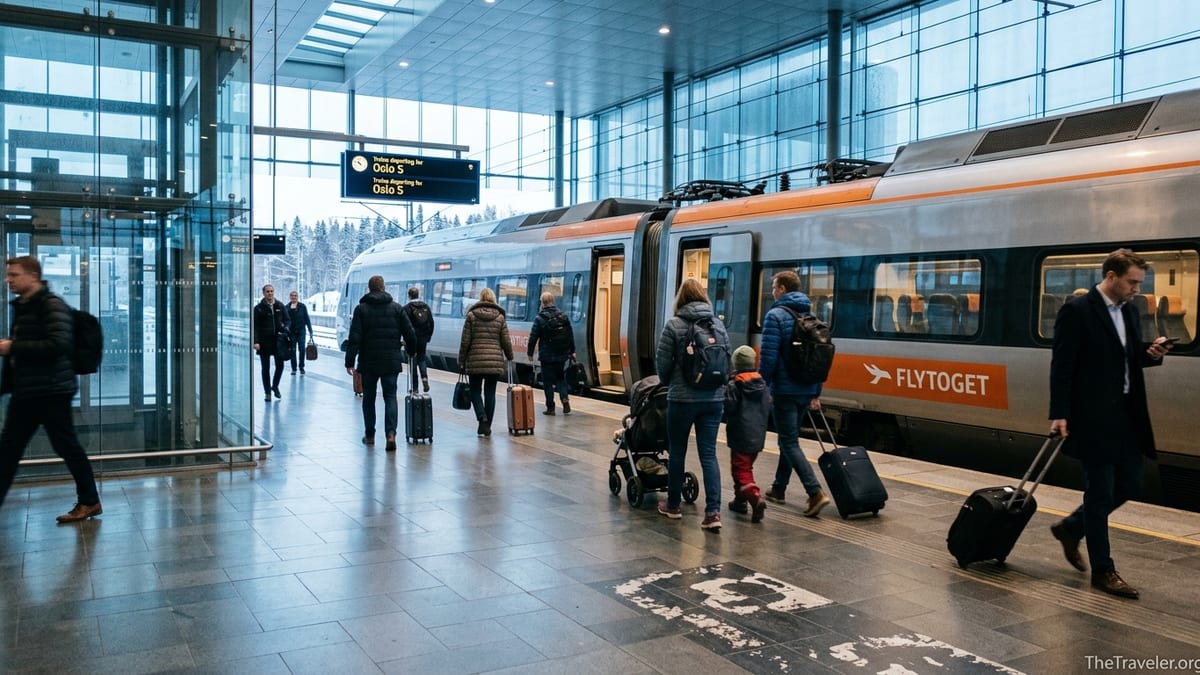
What Flytoget Actually Is (and How It Differs from Other Trains)
Flytoget is a high speed airport rail service connecting Oslo Airport Gardermoen with Oslo Central Station and several key stops in the greater Oslo area. The core journey between the airport and Oslo S takes about 19 to 22 minutes, with trains typically running around every 10 minutes during most of the day. Some departures continue beyond Oslo S to stations such as Nationaltheatret, Lysaker and Drammen, which can be useful if you are staying or working in western Oslo rather than in the central district.
From a passenger perspective, the most important point is that Flytoget is a separate service from the standard Vy trains that also run between Oslo Airport and the city. They use the same tracks and share Oslo Airport Station, but they have different branding, ticket systems and prices. If you accidentally board Flytoget with only a Vy or Ruter ticket, you will be treated as traveling without a valid ticket and may face a penalty fare. The Flytoget platforms at the airport are clearly marked with the orange Flytoget logo and usually depart from track 3, while Vy trains often use track 4, so pay attention to the signs on the concourse.
In practice, your choice is usually between Flytoget and the regular Vy regional or commuter trains. The Vy services are a few minutes slower on average but considerably cheaper, and their tickets integrate with local public transport within the Oslo area. Flytoget, by contrast, is priced as a premium, point to point airport link with more frequent departures, a consistent journey time and some extra perks tailored to air travelers.
Imagine arriving on a winter evening when your flight is delayed and your checked bag takes forever. By the time you walk into the arrivals hall, one Vy departure has just left and the next is not due for 25 minutes. On the other hand, the boards show a Flytoget departing in 4 minutes and another in 14. In that situation, many travelers choose to pay extra for Flytoget simply to be in their hotel room half an hour earlier.
Schedules, Journey Times and When to Choose Flytoget
Flytoget generally runs about six departures per hour from the airport towards Oslo S throughout the day, with slightly reduced frequency early in the morning and late at night. In normal conditions you will rarely wait more than 10 minutes on the platform before a train appears. The basic airport to Oslo S journey is scheduled at around 20 minutes. Services that continue to Nationaltheatret, Lysaker or Drammen obviously take longer overall, but they still cover the airport to central stretch in about the same time as the trains that terminate at Oslo S.
By comparison, the Vy regional and commuter trains often take roughly 23 minutes between the airport and Oslo S. On paper, that is only a difference of 3 to 5 minutes, and on a calm midday journey it may not matter at all. Where Flytoget gains an edge is its frequency and its operating span, which tends to cover very early flights and late arrivals more thoroughly than the regular trains. For example, many travelers catching 07:00 departures from Oslo find that Flytoget is the only rail option that lines up perfectly with their airline’s check in and security recommendations.
When deciding whether Flytoget is worth it, start with your schedule. If you have a mid afternoon flight, plenty of time and you are watching your budget, the Vy trains will usually be the better value. But if you are landing on a short layover and want to pop into the city for a couple of hours, the extra departures on Flytoget can make the difference between having coffee on Karl Johans gate and never leaving the terminal. Similarly, if you are catching an international long haul flight and feel more comfortable being at the airport well ahead of boarding, the combination of fast journey time and frequent departures can buy you peace of mind.
Another factor is where you are staying. If your hotel is close to Nationaltheatret or Lysaker, taking a Flytoget service that continues beyond Oslo S can save you the hassle of changing to a local train or tram with suitcases in tow. Conference venues and corporate offices in areas like Lysaker or Fornebu often recommend Flytoget explicitly because it offers a one seat ride from the terminal directly to their nearest station.
Understanding Tickets, Prices and Discounts
Flytoget pricing is simple but different from the standard Norwegian public transport model. Instead of the zone based fares used by Ruter and Vy, Flytoget sells point to point tickets that are valid only on Flytoget services. For a typical adult journey between Oslo Airport and Oslo S in 2026, expect to pay in the region of 220 to 250 Norwegian kroner if you buy a standard ticket on the day. Prices for journeys that continue to stations like Lysaker or Drammen are usually similar, since the product is marketed primarily as an airport link rather than a detailed distance based fare system.
That is roughly double the cost of taking a Vy regional or commuter train on the same route, which often comes in around half the Flytoget price for adults. This gap is why many budget focused travelers, backpackers and families who are not in a rush simply choose the Vy option. However, Flytoget does offer several significant discounts. Children under 16 travel free when accompanied by an adult over 16, and they do not need their own ticket, which can be a major saving for families with two or three kids in tow. Seniors and students with valid ID can usually travel at a reduced fare, bringing the cost much closer to a standard Vy ticket while preserving the advantages of the express service.
When it comes to how you pay, Flytoget is engineered for quick, contactless use. Many local passengers simply tap a contactless bank card or compatible phone wallet on the gates at Oslo Airport and again when they leave at their destination. The system charges the correct fare automatically, which means you do not need to stop at a ticket machine if you are comfortable with your card being billed in Norwegian kroner. Alternatively, you can buy a digital ticket in the Flytoget app or use ticket machines in the station concourse if you prefer a more traditional approach or need a receipt in advance for business travel.
One real world example: a business traveler flying in from London for meetings at Lysaker might download the Flytoget app before departure, register a company credit card and purchase a round trip ticket Oslo Airport to Lysaker. When she lands, she can walk straight to the Flytoget platform, show her QR code to pass the barriers, and head directly to the office with no extra transfers and all receipts neatly listed in the app for her expense report.
Finding the Train and Navigating the Stations
At Oslo Airport Gardermoen, the rail station is directly beneath the main terminal building. After collecting your luggage and walking through customs into the arrivals hall, follow the signs marked “Trains” or the Flytoget logo. A short escalator or elevator ride takes you down to the station level, where you will find clear signage separating Flytoget and Vy services. Information screens list upcoming departures, destination stations and the track number, usually track 3 for Flytoget and track 4 for Vy, though you should always confirm on the day.
The station layout is straightforward, but details matter when you are tired or in a hurry. There are automatic gates between the main concourse and the Flytoget platform. If you have a mobile ticket, scan the QR code; if you are paying with a contactless card, tap it on the reader. For families with children traveling free, Flytoget staff on the platform can open wider gates and help you bring strollers or large luggage through. If you accidentally walk towards the Vy platform expecting Flytoget, you will see different branding and ticket validation equipment, which is a useful prompt to double check before boarding.
Oslo Central Station (Oslo S) is larger and busier, but the airport trains are still easy to locate. Flytoget arrivals and departures are displayed on the same big boards as all other trains. When you step off the train from the airport, follow signs to “Utgang” (exit) and look for exits towards Jernbanetorget, which bring you directly into the heart of the city near the main tram and metro hub. If you are connecting to another train, such as a long distance service to Bergen or Trondheim, allow a few extra minutes to check the platform for your onward departure. In most cases, arriving on Flytoget about two hours before a domestic connection or three hours before an international one will give you a comfortable buffer.
At intermediate stations such as Nationaltheatret or Lysaker, Flytoget uses the same platforms as other trains. Pay close attention to the train identifiers on the overhead screens to make sure you are boarding the express service you actually paid for. If you are uncertain, staff in Flytoget uniforms can confirm that the train at the platform is indeed going to the airport and not terminating somewhere else along the line.
Onboard Experience, Luggage and Family Travel
Once on board, you will find that Flytoget trains are designed for airport passengers. Cars are fitted with generous luggage racks near the doors and overhead shelves suitable for carry on bags. The aisles are relatively wide, which makes it easier to roll suitcases to your seat. Most seats are in a comfortable two by two layout with ample legroom, and there are power outlets suitable for charging phones and laptops, a welcome feature after a long flight.
Luggage rules are generally straightforward and flexible. Ordinary suitcases, backpacks and carry on bags are all accepted, and there is no formal weight limit in the way airlines define it. However, extremely bulky items that might block aisles or exits can be refused or may need special handling. If you are traveling with large sports equipment, such as skis in winter or a bicycle, it is worth arriving a bit early and speaking to onboard staff about the best place to stow it. In most cases, staff will help you position big items in a safe corner, provided they do not interfere with doors or other passengers.
Families tend to find Flytoget particularly convenient. Designated spaces for strollers are located in specific cars, typically at the front when departing the airport and at the rear when heading towards it. You can roll a stroller straight into these areas and secure it using straps provided. Combined with the policy that all children under 16 travel free when accompanied by an adult, this makes the express train a strong choice for parents who value a straightforward, low hassle trip between the terminal and their accommodation.
Consider the case of a couple arriving from North America with a toddler and a baby in a stroller, facing a connection the next morning. Rather than wrestling with multiple tickets and a tight change to a local bus, they can push the stroller onto Flytoget, park it in the dedicated space, settle into nearby seats and know that the entire family will be in downtown Oslo in around 20 minutes, without having paid anything extra for the children’s travel.
Delays, Missed Flights and the Flytoget Guarantee
One of the selling points frequently mentioned by local travelers is Flytoget’s focus on reliability and its approach to delays. While no train operator can avoid disruptions entirely, the company’s conditions of carriage outline specific compensation rules when serious delays cause passengers to miss flights. In broad terms, if you chose a Flytoget departure that should have delivered you to the airport within the airline’s recommended arrival time and at least around one hour before a domestic flight or 90 minutes before an international one, and a delay entirely attributable to the train causes you to miss that flight, Flytoget may help cover the cost of rebooking or a new ticket, subject to their detailed terms.
This guarantee is not a blanket promise to pay for any missed plane under any circumstance. If you gamble on taking the very last possible train before departure, arrive at the airport less than an hour before takeoff and then get stuck in an unexpectedly long security queue, you should not expect Flytoget to reimburse you. The key is to plan conservatively and use the express train’s high frequency to give yourself a time buffer. Local business travelers often pick a departure that gets them to the terminal 30 to 45 minutes earlier than strictly necessary, then grab a coffee in the departure hall while they answer emails, rather than pushing their luck.
In the rare event that a significant disruption shuts down the Gardermoen line entirely, Flytoget will attempt to arrange alternative transport, often in cooperation with other rail operators or bus companies. These situations are uncommon and usually tied to severe weather, infrastructure failures or major incidents. When they do occur, staff will make announcements on the train, on station platforms and via the app, guiding passengers to replacement services where possible. As always, if you are catching a long haul or one off flight, consider travel insurance that covers missed departures, and do not rely on any one operator’s goodwill alone.
For travelers on tight layovers using Flytoget to reach Oslo city and then back to the airport, the same rule applies in reverse. Build your schedule so that you aim to be back at Oslo Airport at least the same 60 or 90 minutes before departure that the airline recommends. If you are tempted by a long lunch in the city, remember that missing your return Flytoget by a couple of minutes might mean waiting 10 minutes for the next one, which quickly eats into your safety margin.
When Flytoget Is Worth It (and When It Is Not)
Ultimately, the decision to use Flytoget is a tradeoff between cost, convenience and your personal tolerance for risk and complexity. For solo backpackers and budget conscious couples arriving in the middle of the day with no urgent commitments, the regular Vy train often represents the sweet spot: roughly the same travel time, integrated with local public transport tickets, and significantly cheaper. If you are staying very close to Oslo S and you do not mind waiting 20 or 30 minutes for the next departure, Flytoget’s premium price may feel unnecessary.
On the other hand, several traveler profiles consistently find Flytoget to be the smarter choice. Business travelers on tight schedules, families with small children and lots of luggage, and visitors arriving very early or very late tend to value Flytoget’s frequency and straightforward boarding process more than the kroner they could save. The free child policy alone can swing the calculation for a family of four. In such cases, the express train becomes not just a way of getting into town but an extension of the airport experience: predictable, clearly signposted and designed around the needs of people catching flights.
Imagine three contrasting scenarios. A solo student arriving for a weekend in Oslo in the early afternoon is usually best served by heading to the Vy platform, buying a standard ticket and spending the savings on an extra pastry later. A consultant landing late at night on a winter Monday, needing to be in a meeting at Lysaker at 09:00 the next morning, will be grateful for the direct Flytoget service straight to that station without additional changes. And a family of five with school age children, staying near Nationaltheatret and arriving the evening before an early flight home, may decide that the combination of free child travel and frequent departures makes Flytoget the most comfortable and even cost effective option.
It is also worth considering where you are headed beyond the city center. If your ultimate destination is somewhere served directly by Flytoget to the west of Oslo, such as Drammen, using the express train can spare you an extra transfer at Oslo S. Conversely, if you are heading into neighborhoods predominantly served by metro or tram from Oslo S or Jernbanetorget, the advantage of Flytoget versus Vy starts to narrow, since you will be making a connection either way.
The Takeaway
Planning to use Flytoget for your airport journey is less about mastering a complex system and more about understanding a handful of key facts in advance. It is a dedicated, premium express train, operating frequently and quickly between Oslo Airport and key urban stations, with clear advantages in speed, simplicity and schedule coverage, especially in the early morning and late evening. Its tickets are not interchangeable with standard Vy or Ruter fares, but they are easy to buy and validate, and significant discounts exist for children, students and seniors.
As you map out your arrival or departure day, consider the particulars of your trip. How tight is your timing. How much luggage will you have. Are you traveling with children or older relatives. Is your final stop closer to Oslo S, Nationaltheatret, Lysaker or Drammen. In many cases, a regular Vy train will do the job perfectly. In others, the extra kroner spent on Flytoget will buy you less waiting, fewer transfers and a calmer start or end to your time in Norway.
The most important step is simply to make the choice with open eyes. Check your flight time against Flytoget’s approximate 20 minute journey, factor in the airline’s recommended airport arrival window, and decide how much buffer you want. With that small bit of planning, Flytoget can be one of the easiest parts of your journey, delivering you smoothly between runway and city street with Scandinavian efficiency and a view of the forests that frame Oslo along the way.
FAQ
Q1. Do I need to buy a Flytoget ticket in advance, or can I just turn up at the station.
You can simply turn up at Oslo Airport or Oslo S and board Flytoget without a prebooked ticket. Many travelers tap a contactless bank card at the gates or buy a digital ticket in the Flytoget app right before travel. Buying early is optional and mainly useful if you want receipts prepared in advance.
Q2. How much does Flytoget cost compared with the regular Vy train.
For a standard adult journey between Oslo Airport and Oslo S, Flytoget typically costs roughly twice as much as a Vy regional or commuter train ticket on the same route. Exact prices vary over time, so it is best to check current fares shortly before you travel.
Q3. Are children really free on Flytoget.
Yes. All children under 16 can travel free on Flytoget when accompanied by an adult over 16. They do not need their own ticket, and staff at the airport gates can help families with passage through the barriers.
Q4. Can I use my Vy or Ruter ticket on Flytoget.
No. Flytoget is a separate service with its own tickets and prices. Vy or Ruter tickets that are valid on regular trains and local public transport cannot be used on Flytoget, and boarding the express train without a valid Flytoget ticket can result in a penalty fare.
Q5. How early should I take Flytoget before my flight.
As a rule of thumb, pick a departure that gets you to Oslo Airport at least the airline’s recommended time before departure, often around one hour for domestic flights and 90 minutes or more for international flights. Many passengers choose an even earlier train to allow a comfortable buffer.
Q6. What happens if Flytoget is delayed and I miss my flight.
If a significant delay caused solely by Flytoget makes you miss a flight, and you chose a train that should have delivered you to the airport within the recommended check in window, Flytoget may offer compensation or assistance according to its conditions of carriage. Each case is assessed against those rules, so always keep your tickets and documentation.
Q7. Is there space for large luggage, skis or strollers on Flytoget.
Flytoget trains include large luggage racks near doors, overhead shelves and dedicated areas for strollers. Ordinary suitcases and sports bags are easily accommodated. For very bulky items like skis or large equipment, arrive a little early and ask staff where best to place them.
Q8. How do I know if my Flytoget train continues past Oslo S to stations like Nationaltheatret or Lysaker.
Departure boards at the airport and in Oslo clearly show the terminus and key intermediate stops for each Flytoget train. Look for your desired station on the screen or train side displays. If you are unsure, ask a uniformed Flytoget staff member before boarding.
Q9. Is Flytoget running late at night or very early in the morning.
Flytoget operates from early morning into late evening, typically covering the majority of flight departures and arrivals at Oslo Airport. However, very early or very late connections may have less frequent service, so check the timetable for your specific date and time.
Q10. Should I choose Flytoget or the Vy train if I am on a layover and want a quick visit to Oslo.
If your layover is short and you want to maximize time in the city with minimal waiting, Flytoget’s higher frequency usually makes it the better option. If your layover is longer and budget matters more than a few extra minutes, the Vy train can be a sensible alternative.