


More news on this day
Australian passengers frustrated by chronic flight delays may be overlooking one key point: the country’s least punctual airlines are also operating in one of the world’s safest aviation systems, where safety records often outshine on-time performance.
Get the latest news straight to your inbox!
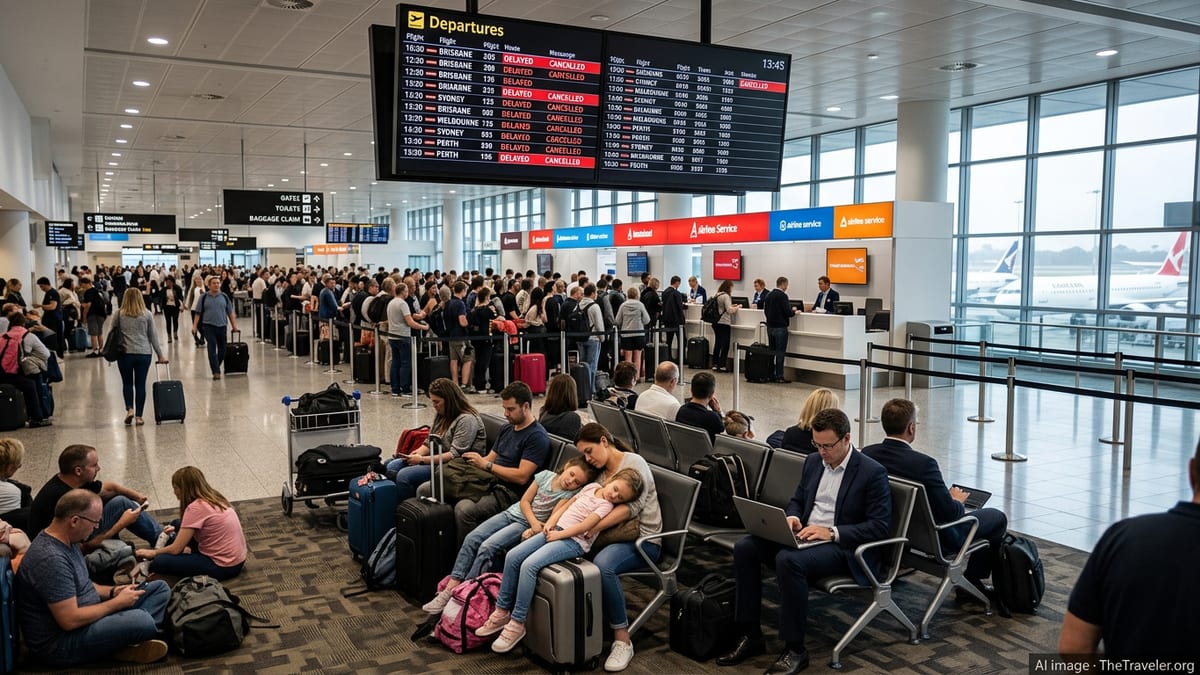
Delays Dominate the Domestic Experience
Recent statistics from Australia’s Bureau of Infrastructure and Transport Research Economics (BITRE) highlight how common delays have become across the domestic network. For 2024, publicly available figures show an industry average of roughly three in four flights arriving and departing on time, leaving about a quarter running late. That performance sits below long-term averages, confirming what many passengers already suspect at the boarding gate: tardiness has become part of the travel routine rather than the exception.
Individual airlines move up and down the rankings month to month, but late operations are widespread. Reports summarising BITRE data describe periods when nearly one in three domestic services arrived or departed behind schedule, with some carriers repeatedly singled out for relatively poor punctuality and elevated cancellation rates. Budget and regional operators have at times fared worst, as leaner schedules and smaller fleets leave less room to recover when an aircraft or crew is out of position.
These statistics have sharpened debate about which airline is “best” or “worst” for delays. Travellers regularly single out certain brands as serial offenders, while others earn praise for relatively smoother operations. Yet when the conversation shifts from punctuality to safety, the hierarchy looks very different.
Australia’s Global Reputation for Airline Safety
Despite persistent timetable frustrations, Australia’s major airlines operate within a regulatory environment widely regarded as among the most rigorous in the world. International safety assessments compiled by AirlineRatings.com and covered by industry and travel outlets consistently place Australian carriers near the top of global rankings. In the 2024 lists of the world’s safest airlines, Qantas and Virgin Australia were both featured in the top tier, reinforcing a long-standing reputation for strong safety outcomes across the country’s flag and full-service brands.
Qantas in particular has become a benchmark name in safety coverage. Publicly available summaries of the airline’s record note its long history without a fatal jet accident and a string of years in which it was rated the world’s safest carrier. Virgin Australia also appears regularly in global safety shortlists, reflecting adherence to international standards and the use of modern aircraft and procedures. These results show that even when Australian airlines attract criticism for customer service issues or delays, their safety credentials remain robust by global comparison.
Underlying these rankings is an ecosystem shaped by the Civil Aviation Safety Authority and the Australian Transport Safety Bureau, supported by detailed incident reporting and oversight. While operational disruptions may be visible to passengers in departure lounges, the more critical metrics that determine an airline’s safety profile sit behind the scenes in maintenance hangars, flight operations centres and training simulators.
Why the “Worst for Delays” Can Still Be a Safe Bet
For travellers, the apparent contradiction is striking: a carrier that regularly runs late can still be an entirely sound choice from a safety perspective. One explanation lies in the trade-offs airlines are incentivised to make. When confronted with weather, congestion or technical inspections, a cautious approach often means holding or cancelling flights rather than pressing ahead to protect punctuality statistics. Publicly available BITRE data show that some airlines with relatively high cancellation rates otherwise meet the same stringent safety and maintenance standards imposed on all Australian carriers.
Industry commentary frequently points out that on-time performance and safety are measured in very different ways. Safety is tracked over many years and millions of flights, with an emphasis on systemic risk management and regulatory compliance. Punctuality, by contrast, is sensitive to short-term shocks such as storms, staff shortages, air traffic control restrictions or aircraft availability. A single difficult month can push an airline to the bottom of the delay tables without implying any change in its underlying safety performance.
There is also a geographic and operational dimension. Airlines that serve more complex networks, remote destinations or congested hubs may face higher odds of disruption, skewing punctuality data. That does not necessarily signal cut corners in safety-critical areas. In practice, a diversion for weather, a precautionary engineering check or a crew duty-time reset may all result in delays that are inconvenient for passengers but entirely consistent with a culture that prioritises safety over schedule.
Reading the Numbers: What Travellers Should Watch
For passengers choosing between Australia’s major airlines, the data suggest that almost all decisions sit within a relatively safe band. Global accident statistics show commercial aviation continuing to trend safer over time, while Australian carriers attract attention more for complaints about timetable reliability and fares than for serious incidents. Published rankings that place several local brands among the world’s safest reinforce the message that, from a risk perspective, differences between them are marginal compared with the gap to other forms of transport.
Where the numbers do diverge more sharply is on service predictability. BITRE reports and competition watchdog briefings repeatedly flag variations in on-time performance and cancellation rates between carriers. Some airlines outperform the market average across the year, while others move in and out of the bottom ranks depending on season, route mix and fleet utilisation. Travellers who value punctuality may find it more useful to track these trends over several months rather than judging an airline solely on one difficult holiday period.
At the same time, experts routinely caution against treating punctuality tables as a proxy for safety. While a long record of severe operational disruption could raise broader questions about an airline’s management, there is no simple formula that turns delay percentages into a measure of accident risk. In Australia’s tightly regulated environment, a flight that pushes back 40 minutes late may in fact be the product of safety checks functioning exactly as intended.
How to Balance Punctuality, Price and Peace of Mind
For most travellers, the practical challenge is to balance the irritation of possible delays with the reassurance provided by Australia’s safety record. One approach is to treat all major local airlines as broadly equivalent on safety, and then compare them on secondary factors such as schedule, price, baggage rules and loyalty benefits. On routes where one carrier has a noticeably better recent punctuality record, that may tip the decision without implying that rivals are unsafe.
It can also be useful to build realistic buffers into itineraries that involve tight connections, time-sensitive events or same-day international transfers. Given that late departures remain above historical norms, allowing extra time at the planning stage can reduce the stress of weather or air traffic disruptions that no airline can fully control. Choosing earlier flights in the day, or services on routes with multiple daily frequencies, may also provide more fallback options if something goes wrong.
Ultimately, the available evidence suggests that the Australian airline most likely to keep you waiting at the gate is still operating within a system designed to keep you safe in the air. For anxious flyers, that may be a small comfort when staring at a departure board filled with delays, but it is a significant one once the aircraft is airborne.
BITRE On-time Performance Data
AirlineRatings 2024 Safety Awards Coverage