


More news on this day
Gulf aviation hubs are rapidly transforming what used to be dead time between flights into a core engine of tourism growth, with Dubai, Doha, Riyadh and Muscat rolling out new transit visas, stopover packages and airport expansions that convert connecting passengers into short-stay visitors.
Get the latest news straight to your inbox!
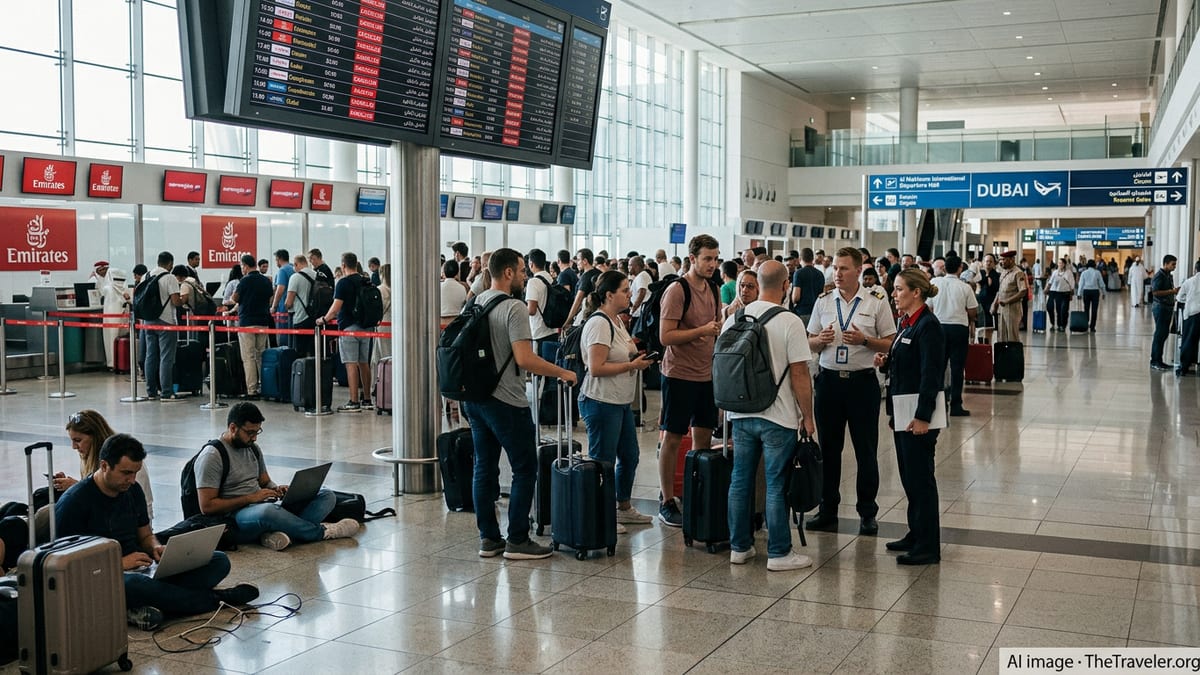
Dubai Converts Record Air Traffic Into Hotel Nights
Dubai is at the center of the Gulf’s layover-to-tourism shift, underpinned by record passenger volumes and an aggressive push to lengthen stays. Publicly available data from the Dubai Department of Economy and Tourism shows the city received 19.59 million international overnight visitors in 2025, its third consecutive record year and a 5 percent increase on 2024, reinforcing its position among the world’s most visited cities.
That tourism momentum is tied closely to aviation. Reports from Dubai’s airport operator indicate Dubai International Airport handled its highest-ever quarterly traffic in the third quarter of 2025, with 24.2 million guests passing through between July and September, as more than 100 airlines operated over 8,500 weekly flights to more than 270 destinations. The airport’s performance is presented as evidence that aviation remains central to Dubai’s strategy to channel connecting traffic into the city’s hotels, shopping districts and attractions.
Recent updates show that even regional airspace disruptions in early 2026 did little to dent the hub’s role. Dubai’s media office reported that Dubai International kept traffic flowing during several weeks of restricted airspace, handling around 6 million passengers and more than 32,000 movements between late February and the end of April 2026. The ability to sustain that throughput is seen locally as essential to maintaining Dubai’s appeal as both a transfer point and a destination.
Longer term, the city is preparing for a further jump in connecting and stopover passengers. Plans for Dubai World Central in Dubai South to become the emirate’s main gateway in the early 2030s, presented as a “future-ready” aviation hub, aim to expand capacity while integrating airport operations with surrounding logistics, business and residential districts. Officials frame this aerotropolis model as a way to make it easier for transit passengers to step into the city for a night or two.
Saudi Arabia Uses Transit Visas to Feed Vision 2030 Tourism Goals
Saudi Arabia is positioning its own aviation hubs, led by Riyadh and Jeddah, to capture a larger share of connecting traffic and convert it into short urban stays and side trips to new tourism megaprojects. Official tourism portals describe a dedicated transit visa that allows travelers to stay in the country for up to 96 hours when flying on national carriers, with packages promoted through the Visit Saudi platform.
Regulatory updates issued in late 2022 introduced a suite of tourism-focused frameworks, including transit visas of 48 and 96 hours aimed at passengers passing through Saudi airports on their way to other destinations. Government information characterizes these visas as part of a broader digital tourism strategy designed to support Vision 2030’s objective of moving the kingdom into the top tier of global leisure destinations, while leveraging its location between Europe, Asia and Africa.
The transit offer is being rolled out alongside large-scale developments intended to entice stopover passengers to stay longer or return. Investor documentation on national projects highlights Neom on the Gulf of Aqaba and the Magna coastal destinations as examples of new resort corridors intended to attract high-spending visitors. Authorities present these projects, together with simplified entry rules, as central pillars in plans to raise annual visitor numbers into the tens of millions by the decade’s end.
Riyadh’s growing network of routes and the planned launch of new carriers are expected to strengthen its role as a transfer point between Asia and Europe. As schedules and fleets expand, analysts expect stopover visas to become a more prominent element of Saudi air ticketing, mirroring the way competing hubs in Dubai and Doha bundle short stays into long-haul itineraries.
Qatar Deepens Stopover Strategy Around Doha Hub
Qatar has long treated stopovers as a strategic extension of its national airline, and recent program updates indicate that Doha is doubling down on this approach. Qatar Airways promotes a dedicated “Qatar Stopover” offer in cooperation with the country’s tourism board, allowing passengers with layovers of at least 12 hours to book hotel stays of one to four nights in Doha at discounted rates while earning frequent-flyer points on both flights and hotel packages.
Information on the carrier’s website details packages ranging from basic city hotel stays to themed products, including offerings tied to major events such as the Formula 1 Qatar Grand Prix in 2026. These bundles are marketed as ways for travelers to add a short city break to long-haul journeys across the airline’s network, which connects Europe, the Americas, Africa and Asia via Hamad International Airport.
Visa policies are being aligned with this strategy. Publicly available guidance notes that many nationalities benefit from visa-on-arrival access, while others can use a specific transit visa for stays between 5 and 96 hours if traveling on Qatar Airways. Travel industry coverage emphasizes that these arrangements are intended to reduce friction for passengers who want to turn a connection into a mini-visit, and to differentiate Doha’s hub from rival airports courting similar flows.
Industry observers point out that this model proved effective during the run-up to and aftermath of the 2022 World Cup, when Qatar used simplified entry, bundled accommodation and curated city experiences to encourage travelers to break their journeys in Doha. Current stopover campaigns seek to maintain that visibility, positioning the capital as a compact, manageable city for first-time visitors from Europe, India and Southeast Asia.
Oman and Smaller Gulf Hubs Market Stopovers as Boutique Experiences
While Dubai, Doha and Riyadh compete at mega-hub scale, smaller Gulf gateways are carving out a niche by marketing their layovers as relaxed, boutique stopovers. Oman is a prominent example. Joint announcements by Oman Air and the Ministry of Heritage and Tourism in recent years have introduced stopover promotions that invite passengers transiting Muscat to add between four hours and four days in the country, with curated hotel, transport and tour options.
More recent material from Oman Air describes a “Muscat Stopover” product that allows passengers to book customizable packages via the airline’s website, with stays in three- to five-star hotels and excursions into Muscat and surrounding regions. The initiative is framed as a first-of-its-kind national stopover program, intended to showcase Oman’s coastline, desert landscapes and mountain scenery to travelers who might otherwise only see the airport.
Complementing these offers, Oman’s e-government portals outline a specific transit visa valid for up to 72 hours, designed for passengers flying through Muscat on international itineraries. Combined with meet-and-greet and transit assistance services at the airport, the aim is to make it straightforward for visitors to clear immigration, check into a hotel and rejoin their onward journey without complex paperwork.
Travel planners note that this positioning differentiates Muscat from the larger Gulf hubs. Rather than competing on the sheer number of onward connections, Oman’s strategy focuses on depth of experience, presenting the stopover as a taster of traditional souqs, coastal forts and wadis that can encourage a return visit. Similar but smaller-scale initiatives are also emerging in Bahrain and Kuwait, where regulators are revising transit rules and airports are expanding facilities in response to rising passenger numbers.
Aviation Infrastructure and Urban Projects Support the Shift
The conversion of layovers into tourism growth is heavily dependent on physical infrastructure, and Gulf states are investing accordingly. Across the United Arab Emirates, aviation statistics released in mid-2026 indicate that the country’s airports handled 156.8 million passengers in 2025, up 6.1 percent from 2024, with aircraft movements rising 6.8 percent to more than 855,000. Dubai’s airports accounted for over 100 million of those passengers, reinforcing their role as primary gateways for both transit and destination traffic.
Beyond terminals and runways, city-level transport projects are being designed with airport connectivity and visitor flows in mind. Concept documents for the Dubai Loop, an urban mobility system announced in 2025, describe a first phase linking key commercial and tourism districts such as Dubai International Financial Centre and Dubai Mall, with subsequent phases envisioned to extend coverage to areas closer to the main transport corridors. While not solely an airport project, the system is intended to simplify movement between business districts, hotels and major attractions for time-pressed visitors.
Dubai South, the wider development zone around the future main airport, has already become a focus for business and private aviation. Public data indicates more than 17,000 private jet movements in 2024 through its aerospace hub and a further increase in business aviation movements during 2025. Planners present this growth as complementary to commercial air traffic, reinforcing Dubai’s broader role as a logistics and tourism platform.
Across the Gulf, these infrastructure moves align with national diversification plans that seek to reduce dependence on hydrocarbons. By coupling hub airport expansion with flexible transit visas, hotel investments and targeted marketing, governments are attempting to capture additional value from passengers who previously only changed planes. The emerging pattern suggests that for many travelers on intercontinental routes, a layover in the Gulf is increasingly being framed as an integral part of the trip rather than a waiting room between flights.
Dubai International traffic and hub performance
Saudi Arabia official stopover visa information
Qatar Airways stopover program details