


On a coastline famous for Capri’s glamour and the Amalfi Coast’s cliffside drama, Baia quietly offers something far rarer: the chance to swim above a sunken Roman resort, walk through imperial ruins and soak in volcanic thermal waters, all within an easy day trip of Naples. For travelers who like their seaside views served with layers of history and local life, this small harbor town on the Campi Flegrei is one of Campania’s most fascinating coastal destinations.
Get the latest updates straight to your inbox!
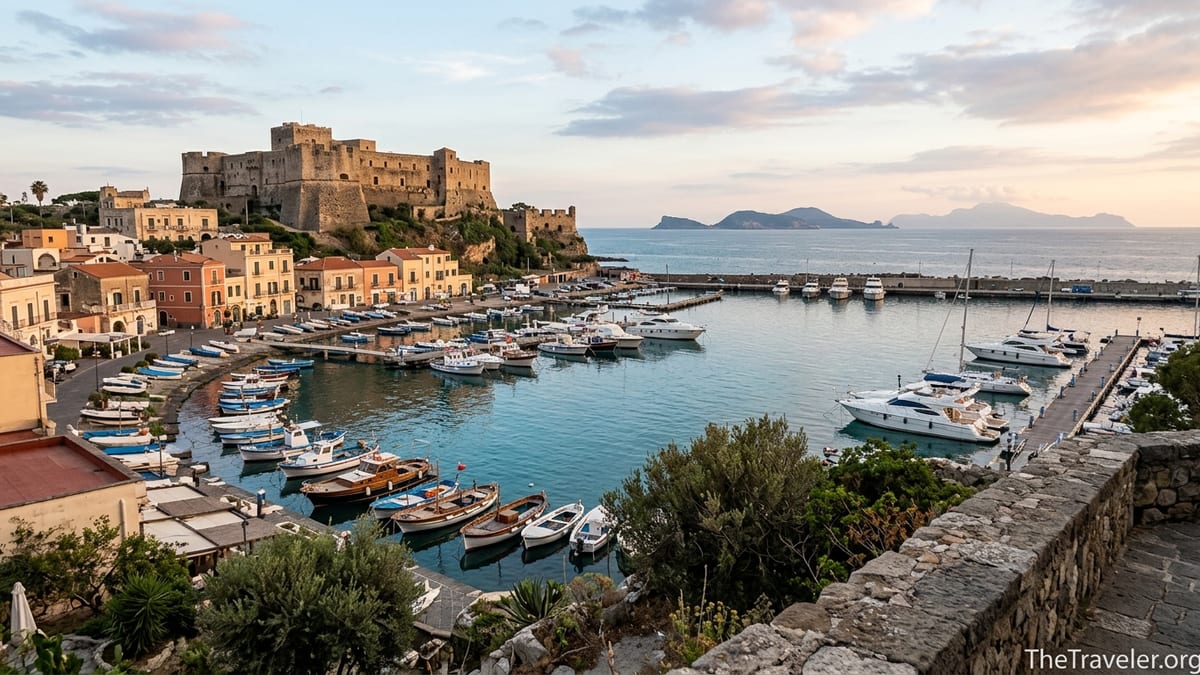
A Roman Las Vegas That Slipped Beneath the Sea
In ancient times Baiae was the playground of Rome’s elite, a place where senators and emperors built sprawling villas, lavish bath complexes and terraced gardens overlooking the Bay of Naples. Writers of the era described it as a byword for luxury and indulgence, the kind of resort where politics, pleasure and intrigue blended together over long banquets and steamy thermal pools. Today, standing on the modern seafront promenade and looking across the marina, it is hard to imagine that much of this world now lies several meters underwater.
The reason Baia is so unusual is geological as much as historical. The town sits within the Campi Flegrei, a restless volcanic area where a phenomenon known as bradyseism slowly raises and lowers the ground over centuries. In Baia’s case, the land gradually subsided while sea level rose, leaving large sections of the Roman shoreline and villa district submerged. Rather than being lost, these ruins are now protected inside the Parco Archeologico Sommerso di Baia, one of the Mediterranean’s most important underwater archaeological parks.
For travelers, this means Baia offers something you do not find at Pompeii or Herculaneum: the chance to see mosaicked floors, marble columns and garden courtyards in their original coastal setting, with schools of fish drifting through the remains. You can still visit the traditional hilltop archaeological zone and its thermal complexes on land, but the true magic of Baia is the juxtaposition of ancient architecture and sea that defines the town’s identity today.
Because Baia is less widely known than the big Vesuvian sites, it also retains a more local rhythm. On a weekday morning you are as likely to see fishermen mending nets along the quay and Neapolitan families taking a coffee at the bar in Piazza Alcide De Gasperi as you are to overhear English, French or German. That mix of everyday life and world-class archaeology is a large part of what makes Baia feel so distinct among Campania’s coastal destinations.
Exploring the Underwater Archaeological Park
The single most compelling reason travelers make the journey to Baia is to experience its submerged ruins. The Underwater Archaeological Park is divided into multiple zones, each with its own villa complexes, bath buildings and street layouts lying at depths typically around 3 to 6 meters. Visibility varies with the season, but the shallow water and relative shelter of the bay make it accessible to a wide range of visitors, from certified divers to non-swimmers.
The most evocative way to see the site is on a guided snorkeling or scuba outing with one of the local dive centers based around the harbor. Operators such as Sea Point, Subaia and Baia Diving run small-boat trips that typically last two to three hours, including a briefing on the boat and around an hour in the water above the ruins. Prices fluctuate with the season and inclusions, but travelers commonly pay in the region of 40 to 70 euros per person for a guided snorkel tour with equipment, and more for a two-dive package with full gear rental.
A standard itinerary might include the so-called Villa a Protiro, where a colonnaded entrance and mosaic pavements are visible, or the Villa dei Pisoni, associated with a powerful senatorial family. In some spots you can clearly distinguish black-and-white geometric mosaics, sections of marble cladding and the outlines of peristyle courtyards. Divers are often struck by how shallow and easy the sites are: depths commonly stay below 6 meters, making it suitable even for relatively new open-water divers who are comfortable in calm conditions.
Those who prefer to stay dry can opt for a glass-bottom boat excursion, which departs from the marina and cruises slowly over the main sectors of the park. These outings appeal to families with younger children or visitors who are less confident in the water, and they still provide a compelling sense of scale, with the boat’s windows framing long stretches of submerged streets and walls. Some tours combine Baia’s underwater park with a circuit of nearby coastal sights around Capo Miseno or the neighboring island of Procida, turning it into a relaxed half-day on the water.
Thermal Baths, Hilltop Castles and Land-Based Ruins
Baia’s fascination does not stop at the waterline. High above the modern marina, the Parco Archeologico delle Terme di Baia preserves an extensive complex of Roman baths, terraces and domed halls that once formed the core of the resort’s land-based spa district. The ruins cascade down the hillside in a series of levels, each connected by stairways and ramps, with views opening out over the entire bay as you climb.
Visitors can walk through vast circular halls such as the so-called Temple of Diana and Temple of Mercury, which were in fact monumental bath structures built to harness the area’s hot springs. Standing inside these echoing spaces, with fragments of brickwork and concrete vaulting towering above, you get a sense of the engineering ambition that made Baiae so famous among Rome’s upper classes. In some rooms the remains of hypocaust heating systems are still visible underfoot, hinting at the luxurious thermal rituals that took place here.
At the summit of the hill sits the Aragonese Castle of Baia, a fortress that has guarded the entrance to the bay since the late Middle Ages. Today the castle houses the Museo Archeologico dei Campi Flegrei, an engaging museum that contextualizes the entire volcanic area from Cumae to Pozzuoli. Inside, travelers can see sculptures and artifacts discovered in the Baia underwater park, including statuary recovered from the nymphaea and villa complexes. Many of the statues displayed around the submerged sites are now replicas, with the originals safely conserved here, so it is worth pairing a museum visit with a water-based excursion to piece together the full story.
Practical details such as opening hours and ticketing for the Baia archaeological zone can change, but in recent seasons a combined ticket has typically covered multiple Campi Flegrei sites, including the Baia baths, Cumae and the Flavian Amphitheater in nearby Pozzuoli, and has been valid for several days. Front-desk staff generally provide a leaflet showing current prices and which monuments are included, allowing travelers to plan a circuit of the region that balances coastal scenery with little-visited ruins.
The Living Waterfront: Marinas, Cafes and Local Flavor
Part of Baia’s appeal lies in the way ancient and modern coexist around its crescent-shaped waterfront. Where Roman villas once stepped down into private harbors, today the Porto di Baia hosts a substantial marina with several hundred berths for leisure boats and small yachts. In summer, the sight of sleek motor cruisers tied up alongside modest fishing vessels reinforces the town’s identity as both a working harbor and a recreational hub for the wider Bay of Naples.
For visitors, the waterfront functions as Baia’s informal living room. A string of bars and trattorias lines the road that curves around the harbor, each with outdoor tables facing the water. It is common to see Neapolitans drive out from the city on a Sunday simply to enjoy a seafood lunch here, combining grilled local fish or a plate of spaghetti alle vongole with a stroll along the quay. Prices range widely, from casual spots offering a fixed-price lunch menu for a modest sum to higher-end restaurants where the focus is on raw seafood platters and an extensive Campanian wine list.
Because Baia attracts a mix of divers, day-trippers and local families, the atmosphere can change markedly over the course of the day. Early mornings are often quiet, with dive boats loading tanks and fishermen unloading crates, while late afternoons and early evenings take on a more social tone as people gather for aperitivo. Ordering a simple espresso or a spritz at a bar facing the marina is an easy way to absorb the rhythm of the place and to watch the play of light across the water and surrounding hills.
Just beyond the central harbor area, small stretches of free shoreline and beach clubs offer access to the sea, though the immediate coastline is heavily shaped by ports, breakwaters and archaeological zones. Travelers set on a traditional sandy beach experience often pair Baia with nearby Bacoli or Miseno, which have longer strands, but still choose to stay or dine in Baia for its distinctive combination of harbor life and archaeology.
Volcanic Landscapes and the Wider Campi Flegrei
Baia is one of several towns clustered around the Campi Flegrei, a large volcanic caldera west of Naples whose gentle hills, fumaroles and crater lakes tell a dramatic geological story. For travelers, using Baia as a base or focal point makes it easy to explore this wider landscape, which feels markedly different from the Amalfi Coast despite being only a short distance away.
To the south, Pozzuoli offers another working port atmosphere, a monumental Roman amphitheater and the famous Macellum, where sunken columns visibly document centuries of bradyseism as the ground has risen and fallen. Inland, craters such as the Solfatara (currently closed to visitors for safety reasons at the time of writing) and the Astroni nature reserve demonstrate the raw volcanic forces that shaped the region. North of Baia, the acropolis and Sibyl’s Cave at Cumae sit above a stretch of wild coastline that has retained a far less developed character than many better-known parts of the Bay of Naples.
Experiencing Baia within this context helps explain why its underwater ruins exist at all. Guides on dive boats and glass-bottom tours often reference the same slow vertical movements of the earth’s crust that have affected nearby monuments at Pozzuoli and Cumae. Even if you are not a geology enthusiast, it is difficult not to be intrigued when you realize that the waterfront cafe where you are sipping a coffee stands on land that has subtly shifted multiple times over the past two thousand years.
For hikers and photographers, the low hills behind Baia and around Capo Miseno offer viewpoints where the interplay of sea, islands and volcanic relief becomes particularly striking. From certain promontories you can see the coastline sweep from Naples to the islands of Procida and Ischia, with Baia’s marina and castle anchoring the foreground. These views are a reminder that Baia is not just about ruins; it is part of a broader, actively evolving volcanic landscape that feels both Mediterranean and slightly otherworldly.
Getting to Baia and Making It a Day Trip
Despite its distinctive character, Baia is relatively straightforward to reach from central Naples, which makes it an appealing option for travelers who have already planned time in the city. The coastal railway known as the Cumana links Naples’ Montesanto station with the western suburbs and the Campi Flegrei, following the shoreline toward Torregaveta. Baia has its own station on this line run by the regional operator EAV, and services typically take around 35 to 45 minutes from Naples, depending on intermediate stops and schedules.
Timetables and service frequency on the Cumana can vary, so travelers are wise to check details locally and allow some flexibility, particularly if planning to return to Naples in time for an evening train or dinner reservation. The Baia station lies inland above the harbor, and the walk down to the waterfront takes around 10 to 15 minutes, descending through residential streets. Alternatively, some visitors opt for a taxi or rideshare from Naples, which can be more convenient if you are traveling with dive gear or in a small group willing to share the fare.
Drivers coming from Naples typically follow the coastal road through Pozzuoli or use the Tangenziale ring road to exit near Arco Felice and then continue toward Bacoli and Baia. Parking around the harbor can be competitive in high season and on weekends, when local visitors arrive for lunches and boat outings, so arriving earlier in the day improves your chances of finding a space in one of the pay-and-display lots or supervised parking areas.
Because Baia’s main attractions are relatively compact, many travelers successfully combine several experiences in a single day: a morning glass-bottom boat tour or dive at the underwater park, a seafood lunch on the waterfront, then an afternoon exploring the hilltop thermal complex and castle museum before returning to Naples. Others choose to pair Baia with a visit to Cumae or Pozzuoli, creating a Campi Flegrei-focused day that feels very different from the standard Pompeii and Vesuvius excursion.
Planning Your Visit: Seasons, Conditions and Practical Tips
When to visit Baia depends partly on your priorities. For underwater visibility and comfortable sea temperatures, late spring through early autumn is generally the most appealing period, with July and August bringing warmer water but also busier boats and hotter conditions on land. Shoulder months such as May, June, September and early October often strike a balance between pleasant weather and more manageable crowds, both at the archaeological sites and across the wider Bay of Naples.
Water-based excursions in the Underwater Archaeological Park are weather-dependent; strong winds or rough seas can lead to cancellations or itinerary changes. For that reason, divers and snorkelers often book early in their stay around Naples or the Campi Flegrei, building in a buffer day in case conditions require rescheduling. It is also sensible to confirm in advance what is included in the advertised price: some operators bundle all equipment, boat fees and park access into a single per-person rate, while others may charge extra for certain items or for the marine park permit.
On land, the archaeological zone and castle museum have set opening hours that sometimes shift seasonally. Heat can be intense on the terraces around midday in high summer, as shaded areas are limited, so carrying water, a hat and sunscreen makes the experience more comfortable. Sturdy footwear is advisable, since paths involve steps, uneven surfaces and occasional steep gradients as you move between levels of the ruins.
Travelers who like to plan ahead might consider how Baia fits into a broader Campania itinerary. For example, a four- or five-day stay in Naples could include one day for the historic center, one for Pompeii and Vesuvius, one for the Amalfi Coast or Capri, and one devoted to Baia and the Campi Flegrei. Those with a particular interest in underwater archaeology or volcanic landscapes may choose to stay locally in Bacoli or Pozzuoli for a night or two, using Baia’s harbor as a jumping-off point for boat trips to Procida or for repeated dives in the park’s different sectors.
The Takeaway
Baia does not compete with the Amalfi Coast on postcard clichés, nor with Capri on celebrity sparkle. Its allure is quieter and more layered, combining the archaeological richness of a place like Pompeii with the lived-in feel of a small harbor town on the edge of a volcanic caldera. For travelers willing to look beyond the most obvious Campania highlights, it offers experiences that are hard to match elsewhere in Italy: snorkeling above Roman mosaics, walking through monumental bath halls and watching the sun set over a marina that has been a maritime gateway for centuries.
Whether you come for a single day from Naples or linger longer in the Campi Flegrei, Baia rewards curiosity. It invites you to think about how landscapes change over millennia, how luxury and power shaped coastlines in antiquity, and how modern communities adapt to living with a restless geology beneath their feet. If your ideal coastal destination combines sea, history and a sense of discovery, Baia deserves a prominent place on your Campania shortlist.
FAQ
Q1. Is Baia worth visiting if I have already seen Pompeii and Herculaneum?
Yes. Baia offers a very different experience, centered on underwater ruins, thermal bath complexes and a working harbor atmosphere, so it complements rather than duplicates the Vesuvian sites.
Q2. Do I need to be a certified diver to see the underwater archaeological park?
No. You can visit on glass-bottom boat tours or guided snorkeling excursions that do not require dive certification, although certified divers can explore more of the submerged structures up close.
Q3. How long should I plan for a visit to Baia?
A full day is ideal to fit in a water-based tour, a relaxed lunch by the marina and time to visit the hilltop thermal ruins and castle museum without feeling rushed.
Q4. Can I visit Baia as a day trip from Naples using public transport?
Yes. The Cumana railway connects Naples’ Montesanto station with Baia, and the journey typically takes under an hour, followed by a short walk downhill to the harbor.
Q5. Is the underwater visibility good enough to appreciate the ruins?
Visibility varies with season and conditions but is often adequate to clearly see mosaics, walls and columns from snorkeling depth on guided tours during the main visiting months.
Q6. Are the statues underwater original or replicas?
Many of the statues you see in the water are replicas, with the originals conserved and displayed in the Archaeological Museum housed in Baia’s hilltop castle.
Q7. Is Baia suitable for children and less confident swimmers?
Yes. Glass-bottom boat trips are popular with families, and some snorkeling operators provide flotation aids and shallow, closely supervised experiences for beginners.
Q8. What should I wear and bring for a day in Baia?
Comfortable walking shoes, sun protection, swimwear if you plan to go on the water, and a light layer for boat rides are usually sufficient; most operators supply technical gear.
Q9. Can I combine Baia with other nearby attractions in one day?
Often yes. Travelers frequently pair Baia with Pozzuoli or Cumae, or focus on multiple Campi Flegrei sites using a combined archaeological ticket valid across the area.
Q10. Is Baia very crowded in high season?
Baia can be busy on summer weekends and holidays, especially around the harbor and at lunchtime, but it generally sees fewer crowds than the most famous Campanian resorts.