


On paper, Bosco di Capodimonte should feel like a busy city park. It is the largest public green space in Naples, wrapped around a major art museum and bordered by dense residential neighborhoods and bus routes. Yet when I finally stepped through its gates and walked under the plane trees, what surprised me most was not the scale of the park or the grandeur of the royal palace. It was how immediately, almost improbably, peaceful it felt.
Get the latest updates straight to your inbox!
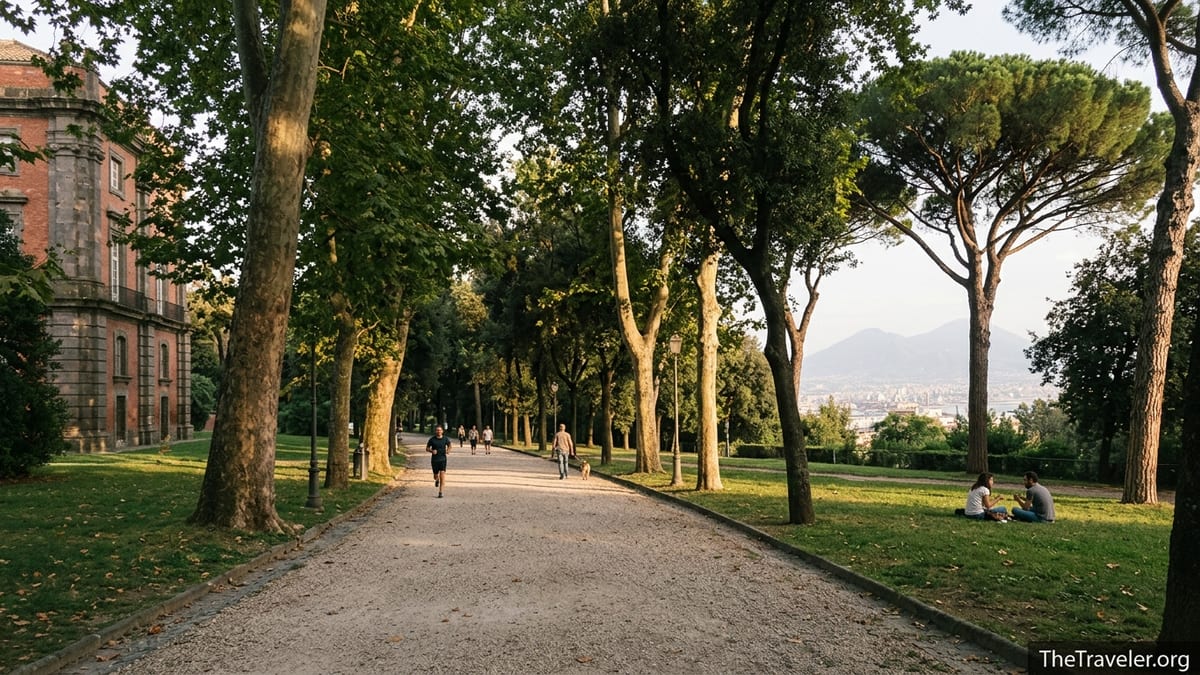
An Urban Forest That Feels Far From Naples
Officially called the Real Bosco di Capodimonte, this park covers around 134 hectares on a hill above Naples, making it one of the largest urban green spaces in Italy. In theory, you are only a 15 to 20 minute bus ride from the Archaeological Museum or Piazza Cavour, but in practice it feels like stepping out of the city entirely. The noise of scooters drops away as soon as you move past the entrance and onto the long, tree lined avenues that once served as royal carriage routes.
The effect is helped by the elevation. Capodimonte literally means top of the hill, and the park sits high above the streets below. The air feels slightly cooler and cleaner, especially in the warmer months, and the perspective is different too. Instead of looking up at the city’s crowded facades, you look out across a canopy of trees, then beyond to the Bay of Naples and the profile of Vesuvius. It is the same city, but from here it seems less frantic, more orderly, almost serene.
What you notice first is the scale of the open space. Naples is famous for its narrow alleys and small courtyards. At Capodimonte, you suddenly have broad gravel avenues, wide lawns and long sightlines. Even on a weekend afternoon, when locals come in to walk dogs and push strollers, everyone seems to disperse across the park’s different clearings and paths. You are rarely forced into the crowding that is so common in the historic center.
There is also a psychological effect that comes from entering through gates into a defined green world. The moment the traffic is behind you, the palace appears ahead, framed by an alley of trees, and you feel the shift. I found myself walking more slowly than I usually do in Naples, matching the unhurried pace of people around me, as if the park gently insists you leave city speed outside.
Royal Geometry, Wild Edges
The park began as a royal hunting ground for the Bourbon kings, and some of that 18th century formality is still obvious. Close to the Palace of Capodimonte, the avenues run straight and symmetrical. The lawns in front of the façade are trimmed, the trees evenly spaced. It has the reputation of a historic garden as much as a public park, and the design plays a quiet role in how calm it feels: the geometry is legible at a glance, so your eyes and mind have less to process.
Walk a little farther from the palace, though, and the formal layout loosens into something closer to an English style landscape garden, a transformation guided in the 19th century by Friedrich Dehnhardt, a German gardener who introduced more naturalistic planting and scenic viewpoints. You might turn off a straight avenue and suddenly find yourself on a curved path edged with oaks and holm trees, the ground uneven, the horizon broken by foliage instead of architecture. That mixture of order and mild wildness is part of the park’s character: enough structure to feel safe and easy to navigate, but enough natural variation to make a simple walk feel like a small escape.
Some of the most peaceful corners are in these in between zones, where the royal past meets the lived present. I remember stopping near a cluster of umbrella pines whose branches cast a wide pool of shade over a slope of grass. There were maybe three small groups using that entire area: an older couple sharing a sandwich from a paper bag, a teenager reading with headphones on, and a family teaching a toddler to kick a football. No one was competing for space, and no one was performing for anyone else. It felt like the opposite of a crowded seafront promenade.
Even the planting choices contribute to the atmosphere. The park hosts hundreds of plant species, including Mediterranean evergreens and non native trees like cedars and eucalyptus. Many of them are large, mature specimens, so there is a high, almost cathedral like canopy in parts of the Bosco. Under those arches of branches, the light is softer and the ground seems quieter, as if the leaves absorb both sun and sound.
Everyday Naples, Softly Framed
Part of what makes the peace of Capodimonte so surprising is that it is not an empty or sterile quiet. This is not a manicured garden where visitors tiptoe around flowerbeds. It is a real neighborhood park woven into everyday life in Naples, and you feel that in the small scenes that play out along the paths. On a weekday morning, you might pass office workers cutting across the park in suit jackets, taking a shortcut between bus stops and nearby apartment blocks. Later in the day, you see parents pushing strollers, older residents walking in slow pairs, and joggers using the long avenues as an outdoor track.
One of my favorite moments came near the Belvedere, one of the viewpoints built into the park’s design. A group of teenagers who had clearly come up from the center were sitting on the low wall, trading jokes in Neapolitan and eating slices of takeaway pizza from a cardboard box. Behind them, the city stretched to the sea in hazy afternoon light. You could hear their laughter, but it floated in the open air instead of bouncing between stone buildings. It was social noise, but it did not feel like city noise.
Food and drink tend to be low key here compared with big destination parks elsewhere in Europe. Instead of flashy kiosks, you find simple refreshment options, like the Giardino Torre cafe tucked inside the park, or small bars just outside some gates where people stop for a coffee before or after a walk. Many regulars simply bring their own. On a Sunday, you see families rolling up with plastic bags filled with homemade focaccia, fruit and bottles of water, then spreading out on the grass for picnics. That do it yourself culture keeps the commercial footprint light and helps preserve the sense of being in a genuine green refuge rather than an open air mall.
The park’s regulations also shape the experience. Official rules limit certain activities, from loud amplified music to ball games in designated historic areas. In practice, enforcement is gentle but present enough that the park rarely turns into the kind of chaotic playground you can find along Naples’ waterfront. Children run and play, dogs chase sticks, but there are still plenty of corners where you can lie down with a book and hear only wind in the leaves and the occasional train horn distant below.
Walking Routes That Slow You Down
Capodimonte is not a park you cross in five minutes. The main avenues run for long, steady stretches, and walking their full length turns into a kind of moving meditation. A common route begins at the main museum entrance near Via Miano, follows the straight Viale Belvedere to the viewpoint, then loops left past the meadows that locals call the prati. This loop alone can easily take half an hour at a relaxed pace, and yet it feels like less because there is always a new angle on the palace or a fresh glimpse of the bay.
If you have more time, you can drop down onto smaller side paths that circle patchwork lawns and clusters of woodland. Runners from central Naples often come up specifically for these circuits, taking advantage of the gentle inclines and shaded stretches. I met one man in his thirties who said he preferred to do his evening 10 kilometer training here instead of along the seafront, precisely because the park’s quieter environment let him focus on his breathing rather than dodging tourists and scooters.
The distance between amenities contributes to an unfussy atmosphere. You will not find a cafe at every corner or souvenir stalls lining the paths. Instead, you might walk ten or fifteen minutes without passing any service at all, just benches and occasional drinking fountains. For some visitors, that demands a little planning. For others, it is a relief: you are free to get lost in your own thoughts without constant prompts to buy something.
Because the Bosco is open from early morning, locals use it at times of day when Naples feels most intense elsewhere. Arrive around 7.30 on a summer day and you will meet dog walkers starting their routines and retirees doing light exercise before the heat builds. By the time buses and metros are full in the center, the park is already easing into a different rhythm, with birdsong and the slap of running shoes on gravel replacing car horns as the dominant sounds.
Views, Light and the Sound of Leaves
If you ask people why they love Capodimonte, many will point first to the views. From the main Belvedere, the panorama takes in the sprawl of Naples, the curve of the harbor and the dark outline of Vesuvius. Yet what struck me most was not just the vista, but the way it is framed. Stone balustrades and low walls create a defined edge between the green of the park and the blue and gray of the city and sea. Standing there, you feel anchored inside the Bosco, looking out at the rest of Naples as if from a balcony.
The light changes the mood throughout the day. In the early morning, mist can hang low between the trunks, softening the lines of the palace and turning the avenues into pale corridors. By midday, the sun brightens the lawns and throws hard shadows from the tree canopies, ideal for sitting on the edge of the shade with a book. In the late afternoon, the color temperature warms, and the palace’s red brick looks deeper and richer against the green. I found the golden hour particularly quiet; museum visitors had started to drift away, and local families had not yet arrived for evening walks, leaving the Belvedere almost to itself.
Sound plays a big role too. One of the peculiarities of Capodimonte is that you are very aware of the wind passing through the leaves. In many parts of Naples, constant urban noise drowns out that simple natural soundtrack. Up here, especially in the deeper wooded sections, the dominant noise is rustling foliage. It is a reminder that this is, first and foremost, a forest, even if it was shaped by human hands.
There are also small, grounding details: the crunch of the gravel underfoot on the main avenues, the faint hum of insects along the edges of the meadows, the smell of damp earth in shaded patches that do not see full sun until the afternoon. The combination is subtle but cumulative. After half an hour, your shoulders drop; after an hour, you realize you have not checked your phone in some time.
Sharing Space With the Palace and its Art
The Palace of Capodimonte sits at the heart of the park, housing one of Italy’s great art collections, including works by Raphael, Titian, Caravaggio and others. Yet even if you do not step inside the museum, its sheer presence shapes the feeling of the Bosco. The palace is a solid, steady anchor in the landscape, visible from many paths and clearings. Knowing that masterpieces hang just behind its walls adds a quiet sense of significance to what might otherwise feel like an ordinary walk.
Spending a morning in the galleries and an afternoon in the park creates a particularly satisfying contrast. After moving through rooms of intense color and religious drama, you emerge into open air and long perspectives. The emotional load of the artwork slowly disperses as you cross the lawns. On my visit, I left the museum around midday, walked straight across to a patch of grass under a cedar and ate a simple picnic picked up earlier from a bakery near the Materdei metro stop. It felt like giving my eyes and mind a chance to reset.
Because the museum and park share the same site, you see visitors moving between them in an easy, unhurried way. Some couples dress up slightly for the galleries, then loosen ties and kick off shoes on the grass afterward. Families with children often split their time, promising a playground stop after an hour of paintings. The presence of art within walking distance seems to ground people, encouraging slower, more reflective use of the green space outside.
There is also a cultural dimension: Capodimonte is part of Naples’ identity, not just a tourist attraction. Locals talk about school trips there, Sunday outings with grandparents, first dates under its trees. That layered association builds a sense of shared ownership and affection, which in turn fosters relatively respectful behavior on the lawns and paths. When a place matters to people, they tend to treat it with a little more care.
Practical Ways to Tap Into the Park’s Calm
Experiencing the quiet side of Capodimonte is partly a matter of timing and partly of strategy. On weekdays outside of peak holiday periods, the park can feel almost empty in the early morning and late afternoon. Arriving soon after the gates open, often around 7 in the morning in the warmer months, gives you broad avenues nearly to yourself. You will share them mainly with joggers, dog walkers and grounds staff checking irrigation systems and flowerbeds.
Midday and weekend afternoons are more social, especially near the main entrances and around the palace, but even then you can usually find solitude by walking ten or fifteen minutes away from the central lawns. If you are sensitive to noise, it helps to avoid sitting near the playgrounds and main intersections of paths. Instead, aim for the edges of the woods, where the trees thicken and the sound of the city fades almost completely.
Public transport makes arriving straightforward. Several buses, including routes from Piazza Cavour near the Archaeological Museum, climb up to the Capodimonte area and stop close to one of the gates. The journey is not glamorous, often involving crowded vehicles and abrupt driving up steep streets, which makes the contrast with the park’s calm even starker when you finally step off at the stop labeled for the museum and walk through the nearest entrance.
In terms of safety and comfort, Bosco di Capodimonte feels like a typical large urban park. It is generally fine in daylight and in the early evening when other visitors are around, but it is still wise to stay on main paths, avoid very secluded spots if you are alone, and plan to leave before closing time rather than cutting it fine. Bringing water, a small snack and something to sit on, like a scarf or light travel blanket, lets you settle into the park’s slower rhythm without needing to go in search of services.
The Takeaway
Walking into Bosco di Capodimonte for the first time, I expected a pleasant park and a good view. What I did not expect was such a strong sense of calm so close to Naples’ noisy core. The peace here is not absolute silence or pristine wilderness. It is a softer, more urban kind of tranquility, built from wide spaces, tall trees, long sightlines and the gentle routine of everyday Neapolitan life unfolding at a slower tempo.
If you are spending time in Naples, Capodimonte is worth more than a quick museum stop. Give yourself half a day to combine an unhurried walk in the park with a visit to the galleries, or simply come up with a sandwich, find a spot under the trees and watch the city glimmer far below. The surprise, as it was for me, is how easy it becomes, up here on the hill, to forget how close the chaos really is.
FAQ
Q1. Where exactly is Bosco di Capodimonte in Naples?
It sits on a hill in the Capodimonte district in northern Naples, surrounding the Palace and Museum of Capodimonte, a short bus ride from the historic center.
Q2. How do I get to Bosco di Capodimonte by public transport?
From central Naples, you can take buses that climb from areas like Piazza Cavour or the Archaeological Museum up to stops signed for the Capodimonte museum and park entrances.
Q3. Is there an entrance fee for the park itself?
The Bosco di Capodimonte park is generally free to enter, while the Palace and Museum of Capodimonte charge a separate admission fee for the galleries.
Q4. What are the typical opening hours of the park?
Opening hours vary by season, but the park usually opens around 7 in the morning and closes in the early evening or early night, with longer hours in summer.
Q5. Is Bosco di Capodimonte safe for solo travelers?
In daylight it feels comparable to other large city parks, with walkers, runners and families around. It is still sensible to stay on main paths and avoid very isolated corners.
Q6. Can I picnic inside the park?
Yes, picnicking on the lawns is common, especially on weekends. Many locals bring simple food and drinks from home and choose a spot under the trees.
Q7. Are there cafes or food options inside Bosco di Capodimonte?
There are a few low key options such as a cafe inside the park and small bars near some gates, but it is wise to bring water and snacks, especially for longer visits.
Q8. How much time should I plan for a visit?
If you want to see both the museum and enjoy a walk in the park, allow at least half a day. A relaxed loop through the main avenues alone can easily fill a couple of hours.
Q9. Is Bosco di Capodimonte suitable for running or exercise?
Yes, many locals come specifically to run or walk for exercise along the long, shaded avenues, which offer gentler conditions than the busy streets and seafront below.
Q10. When is the most peaceful time to visit?
Early mornings on weekdays are usually the quietest, followed by late afternoons outside peak holiday periods, when there are fewer large groups and more space to yourself.