


Visitors come to Naples for Caravaggio, pizza and the chaos of its narrow streets, but few realize that one of Italy’s most impressive royal parks stretches quietly above the city. The Bosco di Capodimonte, wrapped around the hilltop Capodimonte Palace and its world-class museum, is more than just another urban garden. It is Naples’ largest public green space, a historic hunting wood turned everyday escape where locals jog under centuries-old oaks, families picnic on wide lawns and the Gulf of Naples glints in the distance. Skipping it means missing the side of the city that breathes deepest.
Get the latest updates straight to your inbox!
A Royal Wood Turned Urban Lifeline
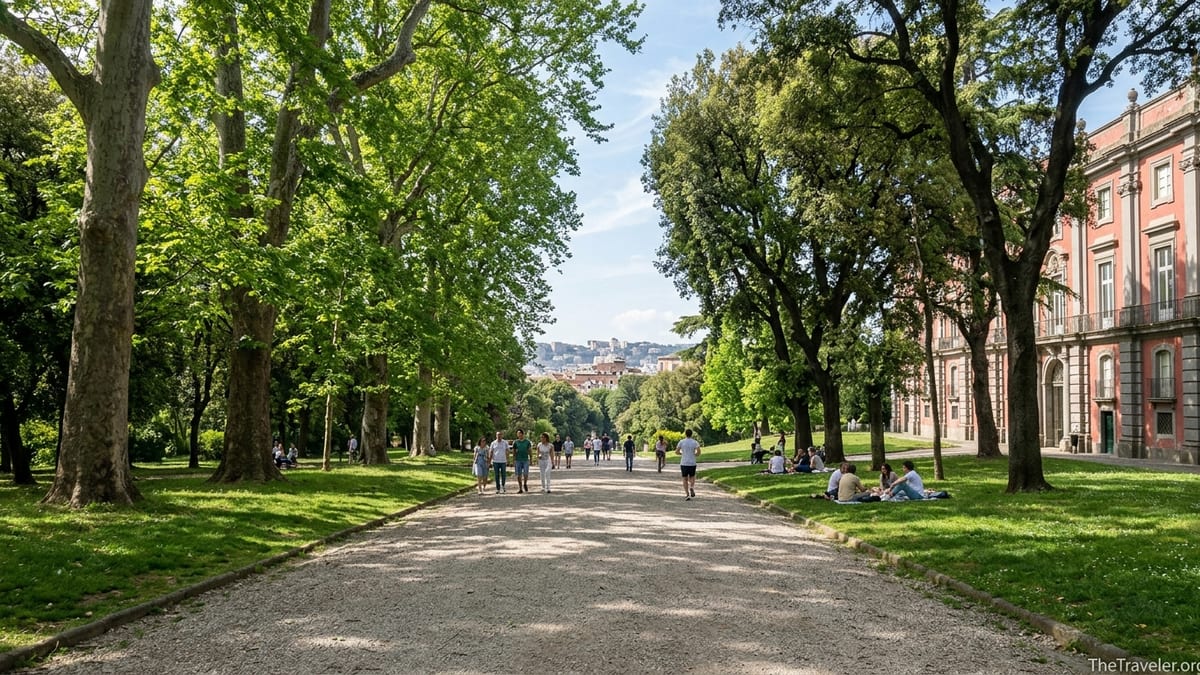
The Bosco di Capodimonte began in the 18th century as the private hunting grounds of the Bourbon kings, laid out around their new hilltop palace just north of Naples’ historic center. Today, this former royal estate has become the city’s green lung, a public park where 120 to 130 hectares of woodland and meadows offer space that can feel almost unimaginable after an hour in Spaccanapoli. Strolling its broad gravel avenues, you move between tall holm oaks, pines and plane trees planted to shade the royal family and their guests on summer days.
The park’s size is not abstract. On a practical level, this means you can walk for half an hour without repeating your route, or find a bench that feels genuinely quiet even on a Sunday. Compare that with the little cloister gardens in the centro storico or the compact Villa Comunale along the seafront, pleasant but quickly crowded. At Capodimonte, morning dog walkers disappear into side paths, teenagers cut across the lawns to reach a football pitch, and runners loop the internal roads as if they were training in a countryside estate rather than within a dense city.
The royal past is still visible everywhere. Beyond the main Reggia, lesser pavilions such as the Casino dei Principi or the former porcelain factory appear unexpectedly at the end of tree-lined alleys, reminders that this was once a self-contained world for the court. Small churches, farm buildings and lodges now sit behind fences or serve new cultural and social uses, but their presence gives the park a sense of depth and narrative that a newer urban green space simply cannot replicate.
For modern travelers, this history translates into atmosphere. Walking up toward the palace on a hazy afternoon, with the red facade glowing through avenues of trees and the sound of city traffic muted to a background hum, you are not just in a park. You are in a landscape that has witnessed royal hunts, political upheavals and the gradual transformation of a closed estate into a democratic public space. That layered feeling is part of what makes Capodimonte such a distinctive escape in Naples.
Naples’ Coolest Refuge on a Hot Day
Naples’ summers can be harsh. In July and August, the historic alleys trap heat, and the waterfront promenade can feel relentless under a midday sun. Capodimonte’s position on a hill, combined with its dense tree cover, usually offers temperatures a few degrees cooler and a much more forgiving microclimate. Locals know this. On sultry weekends, you will see groups arriving with coolers and picnic blankets, claiming patches of shade that may last the entire afternoon, something that is simply not possible in the small squares of the old town.
The scale of the park also shapes how you experience the city’s noise. Even popular viewpoints like Castel Sant’Elmo or the Belvedere di San Martino, while spectacular, are usually busy and framed by stone and asphalt. At Capodimonte, you can sit on the grass near one of the clearings, hear birds and leaves first and only faintly catch the murmur of motorcycles and buses below. Runners often choose the internal loops precisely because the air feels fresher and the ground underfoot is softer than Naples’ ubiquitous paving stones.
The opening hours help make this a daily refuge. The Bosco generally opens around 7:15 in the morning, which means early risers can jog or walk before the city fully wakes up. Closing times shift with the seasons, tending to early evening in winter and around 7:30 in the brighter months, so late-afternoon visits are especially pleasant. A traveler staying near the Archaeological Museum might easily plan a museum visit in the morning, then ride up to Capodimonte for a shaded stroll and picnic when the city below is at its hottest.
There is also a psychological cooling effect. Naples can be intense, especially for first-time visitors: scooters cutting through pedestrian lanes, street sellers calling out, sirens and the constant vibration of traffic. Stepping into Capodimonte, with its long sightlines under trees and wide lawns where children play football, gives the brain permission to slow down. Many visitors describe an hour here as a reset button that allows them to enjoy the rest of the city more fully.
Views, Vistas and the Shape of the City
Capodimonte is not primarily a viewpoint like the promenades of Posillipo or the terraces of Vomero, but its hilltop location gives a different kind of panorama. From certain clearings and from the areas around the palace, the city spreads beneath you: a dense maze of rooftops, church domes and apartment blocks stretching toward the bay, with Vesuvius often appearing as a hazy silhouette on clear days. It is a view framed by trees and lawns rather than stone parapets, which changes the emotional tone. Instead of leaning over a balustrade with a crowd of other sightseers, you might be leaning back against a tree, or sitting on the grass, sharing the vista mostly with local families.
These views help with orientation. Looking down, you can pick out the straight line of Via Toledo cutting toward the sea, or recognize the massive bulk of the National Archaeological Museum. For travelers spending several days in Naples, a visit to Capodimonte midway through a trip can literally put things in perspective, showing how the centro storico, the port, the hills and the northern neighborhoods relate to each other. It can be more instructive than studying a map in a guidebook.
The park’s internal landscape also offers micro-views that are more intimate than sweeping panoramas. Turn onto one of the less-traveled paths and you might find a small meadow edged by shrubs and low stone walls, with just a patch of skyline visible. These are the corners where local couples sit with takeaway coffee from the park’s café, or where solo travelers read with a guidebook open beside them. Because the park is so large, it is easy to feel that a particular spot belongs to you for an hour.
Crucially, these vistas rarely feel over-engineered. Unlike some newer urban parks where every viewpoint comes with explanatory panels and selfie platforms, Capodimonte still has corners that are simply there, unlabelled, discovered by walking. For those who prefer their travel experiences a little less curated, this adds to the sense of authenticity. You are not just ticking off a viewpoint on an itinerary; you are encountering the city in the way many Neapolitans do on a Sunday walk.
Art, Culture and Nature in One Stop
Ignoring Bosco di Capodimonte often means ignoring one of Italy’s great museums, because the two are inseparable. The Capodimonte Museum occupies the former royal palace at the heart of the park and houses an extraordinary collection, including works by Caravaggio, Titian and Raphael, along with the historic Farnese collection. For art travelers, it is a destination in itself. For everyone else, it is an opportunity to combine a serious cultural visit with fresh air and downtime.
As of mid-2026, a standard adult ticket to the Capodimonte Museum is generally around 15 euros, with reduced prices for EU residents between 18 and 25 and free entry for children under 18. On certain days, such as the nationwide free museum Sundays that run at various points in the year, admission can be free, though the park itself costs nothing to enter on any day. This means a couple might easily plan a half-day that includes both a world-class gallery and several hours resting under trees without significantly stretching their budget.
Inside the palace, the contrast with the surrounding woods is striking. You move from cool, high-ceilinged galleries lined with paintings into stairwells where windows frame green views of the park below. Many visitors choose to break up their museum visit by stepping outside for a walk or coffee and then going back in, taking advantage of tickets that are valid for multiple entries on the same day. For families, this flexibility can be essential. Children who have reached their saturation point with Renaissance art can run on the lawns or play in designated areas while adults alternate short visits to specific collections.
The park itself also hosts cultural events, from open-air concerts to temporary installations, particularly in the warmer months. While schedules vary year by year, it is not uncommon to find an evening performance advertised on posters around the palace or near the entrances. Attending one of these events adds another layer to the experience: you might arrive in daylight to wander the woods, then sit on the grass as twilight falls and music begins, with the silhouette of the palace behind the stage.
How to Reach Naples’ Greenest Escape
One reason travelers sometimes skip Capodimonte is the perception that it is hard to reach. In practice, it is reasonably straightforward if you plan ahead. The park lies about 3 kilometers north of the historic center. From around the National Archaeological Museum, several city buses climb the hill to stops near the palace and park gates. Routes such as the 3M, 168, 178 and C63 typically connect the museum area or central neighborhoods with Capodimonte, dropping passengers near entrances like Porta Piccola or Porta Grande.
A common itinerary is to take Metro Line 1 or Line 2 to the Museo or Cavour stations, visit the National Archaeological Museum in the morning, and then catch a bus from the adjacent Piazza Museo up to Capodimonte in about 15 to 20 minutes, depending on traffic. Tickets for buses and metro are usually sold in tabacchi shops, newsstands and vending machines at metro stations, and must be validated on board. Schedules can be irregular, so using a journey-planning app that covers Naples or checking posted timetables at the stop helps manage expectations.
Taxis and ride-hailing services remain an option, especially for small groups or travelers with limited mobility. A taxi from the historic center to the Bosco di Capodimonte will often cost roughly the price of two or three museum tickets, but the door-to-door convenience can be worth it if you want to avoid crowded buses or are visiting during peak heat. Drivers in Naples are usually familiar with the palace and park; specifying one of the main entrances, such as Porta Grande on via Capodimonte, will help ensure you are dropped close to the main avenues.
Driving yourself is less advisable unless your accommodation already sits in the hills with easy access, as parking around the park can be competitive and local drivers are assertive. For most visitors, public transport up and a leisurely walk back down via residential streets and viewpoints can be a pleasant compromise. The downhill return offers glimpses into everyday Neapolitan life: laundry on balconies, small cafés, children playing football in side streets, all before you re-enter the denser historic core.
What You Can Actually Do Inside the Bosco
Beyond simply walking, the Bosco di Capodimonte offers a remarkably flexible setting for different types of days. Fitness-minded travelers will find long, mostly level avenues perfect for running or brisk walking, with enough loops to build routes of 5 kilometers or more without repeating too much ground. Locals frequently jog in the early morning or late afternoon, when the light is soft and the air cooler, and visitors often join them, blending into the steady flow of movement under the trees.
Families lean into the open spaces. On weekends, broad lawns near the main paths fill with impromptu football games, frisbee throwing and children learning to ride bicycles. Bringing a picnic is common practice. A simple spread of takeaway pizza from a local pizzeria, fruit from a street vendor and bottled water or soft drinks turns a low-cost afternoon into an event. There are also cafés and kiosks inside or near the park that provide espresso, pastries or light snacks, useful if you decide to stay longer than expected and want a second coffee under the greenery.
For slower travelers, the park works well as a reading and reflection space. Many benches sit at the edges of paths or near smaller clearings, and it is easy to find a quiet spot for an hour of journaling or planning the next stages of your Italy trip. Artists sometimes set up with sketchbooks or small watercolor sets, using the palace’s facade, individual trees or distant city views as subjects. Photographers, meanwhile, can experiment with capturing Naples in an unusually green frame, focusing on long perspectives down tree-lined avenues or the contrast between formal architecture and wild-looking branches.
Because the park is large and has multiple entrances, it also invites simple wandering. You might enter at Porta Piccola, follow a main road past joggers and families, then turn onto a narrower path that skirts the edge of a wooded section before opening suddenly onto a broad meadow. Without strict wayfinding or crowds funneling everyone onto the same loop, your route can be improvised, an appealing prospect for travelers who like to discover places at their own pace.
Staying Safe and Respectful
As with most large urban parks, safety at Capodimonte is largely a matter of common sense and timing. By day, especially on weekends and in good weather, the park is filled with walkers, families, runners and dog owners. This everyday presence creates a relaxed atmosphere, and many solo travelers feel comfortable exploring the main avenues. As evening approaches and visitor numbers fall, it is prudent to stick to better-lit, more frequented routes near the palace and main gates, and to avoid cutting through the park late at night, much as you would in any big city.
The park has posted regulations that ask visitors to respect the natural environment and other users. Cycling is often permitted only on certain routes; open fires are prohibited; and organized sports are generally meant to stay in designated areas. Littering is a persistent issue in many Italian parks, so carrying a small bag for your own rubbish and disposing of it in bins near exits is a simple but meaningful contribution. Locals notice and appreciate visitors who treat the park as carefully as they do their own backyards.
Pet owners bring dogs on leads, and it is wise for visitors to do the same, both out of courtesy and because of local regulations. Outside the main avenues, some paths border slightly wilder sections where undergrowth and uneven ground require more attention, particularly after rain. Good walking shoes or trainers with decent grip will make your visit more comfortable, especially if you plan to explore beyond the most manicured areas.
Respect also extends to the historic structures scattered throughout the Bosco. Many of the smaller buildings are not open to the public or are used for specific programs, and fences or barriers should be taken seriously. Climbing onto walls for a better photo or pushing through semi-open gates can damage fragile stonework or vegetation. From a traveler’s perspective, the best approach is to enjoy these glimpses into the royal estate’s past from the paths provided, saving closer contact for the palace and museum interiors where visitors are welcomed.
The Takeaway
In a city that can feel defined by its density and intensity, the Bosco di Capodimonte is a reminder that Naples also excels at space, quiet and slow time. It is not as famous as Pompeii or the Amalfi Coast, and it often appears only as a footnote in quick-hit itineraries focused on pizza, underground tours and the archaeological museum. Yet spending even a couple of hours here can change your relationship with the city, giving you room to breathe and a broader sense of its geography and history.
Skipping Capodimonte means missing Naples’ greenest escape, but also missing the chance to experience royal architecture, major artworks and everyday local life in one setting. It is where joggers in modern sportswear pass Baroque pavilions, where museum-goers step out between galleries to sit under centuries-old trees, and where children kick footballs on lawns that once hosted royal hunts. For travelers willing to ride a bus up the hill or share a taxi, the reward is a side of Naples that few guidebook tick-lists fully capture.
If your schedule in the city is short, consider trading one additional church or shopping hour for a walk through the Bosco. Bring a bottle of water, a takeaway snack and perhaps a paperback. Let the noise of the centro storico recede behind the rustle of leaves. When you return downhill, the city will be the same, but you may find you are looking at it with fresher eyes.
FAQ
Q1. Where exactly is the Bosco di Capodimonte in Naples?
The Bosco di Capodimonte surrounds the Capodimonte Palace on a hill about 3 kilometers north of Naples’ historic center, in the Capodimonte district above the National Archaeological Museum.
Q2. How much does it cost to visit the Bosco di Capodimonte?
Entry to the park itself is free. You only pay if you choose to visit the Capodimonte Museum inside the palace, where standard adult tickets are typically around 15 euros, with various reductions and free categories.
Q3. What are the usual opening hours of the park?
The Bosco generally opens early in the morning, around 7:15, and closes in the early evening, with later closing times, often around 7:30, during the longer days of spring and summer. Exact hours can vary by season and day.
Q4. How do I get to Bosco di Capodimonte by public transport?
From central Naples, you can take metro Line 1 or Line 2 to the Museo or Cavour stations, then catch buses such as the 3M, 168, 178 or C63 from the area around the National Archaeological Museum up to the Capodimonte gates.
Q5. Is Bosco di Capodimonte safe for solo travelers?
By day the park is generally considered safe and is frequented by families, runners and dog walkers. As in any large city park, it is best to stay on main paths, be aware of your surroundings and avoid crossing the park late at night.
Q6. Can I have a picnic inside the park?
Yes, picnicking on the lawns is common and popular with locals, especially on weekends. Open fires are not allowed, so bring cold food or items like takeaway pizza, and remember to collect your rubbish.
Q7. What should I wear or bring for a visit?
Comfortable walking shoes, water, sun protection in warmer months and perhaps a light jacket in the cooler seasons are recommended. A small picnic blanket or towel can make sitting on the grass more comfortable.
Q8. Is the Capodimonte Museum worth visiting if I am not an art expert?
Yes. Even without specialist knowledge, the palace’s grand interiors, famous works by artists like Caravaggio and the views over the park create a memorable experience, and you can easily combine a shorter museum visit with time outdoors.
Q9. Are there places to buy food or drinks in or near the park?
There are cafés and kiosks in or near the palace and park that sell coffee, soft drinks and light snacks. Many visitors also bring food from bakeries, supermarkets or pizzerias in the city and eat it on the lawns.
Q10. How much time should I plan for Bosco di Capodimonte?
If you are only walking in the park, allow at least one to two hours to appreciate the space. Combining the Bosco with a visit to the Capodimonte Museum can easily fill half a day or more, especially if you add a picnic or a leisurely stroll.