


Ask a Neapolitan where to escape the city without really leaving it and you will hear the same answer again and again: the Real Bosco di Capodimonte. Spreading across 134 hectares of lawns, forest and panoramic terraces high above the historic center, this royal hunting park turned public green lung is where locals go to breathe, jog, picnic and simply look at Naples from a calmer distance. For travelers who want to see the city the way residents do, Bosco di Capodimonte is one of the most revealing places you can visit.
Get the latest updates straight to your inbox!
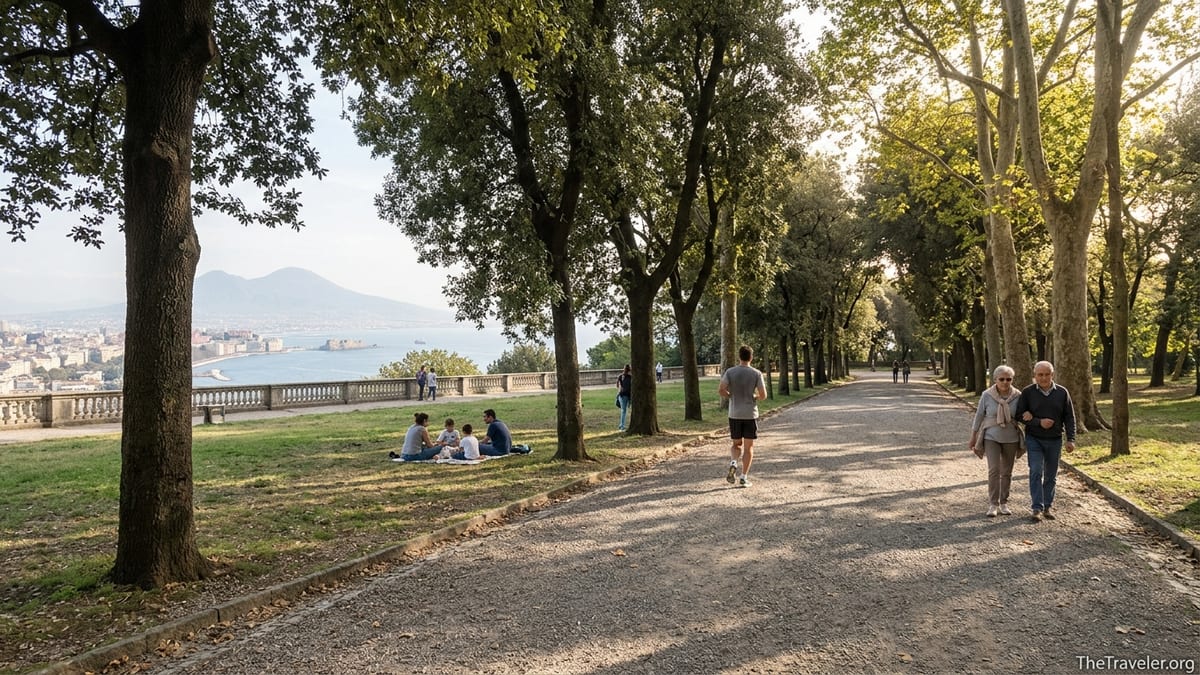
A Royal Forest Turned Everyday Backyard
Locals love Bosco di Capodimonte partly because it feels both grand and familiar at the same time. Created in the 18th century as the royal hunting grounds for the Bourbon kings who built the Reggia di Capodimonte, the park still wraps around the red palace that today houses the Capodimonte Museum. What was once an exclusive playground for monarchs has, over time, become an open backyard for the city, with Neapolitans of every age using the same avenues where royal carriages once rolled to walk dogs, push strollers or cycle on weekends.
With roughly 134 hectares of meadows, woodland and landscaped gardens, the Bosco is now considered the largest urban public park in Italy, at least by surface area. You feel that size as soon as you pass through one of the gates, such as Porta Grande or Porta Miano. Traffic noise drops away, the air cools by a few degrees compared with downtown, and the dense canopy of oaks, holm oaks and plane trees closes above the long, straight avenues. This scale is what makes it such a beloved escape: there is almost always space to spread out, even on sunny Sundays in May when many other Naples parks feel crowded.
Because it stands on a hill at the northern edge of the city, the Bosco also enjoys slightly fresher air and more breeze than the low-lying historic center. In humid summer months, locals from dense neighborhoods like the Spanish Quarter or Sanità often come up in the late afternoon, when the light softens over the bay and the lawns fill slowly with groups chatting on picnic blankets. You will hear Neapolitan dialect as much as standard Italian, a sign that this is not a site used only by visitors following guidebooks.
The park’s royal origins still shape how it looks. Long axial avenues cut through the greenery, pointing the eye toward the palace or toward viewpoints over the city, in a layout influenced by grand European gardens such as Versailles. At the same time, decades of being lived in by ordinary people have softened the atmosphere. Children weave between joggers on scooters, teenagers sit in loose circles on the grass, and pensioners claim the same benches every morning for their slow walk and chat. This mix of historical formality and lived-in warmth is central to why locals identify with the Bosco.
Nature, Quiet and Views in One Place
For Neapolitans, Bosco di Capodimonte is first of all a place to breathe. The park has tens of thousands of mature trees and hundreds of different plant species, including Mediterranean pines, camphor trees and palms. Large open praterie, or meadows, break up the woodland, giving space for sunbathing and games. Compared with compact gardens in the center, like Villa Comunale along the seafront, the Bosco feels wilder and more varied, with shady side paths where you can walk for several minutes without hearing a car.
One of the biggest draws is the series of belvedere points that open dramatic views across the city, the Gulf of Naples and Vesuvius. From the Belvedere di Capodimonte, a broad terrace not far from the palace, you look straight down over tiled rooftops, church domes and the long curve of the waterfront. Locals bring visiting relatives here instead of climbing Vesuvius, because the panorama is almost as wide and it costs nothing more than a bus ticket to reach it. On clear winter days the air can be extremely sharp, with snow visible on the Apennine peaks inland as ferries crisscross the bay below.
The park is also one of the quietest large spaces in Naples. Cars are not allowed inside the main network of avenues, and the high walls that ring the property shield it from surrounding streets. The result is that bird calls, the crunch of gravel under running shoes and distant shouts from football games on the grass are often the loudest sounds you hear. Many locals choose the Bosco for reading or studying outdoors, especially university students who live in central neighborhoods but want to revise in peace before exams. You will often see them sitting under trees with notebooks spread out, a takeaway coffee from a bar near Porta Grande beside them.
Because of this quiet atmosphere, the Bosco is also where Neapolitans come for small private moments. It is a common place for low-key marriage proposals and for couples’ anniversary picnics. Residents talk about specific spots, like the stretch of avenue near Porta Miano that catches the late sun, or a certain bench beside one of the old fountains, as if they were rooms in their own homes. These personal relationships with parts of the park give it an emotional weight that goes beyond a normal tourist sight.
How Locals Actually Use the Bosco Day to Day
Visitors often imagine that residents use the Bosco only for leisurely strolls, but for many Neapolitans it is part of a weekly or even daily routine. Jogging is one of the most visible activities. Running groups meet at sunrise at entrances like Porta Grande, when the gates open around 7.15 a.m., to do laps along the main avenues before work. A typical loop from the palace, down past the wide meadows and back can easily measure five or six kilometers, and the mix of gentle slopes and flat sections makes it popular training ground for local amateur runners preparing for events such as the Napoli City Half Marathon.
Families with young children tend to arrive mid-morning on weekends, often loaded with foldable chairs, balls and simple picnic supplies bought at nearby bakeries or supermarkets. Instead of elaborate barbecue setups, it is more common to see groups sharing foil-wrapped panini, supermarket fruit and plastic bottles of water. The rules of the Bosco discourage open flames and leaving litter, so people usually keep things basic and easy to carry. Children use the meadows as improvised football fields or for flying small kites bought from street stalls in other parts of the city.
Dog owners are another constant presence. Around entrances such as Porta Miano, there are areas where dogs can exercise on-leash and, in certain marked sections, off-leash. Locals from surrounding residential districts often synchronize their dog walks, so regulars get to know each other by their pets first. A traveler strolling these paths in the late afternoon might overhear long conversations about neighborhood news unfolding while dogs sniff and explore the undergrowth.
On summer evenings, the park shifts into a more social but still relaxed space. After 6 p.m., when the worst heat has passed, couples and groups of friends drift through the avenues, often stopping at panoramic spots to watch the sky change color over Vesuvius. It is common for locals to combine an early evening walk in the Bosco with a later dinner in nearby districts, or with a cultural event at the Capodimonte Museum when evening openings or concerts are scheduled. This blend of nature and culture in a single outing is one reason many Neapolitans feel particularly attached to the hill of Capodimonte.
Reaching the Bosco: A Realistic Guide for Travelers
Part of the charm of Bosco di Capodimonte is that it is accessible yet slightly removed from tourist circuits. From the historic center, most locals reach it by bus from the area around the National Archaeological Museum or Piazza Cavour. Common routes include lines such as 168, 178 or C63, which stop near the Museo e Real Bosco di Capodimonte entrance on Via Miano. The ride usually takes around 15 to 20 minutes, depending on traffic and how long you wait for the bus. Tickets for city buses are typically inexpensive by European standards, but visitors should buy them in advance at a tabacchi shop or metro station rather than expecting to pay on board.
Because public transport in Naples can sometimes run irregularly, many residents simply walk up from the museum area, accepting the climb in exchange for independence from timetables. The walk from the Archaeological Museum to one of the lower gates of the Bosco can take roughly 20 to 30 minutes uphill at a moderate pace. It follows city streets, so it is not a scenic hike, but this route is perfectly manageable for travelers in normal health and gives a sense of everyday city life along the way.
Arriving by taxi or ride-hailing service is another realistic option, especially in the hotter months or if you are visiting with small children. From central Naples, the ride to the main entrance near the palace is relatively short, often under 15 minutes outside rush hour. Fares can vary depending on traffic and where exactly you start, so it is wise to ask the driver for an approximate cost before setting off or to rely on the meter. Locals sometimes split a taxi between friends when heading up for an evening walk, then return by bus or on foot once the heat has eased.
Once you reach the Bosco, entrance to the park itself is free. This is one of the reasons it is so beloved: in a city where many families keep a careful eye on their budget, having such a large, well-situated green space with no admission fee is a real luxury. Opening hours shift with the seasons, with the park generally opening from around 7.15 a.m. and closing between late afternoon and early evening. Travelers should always check current times locally, for example on notices posted at the gates, because hours can change for maintenance or special events.
Hidden Corners and Lesser-Known Experiences
Repeat visitors from Naples often speak about Bosco di Capodimonte not as a single attraction but as a collection of distinct zones, each with its own mood. Near the palace and the main avenues, the atmosphere is open and formal, with broad lawns and clear sightlines. Farther out, especially near gates like Porta Miano, the landscape becomes more intimate, with narrower paths, small clearings and informal seating areas where you are more likely to see small groups of locals than guided tours.
One such lesser-known experience for travelers is to follow the avenues away from the palace toward the more wooded northwestern sections of the park. Here, the terrain dips and rises gently, and the tree cover thickens, creating shady corridors that can feel almost rural. It is in these areas that you might unexpectedly hear the thud of a football and discover a group of teenagers playing a game with makeshift goals, or see older residents walking slowly while chatting arm in arm. These scenes give a more authentic picture of Neapolitan life than many postcard viewpoints.
Another rewarding angle is to combine exploration of the Bosco with a visit to the Capodimonte Museum in the palace. Locals sometimes describe this as an ideal “mixed day,” starting with a couple of hours of art and then rewarding themselves with a long walk through the park. The museum houses major works by artists connected to Naples and beyond, and its upper-floor windows offer alternative perspectives over the park and the city. Even if you are primarily interested in the greenery, ducking inside for a short visit can give context to the royal history of the grounds outside.
Attentive visitors will also notice small architectural features scattered through the park: old farm buildings from when parts of the estate were cultivated, fountains supplied by historic aqueducts, and remnants of older garden layouts. Local walking groups and cultural associations sometimes organize themed walks to highlight these elements, focusing on topics such as historical botany or the evolution of royal hunting landscapes. If you happen to see a group with a guide and a portable microphone near one of the gates, it is likely one of these activities that reinforces the bond between citizens and their park.
Planning a Peaceful Visit: Practical Tips
To experience Bosco di Capodimonte the way residents do, timing matters. Many locals consider early morning the best moment, particularly from late spring through early autumn. Arriving around opening time lets you feel the park wake up, with runners appearing, gardeners starting their rounds and soft light slanting between the tree trunks. The air is coolest then, which is important in a city that often sees high humidity and intense sun from June through September.
Late afternoon into early evening is the other prime window. On clear days from October to March, you may get crisp light and striking views of Vesuvius, often with a band of pink or orange over the bay at sunset. In high summer, locals tend to come a bit later, when the heat has finally dipped. Midday, especially around August, can be uncomfortably hot in the open meadows, so if that is the only time you can visit, aim for the shadier paths and carry plenty of water.
Sensible footwear is important, as many of the main avenues are gravel rather than smooth pavement, and some side paths can be uneven after rain. Locals who walk or run regularly in the Bosco typically wear simple running shoes rather than sandals, even in warm weather. Bringing a light picnic blanket or sarong to sit on will make it easier to take advantage of the lawns, which can hold moisture in the mornings. Since food options inside the park are limited, many residents pick up inexpensive snacks in advance from bakeries or supermarkets near their homes or near the museum area below.
Travelers should also be aware of basic rules that help keep the Bosco pleasant for everyone. Open fires and barbecues are generally prohibited, and visitors are expected to carry their rubbish to bins along the main avenues. Cycling is allowed only on certain paths, and ball games are usually kept to open meadows away from busy walkways. While the atmosphere is relaxed and informal, locals tend to respect these guidelines, understanding that the park’s relative cleanliness and order are part of what makes it such a beloved refuge.
The Takeaway
Bosco di Capodimonte is much more than a patch of green on the map of Naples. It is a layered landscape where royal history, everyday exercise, family rituals and some of the city’s best views come together in one expansive space. Locals value it not only for its beauty but also for its accessibility: a place where you can run five kilometers before work, share an inexpensive picnic with your children, or simply sit on a bench and watch Vesuvius at dusk without spending anything at the gate.
For travelers, spending a few hours in the Bosco offers a perspective on Naples that balances the intensity of its historic center and chaotic traffic. Walking its avenues, you see how residents carve out calm in a city famous for its energy, and how nature and culture intertwine on this hilltop. Whether you arrive via a crowded bus from the Archaeological Museum, a steady uphill walk, or a short taxi ride, you step through the gates into a slower rhythm that explains why so many Neapolitans feel that Bosco di Capodimonte is, in a very real sense, their shared backyard.
FAQ
Q1. Is there an entrance fee for Bosco di Capodimonte?
Entry to the park itself is generally free, which is one reason locals use it so often, though the museum in the palace has a separate ticket.
Q2. What are the typical opening hours of the Bosco?
The park usually opens around 7.15 a.m. and closes between late afternoon and early evening, with exact times varying by season, so always check the posted schedule at the gate.
Q3. How do I get to Bosco di Capodimonte from central Naples by public transport?
Many locals take buses from the National Archaeological Museum or Piazza Cavour area, on routes such as 168, 178 or C63, which stop near the main entrances on the hill.
Q4. Is the park safe to visit?
During daylight hours, especially mornings and late afternoons when many locals are walking, running or picnicking, the Bosco feels generally safe, though normal city awareness is still advisable.
Q5. Can I bring a picnic into Bosco di Capodimonte?
Yes, informal picnics are common, with locals bringing simple food like sandwiches and fruit, but open flames and barbecues are typically not allowed and litter must be taken to bins.
Q6. Are there good viewpoints for photos of Naples and Vesuvius?
Several panoramic terraces, especially the Belvedere area near the palace, offer wide views over the historic center, the Gulf of Naples and Mount Vesuvius.
Q7. Is Bosco di Capodimonte suitable for running and walking?
Very much so; long gravel avenues and gentle slopes make it a favorite training ground for local runners and a comfortable place for extended walks away from traffic.
Q8. Are there restroom or café facilities inside the park?
Facilities are limited compared with a city center mall or station, but around the palace and main entrances you can usually find restrooms and at least one café or kiosk.
Q9. Can I visit the Capodimonte Museum and the Bosco in the same day?
Yes, many residents and visitors combine a museum visit with a walk in the park, since the palace sits within the grounds and the two share the same hilltop setting.
Q10. Is Bosco di Capodimonte a good place to visit with children?
Families in Naples use the Bosco regularly, as its large meadows and traffic-free avenues provide plenty of space for children to run, play ball games and ride scooters under adult supervision.