


Arriving in Cape May can feel a little disorienting if you think you already know the Jersey Shore. Instead of neon signs, bumper cars and blaring arcades, you step into tree-lined streets of painted Victorian houses, a compact historic downtown and beaches where people are almost whisper-quiet at sunset. Cape May is very much part of the Shore, yet it looks, sounds and moves at a different speed. Understanding why is the key to planning the right kind of trip here, and to appreciating what makes this southernmost New Jersey town so unusual.
Get the latest updates straight to your inbox!
America’s Oldest Seaside Resort, Not Just Another Beach Town
Cape May has been welcoming vacationers since the mid-18th century, which makes it widely regarded as the oldest seaside resort in the United States. That long history is not just a trivia fact; you feel it walking down streets where grand hotels and guesthouses were built to host nineteenth-century visitors arriving by steamboat and train. Many Jersey Shore towns did not truly boom until the automobile era, and their layouts reflect that, with broad avenues and roadside motels. Cape May’s compact grid and human-scale streets belong to an earlier age.
The town’s status as a National Historic Landmark District, covering hundreds of preserved buildings in under two square miles, also sets it apart. In most Shore communities, you are never more than a block or two from something new and boxy. In Cape May, entire blocks of historic inns, churches and cottages line up almost uninterrupted. This concentrated sense of place is rare on a coastline that has repeatedly rebuilt itself to chase the latest tourism trends.
That historic fabric shapes the way visitors use the town. Instead of driving from a condo to the boardwalk, many people stay in small inns or restored hotels and walk everywhere, from the beach to dinner to evening ice cream. It feels more like a traditional European resort than a car-centric American beach strip, and that alone can make it feel like a different world compared with Wildwood, Atlantic City or Seaside Heights.
Even the town’s geography nudges it in a different direction. Cape May sits at the very tip of New Jersey, with the Atlantic Ocean on one side and Delaware Bay on the other. You are at the end of the line rather than somewhere along a long strip of coastal development. That “edge of the map” feeling contributes to the slower pace many visitors notice as soon as they park the car and step onto the brick sidewalks.
Victorian Storybook Streets Instead of Neon Boardwalks
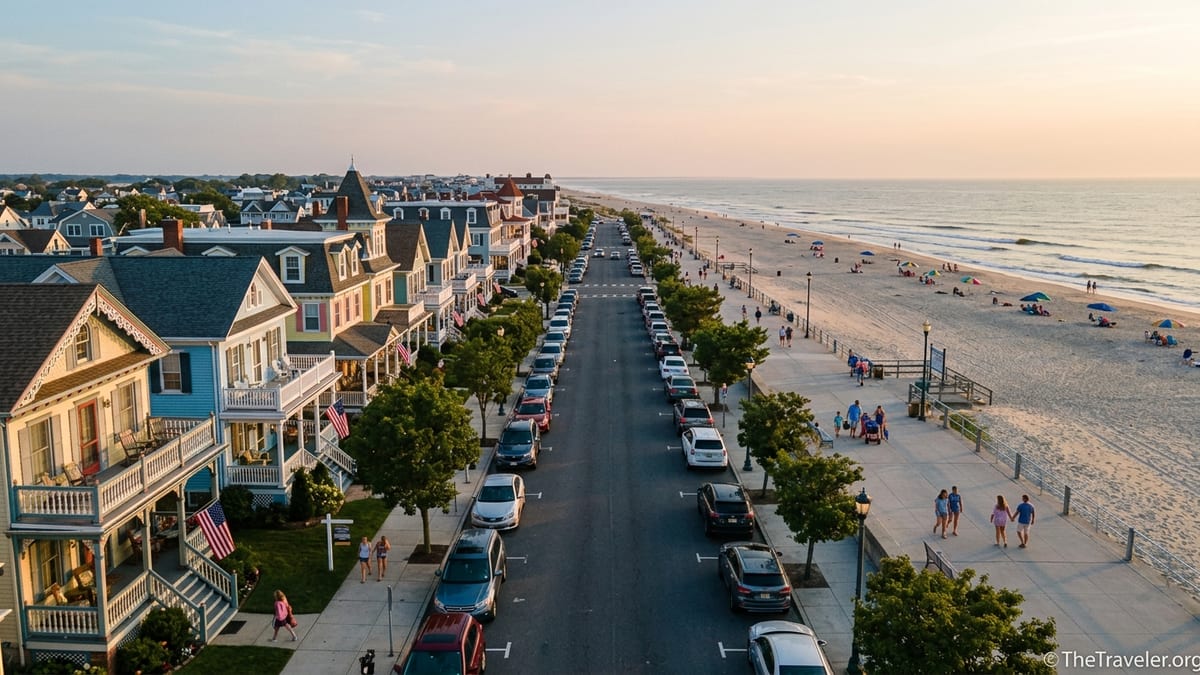
The most obvious difference between Cape May and much of the Jersey Shore is visual. Where other towns are defined by their boardwalks, Cape May is defined by its houses. More than 600 Victorian-era buildings remain, many of them exuberantly painted in shades of teal, rose, buttercream and mint. Wraparound porches with wicker rockers take the place of plastic outdoor bars, and intricate gingerbread trim stands in for flashing LED signs.
The Washington Street Mall, a three-block pedestrianized stretch right in the middle of town, underlines this difference. Instead of a boardwalk lined with funnel cake stalls and ride piers, the “main drag” is a brick plaza shaded by trees, with benches, planters and old-fashioned lampposts. You can stroll past independent bookstores, candy shops and boutiques housed in converted nineteenth-century buildings, then duck down a side street and suddenly be facing a line of B&B verandas. It is busy on summer evenings, but the energy is closer to a small-town festival than a carnival midway.
The lack of a traditional amusement boardwalk is one of the defining traits that sets Cape May apart. Families used to the sensory overload of Seaside or Wildwood sometimes do a double-take when they realize there are no roller coasters rumbling overhead. The most you will see on the beachfront strip is a handful of casual bars and restaurants along Beach Avenue, bike rentals and the promenade itself. If you want rides, you will be driving 20 to 30 minutes to Ocean City or Wildwood. For some travelers, that is a drawback; for others, it is the entire point of coming here.
This architecture-first character also affects where you stay. Instead of high-rise hotels, you find medium-scale historic properties like former sea captains’ homes turned into inns, plus a scattering of low-rise motels and a few larger beachfront hotels. It is one of the few New Jersey towns where your ocean-view balcony might look across at a Victorian church steeple instead of another condo tower.
A Different Rhythm on the Sand and in the Streets
Even on the beach, Cape May moves to a different rhythm than many Shore towns. The city requires beach tags in summer, but the sandy strip in front of town generally feels calmer than the party-oriented scenes to the north. You will see families with umbrellas, readers with paperbacks and couples quietly watching dolphins offshore more often than you will see sprawling speaker setups or rowdy games spilling into neighboring spaces.
Prices and logistics subtly reinforce that quieter feel. Day parking near the beach often runs in the same ballpark as other popular Shore towns, yet the most convenient lots can fill early and many streets around the historic district are metered or permit-only. That encourages people to park once for the day instead of cruising up and down the avenue. Once they are parked, they walk or hop on the seasonal trolley, which loops between the beachfront and key downtown stops. You are less likely to see people driving from place to place the way they might on a long, straight boardwalk town.
The promenade along the ocean is another contrast point. In Cape May, it is a paved walkway set just above the sand, lined with benches and a few pavilions. You might find a musician playing acoustic guitar in the evening or families eating ice cream from a nearby stand, but there is no arcade noise, no rides and comparatively little commercial frontage. At sunset, it can feel almost contemplative as people gather to watch the sky change color behind the historic Congress Hall hotel and the lighthouse down the coast.
That same rhythm carries into the evenings off the sand. Instead of a single high-energy strip, nightlife is dispersed: a piano bar tucked into a hotel, live jazz at a restaurant, a cozy cocktail bar in a former residence. You can certainly find a noisy pub if you want one, but it is not the default. It is possible to walk back to your inn at 10:30 p.m. under dim streetlights and hear little more than crickets and the clink of cutlery from late diners on a porch.
Birds, Whales and Wineries: Nature Forward, Not Just Sun and Surf
Most Jersey Shore towns focus tightly on the beach itself. Cape May, by contrast, is internationally known for what happens in the skies and waters around it. The peninsula’s shape funnels migrating birds and butterflies along the coast, making the area one of North America’s top spots for fall bird migration. The Cape May Bird Observatory and local nature centers run walks, counts and festivals that draw visitors from across the country who care more about warblers and hawks than they do about tanning.
That focus on wildlife spills over into everyday tourism. It is common to see people in hiking boots and binoculars at breakfast before they head to the meadows, marshes or lighthouse trails. Whale and dolphin watching trips leave from the harbor to explore the nutrient-rich meeting point of the Delaware Bay and Atlantic Ocean, where marine mammals frequently feed and travel. On a typical summer morning, you might see one boat full of anglers heading toward the open ocean and another full of families hoping to see a pod of dolphins surfacing just offshore.
Inland from the beaches, Cape May County’s flat farmland has supported a quiet but steady growth of wineries and farm markets. A short drive from town brings you to tasting rooms surrounded by vines, where visitors sample local chardonnays and cabernets on lawn chairs and Adirondack seats. This is not the kind of activity you associate with a loud, midway-style resort, yet in Cape May it fits naturally into an afternoon between beach time and dinner. Craft breweries and a small distillery scene echo that relaxed, regional flavor.
All of this creates a broader menu of low-key things to do than you find in many boardwalk-heavy towns. A visitor might spend a morning on the beach, take a late lunch in town, then head out for an early evening bird walk or a sunset cruise around the lighthouse. The town feels less like a single-purpose beach machine and more like a compact coastal region where nature, agriculture and seaside leisure overlap.
Food, Lodging and Price Point: A More Grown-Up Shore Experience
The way Cape May eats and sleeps is another reason it feels so distinct. Restaurants here lean heavily toward sit-down dining, often with strong seasonal menus and a focus on local seafood and produce. Instead of a continuous wall of pizza and fries, you find intimate bistros in former homes, raw bars in old brick warehouses and hotel dining rooms with white tablecloths alongside more casual beach cafes. It is entirely possible to build a trip around dinner reservations rather than arcade tickets.
Lodging choices support that more grown-up atmosphere. Many properties are small inns with shared parlors, porches and afternoon teas, which naturally appeal to couples, friend groups and families who enjoy a quieter setting. There are certainly family-friendly motels with pools and simple rooms, but even those tend to be on a smaller scale than the tower hotels in some other resorts. The overall impression for many first-time visitors is that of a town tailored more toward adults and multigenerational families than toward large groups of unsupervised teens.
Prices reflect both the historic charm and the limited space. In peak summer, it is common to see nightly rates at centrally located inns that would compare more closely to city boutique hotels than to budget motels. Dinner at a popular restaurant can feel similar, especially if you are ordering seafood and drinks. By contrast, boardwalk-centric towns sometimes offer a wider spectrum of very basic accommodations and lower-priced, grab-and-go food options. For travelers who measure value in atmosphere and quality over sheer volume of attractions, Cape May’s cost structure can make sense; for those seeking the most rides per dollar, it may not.
Even small everyday expenses, like paid parking near the Washington Street Mall or the price of a beach tag for the week, contribute to a subtle sense that you are in a curated, historic resort rather than an improvisational beach strip. Many visitors accept those costs as the tradeoff for quieter evenings, walkable streets and preserved architecture.
Family Trips Here Feel Different Too
For families, the Cape May experience diverges from the classic Jersey Shore vacation in ways that can be either delightful or disappointing, depending on expectations. Children who are used to boardwalk rides, arcades and water slides being footsteps from the sand may initially look around and wonder where the action is. Parents, on the other hand, often appreciate that the most common evening activity is getting ice cream, listening to live music on a porch or browsing shops, rather than navigating an endless corridor of flashing games.
Many families solve the “no boardwalk” issue with a hybrid strategy. They base themselves in Cape May for its beaches and calm atmosphere, then drive up to Wildwood or Ocean City for a night of rides and games. The contrast can be startling: in one day you might be having a quiet breakfast on a Victorian porch, spending the afternoon on a relatively mellow beach, then dodging crowds and roller-coaster screams after dark. For kids, that can feel like the best of both worlds; for adults, it reinforces just how different Cape May’s baseline is.
The types of family activities you find advertised around town also tell a story. Instead of multiple go-kart tracks and mini-golf courses squeezed between motels, you see trolley tours of historic districts, lighthouse climbs, nature walks through wetlands and boat excursions to spot dolphins. Even rainy-day options tend toward indoor pools, small museums and cozy cafes rather than cavernous arcades. Families that enjoy talking about history, nature and wildlife with their kids often find Cape May deeply satisfying.
At the same time, the slower pace and quieter evenings make Cape May popular with multigenerational groups and families with young children who go to bed early. Grandparents can enjoy architectural tours and wine tastings while parents and kids hit the beach; everyone reconvenes for dinner and a stroll on the mall. It is harder to picture that same cross-generational contentment in a town where bass-heavy music pours out over the sand until midnight.
The Takeaway
Put simply, Cape May feels different from the rest of the Jersey Shore because it is built on a different foundation and has chosen a different future. Its early history as a nineteenth-century resort, its tightly preserved Victorian streets, its position at the tip of the peninsula and its global reputation for birding and marine life all pull it away from the standard boardwalk template. The town has leaned into that difference rather than flattening it with high-rises or massive amusement piers.
For travelers, the key is deciding what kind of Shore experience you really want. If your ideal day involves an ocean of arcade lights, late-night rides and cheap slices on a wooden boardwalk, you will likely be happier up the coast. If, instead, you imagine mornings on a quieter beach, afternoons walking shaded residential streets or sipping wine a few miles inland and evenings on a brick pedestrian mall or a creaking front porch, Cape May may feel like a revelation.
Understanding these contrasts before you arrive helps you pack and plan accordingly. Bring a good book, nicer clothes for dinner, perhaps binoculars for the lighthouse or marsh, and a willingness to walk instead of drive. With those expectations in place, you will be able to appreciate why so many visitors describe Cape May not as just another stop on the Jersey Shore, but as a world apart tucked at its very end.
FAQ
Q1. Is Cape May a good choice if I want a classic Jersey Shore boardwalk with rides and arcades?
Cape May itself does not have a traditional amusement boardwalk. You will find a promenade, shops and restaurants, but no roller coasters or large arcades. Many visitors drive to Wildwood or Ocean City, about 20 to 30 minutes away, for a night of rides and then return to Cape May for the quieter atmosphere.
Q2. How does the beach scene in Cape May compare with places like Wildwood or Seaside Heights?
Cape May’s beaches are typically calmer and more low-key, with families, couples and small groups spread out under umbrellas. You will see fewer large party groups, less amplified music and minimal commercial activity on the sand itself compared with the high-energy beaches in some other Shore towns.
Q3. Is Cape May more expensive than other Jersey Shore towns?
In peak summer, lodging and dining in Cape May often run higher than in many boardwalk-focused towns, especially for historic inns and popular restaurants. You can find more modest motels and casual food, but overall it is best to budget for a slightly higher price point in exchange for the historic setting and quieter vibe.
Q4. What makes Cape May’s architecture so special?
Cape May is known for its dense collection of Victorian-era buildings, many preserved and colorfully painted, which earned the town designation as a National Historic Landmark District. Instead of high-rise hotels, you see wraparound porches, gingerbread trim and tree-lined streets of historic homes, inns and churches right up to the beach blocks.
Q5. Are there enough activities for kids in Cape May without a big boardwalk?
Yes, but they are different from the typical boardwalk attractions. Families often enjoy the beach, lighthouse climbs, trolley tours, nature walks, dolphin and whale watching trips and small-scale mini-golf or arcade options. Many parents pair a Cape May stay with one or two evenings at the ride-filled boardwalks in nearby towns.
Q6. Why is Cape May so popular with birders and nature lovers?
The tip of the Cape May peninsula funnels migrating birds and butterflies along the coast, making the area a famous migration hotspot. Local organizations offer bird walks, festivals and educational programs, and there are protected wetlands, meadows and beaches where visitors can see wildlife, as well as frequent dolphin and occasional whale sightings offshore.
Q7. Do I need a car once I am in Cape May?
Many visitors park the car and leave it for most of their stay. The historic district, Washington Street Mall and main beaches are walkable from many inns and hotels, and seasonal trolleys connect key areas. A car is most useful if you plan side trips to wineries, nearby wildlife areas or other Shore towns.
Q8. What is the nightlife like compared with other Jersey Shore resorts?
Cape May’s nightlife is generally more subdued and centered on restaurants, bars with live music, hotel lounges and a few late-night pubs. You will not find long rows of nightclubs or huge bar crawls like those in some party-oriented Shore towns, which many visitors see as part of Cape May’s appeal.
Q9. When is the best time to visit if I want to avoid crowds but still enjoy the beach?
Late spring and early fall often strike a good balance, with milder crowds, pleasant temperatures and many businesses still operating. In shoulder seasons, the ocean may be cooler, but you can enjoy the beaches, historic streets and nature activities with more breathing room than in peak July and August.
Q10. Is Cape May a good base for exploring other parts of the Jersey Shore?
Yes, if you are comfortable driving. From Cape May, you can reach Wildwood, Stone Harbor, Avalon and Ocean City in under an hour, and even Atlantic City in a bit more. Many travelers use Cape May as a peaceful home base, taking day or evening trips to busier boardwalks and then returning to the town’s quieter streets at night.