


Capri is the rare destination that lives up to the postcards. Floating in the Bay of Naples, this small limestone island has seduced Roman emperors, mid-century movie stars and today’s global travelers with the same combination of dramatic cliffs, blue water and unapologetic dolce vita. Yet for all its fame, Capri is also a place of surprising quiet corners, simple pleasures and real island life, especially once the last day-tripper ferry pulls away. Understanding why Capri became one of Italy’s most famous island escapes helps you decide not only whether to go, but how to experience it in a way that feels unforgettable rather than overwhelming.
Get the latest updates straight to your inbox!
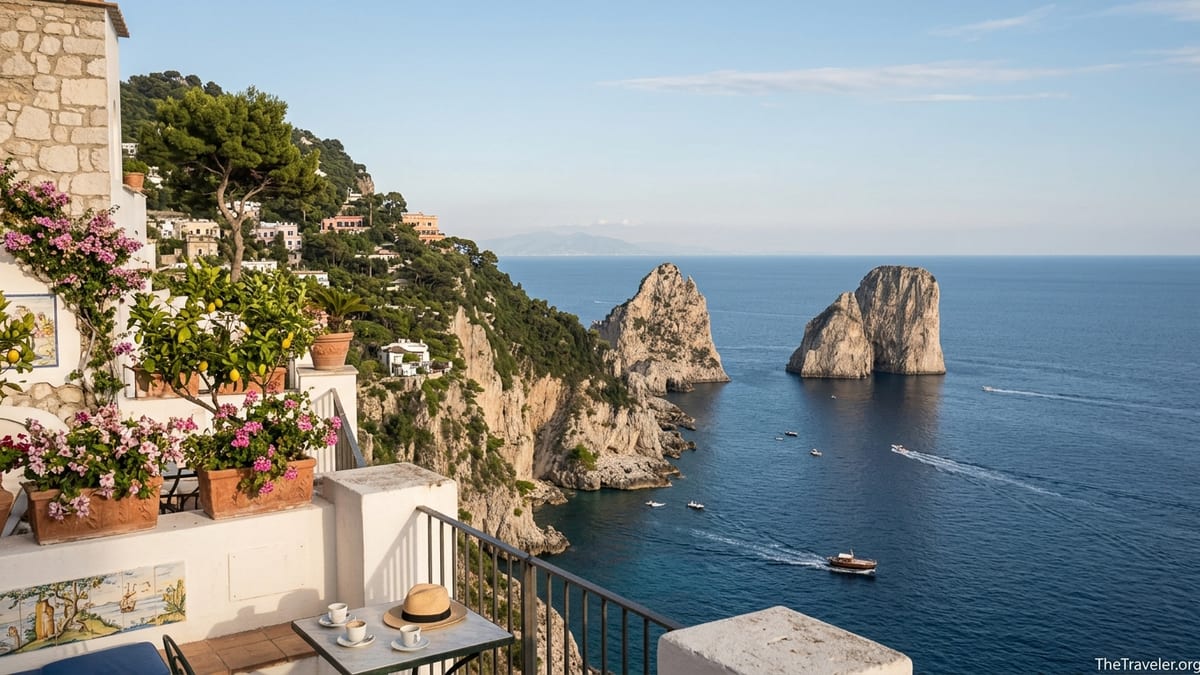
A Landscape That Made Capri Legendary
The first reason Capri became iconic is purely visual. Sailing in from Naples or Sorrento on a morning hydrofoil, the island rises almost vertically from the sea, all white cliffs and terraces of green. The boat docks at Marina Grande, a compact working harbor where fishing boats bob beside sleek Riva-style motor launches used for private tours. From here, visitors see the classic Capri contrasts immediately: crates of lemons stacked outside modest cafés alongside luggage porters loading designer suitcases for five-star hotels.
Off the south coast, the Faraglioni sea stacks are Capri’s most photographed feature, three jagged limestone columns that rise roughly 100 meters from the water. Most visitors see them on a 2-hour circumnavigation boat tour that typically costs around 25 to 30 euros per person, with skippers swinging close enough for guests to snap photos as the boat passes through the natural rock arch in the central stack. On calm days, small rental boats and paddleboards gather nearby, but the cliffs remain so sheer that the scene never loses its drama.
Capri’s natural showpiece on the opposite side of the island is the Blue Grotto, a sea cave where sunlight refracts through an underwater opening and colors the interior water a saturated electric blue. Official entry tickets for the cave itself are around 18 euros per person, on top of the cost of a boat transfer from Marina Grande, which is often about 24 euros for a dedicated round-trip ride or part of a longer island tour. Visits inside the grotto last only a few minutes, but for many travelers, that eerie interior glow is the moment Capri becomes real rather than mythical.
Inland, the landscape softens into lemon groves and narrow lanes. From Anacapri, the quieter upper town, a single-seat chairlift floats to the summit of Monte Solaro, the island’s highest point. As of 2026, a round-trip ticket costs about 14 euros, and the 13-minute ride offers a bird’s-eye view over terracotta rooftops, the Sorrentine Peninsula and, on clear days, the distant outline of the Amalfi Coast. At the top, simple outdoor cafés serve espresso and caprese sandwiches while hikers pick up stone paths leading down toward the Hermitage of Cetrella.
History of an Island Retreat, From Emperors to Icons
Capri’s reputation as a refuge predates modern tourism by nearly two millennia. The Roman emperor Tiberius famously moved his court from Rome to Capri in the first century, ruling the empire for a decade from a complex of villas that included Villa Jovis on the island’s eastern cliffs. Today, a 45-minute uphill walk from Capri Town brings visitors to the villa’s ruins, where low walls trace the outlines of former baths and reception halls. The appeal for Tiberius was clear: cool breezes, commanding views and a feeling of being removed from mainland intrigues.
In the 19th century, Capri became popular with European writers, painters and political exiles who were drawn by both the scenery and a certain social freedom. Swedish physician and author Axel Munthe built Villa San Michele at the turn of the 20th century on the site of a Roman ruin above Anacapri. The villa, now a museum, has colonnaded terraces overlooking the Bay of Naples and is reachable by local bus or a stair climb from Anacapri’s center. Admission is modest compared with many big-city museums, and visitors often linger on the terrace café over a glass of cold white wine.
The island’s modern fame took off after the 1950s, when film stars and fashion editors began arriving on summer holidays. Photographs from that era show Jackie Kennedy strolling along Via Camerelle, and Brigitte Bardot sunning on wooden boats in Marina Piccola. Many of the same establishments still trade on that heritage: traditional sandal-makers in Capri Town will craft leather sandals to fit a traveler’s foot on the spot, and long-running cafés on the Piazzetta still serve Negronis to a mix of locals, tourists and the occasional familiar face from a magazine cover.
Today, Capri’s glamorous image is reinforced by brands and experiences that travelers recognize instantly. Luxury hotels such as JK Place Capri, perched above Marina Grande, often advertise nightly rates that reach well over 1,000 euros in peak season. Meanwhile, more modest three-star guesthouses cluster in backstreets of Anacapri, where a double room in May might cost closer to 180 to 250 euros. The coexistence of these worlds is part of what keeps Capri interesting: on the same evening, a visitor might pass a couple in black-tie attire heading to a tasting menu dinner and, one street over, families eating takeaway pizza slices on a bench.
Capri’s Signature Experiences: From Sea to Sky
Beyond general scenery, Capri is defined by a handful of specific experiences that many travelers plan their trips around. Boat tours are at the top of that list. At Marina Grande, kiosks line the harbor selling everything from crowded group loops around the island to private gozzo charters with a skipper. A shared 2-hour tour might start around 25 euros per person, while a private wooden gozzo for four people, complete with towels and a cooler of drinks, often falls in the 180 to 260 euro range depending on season and duration. On summer afternoons, boats queue under the sun to enter smaller caves and coves, yet there are still quiet moments drifting under the cliffs between stops.
Many visitors time their boat trips to include or avoid the Blue Grotto. Because sea conditions and queues can be unpredictable, some travelers opt for a simple lap of the island, swimming in small bays near the Faraglioni or along the Punta Carena lighthouse instead. Local skippers often suggest alternate swim spots if the grotto is closed or the line of rowboats grows too long, which can easily stretch beyond an hour by late morning in July and August.
On land, the journey from Marina Grande to Capri Town is an experience in itself. The funicular, a short hillside railway, connects the harbor with the main square in about 4 minutes. As of 2026, a one-way ticket costs roughly 2.40 euros, purchased from a booth just behind the docks. At peak arrival times, queues can spill across the piazza, so some travelers choose to board one of the orange public buses instead, or walk up the steep but well-signed footpath in about 15 to 20 minutes. Each option reveals a different layer of island life, from the quiet of residential lanes to the bustle of the Piazza Umberto I, known simply as the Piazzetta.
From the Piazzetta, Capri Town unfolds in a network of narrow pedestrian streets lined with designer boutiques, perfumeries and small hotels that hide leafy courtyards behind discreet gates. A short walk leads to the Gardens of Augustus, where a modest entrance fee gives access to a terraced park with front-row views over the Faraglioni and the hairpin turns of Via Krupp far below. In high season, sunset here can feel busy, but early in the day, visitors often share the terraces only with local gardeners and the occasional cat stretched out in the sun.
Glamour, Luxury and the Art of La Dolce Vita
Part of Capri’s fame comes from the way it embodies a very specific Italian idea of pleasure. On summer evenings, the main streets around Via Camerelle and Via Vittorio Emanuele turn into a promenade where locals and visitors wander past hotel terraces, gelaterias and fashion windows. It is common to see classic linen boutiques showcasing airy white clothing, while contemporary brands display resort collections in shades of sea blue and coral. For many travelers, simply joining this early-evening passeggiata with a gelato from a well-known shop near the Piazzetta is as much the experience as any formal sightseeing.
Café culture is central to this mood. Tables at historic bars on the Piazzetta can command steep prices, with an aperitivo easily costing over 15 euros. Yet sitting here for an hour, watching porters navigate the square with stacked luggage trolleys and locals greeting one another at dusk, offers front-row access to Capri’s theater of daily life. Budget-conscious travelers often order a single espresso or soft drink to keep costs manageable while still absorbing the atmosphere.
Capri’s hotel scene is another pillar of its luxe reputation. Besides headline-making properties like JK Place Capri or the historic Grand Hotel Quisisana, many smaller four-star hotels and high-end guesthouses capitalize on sea views and lush gardens. A typical room in a well-rated boutique property in Capri Town in June might start around 450 to 600 euros per night, often including breakfast served on a tiled terrace overlooking bougainvillea. Spa menus highlight treatments with local ingredients such as lemon and rosemary, and some hotels run their own small boats to shuttle guests to private platforms or beach clubs.
Dining runs the spectrum from simple trattorias in side streets of Anacapri to Michelin-noted restaurants with tasting menus. A traveler might find a plate of spaghetti alla nerano, made with local zucchini and provolone cheese, at a neighborhood spot for 16 to 20 euros, while a multicourse seafood dinner at a clifftop restaurant with a Faraglioni view can easily exceed 100 euros per person before wine. The most memorable meals, many visitors report, are not always the most elaborate: a caprese salad with island-grown tomatoes and buffalo mozzarella, eaten under a pergola at lunch, often becomes the flavor travelers associate most with Capri long after they leave.
Finding Quiet: Escaping the Day-Tripper Rush
Capri’s popularity has a downside, particularly between June and early September when ferries from Naples, Sorrento and the Amalfi Coast disgorge thousands of day visitors each morning. In recent years, local authorities have occasionally considered or imposed temporary restrictions when infrastructure is strained, such as short-term bans on new arrivals during acute water shortages. Travelers arriving in these peak months often describe crowded alleys in Capri Town and long waits for buses up to Anacapri.
Yet one of the island’s secrets is how different it feels outside the middle of the day. Many organized day tours leave around 4 or 5 p.m., and by early evening the Piazzetta becomes more relaxed, with space at café tables and local children playing near the church steps. Staying at least one night allows visitors to see early-morning Capri as well, when delivery carts rattle over the stones and the only people on Via Tragara might be a few joggers and hotel staff setting out breakfast tables.
Travelers who want to sidestep crowds increasingly focus on the shoulder seasons of April, May, late September and October. Ferry schedules are still frequent, but daytime temperatures are milder and cruise ship calls are often fewer than in high summer. Accommodation prices in these months can be significantly lower, with some midrange hotels advertising nightly rates that are 20 to 30 percent below August levels. Pack a light jacket for breezy evenings and check sea conditions before planning boat trips, as spring and autumn can bring choppier water.
On the island itself, choosing certain routes makes a difference. Instead of queueing for the bus at Capri’s central station in midday, visitors can walk the scenic path from Capri Town toward the Natural Arch and continue to Belvedere di Tragara, where benches face the Faraglioni in relative calm. In Anacapri, side streets quickly become residential and quiet just a block or two from the main shopping lane of Via Giuseppe Orlandi. A simple espresso at a bar used mostly by locals, away from the main square, often costs less than half the price of a coffee on the Piazzetta and offers a more grounded sense of the island’s rhythm.
Practicalities: What a Capri Escape Really Costs
Because Capri is widely perceived as expensive, understanding real-world costs helps travelers decide whether and how to include it in an Italy itinerary. Transportation is the first consideration. Round-trip high-speed ferry tickets from Naples typically run in the range of 40 to 45 euros, with slower ferries from the mainland costing somewhat less. From Sorrento, return tickets often fall in the 30 to 40 euro bracket depending on season and operator. Families see these numbers multiply quickly, which is one reason many Italians treat Capri as an occasional outing rather than a weekly escape.
On the island, moving around by public transport is relatively affordable. Single bus tickets between Capri, Anacapri and Marina Piccola usually cost only a few euros and can be purchased at small ticket offices or authorized bars. The funicular train from Marina Grande up to Capri Town, at about 2.40 euros per ride, is one of the cheapest and fastest ways to climb the hill, though luggage incurs an extra fee. Budget-conscious visitors often combine one funicular ride on arrival with walking or bus journeys the rest of the day.
Daily spending varies widely based on choices. A traveler who books a private boat tour, eats lunch at a beachfront restaurant and has cocktails on the Piazzetta before a multi-course dinner could easily spend 250 euros or more in a single day, excluding accommodation. At the other end of the spectrum, someone who brings a picnic from the mainland, uses only public buses, skips paid boat tours and focuses on free viewpoints might keep daily expenses around 80 to 100 euros. Many visitors strike a balance, splurging on one standout experience, such as a short private boat ride at sunset, and keeping other elements simple.
Lodging is often the largest line item. Three-star hotels or well-reviewed guesthouses in Anacapri sometimes advertise double rooms in low season from around 130 to 170 euros per night, though rates can double in late July and August. In Capri Town, properties with sea views and pools tend to start higher, with even small boutique hotels commonly priced from 300 euros per night in shoulder season. Booking several months in advance, especially for spring and autumn weekends, gives the best chance of finding a place that matches both budget and expectations.
The Takeaway
Capri’s enduring fame as Italy’s quintessential island escape rests on more than its celebrity guests. The island combines a striking landscape, deep historical layers and a distinctive culture of leisurely pleasure that has appealed to visitors since the days of Roman emperors. For modern travelers, that reputation translates into very specific experiences: boat rides under sheer cliffs, aperitivo on a busy square, quiet walks along flower-framed paths and sweeping views from Monte Solaro.
At the same time, Capri is a real community that grapples with the pressures of mass tourism, especially in high season. Understanding ferry timetables, local transport, seasonal patterns and price realities makes the difference between a rushed, crowded day trip and a stay that feels genuinely restorative. Whether you splurge on a cliffside suite, choose a simple room in Anacapri or visit for a single carefully planned day, approaching Capri with realistic expectations and a bit of flexibility helps reveal why this small island has inspired such long-lasting devotion.
In the end, Capri rewards those who slow down. Sit a little longer at a café that looks toward the sea rather than the square, choose an early morning boat instead of a midday departure, or wander just beyond the main shopping streets to find a quiet bench shaded by pines. In those unscripted moments, with the scent of lemon blossoms on the breeze and the sound of waves echoing off the cliffs far below, it becomes clear why Capri remains one of Italy’s most famous and beloved island escapes.
FAQ
Q1. Is Capri worth visiting if I am on a moderate budget?
Yes, but it requires choices. Using public ferries and buses, visiting free viewpoints, and limiting pricey café stops can keep a day on Capri around a reasonable mid-range budget, especially in shoulder season.
Q2. How many days should I spend on Capri?
Many travelers visit as a day trip, but staying one or two nights lets you experience the island before and after the busiest hours. With two full days, you can combine boat time, Monte Solaro, Anacapri and slower explorations without rushing.
Q3. When is the best time of year to visit Capri?
Late April to early June and late September to October usually offer the best balance of pleasant weather and manageable crowds. July and August are livelier but also hotter, busier and more expensive, while winter brings quiet streets but limited boat excursions and some hotel closures.
Q4. Do I need to book boat tours and the Blue Grotto in advance?
For shared boat loops sold at kiosks in Marina Grande, advance booking is usually optional. Private gozzo charters in high season and organized excursions that guarantee Blue Grotto entry are better reserved ahead, especially on weekends or during holiday periods.
Q5. Is Capri suitable for families with children?
Yes, though families should plan around heat, stairs and crowds. Shorter boat rides, time at small pebble beaches, and rides on the funicular and chairlift tend to be highlights for children, while strollers can be challenging on steep, narrow streets.
Q6. Where is it better to stay, Capri Town or Anacapri?
Capri Town is more central and atmospheric at night, with many restaurants and bars nearby, but also busier and often pricier. Anacapri is quieter, slightly less expensive and convenient for the Monte Solaro chairlift and Villa San Michele, making it appealing for travelers seeking a calmer base.
Q7. Do I need a car on Capri?
No. Private cars are heavily restricted, and the island is designed for walking, buses, taxis and boats. Most visitors arrive by ferry and then use the funicular, public buses and taxis to move between Capri, Anacapri and the main coastal areas.
Q8. How far in advance should I book accommodation on Capri?
For stays in May, June, September and October, booking two to four months in advance is usually sufficient for a good choice of rooms. For peak July and August, especially weekends or specific popular hotels, planning four to six months ahead is wise.
Q9. Is swimming in the sea easy to access on Capri?
Beaches are small and mostly pebbly or rocky platforms rather than long sandy stretches. Public areas exist at Marina Piccola and near the lighthouse, while beach clubs offer sunbeds and ladders into the sea for a fee, so planning where to swim in advance is helpful.
Q10. What should I wear on Capri to feel comfortable and appropriate?
Light, breathable clothing, comfortable walking shoes or sandals with good grip, and a hat are essential in warm months. Many visitors dress smart-casual in the evenings, but formal attire is only necessary at a few upscale venues, so neat resort wear works well almost everywhere.