


Seen from the deck of a ferry pulling out of Naples, Capri looks like another beautiful island in a region full of them. The Bay of Naples and the nearby Amalfi Coast offer Ischia’s thermal springs, Procida’s pastel harbor and countless smaller islets scattered along the Tyrrhenian Sea. Yet many travelers quickly discover that Capri feels very different from other southern Italian islands. From its sheer cliffs and celebrity-studded piazzas to its prices, pace and personality, Capri is its own world. Understanding those differences will help you decide whether this island belongs on your itinerary, and how to enjoy it on your own terms.
Get the latest updates straight to your inbox!
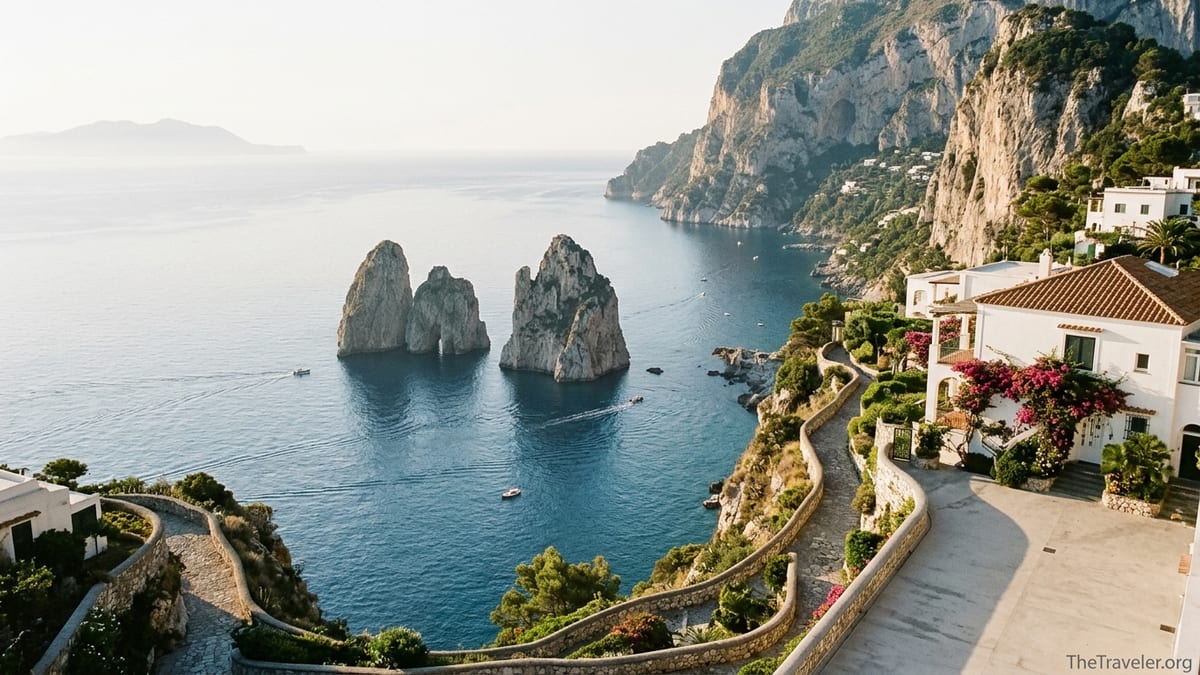
A Dramatic Rock in the Sea, Not a Classic Beach Island
Geography is the first major way Capri sets itself apart. While Ischia spreads out over rolling volcanic hills and Procida frames a sheltered bay with small beaches, Capri rises almost vertically from the Tyrrhenian Sea. Approaching Marina Grande by ferry from Naples or Sorrento, you see high cliffs instead of long sandy shores. The island’s two main towns, Capri and Anacapri, cling to terraces above the water rather than unfolding gently down to a seafront promenade.
This topography shapes your stay in very practical ways. Capri has no broad sandy beaches comparable to Maronti Beach on Ischia or Chiaia Beach on Procida. Instead, you get rocky bathing platforms and pebble coves like Marina Piccola or Bagni di Tiberio, often reached by steep staircases or shuttle boats. That dramatic coastline is exactly why the water around Capri is such an intense blue and why boat trips here feel more like cruising a fjord than lounging on a beach.
Even basic logistics reflect this vertical reality. From the main port at Marina Grande, most visitors take the funicular up to Capri Town rather than walking. The ride takes only a few minutes but avoids a hot, strenuous climb. Reaching Anacapri, the quieter hilltop town, involves a public bus that winds up hairpin bends with sweeping sea views. On Ischia or Procida you can stroll from port to town in a few easy minutes; on Capri, almost everything involves going uphill.
That geography also affects where you stay. If you want to be right on the water, your options are mostly limited to the area around Marina Grande or a small number of waterfront hotels and beach clubs. Many visitors instead choose hotels in or around Capri Town, trading direct sea access for views and easier access to restaurants and nightlife. In contrast, on Ischia you can choose between spa resorts in the interior, beach hotels in Sant’Angelo or Forio, and simple guesthouses near the port.
Luxury, Glamour and the Jet-Set Atmosphere
No other island in southern Italy leans into glamour quite like Capri. Ischia and Procida have upscale spots, but Capri’s core identity is tied to high fashion, luxury hotels and a decades-long reputation as a playground for the international jet set. Strolling along Via Camerelle above Capri Town, you pass window displays from global fashion houses sitting side by side with historic Italian jewelers and perfumeries. It feels much closer to a compact designer district in Milan than to a fishing island.
This emphasis on luxury carries through to accommodation. While you can still find modest guesthouses, Capri’s hotel scene tilts heavily toward four and five stars. A simple double room in high season can easily run several hundred euros per night, especially anywhere within a short walk of the Piazzetta. On Ischia, by comparison, a comfortable mid-range spa hotel with pools fed by natural hot springs often costs noticeably less, reflecting a broader mix of domestic vacationers and longer-stay guests.
Restaurants follow the same pattern. Along the lanes just off the Piazzetta and in Marina Grande, many menus cater to an international clientele ready to pay premium prices for a view and a glass of local Falanghina. You might see main courses starting from around 25 to 30 euros at casual sit-down spots, with higher prices at panoramic terraces overlooking the Faraglioni rock formations. On Procida, a plate of fresh grilled fish at a family-run trattoria near Marina Corricella is often significantly cheaper, and the crowd is more likely to be Italian families than honeymooners in designer resort wear.
For some travelers, this polished atmosphere is exactly the point. Afternoon people-watching on the Piazzetta with an espresso or aperitivo can feel like a low-key fashion show, and evenings bring a mix of yacht crews, weekenders from Rome and international visitors. Others find it too polished and prefer the more everyday feel of Ischia’s port towns or Procida’s working fishing harbor. Either way, the contrast is one of the clearest reasons Capri stands out.
Signature Sights You Will Not Find Anywhere Else
Capri’s most famous sights are also some of the most distinctive in southern Italy. The Faraglioni sea stacks, three towering rock formations just off the coast, are perhaps the island’s most iconic image. Boat excursions from Marina Grande loop around them, often pausing so passengers can take photos as they pass through the natural arch in the middle rock. While Ischia has the photogenic Aragonese Castle and Procida has its pastel harbor, there is nothing quite like cruising beneath these sheer limestone towers glowing gold in late afternoon light.
The Blue Grotto, a sea cave on Capri’s northwest coast, is another experience specific to the island. Visitors typically take a boat from Marina Grande or a bus to Anacapri and then down to the small waiting pier. From there, local rowboats ferry people inside the low opening of the cave. Admission involves a combination of boat transport plus a separate grotto ticket, with the rowboat portion alone costing roughly the price of a casual lunch per person. Weather and sea conditions often dictate whether visits run at all, so even planning around this one attraction requires more flexibility than most island sights.
On land, Capri offers Roman imperial ruins on a scale not seen on its neighbors. Villa Jovis, perched on the eastern cliffs, showcases the remains of one of Emperor Tiberius’s grandest residences. The walk there from Capri Town takes around 45 minutes along narrow lanes lined with gardens and villas. Ischia and Procida have their own historical sites, but Capri’s combination of imperial ruins, natural drama and cultivated gardens such as the Giardini di Augusto gives sightseeing a very particular flavor.
Even Capri’s viewpoints have their own character. The Belvedere of Tragara overlooks the Faraglioni and the rugged southern coastline, while the chairlift from Anacapri up Monte Solaro delivers a slow, silent ascent above terraced lemon groves to one of the best panoramas in the Bay of Naples. On Ischia you might drive or hike up to Mount Epomeo, and from Procida you can climb to Terra Murata for a sweeping harbor view, but Capri’s viewpoints feel more tightly choreographed to showcase cliffs, villas and sea in a single frame.
The Price of Beauty: Costs, Crowds and Seasonality
Capri is widely regarded as the most expensive of the Bay of Naples islands, and that reputation is not misplaced. Ferry tickets from Naples or Sorrento are typically similar across the islands, with one-way high-speed crossings starting at around 20 to 30 euros depending on the operator and season. Once you arrive, though, prices for everyday items tend to climb more steeply on Capri than on Ischia or Procida. A simple cappuccino in a bar just off the Piazzetta may cost a noticeable premium compared with what you paid that morning in Naples.
Crowds compound the sense of intensity. During the main season from roughly late April to early October, Capri receives heavy day-trip traffic from cruise ships, the Amalfi Coast and Sorrento. Midday in high summer, Capri Town’s central alleys can feel as busy as a city center, while the funicular queues spill out across Marina Grande. By contrast, Ischia disperses visitors across multiple towns like Forio, Sant’Angelo and Ischia Porto, and Procida’s smaller size and more residential character mean that even when ferries are full, the island can still feel relatively calm away from the main harbor.
Seasonality also plays out differently here. In early spring and late autumn, many Capri hotels, beach clubs and high-end boutiques shorten hours or close entirely, especially outside Capri Town. The island can feel peaceful and almost village-like, which some travelers love but others find too quiet if they expect full services. Ischia, serving more domestic tourism and longer stays tied to thermal spas, often has a slightly longer shoulder season with more facilities open, while Procida retains a lived-in feel even in cooler months because of its resident population.
Understanding this rhythm helps you tailor your visit. If you dream of shopping on Via Camerelle and sipping cocktails at a rooftop bar, plan for late spring to early autumn and be ready for crowds. If you prefer empty lanes and quiet hikes along the Pizzolungo coastal path, an April or late October trip might better match your expectations, accepting that some high-end venues will be closed and that ferry schedules may be less frequent.
How You Move: Walkways, Buses and Boat Culture
Capri’s compact size and steep terrain mean that movement is more constrained and choreographed than on other islands in southern Italy. There are no private cars for most visitors in the central areas. Instead, you rely on a combination of walking, small public buses, the funicular and taxis, many of which are distinctive open-top convertibles. This creates a specific rhythm to the day: ferry to Marina Grande, funicular or taxi to Capri Town, bus up to Anacapri, chairlift to Monte Solaro, then back down again.
On Ischia, wider roads and lower gradients allow for rental scooters and even cars, letting visitors build itineraries that bounce between thermal parks, beaches and hilltop villages at their own pace. Procida, while car traffic is still limited in places, feels more like a traditional small town where you can simply wander from one fishing cove to the next without planning the next bus connection. Capri, by contrast, requires more attention to timetables, particularly if you want to combine a Blue Grotto visit, a boat tour and time in both Capri Town and Anacapri in a single day.
Boat culture is strong across the region, but Capri takes it a step further. Numerous operators based in Marina Grande offer shared or private circumnavigation tours that include stops for swimming in small coves and passes by lesser-known sea caves. Prices vary widely, from relatively affordable shared boats lasting a couple of hours to high-end private charters that can cost as much as a luxury hotel night. On Ischia, boat excursions often focus on longer cruises that might include Procida or stretches of the Amalfi Coast, reflecting that island’s role as a base for broader exploration rather than a concentrated destination.
All of this shapes the feel of your day. On Capri, you are often either on foot along narrow pedestrian lanes, on a short hop in a small bus or on a boat circling the island. There is less sense of casual drifting through different neighborhoods by car or scooter. For many visitors, that makes Capri feel more curated and intense, for better or worse.
Contrasting Island Personalities: Capri, Ischia and Procida
Putting Capri in context with its neighbors helps clarify what makes it different. Ischia is larger, greener and more spread out, known for its thermal spas and beaches as much as its historic villages. People come for week-long stays focused on wellness, alternating days at thermal parks with hikes inland and evenings in low-key seaside towns. Procida, by contrast, is the smallest and most intimate of the three, defined by its colorful fishermen’s houses, simple trattorias and a pace that still feels rooted in everyday life.
Capri sits at the other end of this spectrum. Its personality centers on style, spectacle and scenery compressed into a small area. Where Procida’s main harbor of Marina Corricella might greet you with fishing nets drying beside boats and locals chatting under laundry lines, Capri Town welcomes you with polished shop windows and a piazza lined with cafés charging premium prices for prime people-watching seats. Ischia’s Aragonese Castle dominates a wide bay; Capri’s Faraglioni punctuate a steep coastline visible from nearly every southern viewpoint.
The type of traveler each island attracts differs accordingly. Capri draws honeymooners, short-break visitors and day-trippers who want to tick off iconic sights in one or two days. Ischia leans toward families, older travelers and repeat visitors from around Europe who appreciate the mix of spa culture and beach time. Procida often appeals to travelers who are comfortable with fewer services and more local character, choosing it as a quieter alternative after time in Naples or along the Amalfi Coast.
None of this makes one island “better” than the others. Instead, it explains why Capri can feel so distinct once you arrive. If you value glamorous settings, dramatic views and the chance to see some of Italy’s most famous coastal scenery in a concentrated area, Capri delivers exactly that. If you are chasing sandy beaches, thermal baths or unvarnished village life, the other islands might suit you more, with Capri being a spectacular day trip rather than your base.
Planning Your Visit: When Capri Belongs on Your Itinerary
Deciding whether Capri is the right island for you starts with your priorities and budget. For many travelers staying along the Amalfi Coast or in Sorrento, a day trip to Capri is the most practical way to sample its highlights without committing to the higher cost of overnight stays. Early-morning ferries from Naples, Sorrento, Amalfi and Positano allow you to arrive before the busiest midday crowds, giving you time to visit at least one major viewpoint, stroll through Capri Town and perhaps fit in a short boat tour.
Spending one or two nights on Capri, however, reveals a different side of the island. Once the last day-trip boats depart, the Piazzetta quiets, lanes empty and the light softens over the Faraglioni. This is when sunset drinks on a terrace and unhurried dinners in Anacapri feel most special. If your budget allows, a one-night stay can be enough to experience this calmer atmosphere, especially in shoulder season when rates are slightly lower and evening temperatures are pleasant.
Capri is less ideal if you are traveling with a strict budget or looking for a long, lazy beach holiday. In that case, using Ischia as a base with a thermal spa day or beach afternoons at Citara or Maronti, and then visiting Capri once on a day trip, often makes more sense. Procida can play a similar role for those who prefer a smaller, more intimate setting, pairing a couple of nights in a simple harbor-side guesthouse with a ferry hop to Capri for a single packed day.
Whatever you choose, planning ahead matters more here than on many other islands. Check ferry schedules in advance, especially outside peak season, and allow generous connection times if you are returning to catch a train or flight from Naples. If the Blue Grotto is a priority, keep an eye on sea conditions locally, and always have a backup plan such as walking the coastal path from the Natural Arch or visiting Villa San Michele in Anacapri in case boat access is suspended.
The Takeaway
Capri is not just another pretty island in southern Italy. Its steep cliffs, lack of wide sandy beaches, choreographed movement patterns and strong emphasis on luxury give it a personality that stands apart from Ischia’s spacious spa resorts and Procida’s quietly working harbor. The island delivers highly concentrated drama: imperial ruins perched above turquoise water, boats threading between sea stacks, designer boutiques set against staggering views.
Those same qualities can also make Capri feel intense, expensive and crowded, especially on midsummer afternoons when ferries unload wave after wave of visitors into the Piazzetta and Marina Grande. For some, that blend of spectacle and bustle is exhilarating; for others, it confirms that a quieter base elsewhere in the Bay of Naples suits them better, with Capri reserved for a single unforgettable day.
Understanding what makes Capri different helps you decide how to approach it. If you arrive knowing that it is a vertical, curated, glamorous island rather than a relaxed beach destination, you are more likely to enjoy its strengths and accept its trade-offs. Think of Capri as a vivid highlight in a broader southern Italian journey, and you can let its cliffs, coves and cobbled lanes impress you on their own unmistakable terms.
FAQ
Q1. Is Capri really more expensive than Ischia and Procida?
Yes, Capri is generally the most expensive of the Bay of Naples islands, especially for accommodation, restaurants near main squares and high-end shopping, while Ischia and Procida tend to offer a wider range of mid-range and budget-friendly options.
Q2. How long should I stay on Capri to experience it properly?
Many visitors come on a day trip, which is enough to see a few highlights, but staying one or two nights lets you enjoy quieter mornings and evenings after the day-trip crowds leave.
Q3. Does Capri have sandy beaches?
No, Capri is mostly rocky coastline with pebble coves and bathing platforms; if sandy beaches are a priority, nearby Ischia and Procida are better choices.
Q4. Is the Blue Grotto worth visiting?
For many travelers the Blue Grotto is memorable, but it is weather-dependent, can be crowded in high season and relatively expensive for a short visit, so it is best treated as a bonus rather than the only reason to come.
Q5. Can I visit Capri as a day trip from the Amalfi Coast?
Yes, regular ferries and fast boats connect Capri with Amalfi, Positano and Sorrento in season, making a long but workable day trip if you start early and plan your return carefully.
Q6. Which island is better for families, Capri or Ischia?
Ischia usually suits families better thanks to its sandy beaches, wider choice of mid-range hotels and thermal parks, while Capri tends to attract couples, small groups and day-trippers.
Q7. Is Capri crowded all year round?
Capri is busiest from late spring through early autumn, especially midday in July and August; outside those months it can be much quieter, though some hotels and restaurants close in the off-season.
Q8. Do I need a car on Capri?
No, visitors do not need or typically use cars on Capri; you get around by walking, using the funicular, small public buses, taxis and boats, which are sufficient for the island’s size.
Q9. How does nightlife on Capri compare to other islands?
Capri offers more upscale bars and lounges than Ischia or Procida, with a focus on sophisticated cocktails and people-watching rather than large clubs or late-night beach parties.
Q10. If I can visit only one island, should I choose Capri?
If you want dramatic scenery, iconic sights and a glamorous atmosphere in a compact area, Capri is the best choice; if you prefer relaxed beaches, thermal spas or a more local feel, Ischia or Procida might suit you better.