


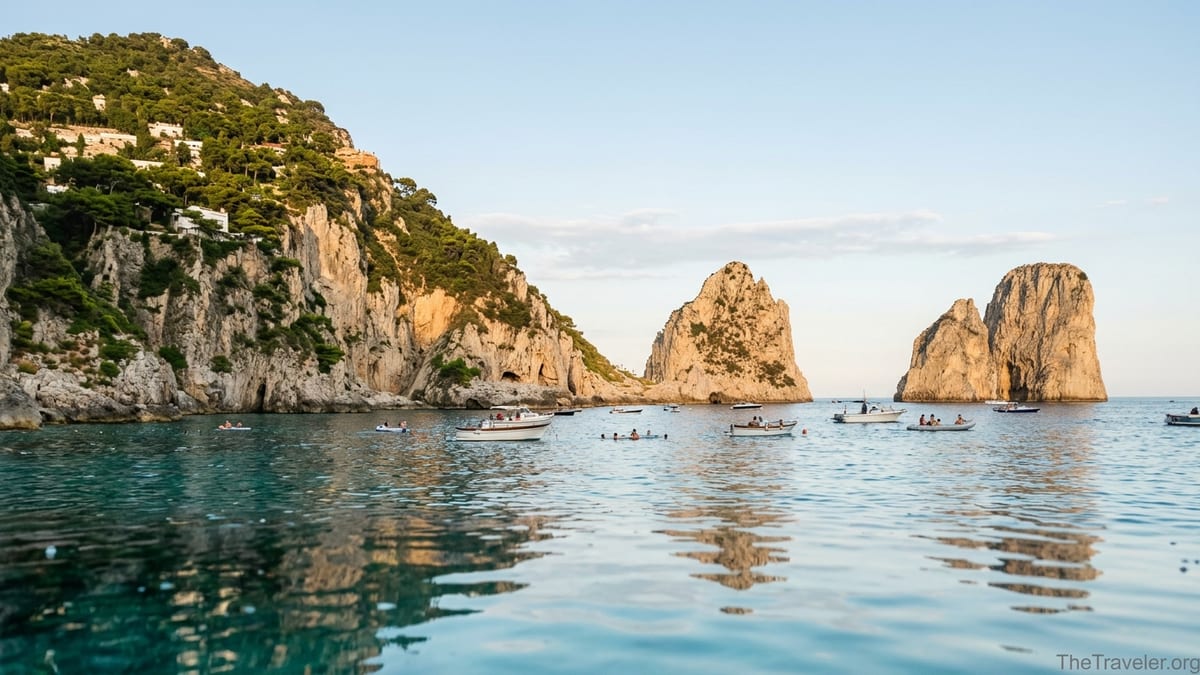
Capri is one of those places where the coastline is the main attraction. Jagged cliffs drop straight into clear water, tiny coves hide below villas and pines, and the Faraglioni rock stacks rise out of the sea like a movie set. The problem for travelers is that it is easy to arrive, get caught in crowds around the Piazzetta, and leave again without ever really experiencing Capri’s most spectacular views and coastal spots. With a bit of planning around boats, chairlifts, and beach clubs, you can see the island at its best without losing hours in queues or spending your entire budget in one day.
Get the latest updates straight to your inbox!
Planning Your Arrival so You Actually See the Coast
Most visitors reach Capri by hydrofoil or ferry from Naples or Sorrento, docking at Marina Grande, the island’s busy main port. High speed hydrofoils from Naples’ Molo Beverello usually take around 45 to 50 minutes each way, while slower ferries can take up to 80 or 90 minutes. Recent price guides put a round-trip hydrofoil from Naples in the region of 40 to 45 euros per adult, with slightly lower prices for the slower ferries. From Sorrento, the crossing is shorter, about 25 minutes by hydrofoil, and priced a bit lower per leg. Buying tickets a few days in advance in peak season (June to September) is wise if you have fixed plans for boat tours or chairlift rides on Capri itself.
Once you land at Marina Grande, it is tempting to jump straight onto the first boat that offers a circuit of the island. Instead, take a moment to think about the light and the crowds. Morning ferries arriving around 8 or 9 a.m. are ideal if you want softer light on the cliffs and fewer people at the chairlift in Anacapri. Travelers arriving with a mid-morning boat from Sorrento and planning to leave again in the late afternoon typically have 6 to 7 hours on the island. In that window, combining one boat experience, at least one major viewpoint, and time at a beach club is realistic without feeling rushed.
From the port, you can either take the funicular up to Capri town, catch a bus or taxi to Anacapri, or head directly to a boat tour operator on the pier. The funicular up to Piazza Umberto I (the Piazzetta) takes just a few minutes and runs frequently, but in high season queues can stretch far back along the harbor. If your priority is coastal scenery rather than shopping, consider going first to Anacapri for Monte Solaro, then working your way back down to the sea later in the day.
Those prone to seasickness should plan boat trips in the calmer early morning or late afternoon and choose larger boats where possible. When the mistral wind picks up, conditions around exposed points such as the Blue Grotto or the Punta Carena lighthouse can become choppy. In shoulder seasons like April or October, it is common for Blue Grotto access to close for a day or more due to swell, even when ferries and other boat tours continue to run.
Capri’s Iconic Viewpoints: Monte Solaro, Punta Tragara and Beyond
Monte Solaro is the highest point on Capri and the single best place to understand how the cliffs, coves, and villages fit together. You reach it from Anacapri via the Monte Solaro chairlift, a simple open-air one-seat lift that rises slowly over terraced gardens and pines. Recent price lists indicate a round-trip ticket of around 12 euros per person and a one-way ticket about 9 euros, with the ride itself taking roughly 13 minutes each way. Many travelers choose to ride up and then hike down on well-marked trails for a more leisurely descent through the countryside.
On a clear day, the terrace at the top of Monte Solaro offers expansive views along the Sorrento Peninsula, across the Bay of Naples, and down onto the Faraglioni and Marina Piccola. If you arrive with the first ferries from Naples or Sorrento and go straight by bus or taxi to Anacapri, you can be on the chairlift shortly after it opens and enjoy quieter conditions before mid-morning groups arrive. Bring a light layer even in early summer, as the breeze at 589 meters can feel surprisingly cool compared with the harbor below.
Closer to Capri town, the Belvedere di Tragara gives you that classic postcard view of the Faraglioni rocks from above. From the Piazzetta it is a pleasant, mostly level walk of about 15 to 20 minutes along Via Camerelle and Via Tragara, passing designer boutiques and villa gates before the street ends in a stone terrace facing the sea. From here you look directly down onto beach clubs such as La Fontelina and Da Luigi ai Faraglioni, their striped umbrellas clinging to the rocks just above the water. Late afternoon is an atmospheric time to visit, as the cliffs warm in the lower sun and returning boats leave white trails across the bay.
Another underused viewpoint is the walk out to the Arco Naturale, a natural limestone arch carved by the sea over millennia. The trail starts near Capri town and involves several flights of steps but rewards you with a framed view of open water through the stone arch. Linking the Arco Naturale with the panoramic Pizzolungo path and finishing at Punta Tragara is an excellent way to spend a morning with cliff-edge views, particularly in spring or early autumn when temperatures are more forgiving.
Seeing Capri from the Sea: Ferries, Shared Tours and Private Boats
If your goal is to experience Capri’s coastline properly, some time on the water is essential. At Marina Grande, ticket offices for local companies such as Motoscafisti and Laser Capri sell shared “giro dell’isola” boat tours that circle the island. Recent tariffs for a simple loop of the island without stopping at the Blue Grotto sit in the area of 20 to 30 euros per person for about two hours on the water. These trips take you under natural arches, close to sea caves like the Green and White Grotto, and typically pass through the gap between the Faraglioni rock stacks, which is a highlight for most visitors.
Many group tours marketed from Sorrento or the Amalfi Coast advertise a Blue Grotto stop and free time on Capri. A typical product might cost around 120 to 150 euros per person for a full day, including boat transfer, an island cruise, and several hours of free time ashore. However, it is important to understand that the Blue Grotto itself charges a separate entrance fee collected at the cave entrance, recently around 18 euros per visitor, and this is rarely included in the base tour price. As a result, travelers often pay for the day trip, then pay again in cash at the grotto for the actual rowboat entry.
For more flexibility, many small operators at Marina Grande rent out small fibreglass boats or rubber inflatables without a skipper for half days. Prices mentioned in recent traveler reports typically range around 100 euros for four hours for a basic motorboat, often excluding fuel. With four friends on board, this can end up cheaper than joining a high-end semi-private tour, and you can swim in quieter coves away from busier routes. The trade-off is that you must be comfortable handling a small boat, respecting no-go zones near caves and staying well clear of large ferries around the main harbor.
Travelers looking for comfort and service can charter skippered wooden gozzo boats for a half or full day, often including towels, soft drinks, and prosecco. Prices for a four-hour private cruise that includes a loop of the island and swim stops typically start around 400 to 500 euros for the boat in shoulder season and rise in July and August. These trips are ideal for couples or small groups who want privacy, unhurried swims near the Faraglioni, and time to linger at spots like the Green Grotto when group tours have moved on.
Making Sense of the Blue Grotto Experience
The Blue Grotto, or Grotta Azzurra, is Capri’s most talked-about sea cave, famous for its luminous electric-blue water. It is also one of the island’s most polarizing experiences. Reaching the grotto can be done either by sea or by land. By sea, larger tour boats or private charters position themselves near the cave entrance, where small licensed rowboats shuttle visitors inside, usually two or three at a time plus the oarsman. By land, you can take a bus or taxi from Capri or Anacapri to the top of the cliff above the grotto and walk down a staircase to a small landing where the same rowboats collect passengers.
When conditions allow, rowboats duck through a very low entrance, so low that passengers are asked to lie back as the boatman pulls on a chain fixed to the rock. Inside, visits last just a few minutes as the boat circles the cave, allowing time for photos. Payment for the grotto itself is divided into a boatman fee and a state museum ticket, but in practice most visitors hand over a single payment of around 18 euros per person in cash, then often feel pressured to add a gratuity for the oarsman on top of that. Local travel forums contain frequent accounts of visitors feeling rushed or surprised by the extra expectation of tips.
The most important factor to understand is that the Blue Grotto closes without much warning when seas are rough or the swell at the tiny entrance is too high. This is common on windy days, particularly outside high summer, and boat tour operators at Marina Grande will usually warn you on the morning of departure if access is unlikely. Many island-circuit cruises therefore advertise a possible stop at the grotto but instead simply pause outside for photos if it is closed. It is wise to treat entry as a bonus rather than a guarantee.
If your main priority is scenic coastline rather than ticking off a sight, you may find that time and money are better spent on an extended circuit of the island with multiple swim stops. On a calm day, water clarity around coves such as Marina Piccola or the Green Grotto can be remarkable, and many travelers come away describing these relaxed swims beneath cliffs and villas as the highlight of their visit rather than the short, crowded grotto experience.
Choosing the Right Beach Club for Views and Atmosphere
Capri’s beaches are mostly rocky platforms rather than long stretches of sand, and many of the island’s best coastal spots are private beach clubs built directly onto the cliffs. With demand high and space limited, advance reservations from late spring through early autumn are strongly recommended, particularly at the most iconic venues. Recent booking platforms for Capri beach clubs list entrance packages starting around 40 euros per person at simpler establishments and rising above 100 euros per person at the most exclusive clubs, often including sunbed, umbrella, and a credit toward drinks or lunch.
On the southern side of the island, Marina Piccola offers a dramatic setting beneath sheer cliffs facing the Faraglioni. Clubs here, such as Torre Saracena or La Canzone del Mare, combine restaurant terraces with decks stepped down nearly to water level. Reviews often praise the scenery and swimming but note that prices for food and loungers run significantly higher than on the mainland, with some visitors commenting that service can lag behind the premium prices. Still, for many travelers, a day stretched out on a lounger with the Faraglioni in full view is the very definition of the Capri experience.
For those who want to be almost underneath the Faraglioni themselves, classic spots like La Fontelina and Da Luigi ai Faraglioni are tucked into narrow coves directly below the cliffs you see from the Tragara viewpoint. Access involves either steep walking paths down from Capri town or scheduled shuttle boats from Marina Piccola or Marina Grande, often reserved when you book your lounger. Recent activity listings show day entrance at Da Luigi priced over 100 euros per person in high season, while top-tier “VIP” packages in prime front-row locations can run several hundred euros for two.
If you prefer something simpler and more budget-conscious, consider the pebble beaches near Marina Grande or smaller clubs such as Bagni Tiberio, which runs a small shuttle boat from the main port to a family-friendly cove with a casual restaurant. Here, entrance and lounger packages are still a significant expense compared with many other Italian coastal towns but can be closer to 40 or 50 euros per person outside peak dates. The trade-off is that you will not be directly in front of the Faraglioni, but you will be swimming in clear water with views back toward the colorful harbor houses and the slopes of Monte Solaro.
Linking Land and Sea: Smart Itineraries for One or Two Days
On a single-day visit from Naples or Sorrento, your main challenge is deciding how many activities you can realistically fit without feeling rushed. A practical one-day plan focused on views and coastline could look like this: take an early hydrofoil to arrive at Marina Grande by around 8:30 a.m., go straight by taxi or bus to Anacapri, ride the Monte Solaro chairlift as soon as it opens, and enjoy the summit while it is still relatively quiet. After descending, wander briefly through Anacapri’s lanes before catching a bus down to Marina Piccola for a few hours at a pre-booked beach club with a direct view of the Faraglioni.
Mid-afternoon, use the beach club’s shuttle or the public bus to return to Marina Grande and join a late-afternoon shared island boat tour of around two hours. This timing puts you under the cliffs and near the Faraglioni while the light softens and most day-trip crowds are beginning to leave. Afterward, you can have a simple dinner in or near the harbor before taking an evening hydrofoil back to the mainland. In this scenario, you have experienced Capri from its highest viewpoint, swum in one of its most scenic bays, and seen the coastline from the water, all without doubling back excessively.
If you are staying overnight, you can slow the pace considerably. On your first afternoon, focus on Capri town and the clifftop walks toward the Arco Naturale and Pizzolungo. Have an aperitivo on a terrace near the Piazzetta while the day trippers line up for ferries home. The next morning, dedicate time either to the Blue Grotto, accepting that access may close, or to a longer private boat charter around the island with swimming and snacks on board. Spend the afternoon at a beach club that fits your style and budget, then walk in the early evening to the Tragara viewpoint for a final look at the Faraglioni from above.
Families with children might shift the balance slightly, favoring more time at easily accessed beaches near Marina Grande or quieter sections of Marina Piccola over longer cliff walks. The Monte Solaro chairlift can be a highlight for older children who enjoy the open-air ride, but very young kids or those uncomfortable with heights may prefer the short hikes and boat rides instead. Strollers are difficult to manage on many of Capri’s stepped lanes and paths, so a light, foldable model or a child carrier backpack is advisable.
Practical Tips for Avoiding Crowds, Queues and Sticker Shock
Capri’s beauty and celebrity status come with two predictable consequences: crowding and high prices. Protecting your enjoyment of the coastal scenery starts with a realistic budget. For a typical high-season day that includes a return hydrofoil from Naples or Sorrento, the Monte Solaro chairlift, a shared island boat tour, and a mid-range lunch, planning for around 100 to 150 euros per person is reasonable before any beach club splurges. Adding a full day with loungers and lunch at a top-tier club under the Faraglioni can easily double that figure, especially for couples ordering bottles of wine or cocktails with sea views.
Booking key elements in advance where possible is essential between late May and early October. This includes ferry tickets for your preferred departure times, chairlift-inclusive tours if you are short on time, and especially beach club reservations in Marina Piccola or under the Faraglioni. Many clubs accept online reservations for sunbeds and restaurant tables with time slots. Turning up at midday in July without a booking often results in disappointment or a long wait in full sun on the path above.
To avoid the most intense crowds at viewpoints, aim for early morning or late afternoon. The Piazzetta, Monte Solaro chairlift base station, and the Tragara walkway all see peak foot traffic in late morning and mid-afternoon when day-trip groups overlap. Starting your day with the chairlift or saving cliff walks for after 5 p.m. can make the difference between jostling for rail space and having time to linger with your camera. On the water, the busiest hours for shared boat tours tend to be mid-morning; late-afternoon departures often feel calmer, with better photo light on the cliffs.
Finally, carry some cash specifically for small extras around the coast. While many restaurants and beach clubs accept cards, smaller purchases such as Blue Grotto rowboat fees, bus tickets, or an impromptu snack at a kiosk near Marina Piccola may be cash-only or have card minimums. Having a mix of small bills and coins on hand can make these moments smoother and prevent you from having to hunt for an ATM when you would rather be watching the sun on the water.
FAQ
Q1. What is the best time of year to visit Capri for coastal scenery?
Late April to early June and September to early October usually offer warm weather, swimmable water, and fewer crowds than peak summer, while most ferries, chairlifts, and beach clubs are operating.
Q2. How much should I budget for a day on Capri focused on views and the coast?
If you include a round-trip hydrofoil, the Monte Solaro chairlift, a shared island boat tour, and a sit-down lunch, planning around 100 to 150 euros per person is sensible before any beach club splurges.
Q3. Is it necessary to book Capri beach clubs in advance?
From late May through early October it is strongly recommended, especially for popular spots like those in Marina Piccola or under the Faraglioni, where walk-in loungers are often unavailable by late morning.
Q4. How long does the Monte Solaro chairlift take and is it worth it?
The ride takes roughly 13 minutes each way, and most visitors consider it essential for the panoramic view over Capri’s cliffs, the Faraglioni, and the Bay of Naples.
Q5. Should I visit the Blue Grotto or choose a regular coastal boat tour instead?
If you value a relaxed atmosphere and swimming, an island-circuit boat tour with swim stops often feels more rewarding, while the Blue Grotto is a short, intense experience best treated as a bonus if sea conditions allow.
Q6. Can I see Capri’s main viewpoints and enjoy the sea on a single day trip?
Yes, if you take an early ferry, go straight to the Monte Solaro chairlift, spend a few hours at a beach club, and finish with a late-afternoon island boat tour, you can fit the essentials into one day.
Q7. Are there any free coastal spots to swim on Capri?
There are small public sections of pebble beach near Marina Grande and in parts of Marina Piccola where you can swim without paying a club fee, though space is limited and fills quickly in summer.
Q8. What is the easiest way to reach Marina Piccola from the port?
From Marina Grande you can take a public bus directly to Marina Piccola or ride the funicular up to Capri town and walk down, but the bus is usually faster if you are carrying beach bags.
Q9. Do I need to be an experienced boater to rent a small boat around Capri?
For basic small-boat rentals from Marina Grande you do not need a license, but you should be comfortable handling a motorboat, staying clear of restricted areas, and managing changing sea conditions.
Q10. Is Capri suitable for families who want coastal activities?
Yes, families often enjoy short boat tours, time at calmer coves like those near Marina Grande or Marina Piccola, and the Monte Solaro chairlift, though steep paths and steps mean lightweight strollers or child carriers are advisable.