


In the heart of Bologna’s historic center, just off Piazza Maggiore, the Fountain of Neptune rises in bronze and stone, surrounded by students, shoppers and street musicians. It looks like a simple meeting point, but this 16th century monument, completed in 1566, is loaded with history, symbolism and a few surprising ground rules for visitors. If you are planning to see it for the first time, understanding how the square works, what you are allowed to do, and how to spot its hidden details will make your visit far more rewarding.
Get the latest updates straight to your inbox!
Getting Your Bearings: Where the Fountain of Neptune Fits in Bologna
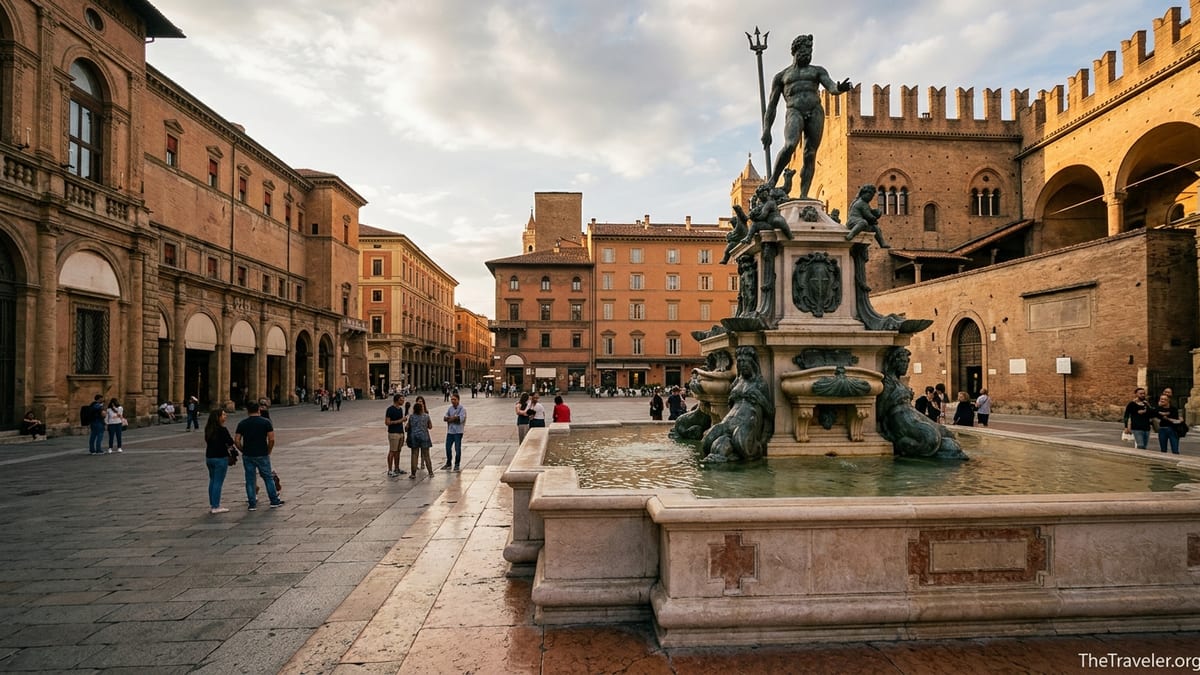
The Fountain of Neptune stands in Piazza del Nettuno, a small square that opens directly onto Piazza Maggiore, Bologna’s main civic space. You will find it between the medieval Palazzo Re Enzo and the imposing Palazzo d’Accursio, a central position that made it a statement of papal power and civic pride when it was built in the 1560s. Today, the fountain is one of the city’s key landmarks and the most common place for locals to say “let’s meet.”
For first-time visitors, this means you will almost inevitably pass the fountain several times a day. Most walking tours of Bologna’s historic center, including those departing from the official tourist office on Piazza Maggiore, stop here within the first 20 to 30 minutes of the route. If you are arriving from Bologna Centrale station, it takes roughly 15 to 20 minutes on foot along Via dell’Indipendenza to reach Piazza Maggiore and the fountain, or about 10 minutes by bus depending on traffic.
The square is entirely pedestrian, but service vehicles, police cars and cleaning machines sometimes cross the area early in the morning or very late at night. This can surprise visitors taking photos close to the basin. When you are framing your shot, it is worth glancing behind you before stepping backward toward the stone steps or the central pavement, which can be slightly uneven in places.
Bologna’s tourist information points regularly highlight the fountain alongside the Due Torri and the porticoes as part of a core “first-time Bologna” itinerary. Many travelers choose accommodation within a 10-minute walk, in areas such as Via Ugo Bassi or Via Rizzoli, specifically so they can see the fountain at different times of day without extra planning.
A Brief History and Why the Fountain Matters
The Fountain of Neptune was commissioned in the 1560s by Cardinal Carlo Borromeo to celebrate his uncle’s election as Pope Pius IV. Designed by the architect Tommaso Laureti with the bronze figure by the Flemish sculptor Giambologna, it was completed in the mid-1560s and quickly became a model of Italian Mannerist sculpture. The over life-size Neptune, poised with trident raised, was meant to evoke the power of the papacy ruling over the “seas” of subject territories.
On the marble base and surrounding basin, you will see four large nereids holding their breasts, from which water flows, as well as cherubs, dolphins and coats of arms. Inscriptions in Latin refer to the public nature of the monument, noting that it was built for the decoration of the square and for the benefit of the people. This mix of religious symbolism, civic pride and elaborate nudity still shapes the way locals talk about the fountain today, often with a wink and a story.
Over the centuries, the monument has undergone several restorations, the most recent major one running from 2016 into 2017. That project combined traditional conservation methods with advanced 3D documentation and modern water system upgrades to address long-term damage to the stone and bronze surfaces and to the recirculation system. When you visit now, the bronze surfaces generally appear deeper and more even in tone than in older photographs, and the water jets follow carefully calibrated patterns rather than irregular trickles.
Understanding this recent restoration helps explain why visitors are no longer allowed the kind of physical contact that appears in vintage images of locals leaning against Neptune’s base. Conservation staff closely monitor the condition of the bronze and marble, and new management plans treat the fountain not just as a civic symbol but as a complex heritage asset that needs active protection.
Practicalities: Best Time to Visit, Crowds and Conditions
The fountain is outdoors, open and visible at all hours, and there is no ticket or queue. The question is not whether you can see it, but when to go for the experience you want. For quiet photography and a more reflective mood, early morning is best. Between about 7:30 and 9:00, especially on weekdays, you may share the square only with commuters cutting across and cleaning crews rinsing the paving stones. In winter, on a clear morning, the low sun behind Palazzo d’Accursio can cast soft light across the bronze surfaces, creating subtle reflections on the water.
By late morning and early afternoon, especially from late spring through early autumn and on weekends, the fountain area can become very busy. School groups, cruise ship day-trippers arriving from Venice or Ravenna, and large walking tours often cluster around one side of the basin. If you arrive with your own guide at 11:00 on a Saturday in May, you might find three or four other groups standing nearby, which can make it hard to appreciate the fine details or take unobstructed photos.
Evenings offer a different atmosphere. Around aperitivo time, typically between 6:00 and 8:00, locals meet in the surrounding bars and under the porticoes, and buskers sometimes perform near Piazza Maggiore. The fountain’s lighting after dark highlights the contours of Neptune and the surrounding figures, and the water appears more luminous against the darker stone. In December, when the Christmas tree is installed nearby, reflections of the lights often shimmer in the fountain’s basin, adding to the festive feel.
Weather plays a role too. Bologna can be very hot in July and August, with daytime temperatures regularly in the high 80s Fahrenheit or above. The stone surfaces around the fountain retain heat, and standing for a long explanation in the full sun at midday can be uncomfortable. Many guides now choose the shadier side of the square or speak briefly, then recommend that guests return on their own in the evening, when the climate and the light are both more forgiving.
Rules, Etiquette and Common Mistakes to Avoid
Despite its playful details, the Fountain of Neptune is not a playground, and the city has tightened rules in recent years. Visitors are not allowed to climb onto the fountain, enter the basin, wash clothes or food, or sit on the higher levels of the structure. These activities were common in earlier centuries, but today they are prohibited both for safety and conservation reasons. Local police patrol the square regularly, and fines for climbing or entering the water can run into several hundred euros per person.
From time to time cases are reported in Italian and international media of tourists being fined after stripping down or posing on the fountain in ways considered disrespectful. These stories have made the authorities even more alert. If you are tempted to recreate dramatic social media photos, it is safer to stay on the surrounding pavement or the lowest stone step and keep any poses discreet and fully clothed. Treat the monument as you would a historic church facade or a museum statue, even though it stands in the open air.
Food and drink near the basin are another point of etiquette. While carrying an ice cream or coffee through the square is normal, placing cups or bottles on the stone or letting children leave sticky fingerprints on the marble figures is frowned upon. Street cleaners work hard to keep the square tidy, but litter accumulates quickly on busy days. Dropping trash into the water is not only disrespectful but can damage the pumps and filters of the recirculation system, which conservation staff have spent years upgrading.
Flash photography is allowed, but at night, repeatedly using a powerful flash close to the faces of other visitors or buskers nearby can be intrusive. If you are using a tripod for long exposures, particularly in the evening, be aware that police might ask you to move if your setup blocks the main pedestrian flow between Piazza Maggiore and Via IV Novembre. In practice, a hand-held shot or a small travel tripod kept close to you is usually sufficient and draws less attention.
What to Look For: Details, Legends and Hidden Angles
At first glance, the fountain can look like a single dramatic gesture: Neptune with trident raised, dominating the square. Spend a few minutes walking slowly around it and you will start to see layers of detail. The four nereids on the corners hold their breasts as water spouts out, a bold representation that shocked some church authorities at the time and still causes double takes from passing families. Around the base, cherubs with dolphins play in ways that echo the water jets, and the coats of arms reference both papal and civic powers.
One of the most famous local anecdotes involves an optical illusion connected to Neptune’s right hand. If you stand at a specific point near the pavement outside the Biblioteca Salaborsa, the outstretched hand and thumb align in a way that some locals say resembles a more explicit anatomical feature. The story goes that Giambologna originally wanted to make Neptune’s genitals larger, but church officials objected, and the artist quietly compensated with this visual trick, visible only from certain angles.
To appreciate the interplay of sculpture and water, approach the basin from the side facing Piazza Maggiore. From here you can see how the different jets define an invisible “territory” around Neptune, echoing the notion of the sea god commanding the surrounding waters. On windy days, fine droplets may drift onto the nearby paving stones, and the constant motion gives the bronze surfaces a shifting pattern of reflected light, especially at sunrise and sunset.
If you are interested in photography, experiment with views that include the surrounding architecture. One effective angle is to frame Neptune’s trident against the brick mass of the Basilica of San Petronio or to capture the reflections of Palazzo d’Accursio’s windows in the water. Wide-angle shots taken from low down on the square’s cobblestones can emphasize the monumentality of the figure, while closer details of the nereids and dolphins work well for documenting the Mannerist style at eye level.
Costs, Tours and Nearby Experiences
Seeing the Fountain of Neptune itself is free, and you can visit as often as you like. The main costs connected with the experience come from tours, nearby attractions and food and drink in the surrounding streets. As of 2026, standard small-group walking tours of central Bologna that include the fountain typically range from about 20 to 35 euros per person for a two-hour itinerary. Private tours, often combining Piazza Maggiore, the fountain and the Due Torri, can run from roughly 120 to 200 euros per group, depending on duration and language.
Bologna also applies a municipal tourist tax to non-residents staying in paid accommodation, with nightly amounts varying according to the price bracket of your room. This tax is collected by your hotel or guesthouse and helps support services that include the maintenance and promotion of historic areas such as Piazza Maggiore and Piazza del Nettuno. When comparing accommodation options online, it is worth checking whether the quoted rate includes this tax so you are not surprised at check-out.
Within a few steps of the fountain, you can enter the Biblioteca Salaborsa, a public library housed in the former Stock Exchange building with glass floors that reveal Roman archaeological remains below. Admission to the building is free, and many visitors combine a short look at the excavations with time at the fountain. On the other side of Piazza Maggiore, the Basilica of San Petronio offers another major, usually low-cost attraction, with modest fees for access to certain chapels or the panoramic terrace when open.
Food and drink prices in the immediate vicinity of the fountain reflect its central location. A coffee at a historic cafe directly on Piazza Maggiore can cost noticeably more than one ordered a few streets away, where a standard espresso at the counter often remains in the range typical for Italian cities. Many travelers choose to take their photos at the fountain, then step two or three blocks under the porticoes toward streets like Via d’Azeglio or Via Oberdan for more moderately priced snacks and aperitivi.
Safety, Accessibility and Photography Tips
Piazza del Nettuno is generally considered safe, especially during the day and early evening, when it is filled with locals and tourists. Still, as in any busy urban square, pickpocketing can occur. When you are absorbed in photographing the fountain or listening to a guide, keep your bag zipped and in front of you, and avoid leaving cameras or phones on the low stone steps unattended. Late at night, foot traffic decreases, but there are usually still people crossing the square, and the area remains lit.
The square’s surface is mostly flat, with a mix of large stone slabs and sections of older paving that can be slightly uneven or slippery after rain. Visitors using wheelchairs or strollers can generally approach quite close to the fountain, though the final step up to the lowest stone ring around the basin requires assistance and is not strictly necessary for a good view. If you have mobility concerns, entering from the Piazza Maggiore side typically provides the smoothest approach.
For photography, the main challenge is balancing crowds and light. Midday offers even illumination but also the highest concentration of people in front of the fountain. If you want clearer frames, aim for shortly after sunrise or around the blue hour after sunset, when artificial lighting adds depth to the scene. A focal length around 24 to 35 millimeters on a full-frame camera is wide enough to capture Neptune and the surrounding buildings without too much distortion, while a slightly longer lens helps isolate details like the nereids and inscriptions.
Respecting other visitors while photographing is part of the experience. Avoid setting up shots that require blocking the main paths people use to cross the square, and keep in mind that street musicians and performers near the fountain are working. If a large group is listening to a busker or guide right in front of your preferred angle, rather than pushing through, it is often easier and more pleasant to circle to another side of the basin or wait a few minutes for the crowd to shift.
The Takeaway
Seeing the Fountain of Neptune for the first time is less about ticking off a sight and more about understanding how history, daily life and careful conservation meet in one compact square. You are looking at a 16th century statement of power and artistry that has survived centuries of use, neglect and restoration, yet still serves as a casual meeting point for students and neighbors.
With a bit of preparation, you can avoid the common pitfalls that lead to fines or disappointing photos, and instead focus on the monument’s stories, details and setting. Choose your time of day deliberately, treat the fountain with the same respect you would give an indoor masterpiece, and allow yourself a few extra minutes to walk around it slowly and notice the play of water, bronze and stone.
Whether you stop by for a quick look between museum visits or return several times at different hours, the Fountain of Neptune offers a concise introduction to Bologna itself: layered with history, animated by everyday life and best appreciated when you take the time to look a little closer.
FAQ
Q1. Is there an entry fee or opening hours for the Fountain of Neptune?
The fountain stands in an open public square, so there is no ticket and no formal opening or closing time. You can view it at any hour.
Q2. Can I touch or climb on the Fountain of Neptune?
No. Climbing on the fountain, entering the basin or sitting on the higher levels is prohibited and can result in substantial on-the-spot fines from local police.
Q3. Is it allowed to throw coins into the Fountain of Neptune like at Trevi Fountain?
Throwing coins is not encouraged, as it complicates maintenance of the pumps and filters. Unlike some fountains, there is no strong local tradition of coin tossing here.
Q4. What is the best time of day to photograph the fountain?
Early morning and early evening generally offer the most attractive light and fewer crowds. Nighttime lighting also creates striking reflections in the water.
Q5. Are guided tours necessary to appreciate the fountain?
Tours are not essential, but a short walking tour that includes the fountain can give helpful context about its symbolism, legends and recent restoration work.
Q6. Is the area around the Fountain of Neptune safe at night?
The square is usually busy and well lit in the evening and is considered reasonably safe, though normal precautions against petty theft still apply.
Q7. How close can visitors with limited mobility get to the fountain?
The surrounding square is largely flat, and visitors using wheelchairs or strollers can approach very close to the basin from the Piazza Maggiore side.
Q8. Are there public restrooms near the Fountain of Neptune?
There are paid public restrooms in and around Piazza Maggiore and in nearby public buildings, and many cafes in the area offer facilities for customers.
Q9. Can I eat or drink while sitting near the fountain?
You may carry food and drinks through the square, but placing items on the stone or leaving litter near the basin is considered disrespectful and should be avoided.
Q10. What other attractions can I combine with a visit to the fountain?
Popular nearby stops include Piazza Maggiore, the Basilica of San Petronio, Biblioteca Salaborsa and the medieval towers, all within a short walk.